How Insurance Companies Handle Car Accident Claims


Every article on this site is researched by our internal team, reviewed for legal accuracy against current Texas law, and held to State Bar of Texas advertising standards before publication. We do not publish content that overstates outcomes or makes promises about results.
Learn more about our
editorial standards .
Key Takeaways
- Adjusters set a reserve and settlement authority limit before making any offer.
- Texas bars recovery entirely once you are found 51% or more at fault.
- Insurers must accept or reject your Texas claim within 15 business days by law.

You’re driving on the Gulf Freeway near downtown Houston when the car behind you fails to stop in time. By the next day, an adjuster from your own insurance company is calling with questions and asking for a recorded statement. You want to cooperate, but you are not sure what you truly owe them. Knowing how the claims process works helps you answer with confidence instead of guessing.
Insurance Adjuster Claims Process
Once you report a crash, the insurer opens a claim file through a step called first notice of loss. That report kicks off the insurance adjuster process for your car accident claim in Texas, starting the clock on how your case will be handled.
From there, the adjuster assigns a percentage of fault based on the early evidence. They also set a reserve, which is an internal estimate of what the claim may ultimately cost to resolve. Settlement authority is tied to that reserve amount. An adjuster who wants to offer more than the reserve allows must get a supervisor’s approval first.
There are laws around how long insurers have to pay claims in Texas. Under Texas Insurance Code § 542.056, insurers must accept or reject your claim within 15 business days of receiving the required proof of loss, though they can request a 45-day extension in some cases.
What Your Own Insurer May Require
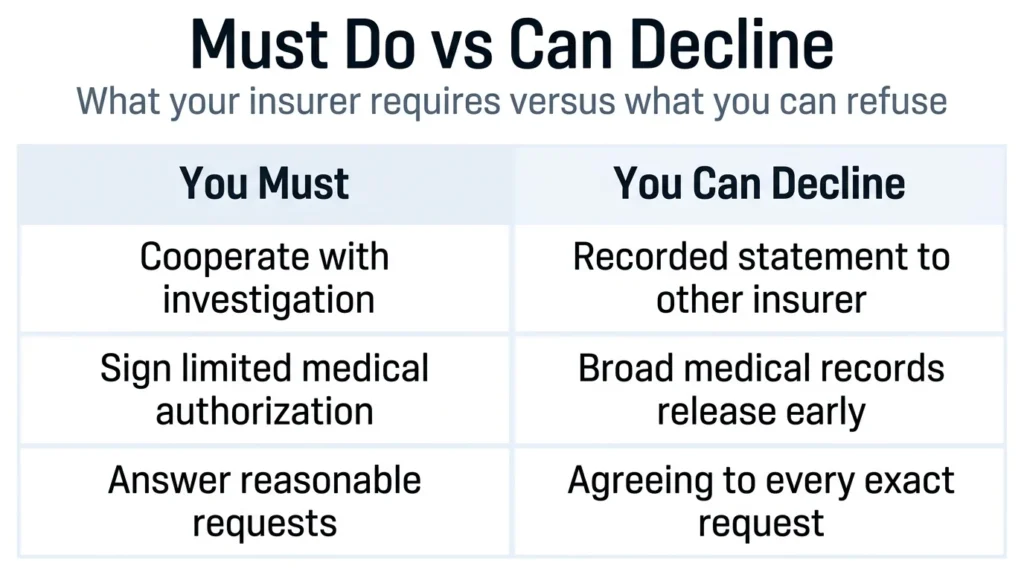
Most auto policies require you to cooperate with your insurer’s investigation. Depending on your policy, this may include answering questions, providing documents, and giving a statement about the crash. That does not mean every statement must be recorded or that you must agree to every request exactly as presented.
You also generally need to sign a medical authorization. Keep it limited to records tied to your accident injuries.
Requests You Can Decline
You are not required to give a recorded statement to the other driver’s insurance company. That request serves their interests, not yours.
You can also decline to sign a broad medical records release covering your full history before your treatment is finished.
How Insurers Investigate Your Claim
Once your claim moves past the initial filing, the adjuster works through five steps to evaluate what happened and what your case is worth.
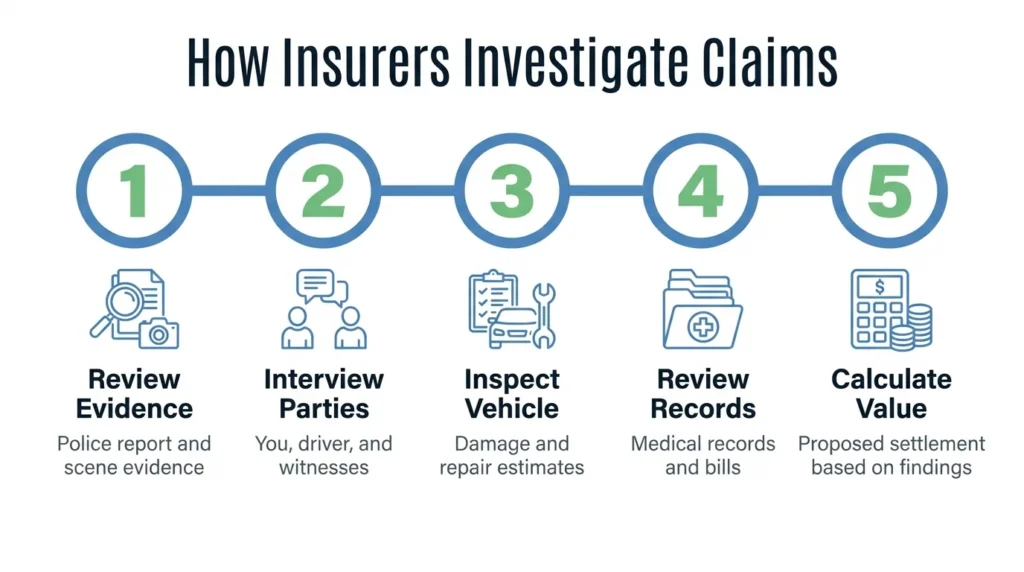
- Reviewing the police report and evidence from the accident scene.
- Interviewing you, the other driver, and any available witnesses.
- Inspecting the vehicle damage and gathering repair estimates.
- Reviewing your medical records and bills tied to the claimed injuries.
- Calculating a proposed settlement value based on everything gathered above.
Each step can take days or weeks, depending on how complete your records are. Gaps in documentation, especially around lost wages, often slow this process down or lower the final number the adjuster proposes.
Not every investigation follows the same order or timeline. Understanding how car accident claims work in Texas can help you anticipate what the adjuster may request and keep the process moving.
How Insurers Dispute Your Claim
Insurers often challenge claims by arguing that you share responsibility for the crash or questioning the cause and severity of your injuries.
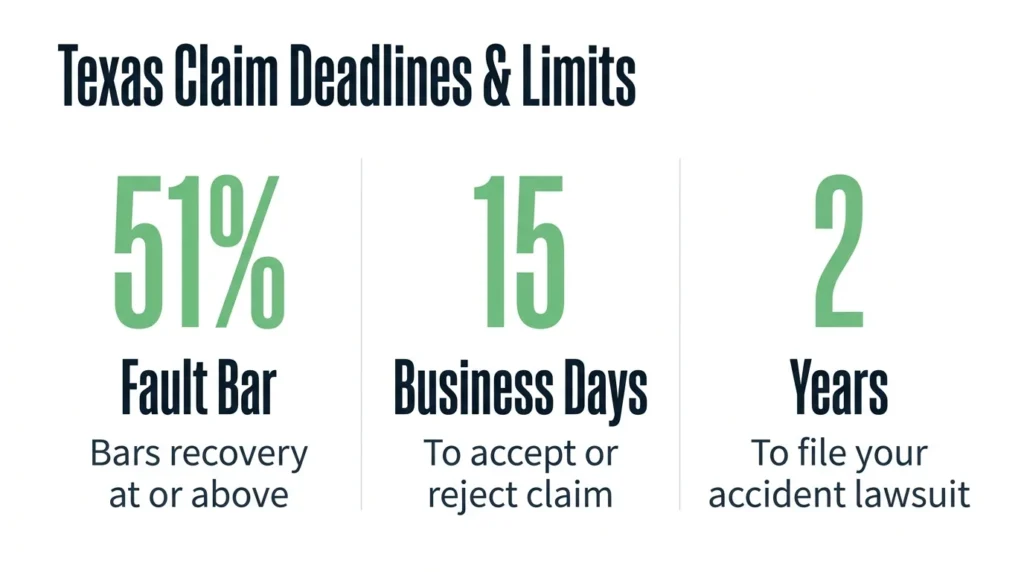
Texas’s comparative negligence rule directly affects your car accident claim value. Under Texas Civil Practice and Remedies Code § 33.001, your recovery is reduced by your percentage of fault, and it is barred entirely if you are found 51% or more responsible. This rule applies to every car accident claim in the state.
An insurer may also question whether your injuries are as serious as your records show. They sometimes send you to an independent medical exam or argue that some treatment was not medically necessary.
When a case cannot be resolved through negotiation, it may move toward litigation. Throughout that process, Texas Insurance Code § 541.060 prohibits insurers from engaging in certain unfair settlement practices, including misrepresenting important facts or policy terms and failing to make a good-faith effort to reach a prompt and fair settlement when liability is reasonably clear.
If you believe an insurer is not negotiating in good faith, you can file a complaint with the Texas Department of Insurance.
Mistakes That Hurt Your Claim Value
The two mistakes that cost claimants the most are settling too early and failing to document real costs.
Accepting a settlement before your treatment ends can lock in a number that leaves out medical costs still to come. Texas gives you two years from the crash to decide, under Texas Civil Practice and Remedies Code § 16.003, so there is rarely a reason to rush.
Comparing an early offer against the reserve amount set early in your claim can show whether it truly accounts for your full course of treatment. An insurer may undervalue your claim if an early offer does not account for your expected treatment, missed work, and other losses.
Keep copies of medical bills, receipts, pay stubs and employer records showing the time you missed from work. Clear documentation helps us present the full financial effect of the crash and respond if the insurer questions part of your claim.
Talk to a Car Accident Lawyer
You do not have to sort through adjuster tactics and Texas insurance law on your own. Angel Reyes & Associates has recovered more than $1 billion for clients and works on a contingency fee basis, so you pay no fee unless we win your case.
Our team can review your claim, handle communication with the adjuster, and help you decide which requests to comply with and which to decline. Contact us today for a free consultation and put an experienced team on your side.
Past results do not guarantee future outcomes.
Insurance Claim Handling FAQs
Can I use my PIP or MedPay coverage before the insurance company decides who was at fault?
Yes. Personal injury protection and MedPay pay medical bills right away because they apply no matter who caused the crash, so you do not need to wait for a fault decision to use them.
What if the other driver does not have enough insurance to cover my losses?
If you carry uninsured or underinsured motorist coverage, you can file a claim directly with your own insurer to make up the difference instead of waiting on the other driver’s policy.
Can I get paid for my car's lost value even after it has been repaired?
Texas law recognizes diminished value as a real loss you can claim against the at-fault driver’s insurer, but a standard collision or comprehensive policy from your own insurer typically will not cover it.
Will my health insurance company or Medicare take part of my settlement?
Often, yes. Health insurers, Medicare, and Medicaid usually have a right to be reimbursed from your settlement for medical bills they already paid related to the crash.
About the Authors

Angel Reyes
Writer
Angel L. Reyes, III is the Founder and Managing Partner of Angel Reyes & Associates. A nationally recognized trial attorney and business leader, Angel founded the firm in 1993, which has gone on to help over 70,000 injury victims recover more than $1 billion. Named to the Texas Super Lawyers list annually since 2008, Angel brings Wall Street experience, Ivy League education, and a deep commitment to client advocacy. He is a frequent legal commentator and published author with extensive contributions to legal scholarship, trial strategy, and consumer protection.

Kyle Nicolas
Editor
Kyle Nicolas is the Web Content & SEO Manager at Angel Reyes & Associates. He has more than 10 years of experience as a marketing co...

Angel Reyes
Reviewer
Angel L. Reyes, III is the Founder and Managing Partner of Angel Reyes & Associates. A nationally recognized trial attorney and business...