What Is the Crash Rate of Tesla’s Robotaxi?


Every article on this site is researched by our internal team, reviewed for legal accuracy against current Texas law, and held to State Bar of Texas advertising standards before publication. We do not publish content that overstates outcomes or makes promises about results.
Learn more about our
editorial standards .
Key Takeaways
- Tesla's federal reports show 35 unique Texas crashes through August 2026, not a per-mile rate.
- Tesla described five crashes with remote driving at impact, despite mixed operator coding.
- Preserve trip and control records after a crash; Texas operator rules alone do not settle fault.
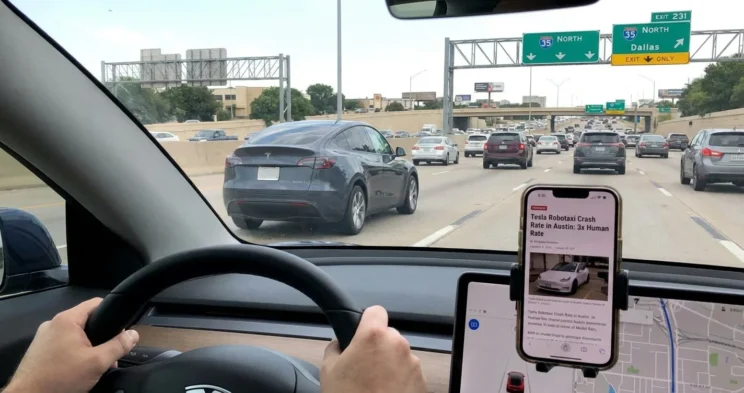
You see a Tesla robotaxi stopped near an Austin construction barricade. A remote worker may be steering it, but you cannot tell from outside the car. If a collision follows, the crash report alone may not show who had control.
Tesla Robotaxi Teleoperator Crashes
Tesla described five Texas crashes in which a remote human was driving or recovering its robotaxi at impact. Those accounts come from Tesla’s submissions to NHTSA’s automated-driving crash reports, not independent findings about fault.
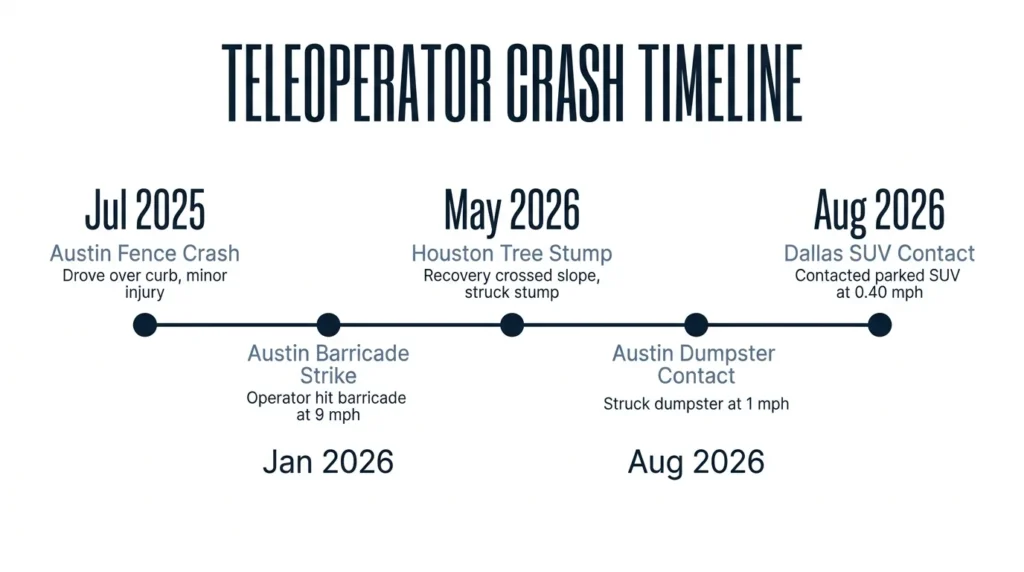
- In July 2025, an Austin robotaxi was stuck beside a street when its safety monitor requested assistance, according to Tesla’s report. A teleoperator took control and drove the car over a curb and into a metal fence. Tesla reported a minor injury without hospitalization from the incident.
- In January 2026, another Austin safety monitor requested navigation help, and Tesla’s narrative says a teleoperator drove into a temporary construction barricade at about 9 mph. The impact scraped the car’s front left fender and tire. A collision involving remote steering can raise the same evidence questions as other Austin car accidents.
- In May 2026, a remote assistance operator was recovering a robotaxi from a Houston dead-end road. According to Tesla, the vehicle crossed a grassy slope and struck a hidden tree stump. In August 2026, Tesla reported that a remote support operator drove into a dumpster in an Austin alley at about 1 mph. Another August report describes a remote operator taking control and contacting a parked SUV in Dallas at about 0.40 mph. Neither incident had passengers or reported injuries.
All five records mark the automated driving system (ADS) as engaged, yet the Houston record and both August records code the operator type as remote operation; the two earlier Austin records say None. However, that field does not erase Tesla’s descriptions of remote driving at impact. Ultimately, NHTSA’s reporting rules also do not decide who bears civil responsibility.
Tesla Robotaxi Crashes in Texas
Federal crash records from the National Highway Traffic Safety Administration offer a detailed view of Tesla’s Automated Driving System performance across Texas cities. The following data breaks down reported crash counts, incident severity, collision types, and speed contexts from July 2025 through August 2026.
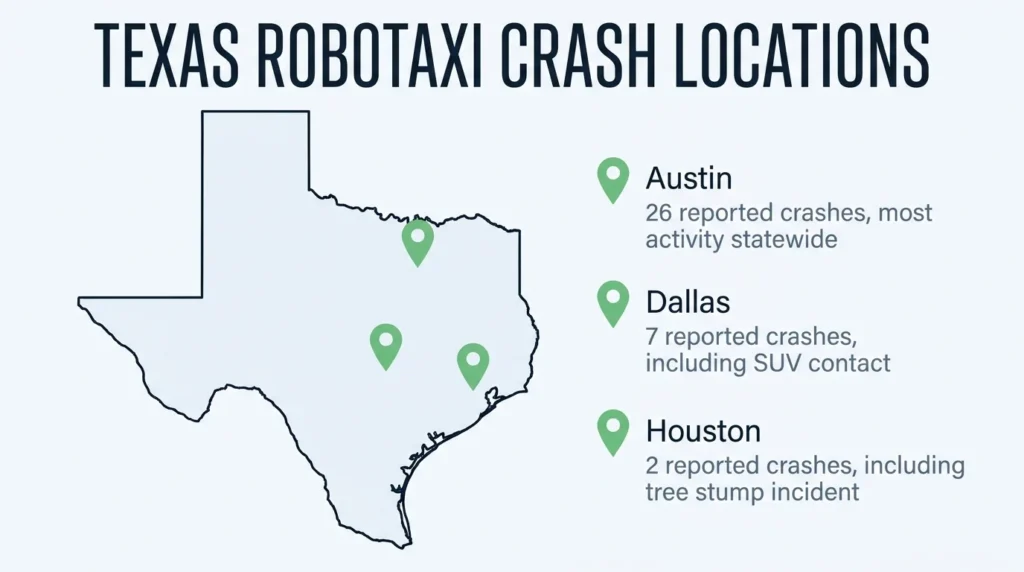
- Crash Counts and Locations: NHTSA’s Tesla ADS records contain 35 unique reported crashes in Texas from July 2025 through August 2026. After duplicate and superseded reports are removed, 26 are in Austin, seven in Dallas, and two in Houston. These figures represent raw crash counts rather than an accident rate, with dates reported by month.
- Injury Classifications: The latest Tesla reports classify 33 incidents as having no reported injury and two as minor injury, with one being the fence collision described above. The other minor injury followed an SUV rear-ending a Tesla creeping through a right-turn slip lane, a report that records a hospital visit. However, these classifications are merely report fields rather than definitive medical conclusions.
- Collision Types: Fifteen incidents involved fixed objects, including four of the five remote-driving events. Tesla’s other narratives describe rear-end collisions, vehicles backing into robotaxis, mirror strikes, and a dog entering the road. Those descriptions do not establish that Tesla caused every crash, or that another party caused every crash.
- Pre-Crash Speeds and Context: Thirteen reports list a pre-crash speed of 0 mph, and the median listed speed is 1 mph. Pre-crash speed in the federal data need not reflect the vehicle’s actual speed at impact. While general Texas car accident facts provide statewide context, they cannot serve as a direct, matched robotaxi comparison.
Tesla Robotaxi Crash Rate
The 35 reported crashes do not establish a defensible per-mile Tesla robotaxi crash rate. A rate needs miles driven by the same fleet, in the same place and period, under a matching definition of trips and crashes.
NHTSA’s Standing General Order reports do not require mileage. Reports may also be updated and may contain incomplete or unverified information. Counting each unique crash addresses duplicate versions, but it does not supply the missing miles.
Tesla’s Q2 2026 paid robotaxi miles chart ends in June, while these crash reports run through August. The chart does not break out Texas miles or say whether it includes empty or recovery trips. Its rounded mileage cannot be paired with the 35 Texas incidents to calculate a rate.
A human-driver comparison needs the same crash definition, driving exposure, geography, and conditions. The available data do not support a claim that Tesla robotaxis crash at any stated multiple of the human rate. A Texas robotaxi accident guide can help place those data limits in the context of an individual collision.

Texas Robotaxi Accident Liability
Texas has an enforceable commercial automated-vehicle authorization program, but its operator rules do not settle civil fault in a crash. The Texas Department of Motor Vehicles program became enforceable May 28, 2026, under the authorization provisions in Texas Transportation Code § 545.456.
Texas Transportation Code § 545.453 addresses rules for automated vehicles. Texas Transportation Code § 545.454 addresses operator status and citation allocation while the ADS is engaged. Neither provision alone decides civil liability when a remote human was steering at impact.
An investigation should examine the control handoff, remote instructions, vehicle logs, and camera footage, as well as what other road users did. However, the federal reports cannot answer those case-specific questions. Texas self-driving car liability depends on the evidence of the particular collision.
Texas Transportation Code § 545.457 requires compliance with applicable Texas Transportation Code Chapter 550 collision duties after an automated-vehicle crash. Those statutory duties and any civil claim call for review under the facts of the event.
Steps After a Robotaxi Crash
After a robotaxi collision, seek medical care and preserve evidence as soon as it is safe. These steps matter whether you rode in the robotaxi or occupied another vehicle.
- Photograph the vehicles, damage, road layout, signals, and nearby cameras if you can do so safely. Get witness details and the other driver’s information when another driver is involved.
- Keep the crash report, medical records, and bills. Save ride receipts, trip identifiers, app messages, screenshots, and any notice of remote assistance.
- Ask promptly that vehicle video, control logs, and remote intervention records be identified and preserved. Those records may show when control changed and what happened before impact.
A Texas car accident lawyer can review the available records and assess a possible claim. That review is especially useful when the report’s operator code differs from the account of remote steering.
Talk with a Texas Car Accident Lawyer
If you were hurt in a robotaxi collision, Angel Reyes & Associates can review the facts through its Texas car accident practice. Bring any photos, trip details, reports, and medical records you have so our team can evaluate your options.
For over 30 years, Angel Reyes & Associates has been helping Texans fight for the justice and financial recovery they deserve. With a team of more than 700 dedicated professionals across more than 30 offices in Texas, we have successfully recovered over $1 billion for our clients.
We offer free consultations and charge no fees unless we win. Our legal staff is available 24/7 to take your call, and we proudly offer full legal service in both English and Spanish. Contact us anytime to schedule your free case review and take the first step toward protecting your rights.
Past results do not guarantee future outcomes.
Tesla Robotaxi Crash Stats FAQs
Do federal robotaxi crash reports include near misses?
No. NHTSA’s reporting rule covers crashes that meet its criteria, so a close call without a collision does not appear in the crash data.
Can a Tesla robotaxi operate in Texas without anyone in the driver's seat?
Yes, Texas law allows an automated vehicle to operate without a person inside if it meets state requirements. A business carrying passengers without a driver also needs state authorization.
Can I report a robotaxi safety problem even if there was no crash?
Yes. NHTSA accepts reports from anyone who witnesses a safety issue with an automated vehicle.
How can I get a Texas police report for a robotaxi crash?
If an officer filed a crash report, you can request a copy through TxDOT’s online system. People involved in the crash are among those eligible to receive the full report.
About the Authors

Angel Reyes
Writer
Angel L. Reyes, III is the Founder and Managing Partner of Angel Reyes & Associates. A nationally recognized trial attorney and business leader, Angel founded the firm in 1993, which has gone on to help over 70,000 injury victims recover more than $1 billion. Named to the Texas Super Lawyers list annually since 2008, Angel brings Wall Street experience, Ivy League education, and a deep commitment to client advocacy. He is a frequent legal commentator and published author with extensive contributions to legal scholarship, trial strategy, and consumer protection.

Kyle Nicolas
Editor
Kyle Nicolas is the Web Content & SEO Manager at Angel Reyes & Associates. He has more than 10 years of experience as a marketing co...

Angel Reyes
Reviewer
Angel L. Reyes, III is the Founder and Managing Partner of Angel Reyes & Associates. A nationally recognized trial attorney and business...