Motorcycle Accidents at Stop Signs & Red Lights in Texas


Every article on this site is researched by our internal team, reviewed for legal accuracy against current Texas law, and held to State Bar of Texas advertising standards before publication. We do not publish content that overstates outcomes or makes promises about results.
Learn more about our
editorial standards .
Key Takeaways
- A driver who rear-ends a stopped rider at a red light or stop sign is almost always at fault.
- Texas gives motorcycle crash victims two years from the crash date to file a claim.
- Riders found 51% or more at fault recover nothing under Texas comparative fault law.
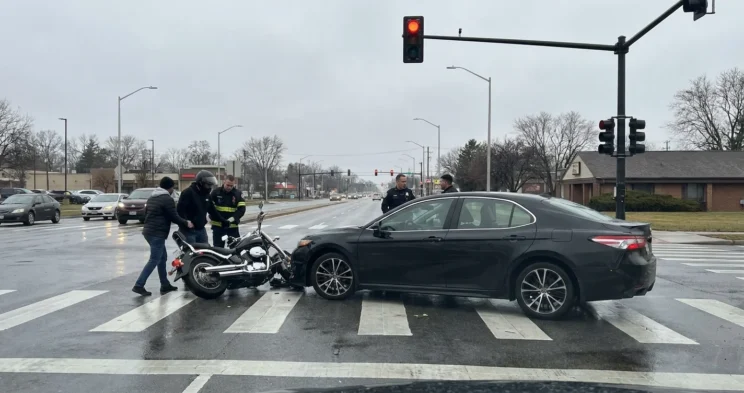
You were waiting at a red light on Lamar Boulevard when the car behind you never slowed down, or perhaps a driver blew through an East Austin stop sign and clipped your front wheel as you crossed. Either way, you are now hurt, your bike is wrecked, and an adjuster is already calling with questions that feel like a trap. Who is actually at fault here?
Two Crashes, Two Fact Patterns
Intersection collisions are the deadliest kind of motorcycle crash. NHTSA reports that roughly 37% of fatal motorcycle crashes happen at intersections, where riders have almost no protection from a vehicle that fails to stop. You can see how these numbers play out in our breakdown of Texas motorcycle accident statistics.
Almost every intersection case falls into one of two fact patterns.
- A following driver rear-ends you while you sit lawfully stopped at a red light.
- A driver runs a stop sign or red light and T-bones you as you cross.
These two crashes look similar from the outside, but they are not the same case. Each one carries a different liability theory, a different statute, and a different set of evidence that decides who pays.
Rear-Ended at a Red Light: Who Is at Fault?
When a driver rear-ends you at a red light, that driver is almost always at fault. The Texas Transportation Code § 545.062 requires every driver to keep a safe stopping distance. A driver who hits a stopped motorcyclist has broken that duty.
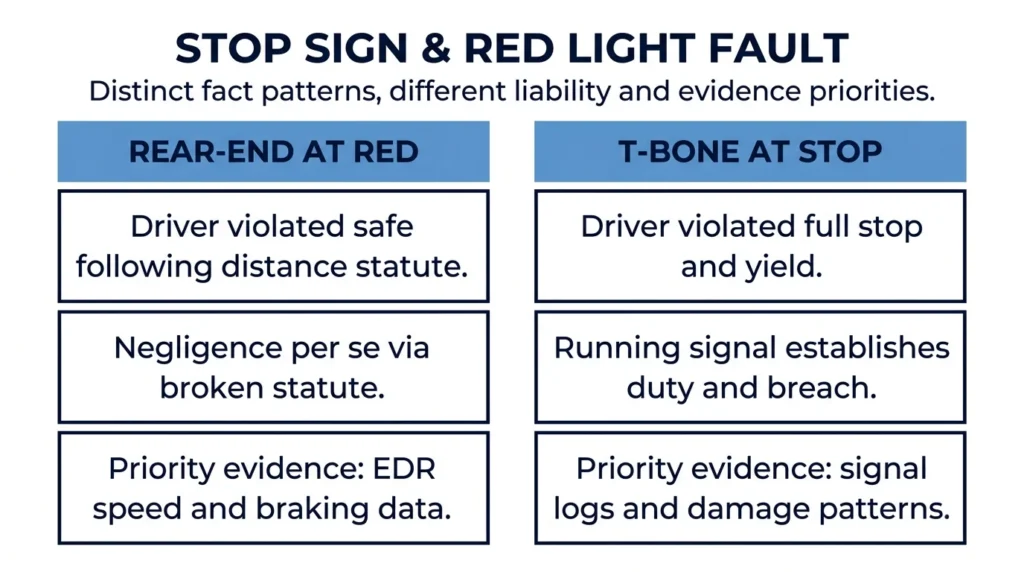
Breaking a traffic safety law is what Texas calls negligence per se, meaning you do not have to prove the driver was careless; you only have to show the driver broke the statute and that the violation caused your crash. This is why a rear-end claim often starts on stronger footing than the driver behind you wants to admit. This rule applies whether you were on two wheels or four, and our look at what to do after being rear-ended walks you through the next steps to protect your case.
Insurers rarely accept this outcome quietly, so you should expect the adjuster to argue you stopped too suddenly or parked your bike in an unsafe spot.
Texas uses a fault-sharing rule, so partial blame can shrink your recovery under the Texas Civil Practice and Remedies Code (CPRC) Chapter 33. Even so, the driver who hit a clearly stopped rider at a red signal carries the heavier share.
The strongest answer to any of those arguments is hard data. The at-fault vehicle’s event data recorder (EDR) captures pre-crash speed, braking, and throttle in the final seconds before impact. That record is often the centerpiece of a rear-end case.
T-Bone at a Stop Sign: Fault & Texas Law
When a driver runs a stop sign and hits you in the intersection, fault usually rests with that driver because the Texas Transportation Code § 544.010 requires a driver at a stop sign to come to a full stop. Texas Transportation Code § 545.153 then requires that the driver yield the right-of-way to any vehicle already in the intersection or approaching close enough to be an immediate hazard before proceeding. Ignoring those requirements is a statutory violation.
Red lights work the same way. The Texas Transportation Code § 544.007 says a driver facing a red signal must stop and stay out of the intersection until the light allows it. A driver who runs that light and strikes you commits negligence per se on the same footing.
Physical evidence is what anchors fault in a T-bone case. Damage patterns, skid marks, and where each vehicle came to rest all show who entered the intersection first and from which direction. Police often log some of this, but a crash report can miss details that early photos capture, which is why our guide to T-bone accidents in Texas matters here.
Expect the other driver to flip the story. A common defense is that you had the red light or failed to yield.
Under Texas fault-sharing rules, you can recover only if you are 50% or less at fault, so neutral outside evidence becomes the deciding factor. Our explainer on how Texas comparative negligence works breaks down that 50% line. For the red-light scenario specifically, here is what to do when someone runs a red light and hits you.
Evidence to Preserve After an Intersection Crash
The evidence that wins your case starts disappearing within days. Footage gets overwritten, vehicles get repaired, and memories fade. Here is what you should do to secure the evidence, and how fast you should do it.
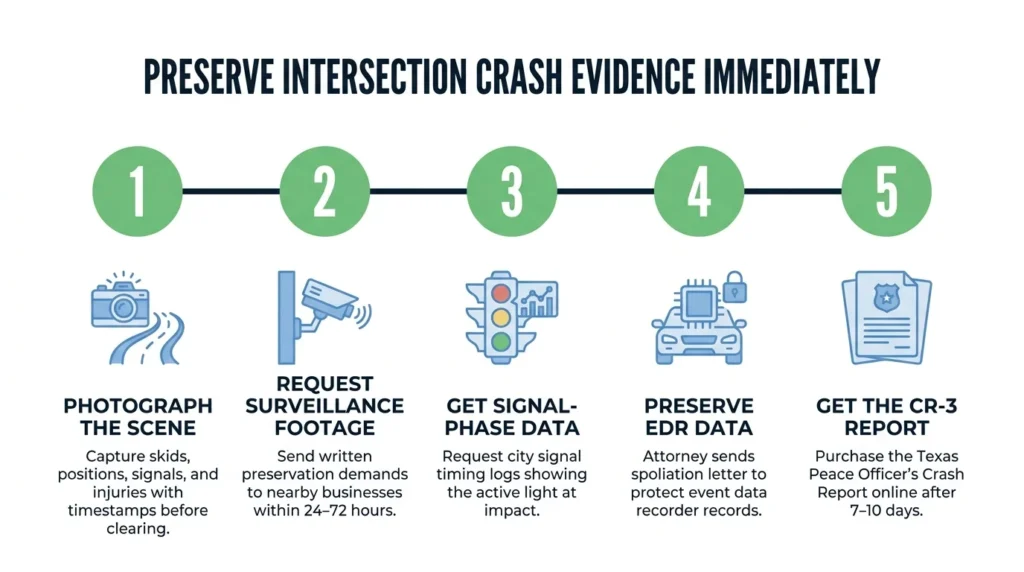
- Scene photographs and video. Photograph skid marks, vehicle positions, intersection signage, signal heads, and your injuries before the scene clears. Time stamps make this evidence far stronger.
- Surveillance footage. Municipal cameras, nearby business cameras, and dashcams are your best sources. TxDOT live traffic cameras do not save footage, and Texas banned red light enforcement cameras in 2019, so those will not help. Send preservation demands within 24 to 72 hours before private footage is recorded over.
- Signal-phase and timing data. The intersection’s signal logs show which light was active at the moment of the crash. The city holds this data, so request it quickly through a preservation demand.
- EDR data from the at-fault vehicle. The event data recorder logs speed and braking in the final seconds. Repairs or scrapping can erase it, so an attorney can send a spoliation letter to protect it.
- Police report and witnesses. Get the Texas Peace Officer’s Crash Report (CR-3) and reach out to any named witnesses. An independent account often settles a fight over who had the green.
Acting on this list is time-sensitive, and an attorney can send the spoliation letters and preservation demands for you right after you hire one.
Texas Filing Deadline & Comparative Fault
You have two years from the date of your crash to file a motorcycle accident claim. The Texas Civil Practice and Remedies Code (CPRC) § 16.003 sets that two-year deadline, and missing it ends your right to recover.
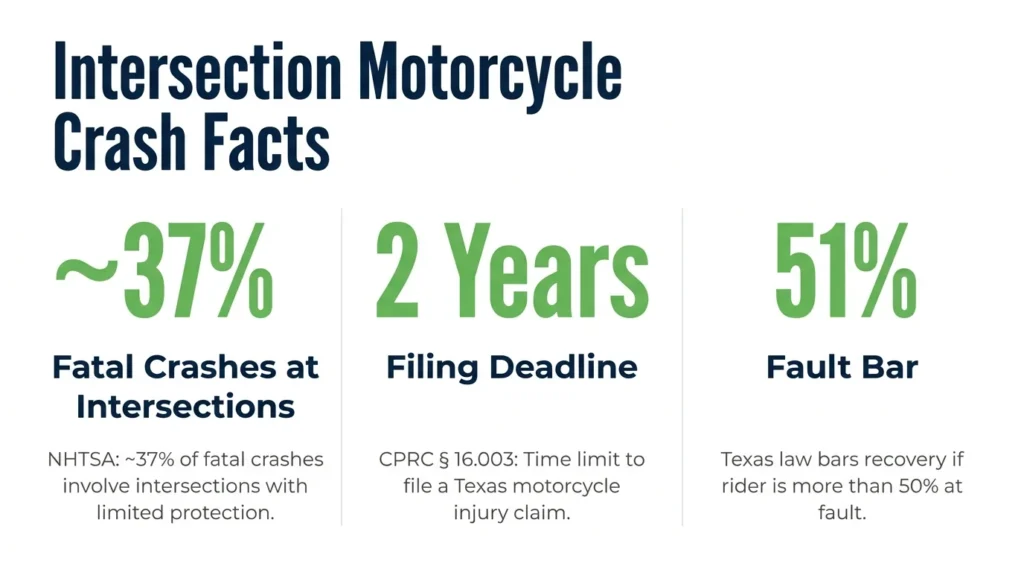
The second rule decides how much you collect. Under CPRC Chapter 33, your recovery drops by your share of fault, and you get nothing if you are found 51% or more at fault.
In practice, this is why the adjuster digs into your lane position, your speed, and your gear. They are building a record that pins part of the blame on you, even when the other driver clearly ran the signal. Knowing how settlements come together in these cases helps you push back.
The stakes are real. TxDOT crash data shows nearly 30% of fatal motorcycle crashes happen at intersections. Serious injuries make a thorough evidence record worth the effort.
Talk to an Attorney if You Were Hurt in a Wreck
A stop-sign or red-light crash leaves you sorting out injuries, a wrecked bike, and an insurer working to shrink your claim. You do not have to face that alone. Angel Reyes & Associates has represented injured riders across Texas for over 30 years, with more than $1 billion recovered for clients.
We serve riders from more than 20 offices across the state, offer free consultations, and you pay no fee unless we win. If you were struck at a stop sign or red light, you can reach out to us for a free review of your options.
Past results do not guarantee future outcomes.
Motorcycle Accidents at Stop Signs & Red Lights FAQs
What damages can I recover after a motorcycle crash at a stop sign or red light in Texas?
You can seek compensation for medical bills, lost wages, property damage to your bike, and pain and suffering. In cases involving especially reckless conduct, Texas law also allows a claim for punitive damages.
What if the driver who hit me had no insurance?
If the at-fault driver is uninsured or underinsured, your own uninsured/underinsured motorist (UM/UIM) coverage can step in to cover your losses. Texas does not require drivers to carry UM/UIM coverage, so check your own policy before assuming it applies.
Does not wearing a helmet affect my motorcycle accident claim in Texas?
Texas requires helmets for riders under 21 and for those who have not completed an approved safety course, but riders 21 and older who qualify may ride without one. If you were not wearing a helmet, the other driver may argue your head injuries were made worse by that choice, which could reduce the portion of damages you collect under Texas comparative fault rules.
Is lane splitting legal in Texas, and does it affect who is at fault?
Lane splitting is not legal in Texas. If you were riding between lanes of traffic at the time of the crash, the other driver’s insurer may use that to argue you share fault, which can reduce or eliminate your recovery depending on how fault is allocated.
What can I do if the driver who hit me fled the scene?
File a police report right away, then check whether your auto or motorcycle policy includes uninsured motorist coverage, which can cover a hit-and-run. Texas also has a Crime Victims’ Compensation program that may help with medical costs if the driver is never found.
About the Authors

Angel Reyes
Writer
Angel L. Reyes, III is the Founder and Managing Partner of Angel Reyes & Associates. A nationally recognized trial attorney and business leader, Angel has helped over 70,000 injury victims recover more than $1 billion since founding the firm in 1993. Named to the Texas Super Lawyers list annually since 2008, Angel brings Wall Street experience, Ivy League education, and a deep commitment to client advocacy. He is a frequent legal commentator and published author with extensive contributions to legal scholarship, trial strategy, and consumer protection.

Kyle Nicolas
Editor
Kyle Nicolas is the Web Content & SEO Manager at Angel Reyes & Associates. He has more than 10 years of experience as a marketing co...

Angel Reyes
Reviewer
Angel L. Reyes, III is the Founder and Managing Partner of Angel Reyes & Associates. A nationally recognized trial attorney and business...