How Fatigue Contributes to Motorcycle Accidents in Texas


Every article on this site is researched by our internal team, reviewed for legal accuracy against current Texas law, and held to State Bar of Texas advertising standards before publication. We do not publish content that overstates outcomes or makes promises about results.
Learn more about our
editorial standards .
Key Takeaways
- Texas leads the nation in drowsy driving crashes, and fatigue impairs drivers as severely as alcohol.
- FMCSA logbooks and ELD data are key evidence when a commercial driver's fatigue caused your crash.
- Texas proportionate fault rules can reduce your recovery if rider fatigue contributed to the crash.

You were riding US-290 near Elgin when a pickup crossed the center line and took you off your bike. The driver had been working a double shift and hadn’t slept in nearly 20 hours. Fatigue leaves almost no trace at a crash scene. But it is one of the most common reasons a driver fails to see a motorcyclist until it is too late.
How Fatigue Impairs Driving and Riding
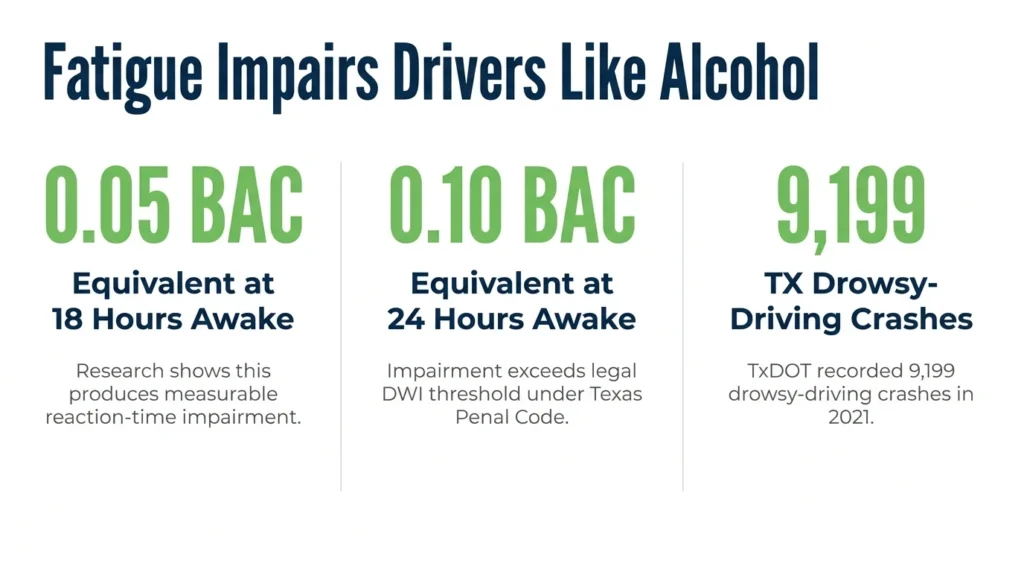
Drowsy driving impairs the same functions that make other drivers dangerous: reaction time, judgment, and awareness. Research shows that staying awake for 18 hours produces reaction-time impairment equivalent to a blood alcohol level of .05. After 24 hours without sleep, the equivalent impairment reaches .10, above the legal limit for driving.
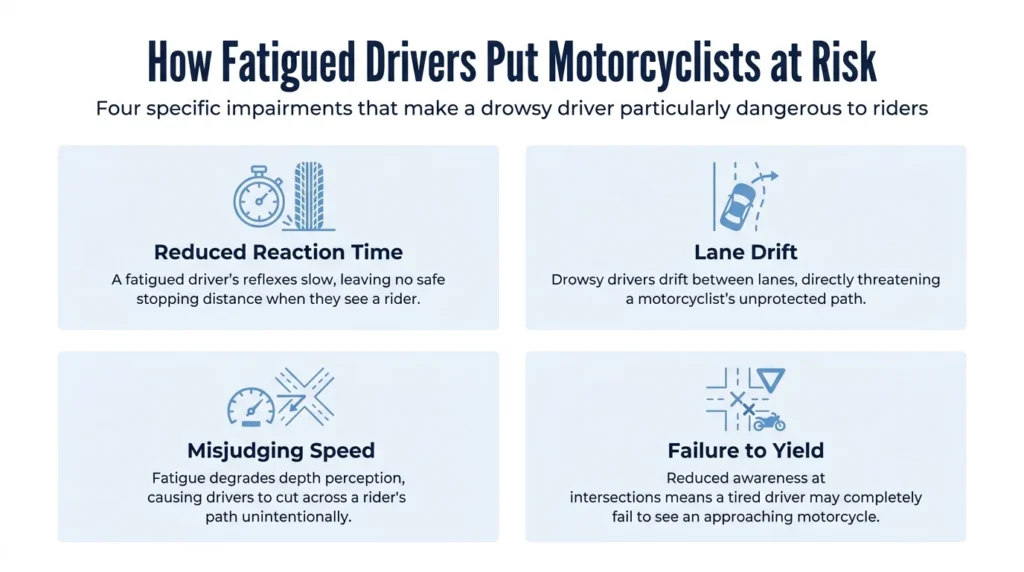
Four conditions make fatigue especially dangerous for motorcyclists sharing the road with drowsy drivers.
- Reduced reaction time. A fatigued driver’s reflexes slow significantly. By the time they notice your presence, there may not be enough distance to brake.
- Lane drift. Drowsy drivers drift between lanes without recognizing that they are doing it. A motorcyclist in that lane has no protection when a vehicle crosses into their path.
- Misjudging speed and distance. Fatigue affects depth perception. A driver who cannot accurately track your approach may cut across your path without intending to.
- Failure to yield. Fatigue reduces awareness of the person’s surroundings. A tired driver at an intersection may not process an approaching motorcycle at all.
NHTSA data shows approximately 91,000 police-reported crashes involved drowsy drivers in 2017, causing roughly 50,000 injuries and 800 deaths. Traffic safety researchers believe the true count is substantially higher, since fatigue is difficult to confirm at the crash scene.
If the other driver’s behavior suggested fatigue, reviewing the injuries common in motorcycle accidents can help you understand what recovery may involve.
Fatigue and Motorcycle Crashes in Texas
Texas ranks among the worst states in the country for drowsy driving crashes. TxDOT crash data shows the state recorded 9,199 crashes related to drowsy driving in 2021. Nearly 4 percent of all fatal crashes in Texas involve driver fatigue.
Long driving distances, heavy commercial freight traffic, and a large population of overnight and shift workers keep fatigued drivers on Texas roads at all hours. That risk falls unevenly on motorcyclists.
A car driver who drifts into your lane or fails to brake in time can cause catastrophic injury. The collision happens before the rider can react. Motorcycle riders are at a higher risk for this kind of crash because their smaller profile makes them harder for a fatigued driver to see or acknowledge.
For context on how these patterns appear in Texas crash data, learn about Texas motorcycle accident statistics and what they mean for riders.
Commercial Drivers, Hours-of-Service Rules, and Motorcycle Crashes
When the vehicle that hit your motorcycle was a commercial truck, federal regulations enter the picture alongside Texas negligence law.
The Federal Motor Carrier Safety Administration limits commercial drivers to 11 hours of driving after 10 consecutive hours off duty. Drivers cannot remain on duty for more than 14 consecutive hours. They must also take a 30-minute break after 8 cumulative hours of driving.
These rules exist specifically to keep fatigued commercial drivers off public roads. When a commercial driver violates those limits and causes a crash, the hours-of-service violation is direct evidence of negligent actions.
Logbooks and electronic logging device data capture exactly how long the driver had been behind the wheel. Dispatch records can show whether the driver’s employer required a schedule that made compliance impossible. A trucking company that pushed a driver past legal rest limits can share civil liability for the resulting crash.
If the vehicle that hit you was a commercial truck, reviewing Texas truck accident claims can help.
Proving Fatigue as Negligence in a Texas Motorcycle Accident Claim
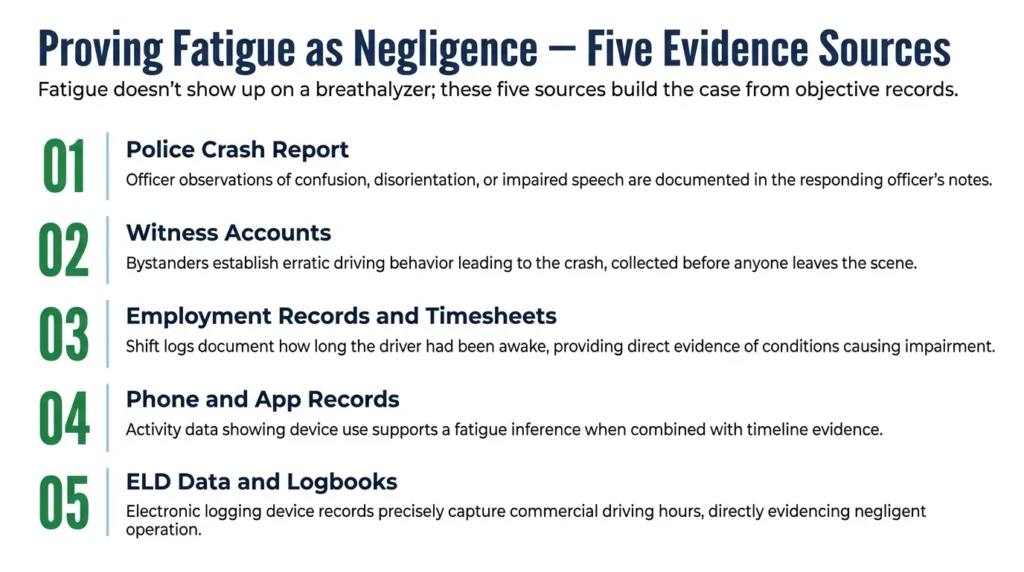
Fatigue does not appear in a breathalyzer reading. Building a claim requires assembling evidence that documents the driver’s condition in the hours before the crash.
Texas negligence law holds every driver to a “duty of reasonable care,” meaning safe driving activities. A driver who continues operating a vehicle despite knowing they are dangerously fatigued has breached that duty. If their fatigue caused your crash, they are civilly liable for the resulting damages.
The evidence that supports a fatigue claim comes from multiple sources.
- The police crash report. Officers document their observations at the scene. Signs of fatigue — confusion, disorientation, or impaired speech in the driver — often appear in the responding officer’s notes.
- Witness accounts. Bystanders or other drivers may have observed erratic behavior before the collision. Those accounts can establish what the driver was doing in the moments that led to the crash.
- Employment records and timesheets. Shift logs and work schedules document how long the driver had been awake or working before the crash occurred.
- Phone and app records. Activity data can show whether the driver was active on a device in the hours before the crash, which, combined with timeline evidence, supports a fatigue inference.
- ELD data and logbooks. For commercial drivers, electronic logging device records capture driving hours precisely. An hours-of-service violation at the time of the crash is direct evidence of negligent operation.
The defense may argue that the rider’s own fatigue contributed to the crash. Texas uses a proportionate responsibility system. This means a rider found 51 percent or more at fault recovers no compensation for an accident. A rider found partly at fault sees their compensation reduced by that fault percentage.
Reviewing how Texas motorcycle accident settlements work can help you assess whether the offer you are receiving reflects your actual losses.
Speak With an Attorney Today
A fatigue-related crash is not easier to resolve because there was no open bottle in the car or other tangible evidence. Proof of drowsy driving can disappear quickly. Shift records may disappear; ELD data has short retention windows. Acting quickly is key.
Angel Reyes & Associates has spent more than 30 years representing crash victims across Texas. We have recovered more than $1 billion for our clients. We offer free initial consultations and take cases on a no-fee-unless-you-win basis. Contact us to talk through what happened and find out what your claim may be worth.
Past results do not guarantee future outcomes.
Rider Fatigue FAQs
How long do I have to file a fatigue-related motorcycle accident claim in Texas?
Texas gives you two years from the date of the crash to file a personal injury lawsuit. If the accident involved a commercial vehicle, FMCSA regulations require carriers to retain ELD records for six months, and other supporting driver records carry similar windows. Waiting significantly reduces the evidence available to support a fatigue claim.
Can a trucking company be held responsible if their driver was fatigued when they hit my motorcycle?
Yes, in some cases. Employers can face liability when they require a driver to operate under a schedule that made compliance with FMCSA hours-of-service rules impossible, or when they knew a driver had been violating rest requirements. A company’s dispatching records and shift assignments are part of the evidence an attorney examines when a commercial driver’s fatigue is under examination.
What if the driver who hit me denied being tired at the scene?
The driver’s own statement is only one piece of evidence. Fatigue claims are built from objective sources: the driver’s work history, logbooks, ELD data, phone records, and what witnesses observed about the driver’s behavior before the crash. An attorney can send preservation letters shortly after the crash to prevent that evidence from being deleted.
Is drowsy driving treated as a criminal offense in Texas?
Texas does not have a statute that criminalizes drowsy driving the way it does drunk driving. A fatigued driver who causes a crash is typically pursued through a civil negligence claim rather than a criminal prosecution. In extreme cases where fatigue-related conduct is reckless, criminal charges are possible, but the primary remedy for most motorcycle crash victims is a civil lawsuit.
Can I still recover damages if I was also tired at the time of the crash?
Possibly, depending on how fault is allocated. Texas uses a proportionate responsibility system. If you were fatigued and that fatigue contributed to the crash, your percentage of fault is calculated and your compensation is reduced by that amount. You can still recover damages as long as your share of fault is less than 51 percent.
About the Authors

Angel Reyes
Writer
Angel L. Reyes, III is the Founder and Managing Partner of Angel Reyes & Associates. A nationally recognized trial attorney and business leader, Angel has helped over 70,000 injury victims recover more than $1 billion since founding the firm in 1993. Named to the Texas Super Lawyers list annually since 2008, Angel brings Wall Street experience, Ivy League education, and a deep commitment to client advocacy. He is a frequent legal commentator and published author with extensive contributions to legal scholarship, trial strategy, and consumer protection.

Kyle Nicolas
Editor
Kyle Nicolas is the Web Content & SEO Manager at Angel Reyes & Associates. He has more than 10 years of experience as a marketing co...

Angel Reyes
Reviewer
Angel L. Reyes, III is the Founder and Managing Partner of Angel Reyes & Associates. A nationally recognized trial attorney and business...