How Road Hazards Cause Motorcycle Accidents in Texas


Every article on this site is researched by our internal team, reviewed for legal accuracy against current Texas law, and held to State Bar of Texas advertising standards before publication. We do not publish content that overstates outcomes or makes promises about results.
Learn more about our
editorial standards .
Key Takeaways
- Texas gives you just six months to notify a government entity of a road-hazard claim.
- A motorcycle's two narrow contact patches make potholes and gravel far more dangerous.
- Being found more than 50% at fault bars all recovery under the Texas 51 percent rule.
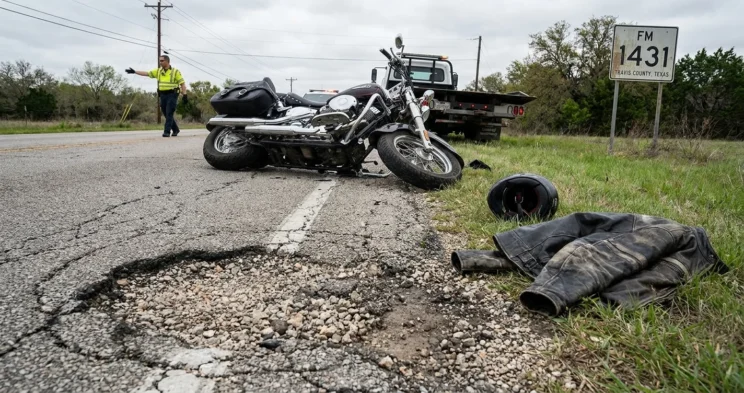
You were riding home down Westheimer Road in Houston when your front wheel dropped into a pothole you never saw coming. The bike pitched, you went down, and now you are looking at medical bills and a motorcycle you cannot ride to work. The crash was not your fault, and you are starting to wonder who let the road get that bad.
Why Road Hazards Hit Motorcycles Harder
A road defect that gives a car a harmless bump can put a motorcycle on the ground. Your bike balances on two narrow contact patches, so a pothole, a patch of gravel, or a deflected wheel can break your traction in an instant.
That same physics turns ordinary hazards into serious threats. Loose gravel, expansion joints, metal bridge grates, uneven pavement edges, and standing water all behave differently under two wheels than under four.
Painted road markings add another risk. They turn slick when wet, and construction debris left in a lane gives you almost no room to react before contact.
The numbers reflect that vulnerability. Federal motorcycle safety data shows that riders face far higher fatality rates per mile traveled than people in passenger cars, with road conditions a leading factor in non-collision crashes.
Texas roads carry their own share of that risk. State crash data analysis tracks how often road conditions contribute to motorcycle crashes across the state.
If you want a sense of the scale, review a breakdown of Texas motorcycle accident statistics, which shows how common these crashes are and what tends to cause them.
Who Is Responsible for Road Maintenance in Texas?
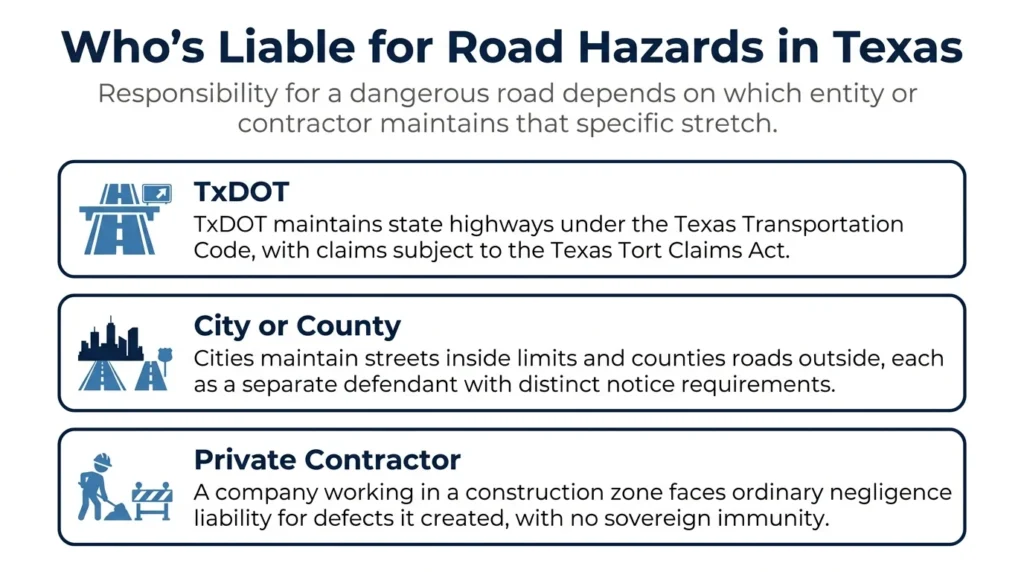
The answer starts with one question: who maintains the road where you went down? Responsibility splits among the state, counties, and cities, and the entity that owns the road is the one you may have a claim against.
TxDOT maintains state highways, U.S. highways, and farm-to-market roads. The Texas Transportation Code § 201.103 gives TxDOT authority over planning, building, and maintaining the state highway system.
Cities maintain the streets inside their limits, and counties maintain the roads outside city limits. Each one is a separate defendant with its own notice rules, so naming the wrong entity can cost you the claim.
Private contractors add another layer. A company working a construction zone can be liable for a defect it created or failed to fix, and that liability sits outside the rules that protect government entities.
Figuring out who maintained that stretch of road is the first move before any claim can move forward. You can review Texas motorcycle accident claims for a walk-through of how these cases come together.
Texas Tort Claims Act & Filing Deadlines
Government entities in Texas start with sovereign immunity, which means you usually cannot sue them. The Texas Civil Practice and Remedies Code (CPRC) § 101.021 carves out a limited exception that lets you bring injury claims tied to the condition of public property, including roads.
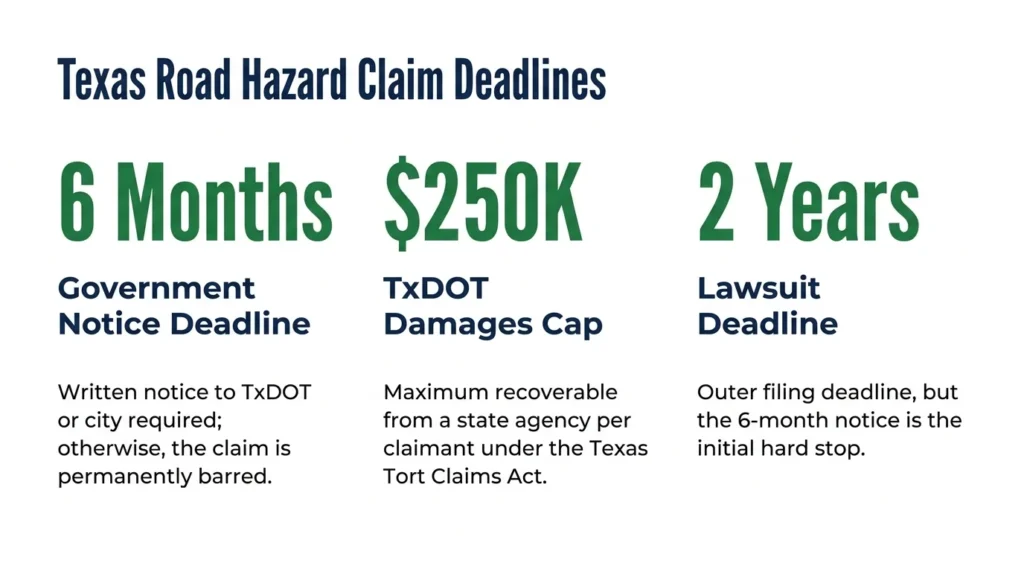
That exception comes with a short fuse.
To protect your claim, work through these steps in order:
Step 1: Identify and notify the responsible entity in writing. Under Texas Civil Practice and Remedies Code (CPRC) § 101.101, you must give the government entity written notice within six months of the crash. Miss that window and your claim is done.
Step 2: Check for a shorter local deadline. Some cities set their own notice rules that run shorter than six months. Confirm the local requirement before you assume you have the full window.
Step 3: Track the outer statute of limitations. Texas Civil Practice and Remedies Code (CPRC) § 16.003 gives you two years to file suit, but the six-month notice rule is the real hard stop for most government claims.
Step 4: Use the state claim process for TxDOT roads. TxDOT’s pavement condition claim resolution process is the administrative channel for crashes on state-maintained roads, and filing there is a practical first step.
These deadlines move fast, and the rules shift depending on which entity you are dealing with.
Review how to sue a government entity in Texas for a layout of what the process looks like from start to finish.
Proving the Government Knew About the Defect
You cannot recover from a government entity just by showing the road was dangerous. You have to prove the entity knew, either through actual notice or constructive notice.
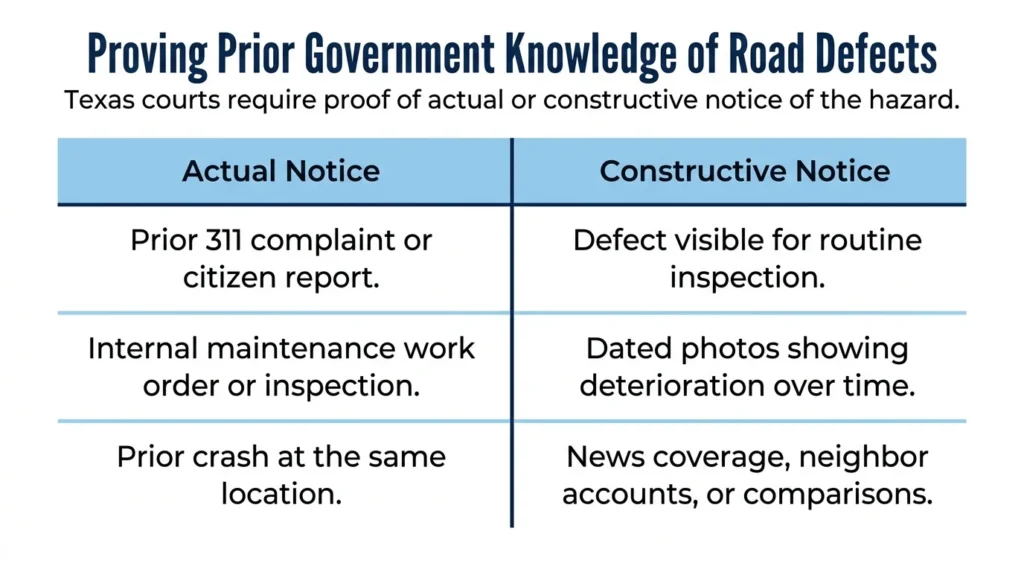
Actual notice means someone told them. A prior 311 complaint, a TxDOT report, an internal maintenance work order, an earlier crash at the same spot, or a contractor inspection log can all show the entity knew the defect was there.
Constructive notice means the defect sat long enough that they should have caught it through routine inspection. Photos showing the road breaking down over time, witness accounts of how long the hazard lasted, prior news coverage, and a comparison with nearby roads in good shape all help build that case.
Expect the entity to push back. Government defendants often raise proportionate responsibility, the fault-sharing rule under Texas Civil Practice and Remedies Code (CPRC) § 33.001, arguing your speed or familiarity with the road means you share the blame.
That argument carries real weight in Texas. Under the 51 percent rule, you recover nothing if you are found more than half at fault, so understanding how comparative negligence works in Texas can change how you approach your claim. Documenting the scene and locking down evidence quickly is your strongest defense against a fault-shifting argument.
Contact Angel Reyes & Associates After a Road-Hazard Crash
A road-hazard motorcycle crash is rarely just bad luck, and you do not have to sort out the jurisdiction, the notice deadlines, and the evidence on your own. Angel Reyes & Associates has handled motorcycle accident cases across Texas for over 30 years, including road-hazard claims against TxDOT, cities, and private contractors.
We work on a no-fee-unless-we-win basis, we are available 24/7, and we have more than $1 billion recovered for clients. You can review how we have approached these cases, and how motorcycle accident settlements work in Texas for what compensation can look like.
The six-month notice clock starts the day of your crash, so reach out for a free consultation before that window closes.
Past results do not guarantee future outcomes.
Road Hazard Motorcycle Accident FAQs
Are there limits on how much money you can recover from a government entity in Texas?
Yes. Claims against a city or county are capped at $100,000 per person under the Texas Tort Claims Act, while claims against a state agency like TxDOT are capped at $250,000 per person. These caps apply even when a jury awards more.
What if a truck or another driver dropped debris that caused my crash?
A private driver or company that lets cargo fall onto the road can be sued under ordinary negligence, not the Texas Tort Claims Act. That means no six-month notice requirement and no government damages cap, but you still need to identify and document who shed the material.
Will my own motorcycle insurance cover a road-hazard crash if no other vehicle was involved?
Collision coverage pays for damage to your bike regardless of fault, including single-vehicle crashes caused by road defects. Uninsured motorist coverage generally does not apply when no other driver is involved, so whether you have coverage depends on which policies you carry.
Does my claim disappear if the government repaired the road before I could document it?
Not necessarily. Prior complaint records, maintenance work orders, dated photos, and witness statements can still show the defect existed and that the entity knew about it before the repair. Moving quickly to gather that evidence and send written notice within six months gives you the best chance of preserving the claim.
Can I file a claim if the crash happened on a private road or HOA-controlled street?
The Texas Tort Claims Act does not cover private roads. If an HOA or private property owner controlled the road and knew about the defect but failed to fix it, you may have a premises liability claim under ordinary negligence rules rather than a government claim.
About the Authors

Angel Reyes
Writer
Angel L. Reyes, III is the Founder and Managing Partner of Angel Reyes & Associates. A nationally recognized trial attorney and business leader, Angel has helped over 70,000 injury victims recover more than $1 billion since founding the firm in 1993. Named to the Texas Super Lawyers list annually since 2008, Angel brings Wall Street experience, Ivy League education, and a deep commitment to client advocacy. He is a frequent legal commentator and published author with extensive contributions to legal scholarship, trial strategy, and consumer protection.

Kyle Nicolas
Editor
Kyle Nicolas is the Web Content & SEO Manager at Angel Reyes & Associates. He has more than 10 years of experience as a marketing co...

Angel Reyes
Reviewer
Angel L. Reyes, III is the Founder and Managing Partner of Angel Reyes & Associates. A nationally recognized trial attorney and business...