How Social Media Can Hurt Your Motorcycle Accident Claim


Every article on this site is researched by our internal team, reviewed for legal accuracy against current Texas law, and held to State Bar of Texas advertising standards before publication. We do not publish content that overstates outcomes or makes promises about results.
Learn more about our
editorial standards .
Key Takeaways
- Insurance adjusters search public and private social media within hours of receiving your claim.
- Activity photos, wellness posts, and location check-ins are the posts that damage your claim most.
- Go private on all platforms immediately and do not delete past posts without attorney guidance.
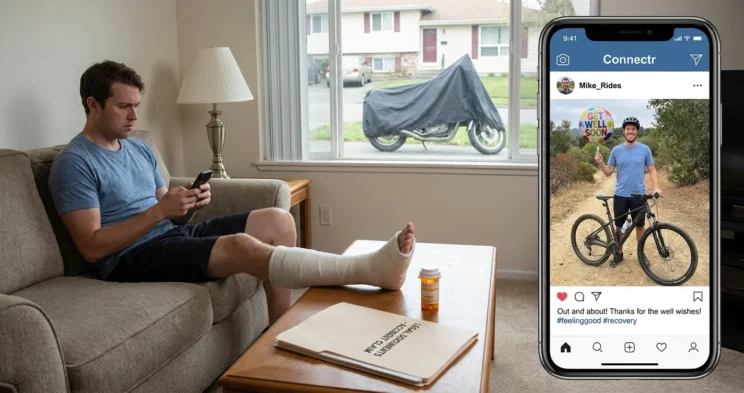
You were riding home on I-35 when a car cut you off near the Waco interchange, and the crash that followed put you in the hospital. You told your family you were okay. Maybe you posted a photo from the hospital bed to let everyone know you survived. That post is already evidence.
Insurance adjusters know that crash victims want to reassure the people who love them. They count on it.
How Insurers Use Social Media Against Your Claim
Insurance companies begin reviewing public social media profiles within hours or days of receiving a claim. The adjuster’s job is to close your claim and pay you as little as possible. Social media is one of the fastest ways to build a case for doing exactly that.
Adjusters are not just scrolling through your feed. They use specialized investigators and open-source intelligence tools to pull location metadata embedded in your photos, search hashtags connected to your name, and monitor posts from friends and family who tag you or comment on your status. A photo of you at a backyard cookout, posted by your cousin, with no caption, can still show up in a claims investigation.
What they find can have a huge impact on your motorcycle accident settlement. Settlements are based on injury severity, treatment duration, and activity limitations. Every post that suggests you were physically active, socially present, or emotionally fine can result in a lower settlement.
What “Private” Really Means
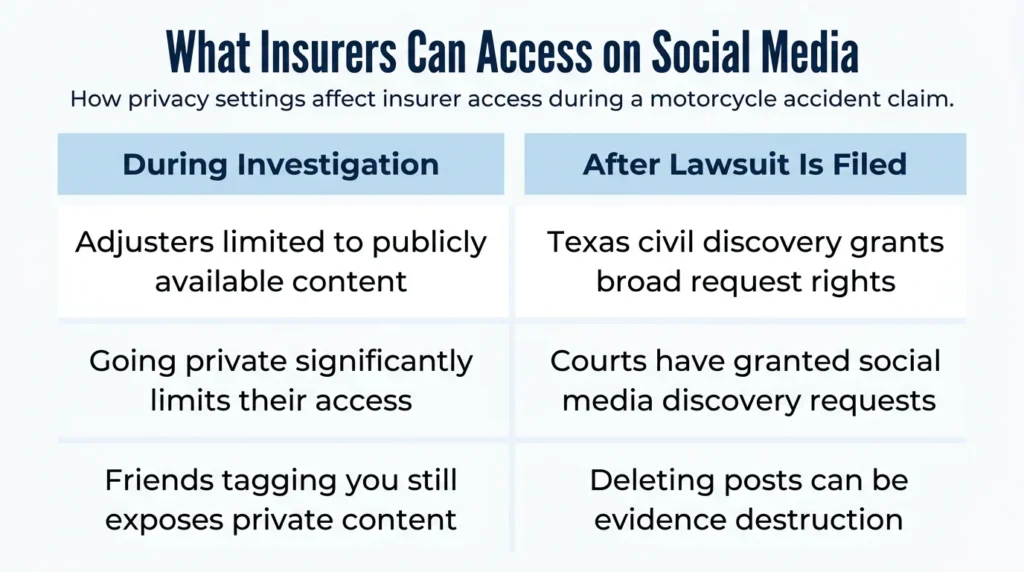
Setting your account to private makes it harder for you to be found during a routine social media search. However, it does not protect you once a lawsuit is filed.
Texas civil procedure gives opposing parties broad rights to request documents and other materials, including social media content, when those materials are relevant to the subject matter of a personal injury case. Courts have granted these requests in injury cases where a claimant’s physical capacity was disputed, and the scope of what counts as relevant is interpreted broadly.
Your friends and family can also expose you without meaning to. A tagged photo, a public comment on your wall, or a shared post from a family member can surface content you thought was buried.
If you are unsure how your social media activity might affect your motorcycle accident claim, an attorney can review your situation before an adjuster does.
3 Types of Posts That Damage Claims
Almost any social media post can be twisted and used against you, but there are certain types of posts that can really be harmful to your case.
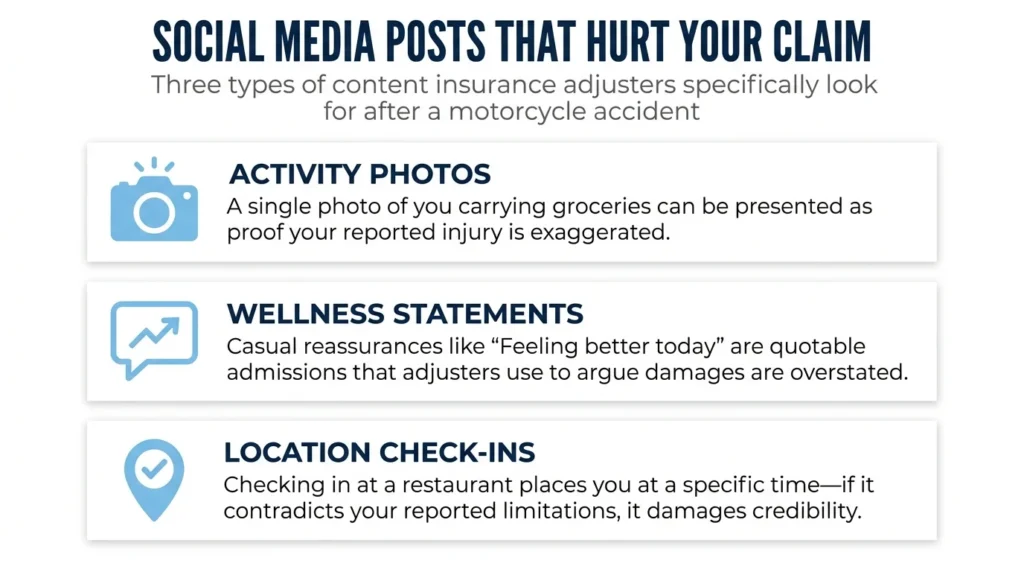
These include:
- Activity photos. Photos of you riding again, lifting anything, working in the yard, or doing anything physically demanding can really work against you. A single photo of you carrying groceries, taken on a day you felt okay, can be presented as proof that your reported “back injury” is exaggerated. Defense attorneys do not need a lot. They only need one image that tells a different story from your medical records.
- Statements about how you feel. “Feeling better today, thanks for all the support” seems harmless. To an adjuster, it is a quotable admission. Even casual emotional reassurances, the kind you post for family and friends, can be pulled out of context and used to argue that your pain and suffering damages are overstated.
- Location check-ins. Checking in at a restaurant, a concert, or even a pharmacy places you at a specific location at a specific time. If you claimed you were unable to leave the house due to your injuries, a check-in two days later contradicts that claim on paper. Timestamps and location data embedded in photos work the same way, even when no check-in was posted.
Remember: The less information an adjuster can collect about your daily life, the less material they have to work with.
What to Do on Social Media After an Accident
Go private and go quiet on every platform, immediately.
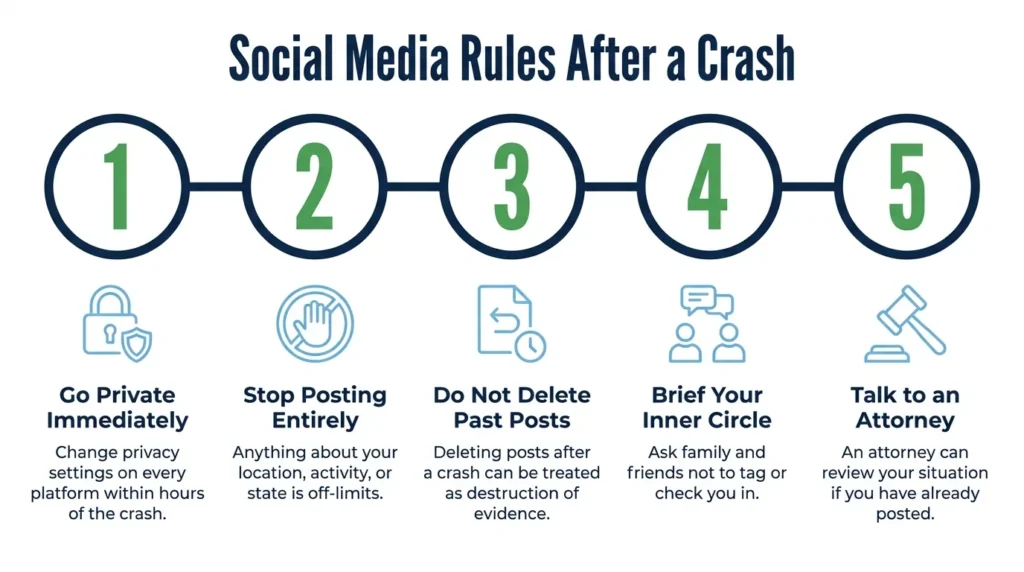
Here is what you need to do on social media following your motorcycle accident:
- Step 1: Change your privacy settings on every platform you use/have, including Facebook, Instagram, TikTok, Snapchat, X, and LinkedIn. Adjusters have been known to check social media shortly after claims are filed.
- Step 2: Stop posting entirely. Anything involving your location, physical activity, or emotional state (even if you think these things have nothing to do with your claim) is off-limits until your claim is resolved. The safest route is not to post anything at all.
- Step 3: Do not delete past posts without speaking to an attorney first. Deleting posts after a crash can be treated as destruction of evidence in Texas. That classification carries serious legal consequences, including sanctions and a negative inference instruction that tells the jury you deleted content because it hurt your case.
- Step 4: Talk to your inner circle. Ask the people closest to you not to tag you in photos, share pictures of you, or check in alongside you at any location until further notice.
This applies whether you are dealing with a Texas motorcycle accident claim involving another driver or a situation where fault is disputed. Your social media is likely to be monitored regardless of who was at fault.
Work with an Attorney Before the Adjuster Acts
Adjusters move quickly, and most claimants do not know that an investigation can already be well underway before a lawyer gets involved.
Angel Reyes & Associates has guided Texans through injury claims, including car accidents, motorcycle accidents, pedestrian accidents, and more, for over 30 years. We offer free consultations and work on a contingency basis, which means you pay nothing unless we recover compensation for you.
If you have already posted something after a crash and you are not sure whether it creates a problem, we can review your situation. Reach out to our attorneys to schedule a free consultation. We are available 24/7 to discuss your case.
Past results do not guarantee future success.
Social Media & Motorcycle Claim FAQs
Can an insurance company access my private social media after a motorcycle accident?
During the investigation phase, insurers are limited to publicly available content, but once a lawsuit is filed, they can request private social media through formal discovery. Texas courts have granted these requests in personal injury cases where a claimant’s physical condition was disputed.
How long do I need to stay off social media after a motorcycle accident?
You should avoid posting about your location, activities, or health until your claim is fully resolved, which in Texas can take anywhere from a few months to two years or more, depending on the complexity of the case.
Does what I post affect how much fault I am assigned in Texas?
It can. Texas uses a proportionate responsibility system, meaning fault is divided among all parties. If your posts suggest you were not as limited as claimed, they may be used to argue your injuries were minor or to dispute the seriousness of your case, which can reduce the damages you recover.
About the Authors

Angel Reyes
Writer
Angel L. Reyes, III is the Founder and Managing Partner of Angel Reyes & Associates. A nationally recognized trial attorney and business leader, Angel has helped over 70,000 injury victims recover more than $1 billion since founding the firm in 1993. Named to the Texas Super Lawyers list annually since 2008, Angel brings Wall Street experience, Ivy League education, and a deep commitment to client advocacy. He is a frequent legal commentator and published author with extensive contributions to legal scholarship, trial strategy, and consumer protection.

Kyle Nicolas
Editor
Kyle Nicolas is the Web Content & SEO Manager at Angel Reyes & Associates. He has more than 10 years of experience as a marketing co...

Angel Reyes
Reviewer
Angel L. Reyes, III is the Founder and Managing Partner of Angel Reyes & Associates. A nationally recognized trial attorney and business...