How Weather Affects Motorcycle Accidents in Texas


Every article on this site is researched by our internal team, reviewed for legal accuracy against current Texas law, and held to State Bar of Texas advertising standards before publication. We do not publish content that overstates outcomes or makes promises about results.
Learn more about our
editorial standards .
Key Takeaways
- Riding in rain does not automatically make a Texas motorcycle rider at fault.
- A rider found 51% or more at fault under Texas law recovers nothing from a crash.
- You have two years from the crash date to file a Texas motorcycle injury claim.
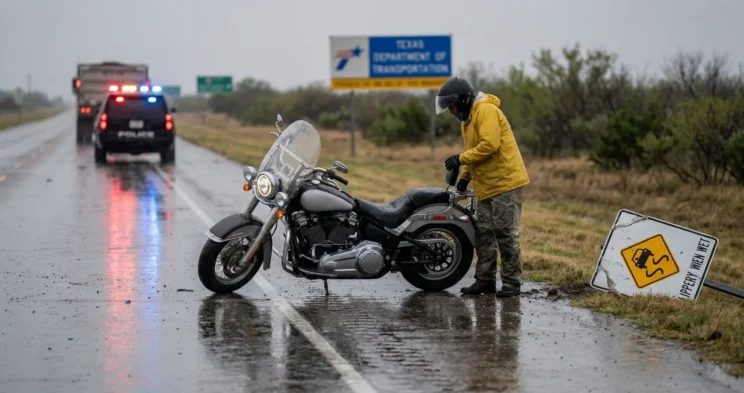
You were riding home through Deep Ellum when the first rain in weeks hit the pavement on Commerce Street. Your back tire slipped, a car cut across your lane, and now you are on the ground wondering what just happened. The crash was not your fault, but the other driver’s insurer keeps asking why you were out riding in the rain at all.
Weather Hazards Texas Motorcyclists Face
Four weather conditions cause or contribute to most motorcycle crashes in Texas: flash flooding, first-rain oil slicks, high winds, and sun glare. Each one hits riders harder than drivers in enclosed vehicles, because a motorcycle gives you almost no physical protection when something goes wrong.
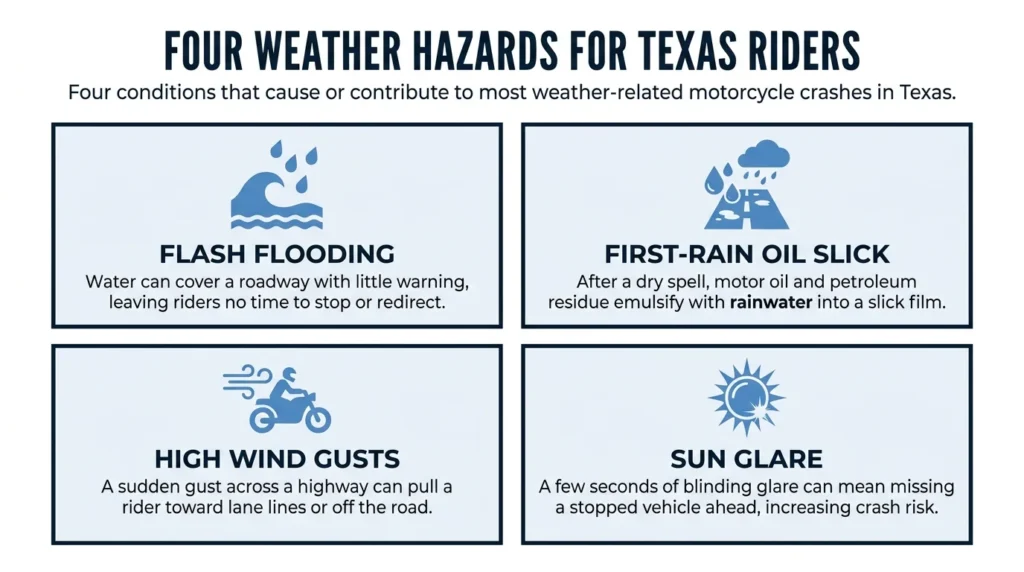
Texas sees more flash flooding than nearly any other state. These crashes are among the deadliest for riders because water can cover a roadway with little warning. You can review how TxDOT explains the danger in its guidance on flash flood safety, which underscores how fast a road turns impassable.
The first rain after a dry spell is its own trap. Motor oil and petroleum residue build up on the pavement, then emulsify with rainwater into a slick film. That film cuts your tire grip sharply until the road washes clean.
High winds add another layer of risk, especially in West Texas and along elevated highway corridors. A sudden gust across a bridge or overpass can pull a rider toward the lane lines or off the road entirely. Drivers in enclosed vehicles rarely feel this kind of force.
Sun glare during low-sun hours in fall and spring is a documented crash contributor. Peer-reviewed research shows crash risk runs 16 percent higher during bright sunlight than under normal conditions. For a rider, a few seconds of blinding glare can mean missing a stopped car ahead.
If you want a fuller picture of how common these crashes are, review a breakdown of Texas motorcycle accident statistics that puts weather-related incidents in context with other crash types. The state’s own fatality data tells the same story.
Fault Rules for Weather-Related Crashes
Riding in bad weather does not automatically make you at fault in Texas. The state follows a modified comparative fault system under the Texas Civil Practice and Remedies Code (CPRC) Chapter 33, which means a rider who is partly at fault for an accident can still recover damages.
The key threshold is the 51 percent bar rule. If you are found 51 percent or more responsible for the crash, you recover nothing. If your share is 50 percent or less, your compensation gets reduced by your percentage of fault.
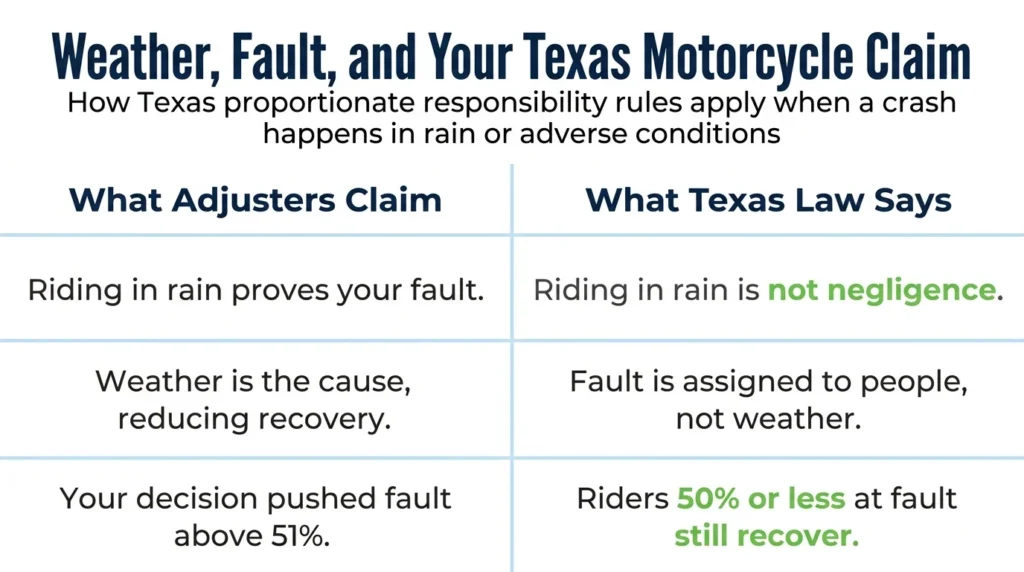
Texas law does not shift fault to the weather itself. Instead, it asks whether each party acted reasonably given the conditions. Riding a motorcycle in rain does not make you negligent on its own, and it does not erase a careless driver’s responsibility for the crash.
That standard cuts both ways. The Texas Transportation Code § 545.351 requires every operator to drive at a speed that is reasonable and prudent for current weather and road conditions. A driver who plowed into you on a wet road was held to that same duty.
The math matters for your compensation. If your fault is set at 20 percent, you still collect 80 percent of your total damages. You can learn more about how motorcycle accident settlements work in Texas for a clearer idea of what that reduction means in real numbers.
A weather-related crash is rarely a lost cause once you understand the proportional reduction. You can also review how comparative fault may apply to your specific facts and whether the weather is likely to be used to cut your recovery.
How Adjusters Use Weather Against Riders
Insurance adjusters often argue that riding in rain, near flooded roads, or in low visibility was itself an unreasonable choice. The goal is to push your fault percentage above the 51 percent bar so they owe you nothing.
The adjuster’s job is to close your claim for as little as possible. That is how the business works, and weather gives them an easy story to tell.
To build that story, adjusters look for proof that you saw the warning signs and rode anyway. They pull weather forecasts, flood warnings, road closure notices, and witness statements about conditions at the time of your crash.
Watch for loaded phrases like “assumed the risk” or “failure to exercise reasonable care.” Adjusters use that language to make your decision to ride as proof of negligence, even when another driver’s action was the direct cause.
If an adjuster is using the weather to argue you were more than 50 percent at fault, an attorney can test whether that argument holds up against the facts. For the broader picture across vehicle types, look at how weather impacts liability in car accidents. The pressure on riders is sharper, because you have no structural protection to soften the crash or the blame.
Protecting Your Claim After a Rain Crash

The single most important thing you can do after a weather-related crash is preserve the evidence before conditions change. The steps below protect your right to compensation for your injuries, lost wages, and general suffering:
Step 1: Document the weather conditions immediately. Photograph the road surface, standing water, flood markers, and any visible debris or oil sheen before it all changes. Note the exact time and location of the crash.
Step 2: Obtain the crash report and check it carefully. Verify that the officer recorded the weather and road conditions accurately. Errors in the report give adjusters room to make incorrect claims about the accident scene.
Step 3: Gather official weather records. Pull TxDOT flood advisory data or National Weather Service alerts that were active at your time and location. Official records carry more weight than personal recollection.
Step 4: Seek medical care the same day. Weather-related crashes often involve impacts that produce delayed symptoms. Gaps in your medical records weaken the damages portion of your claim.
Step 5: Do not give a recorded statement about the weather. Wait until you understand how those words may be used to set your fault percentage.
You also have a hard deadline. The Texas Civil Practice and Remedies Code § 16.003 gives you two years from the date of the crash to file. That clock keeps running no matter how long insurance negotiations drag on.
Talk to an Experienced Lawyer
Weather can complicate a motorcycle claim, but it rarely ends one. Angel Reyes & Associates has spent more than 30 years representing injured riders across Texas, including those whose crashes turned into weather-related fault disputes.
We offer free initial consultations and charge no fee unless we recover money for you, and we have recovered more than $1 billion for clients across Texas. If you want to know how the conditions that day may affect your claim, reach out to us for a free consultation.
Past results do not guarantee future outcomes.
Weather-Related Motorcycle Accident FAQs
Can I file a claim against TxDOT or a city if a flooded road caused my crash?
You may have a claim against a government entity if a dangerous road condition, such as inadequate drainage or missing flood warning signs, contributed to the crash. Texas law allows these suits under the Texas Tort Claims Act, but you must file a formal notice of claim within six months of the crash date.
Does not wearing a helmet affect my injury claim in Texas?
Texas requires riders under 21 to wear a helmet and allows riders 21 and older to ride without one if they meet insurance or safety course requirements. If you were legally riding without a helmet, the other side may still try to argue your injuries were worsened by that choice, which could reduce your recovery.
What if the driver who hit me in the rain was uninsured?
If the at-fault driver had no insurance, you may be able to receive compensation through your own uninsured motorist (UM) coverage if you carry it on your motorcycle policy. Texas does not require UM coverage, so whether it applies depends on what your policy includes.
Does my motorcycle insurance cover my medical bills from a weather-related crash?
Standard motorcycle liability insurance covers damage you cause to others, not your own injuries. For your own medical costs, you would need personal injury protection (PIP), medical payments (MedPay), or health insurance to cover treatment while your claim is pending.
Can dash cam or phone video of the road conditions help my claim?
Yes. Video footage showing standing water, low visibility, or road debris at the time of the crash is strong evidence of the conditions you faced. It is harder for an adjuster to dispute conditions that are captured on video than conditions described only in a written report.
About the Authors

Angel Reyes
Writer
Angel L. Reyes, III is the Founder and Managing Partner of Angel Reyes & Associates. A nationally recognized trial attorney and business leader, Angel has helped over 70,000 injury victims recover more than $1 billion since founding the firm in 1993. Named to the Texas Super Lawyers list annually since 2008, Angel brings Wall Street experience, Ivy League education, and a deep commitment to client advocacy. He is a frequent legal commentator and published author with extensive contributions to legal scholarship, trial strategy, and consumer protection.

Kyle Nicolas
Editor
Kyle Nicolas is the Web Content & SEO Manager at Angel Reyes & Associates. He has more than 10 years of experience as a marketing co...

Angel Reyes
Reviewer
Angel L. Reyes, III is the Founder and Managing Partner of Angel Reyes & Associates. A nationally recognized trial attorney and business...