Can I Get Compensation After a Motorcycle Accident Without a Helmet in Texas?


Every article on this site is researched by our internal team, reviewed for legal accuracy against current Texas law, and held to State Bar of Texas advertising standards before publication. We do not publish content that overstates outcomes or makes promises about results.
Learn more about our
editorial standards .
Key Takeaways
- Not wearing a helmet does not bar a Texas motorcycle accident claim; it may reduce damages under the comparative fault rule.
- Texas riders 21 and older can legally ride without a helmet with qualifying health insurance or a safety course.
- Helmet non-use affects head and facial injury damages most; unrelated injuries like broken bones are far less impacted.
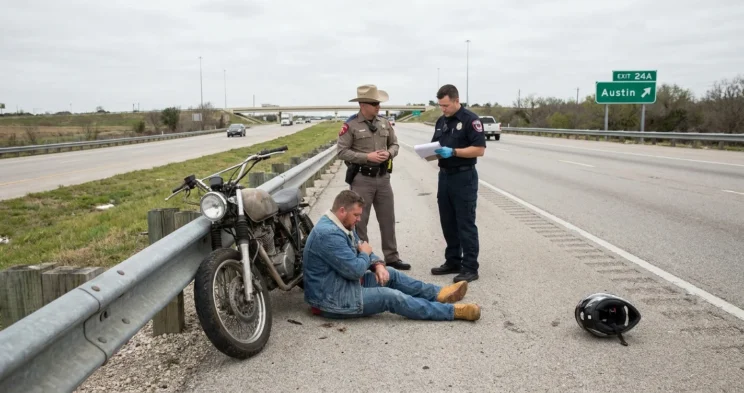
You were on your bike heading home on I-35 when another driver crossed into your lane and hit you. Now you’re in the hospital, and the insurance adjuster has already called with a number that feels way too low. According to the adjuster, part of the problem is that you were not wearing a helmet.
Yes, You Can Still Recover Compensation
Not wearing a helmet does not bar you from filing a motorcycle accident claim. Texas law does not strip away your right to compensation simply because you chose not to wear a helmet. The real question is how helmet non-use affects the value of your claim, not whether you have a claim at all.
Texas uses a fault-sharing system called proportionate responsibility. As long as you are 50% or less responsible for the crash, you can still recover damages. Your recovery decreases by your percentage of fault. A rider found 20% at fault can still recover 80% of their damages. However, if you’re 51% or more at fault, you typically can’t recover anything.
The bigger question is what caused the crash in the first place. If another driver ran a red light, drove drunk, or failed to yield and hit you, that driver’s negligence is what caused the crash. Your helmet status does not change that.
If you suffered injuries to your legs, back, or other areas unrelated to head protection, the insurer has a much harder time blaming these common motorcycle accident injuries on not wearing a helmet. Insurers most often raise helmet non-use when a rider suffers head or facial injuries because they can argue a helmet would have reduced the severity of the harm.
Helmet Law & the Over-21 Exemption
Texas Transportation Code § 661.003 sets out who must wear a helmet and who may legally ride without one. Riders under 21 must wear a helmet that meets federal safety standards. The law applies to both operators and passengers in that age group. Riders 21 and older may qualify for an exemption from the helmet requirement.
The Two Exemption Conditions for Riders 21 & Older
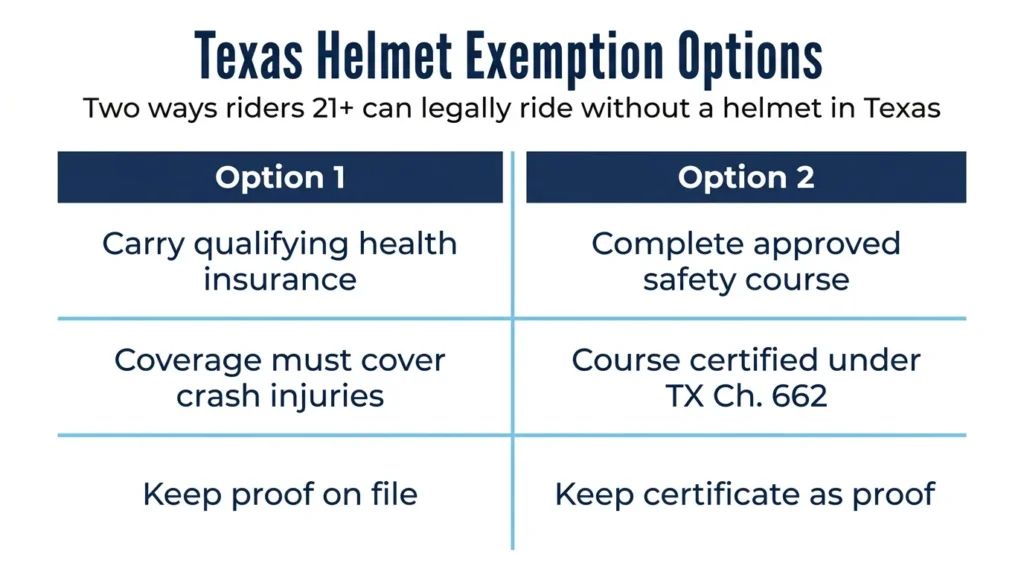
Texas law allows riders who are at least 21 years old to ride without a helmet if they meet one of two conditions. You only need to satisfy one requirement.
Condition 1: You carry health insurance that provides medical benefits for injuries resulting from a motorcycle crash.
Condition 2: You completed an approved motorcycle operator training and safety course under Texas Transportation Code Chapter 662.
If you qualified under either condition, you were legally riding without a helmet. That does not prevent an insurance company from raising helmet non-use after a crash, but it can strengthen your position when fault becomes an issue.
Why the Exemption Matters for Your Claim
A legal right to ride without a helmet and a civil court’s assessment of fault are two different things. Texas courts use a similar approach when evaluating helmet non-use and seatbelt non-use. In both situations, insurers often argue that the injured person’s actions increased the severity of their injuries, even when another driver caused the crash.
An insurer can still argue that not wearing a helmet contributed to your head injuries even if you were fully exempt from the helmet requirement. The exemption does not automatically win the comparative fault argument. But it does strengthen your counter-argument. Texas law itself authorized you to ride that way. That makes it harder for an insurer to portray your conduct as reckless or irresponsible.
How Helmet Non-Use Affects Your Settlement
Insurance companies often argue that non-use of a helmet increases the severity of a rider’s injuries. When you file a claim after a crash without a helmet, the adjuster will often assign a portion of fault to you for the head or facial injuries you suffered. That percentage directly reduces the settlement offer.
Texas Civil Practice and Remedies Code Chapter 33 allows a jury to divide fault between multiple parties. If a jury values your damages at $300,000 and assigns you 25% of the fault, you can still recover $225,000. If a jury assigns you more than 50% of the fault, Texas law typically prevents any recovery.
Insurance companies often build their initial offers around the percentage of fault they believe they can assign to you. Fault is only one piece of the equation, though. Injury severity, available insurance coverage, medical treatment, and other factors can also affect the value of a motorcycle accident settlement.
Medical evidence often becomes the key battleground. Your attorney can use medical records and expert opinions to show which injuries relate to helmet non-use and which injuries would have occurred regardless. That analysis can reduce the percentage of fault the insurer assigns to you and increase the value of your claim.
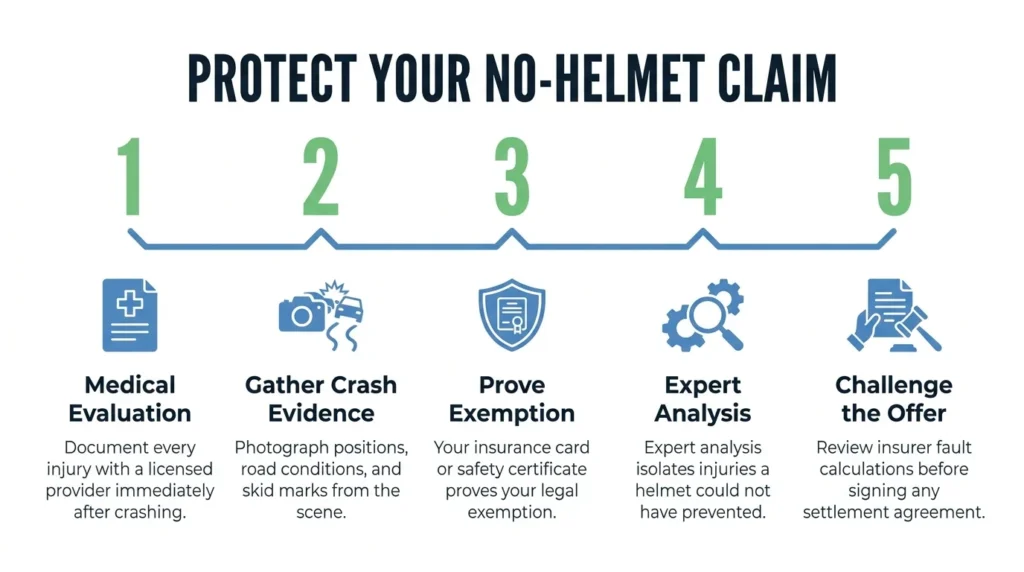
Before accepting a settlement offer that cites helmet non-use, make sure you understand how the insurer calculated fault and whether the evidence actually supports that reduction. Once you sign a settlement agreement, you generally cannot return later and seek additional compensation.
What You Can Do to Protect Your Recovery
You have more ways to counter a helmet-based fault argument than the insurance adjuster may suggest. Taking the right steps early can strengthen your claim and limit the insurer’s ability to shift blame.
Step 1: Get a full medical evaluation immediately. Document every injury with a licensed provider. The insurer’s fault argument is weakest when your documented injuries are clearly unrelated to head trauma.
Step 2: Gather evidence from the crash scene. Photos of vehicle positions, road conditions, skid marks, and traffic controls all support the case that the other driver caused the crash. Witness contact information is equally valuable.
Step 3: Document your exemption status if you were over 21. Your health insurance card or certificate of completion for a safety course is direct evidence that you were legally riding without a helmet.
Step 4: Work with an attorney on injury causation. An attorney can retain medical experts to establish which injuries a helmet would or would not have prevented. That expert analysis directly challenges the percentage of fault the adjuster assigned to your failure to use the helmet.
Speak to an Attorney About Your Case
If you were injured in a motorcycle crash without a helmet, you likely have more of a case than the insurance adjuster is suggesting.
Angel Reyes & Associates has guided injured motorcyclists and their families through the claims process for over 30 years. We work on a contingency basis, so there is no fee unless we win. We have offices across Texas and can handle most, if not all, of your case remotely. If an insurance company has reduced your settlement offer because you were not wearing a helmet, contact us for a free consultation before you accept it. We can review what your case is actually worth.
You can find our office locations across Texas if you prefer to meet in person.
Past results do not guarantee future outcomes.
Motorcycle Helmet Accident FAQs
Does a motorcycle passenger who wasn't wearing a helmet have the same rights as the rider?
Yes. Texas’s proportionate responsibility rules apply to passengers as well as operators. A passenger without a helmet may have their head-injury damages reduced by the percentage of fault assigned to helmet non-use, but they are not barred from filing a claim.
Can an insurance company require me to prove I qualified for the over-21 helmet exemption?
Yes. If helmet non-use becomes an issue, the insurer may ask for evidence that you carried qualifying health insurance or completed an approved motorcycle safety course. Keeping those records can help resolve disputes about your exemption status.
Is there a deadline to file a motorcycle accident claim in Texas?
Texas gives you two years from the date of the crash to file a personal injury lawsuit. Missing that window will almost certainly end your claim before it begins, regardless of how strong the underlying case is.
What if I had health insurance that met the over-21 exemption but didn't have proof with me at the time of the crash?
Your claim is not lost. You can document your coverage after the fact with records from your insurer. The exemption is based on whether qualifying coverage existed, not on whether you showed proof at the scene.
Will a low first offer from the insurer go up if I push back?
First offers from insurers are often lower than a claim’s full value, especially when helmet non-use enters the discussion. Medical records, expert opinions, and evidence demonstrating that you are legally qualified to ride without a helmet can strengthen your position in negotiations, though no outcome is guaranteed.
About the Authors

Spencer Browne
Writer
Spencer Browne is a partner at Angel Reyes & Associates and a Board Certified personal injury trial lawyer with nearly 100 jury trials across Texas. He focuses on car, truck, and wrongful death cases, with notable verdicts including a landmark win in the Choctaw Casino bus crash case. A recognized speaker and legal educator, Spencer is a member of the American Board of Trial Advocates and has been honored as a Texas Super Lawyer and one of D Magazine’s Best Lawyers in Dallas. He brings deep trial experience and relentless advocacy to every client he represents.

Kyle Nicolas
Editor
Kyle Nicolas is the Web Content & SEO Manager at Angel Reyes & Associates. He has more than 10 years of experience as a marketing co...

Angel Reyes
Reviewer
Angel L. Reyes, III is the Founder and Managing Partner of Angel Reyes & Associates. A nationally recognized trial attorney and business...