What Percent of Motorcycle Accidents Are the Rider’s Fault?


Every article on this site is researched by our internal team, reviewed for legal accuracy against current Texas law, and held to State Bar of Texas advertising standards before publication. We do not publish content that overstates outcomes or makes promises about results.
Learn more about our
editorial standards .
Key Takeaways
- In multi-vehicle crashes, other drivers are at fault more often than riders.
- Texas law bars recovery for riders found more than 50% at fault.
- Biker bias leads adjusters to assign inflated fault percentages to riders.
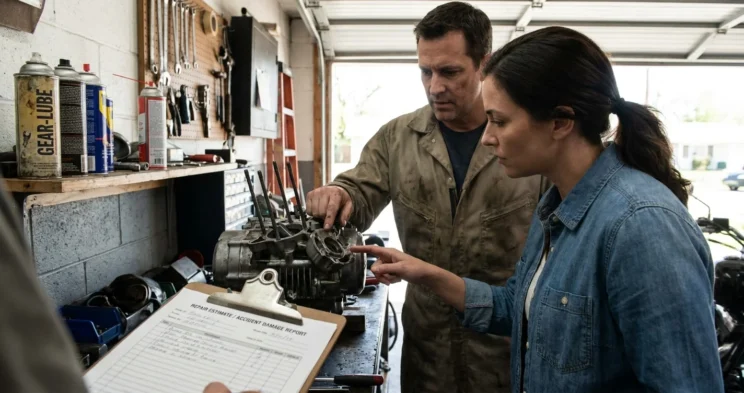
You were clipped by a vehicle changing lanes on Harry Hines Boulevard in Dallas, sending you tumbling down the tarmac. Later, when the phone rings, the first thing the other driver’s insurer does is accuse you of riding recklessly. No investigation. No evidence review. Just a quick assumption that because you were on a motorcycle, the crash was probably your fault.
That assumption has a name: biker bias. It also has a counter-argument, and it starts with the data.
What the Fault Data Actually Shows
Contrary to what a lot of average people might believe, riders are not responsible for most motorcycle accidents. Reality is nuanced, and the individual details of each crash tell a unique story. This is particularly true when comparing single-vehicle and multi-vehicle collisions.
Single-vehicle crashes involve only the motorcycle. A rider loses control on a curve, clips a fixed object, or goes down without another vehicle.
These crashes do show a higher rate of rider-related factors. According to NHTSA motorcycle safety data, 37% of motorcycle riders in fatal crashes in 2024 were speeding, and 40% of riders killed in single-vehicle crashes were alcohol impaired that year.
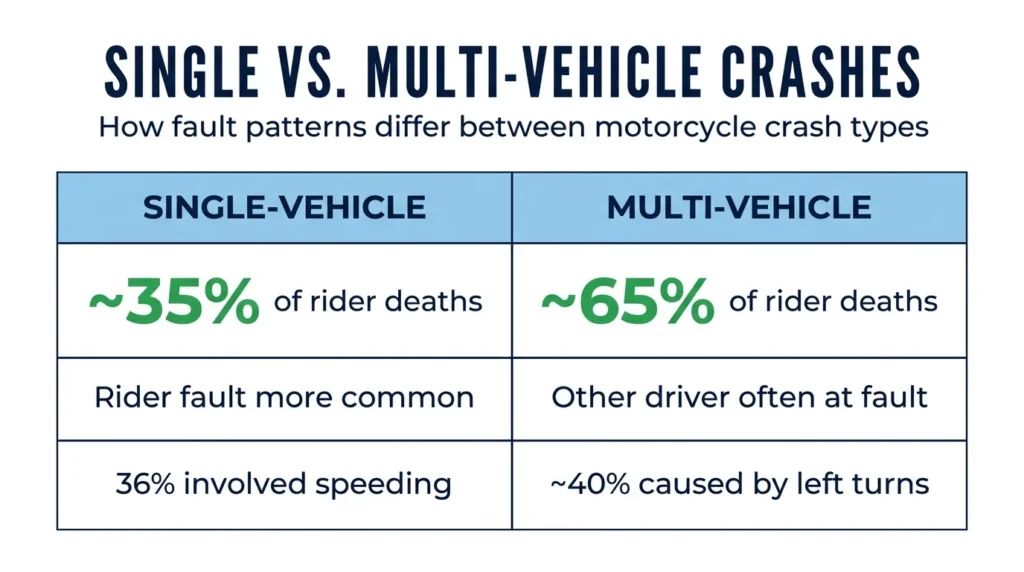
Single-vehicle crashes accounted for roughly 35% of all motorcyclist deaths. That leaves around 65% of fatalities occurring in multi-vehicle crashes, and in those crashes the story changes.
Other drivers violate riders’ right-of-way in a large share of these collisions. Left turns by other drivers are among the most common causes of fatal multi-vehicle motorcycle crashes, accounting for roughly 4 in 10 such collisions according to multiple years of NHTSA data. The rider did not create those situations.
When you look at the full picture of motorcycle accident statistics, riders are not the dominant cause of crashes. They carry a meaningful share of fault in single-vehicle crashes, but they are the victim far more often in the crashes that make up the majority of motorcycle fatalities.
Why Riders Get Blamed More Than the Data Supports
The statistics above are real. The fault percentages that insurers assign to riders often are not.
Biker bias is the tendency of adjusters and jurors to assume a motorcyclist was riding aggressively before they examine a single piece of evidence. It’s a documented pattern in motorcycle claims. Insurance companies know that riders carry a reputation for risk-taking, and some use that reputation as a starting point rather than a conclusion.
The financial incentive is direct. Under Texas law, if your percentage of fault exceeds 50%, you recover nothing.
Pushing a rider’s fault assignment from 40% to 52% does not just reduce the payout. It eliminates the claim entirely. Adjusters understand how this arithmetic works.
The gap between what the motorcycle accident fault statistics show and what insurers argue is where injured riders lose money. The data does not support the idea that riders are always, or even usually, the cause.
Initial fault determinations often reflect a narrative that was never tested against the evidence. Riders who were hit by a driver who turned into them or failed to yield have every reason to push back. Reviewing how Texas motorcycle accident settlements work can help clarify what a fair outcome should look like.
Riders who believe their fault percentage has been inflated have the right to challenge it. An attorney can build an evidence-based case to push back on inaccurate assignments before they become permanent.
How Texas Law Handles Shared Fault
Texas uses a modified comparative fault system. The governing law is the Texas Civil Practice and Remedies Code (CPRC) Chapter 33, which establishes proportionate responsibility for personal injury cases.
Under CPRC Chapter 33, a rider who is found 50% or less responsible for a crash can still recover damages. The recovery is reduced by the rider’s share of fault. A rider found 30% responsible for a crash with $100,000 in documented losses recovers $70,000.
The 51% line is where the rule changes entirely. A rider found 51% responsible recovers nothing, regardless of how severe the injuries are or how high the out-of-pocket costs run.
The moment fault crosses that threshold, the claim is gone.
The fault percentage assigned in a motorcycle claim is not a minor administrative detail. It is the number that determines whether you walk away with compensation or with nothing.
Texas crash data shows that accidents frequently involve shared fault between both parties, which means the exact percentage matters more than you might realize when you first hear a number from an adjuster.
What Shapes the Fault Determination in Your Claim
Fault is not assigned by the facts alone. The evidence that gets collected and presented is a factor too, and that process starts at the scene.
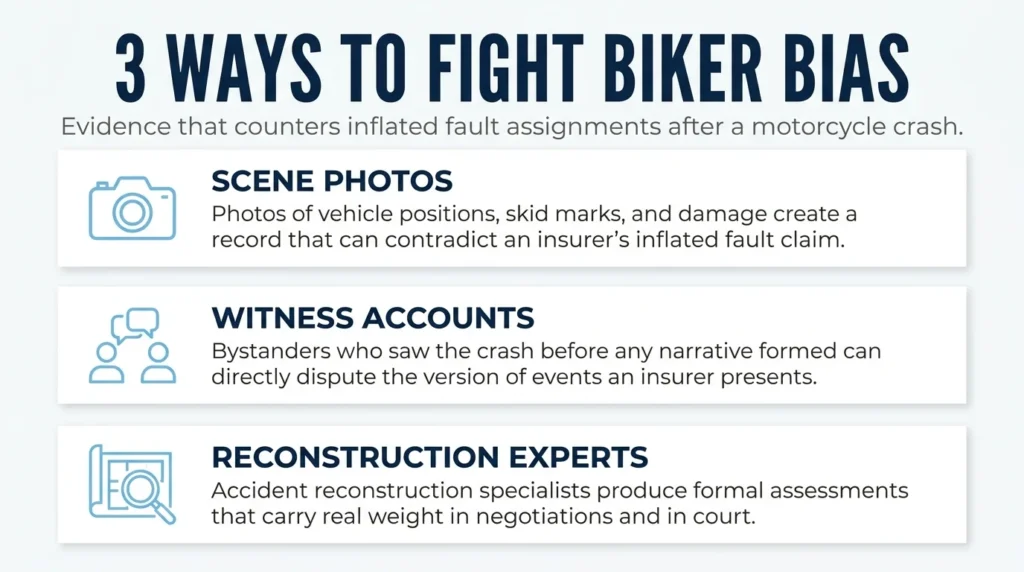
- Gather physical evidence immediately. Photos of vehicle positions, road markings, skid marks, traffic signals, and damage patterns create a record that an adjuster or reconstruction expert can analyze later. If you can document the scene before vehicles are moved, do it.
- Get witness contact information. Bystanders who saw the crash before any narrative formed are among your most valuable resources. Their accounts can directly contradict an insurer’s version of events.
- Do not dismiss the value of an accident reconstruction specialist. These professionals analyze physical evidence to produce formal assessments that carry real weight in negotiations and, if needed, in court.
Evidence gathered early protects your ability to contest a fault assignment that doesn’t match what actually happened.
Talk to an Attorney Before Accepting a Fault Number
If an insurer has told you that you were mostly or entirely at fault for a motorcycle crash, you are not required to accept that assessment. The data on motorcycle accident fault statistics does not support the assumption that riders cause most accidents, and Texas law gives you the right to dispute a fault determination before it becomes final.
Angel Reyes & Associates has handled motorcycle accident claims across Texas for over 30 years. If you are dealing with an inflated fault assignment, biker bias, or a disputed liability determination, we offer free consultations to review your evidence and help you understand your options. We believe riders deserve experienced representation with a history of producing great results in a wide range of cases.
We work on a contingency basis, meaning no fee unless we win. Contact us to schedule your free consultation and get a clear picture of where your claim stands. Our attorneys work with riders across the state.
Motorcycle Accident Fault FAQs
Does not wearing a helmet affect my fault percentage in Texas?
Not wearing a helmet does not cause an accident, but insurers may argue it made your injuries worse and assign you a portion of comparative fault for that reason. In Texas, riders 21 and older can legally ride without a helmet if they meet specific conditions, but insurers can still use the absence of a helmet to reduce your damages if they connect it to your specific injuries.
Can I still recover compensation if the police report says I was at fault?
A police report is one piece of evidence, not a final legal determination of fault. Adjusters and courts also weigh photos, witness accounts, and vehicle damage, so a report that places fault on you can be challenged when the physical evidence tells a different story.
What is the difference between a rider being "at fault" and being "responsible" under Texas law?
In Texas, fault is a percentage under the proportionate responsibility framework, so you can be partially responsible and still recover compensation as long as your share does not exceed 50%. “At fault” in everyday language often implies full blame, but the legal standard allows for shared responsibility with proportional damage reductions.
Does speeding automatically make a motorcyclist more than 50% at fault?
No. Speeding is one factor among several, and if another driver turned in front of you or failed to yield, that driver’s actions factor into the overall fault calculation. A rider who was speeding may still be found 20 or 30% responsible while the other driver carries the larger share.
How long do I have to dispute a fault determination in Texas?
Texas gives most personal injury claimants two years from the date of the accident to file a lawsuit, but disputing a fault assignment with an insurer can start immediately. The earlier you act, the more evidence is available, since physical evidence and witness memories fade over time.
About the Authors

Spencer Browne
Writer
Spencer Browne is a partner at Angel Reyes & Associates and a Board Certified personal injury trial lawyer with nearly 100 jury trials across Texas. He focuses on car, truck, and wrongful death cases, with notable verdicts including a landmark win in the Choctaw Casino bus crash case. A recognized speaker and legal educator, Spencer is a member of the American Board of Trial Advocates and has been honored as a Texas Super Lawyer and one of D Magazine’s Best Lawyers in Dallas. He brings deep trial experience and relentless advocacy to every client he represents.

Kyle Nicolas
Editor
Kyle Nicolas is the Web Content & SEO Manager at Angel Reyes & Associates. He has more than 10 years of experience as a marketing co...

Angel Reyes
Reviewer
Angel L. Reyes, III is the Founder and Managing Partner of Angel Reyes & Associates. A nationally recognized trial attorney and business...