Who Is Liable for a Head-On Motorcycle Collision?


Every article on this site is researched by our internal team, reviewed for legal accuracy against current Texas law, and held to State Bar of Texas advertising standards before publication. We do not publish content that overstates outcomes or makes promises about results.
Learn more about our
editorial standards .
Key Takeaways
- Fault usually falls on the driver who crossed the center line or failed to yield
- A rider found more than 50 percent at fault recovers nothing under Texas proportionate responsibility law
- Texas gives you two years from the crash date to file your injury claim
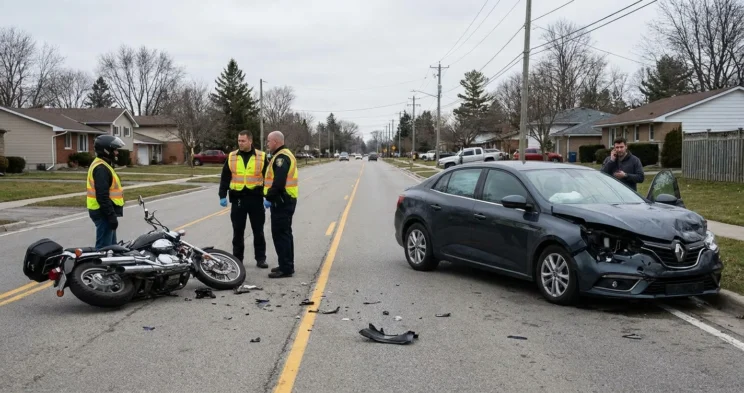
You were riding north on Greenville Avenue near Lower Greenville when an oncoming driver drifted across the center line and into your path. There was nowhere to go. Now you’re in a hospital bed, the bills are stacking up, and the other driver’s insurer is already suggesting you were speeding. You are left wondering who is actually liable for the crash.
Why Head-On Crashes Are Deadly for Riders
A head-on motorcycle accident places the full force of two moving vehicles onto a rider with very little physical protection. A rider usually has no airbags, no crumple zone, and no seatbelt.
Motorcyclists make up a small share of vehicles but a large share of traffic deaths statewide, and that share has climbed in recent years. Federal safety regulators track these crash patterns through motorcycle safety research. Motorcycle accident statistics show there were 561 fatal motorcycle crashes in 2025.
Even when riders survive a head-on collision, the injuries are often severe and life-changing. Common motorcycle accident injuries include traumatic brain injury, spinal cord damage, broken bones, and internal organ injury. Many leave riders permanently disabled.
Common Causes & Who Typically Bears Fault
In most head-on motorcycle crashes, fault falls on the driver who left their lane or failed to yield. Several common scenarios repeatedly appear in motorcycle accident cases. Each scenario comes down to the same thing. One driver broke a duty owed to everyone else on the road.
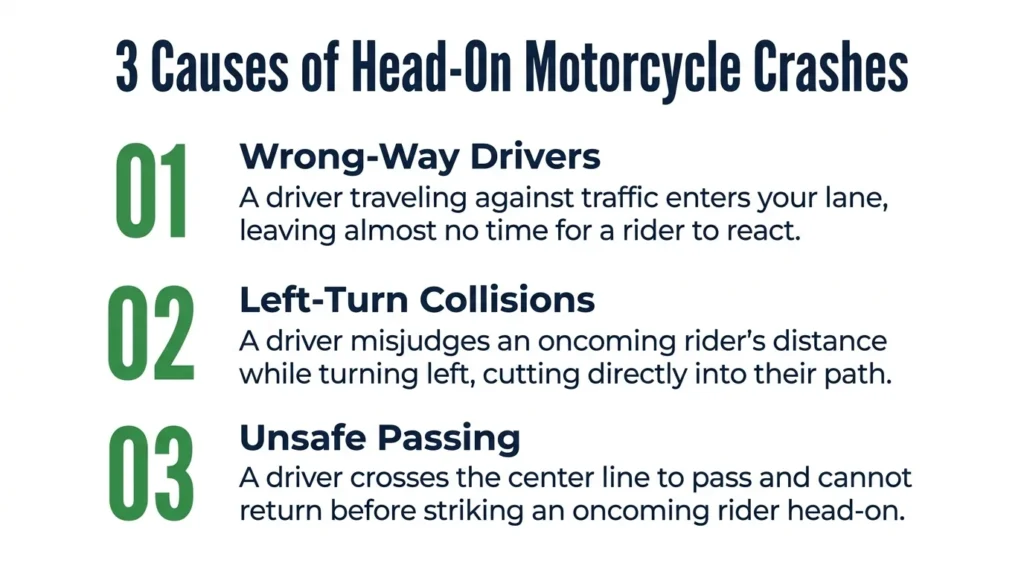
A wrong-way driver motorcycle accident happens when someone travels against traffic and enters your lane. You are left with no safe path and almost no time to react. In many head-on collisions in Texas, the wrong-way driver bears primary responsibility for the crash.
Left-turn collisions are another leading cause of motorcycle accidents. A driver attempts to turn left across traffic, misjudges the distance or speed of an approaching motorcycle, and cuts directly into your path. Because Texas law generally requires left-turning drivers to yield to oncoming traffic, liability often rests with the turning driver.
Unsafe passing on two-lane roads is another common cause. A driver crosses the center line to pass another car, then cannot get back before meeting oncoming traffic. The result is a direct head-on collision, and the motorcycle’s head-on collision fault falls on the driver who crossed the line.
Texas Law & Negligence Per Se
Texas law can turn a traffic violation directly into proof of fault. This rule is called negligence per se. When a driver breaks a safety statute meant to protect other road users, that violation can establish fault on its own.
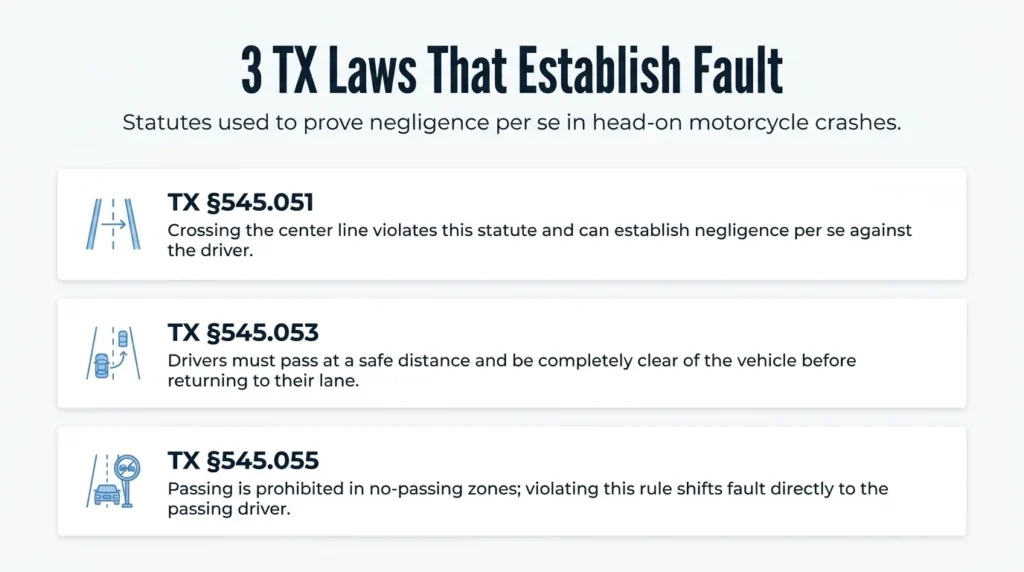
The foundation for many head-on motorcycle claims is Texas Transportation Code § 545.051, which requires drivers to stay on the correct side of the roadway. When a driver crosses the center line and causes a collision, that violation can help establish negligence. A driver who crosses into oncoming traffic at high speed or attempts an obviously dangerous pass may face allegations of reckless driving in addition to ordinary negligence.
Texas law also regulates unsafe passing. Texas Transportation Code § 545.053 requires drivers to pass at a safe distance and remain clear of the vehicle being passed before returning to their lane. Texas Transportation Code § 545.055 prohibits passing in designated no-passing zones where visibility is limited. Violating either statute can strengthen an injured rider’s claim.
After a head-on crash, adjusters often try to shift blame onto the rider by claiming excessive speed or a bad lane position. A clear statutory violation can make those blame-shifting arguments much harder to sustain.
Texas Comparative Fault & Evidence
Texas lets you recover damages as long as you are not mostly to blame for the crash. Under the Texas Civil Practice and Remedies Code (CPRC) § 33.001, a rider whose share of fault is greater than 50 percent may not recover anything.
A rider at 50 percent or less may still recover, with the award reduced by their percentage of fault.
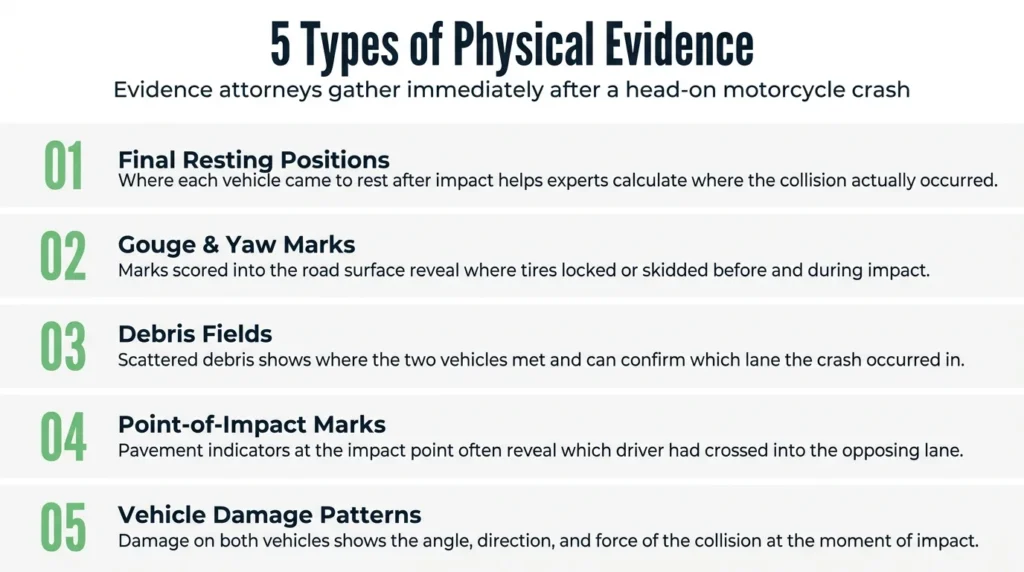
The physical evidence at the scene also carries enormous weight. The strongest physical evidence in a head-on motorcycle crash includes:
- Final resting positions of both vehicles after impact
- Gouge marks and yaw marks scored into the road surface
- Debris fields showing where the vehicles met
- Point-of-impact indicators on the pavement
- Damage patterns on both the car and the motorcycle
Police accident reports, witness statements, traffic and surveillance camera footage, cell phone records showing distraction, and toxicology results can also help establish what happened.
In most high-speed head-on crashes, impact can scatter the vehicle across a wide area. Accident reconstruction specialists may analyze this evidence to try to piece together the exact details of your crash. An attorney can help bring in these experts before the evidence is lost or cleaned up.
You also face a hard deadline once you gather your evidence. The CPRC § 16.003 requires you to file a personal injury claim within two years of the crash date. Miss it, and you lose the right to recover at all. Waiting also lets key evidence disappear.
Talk to an Attorney About Your Case
A head-on motorcycle crash can change your life in a second, and proving who is responsible takes fast action and real investigation. Angel Reyes & Associates has spent over 30 years helping injured Texans hold at-fault drivers accountable across the state.
We work on contingency, so there is no fee unless we win, and your first consultation is free. We have more than $1 billion recovered for clients, and we serve riders and families statewide in English and Spanish. When a head-on crash takes a life, we also handle wrongful death claims for the families left behind. Reach out to us for a free consultation so you understand your options before time runs out.
Past results do not guarantee future outcomes.
Head-On Motorcycle Crash FAQs
Does not wearing a helmet affect a motorcycle injury claim in Texas?
It can. Texas allows riders 21 and older to ride without a helmet if they meet certain conditions. Still, the at-fault driver’s insurer may argue that helmet non-use made your head injuries worse, which could raise your share of fault under Texas comparative fault rules. Wearing a helmet does not change who caused the crash, but it can affect how much you recover.
What if the driver who hit me had no insurance or not enough coverage to pay for my injuries?
If the at-fault driver was uninsured or underinsured, you may be able to file a claim through your own policy’s uninsured or underinsured motorist (UM/UIM) coverage. Texas requires insurers to offer this coverage, and if you never rejected it in writing, you may have it even if it is not listed on your declarations page.
Can a motorcyclist still recover if they were speeding at the time of the crash?
Yes, as long as a jury finds them 50 percent or less at fault for the crash. Speeding can raise your fault percentage, but it does not automatically bar recovery unless your share of fault exceeds 50 percent under Texas proportionate responsibility law.
Does the filing deadline change if the rider died from their injuries?
In most wrongful death cases, the two-year filing period begins on the date of death rather than the date of the crash. Sometimes a rider survives for days or weeks after the collision before passing away.
Can the at-fault driver's employer be held liable if the driver was working at the time of the crash?
Possibly. Under Texas respondeat superior law, an employer can be held liable for a worker’s negligence if the worker caused the crash while acting within the scope of their job duties. If the driver was running an errand for their employer or on a work-related trip when the collision happened, the employer may share responsibility for your damages.
About the Authors

Angel Reyes
Writer
Angel L. Reyes, III is the Founder and Managing Partner of Angel Reyes & Associates. A nationally recognized trial attorney and business leader, Angel has helped over 70,000 injury victims recover more than $1 billion since founding the firm in 1993. Named to the Texas Super Lawyers list annually since 2008, Angel brings Wall Street experience, Ivy League education, and a deep commitment to client advocacy. He is a frequent legal commentator and published author with extensive contributions to legal scholarship, trial strategy, and consumer protection.

Kyle Nicolas
Editor
Kyle Nicolas is the Web Content & SEO Manager at Angel Reyes & Associates. He has more than 10 years of experience as a marketing co...

Angel Reyes
Reviewer
Angel L. Reyes, III is the Founder and Managing Partner of Angel Reyes & Associates. A nationally recognized trial attorney and business...