What Percent of Motorcycle Riders Crash?


Every article on this site is researched by our internal team, reviewed for legal accuracy against current Texas law, and held to State Bar of Texas advertising standards before publication. We do not publish content that overstates outcomes or makes promises about results.
Learn more about our
editorial standards .
Key Takeaways
- About 1 in 100 registered motorcycles is involved in a reported crash per year in the U.S.
- Motorcyclists face a per-mile fatality rate nearly 28 times higher than passenger car occupants.
- Texas recorded 561 motorcycle deaths and 2,518 serious injuries in 2025 alone.
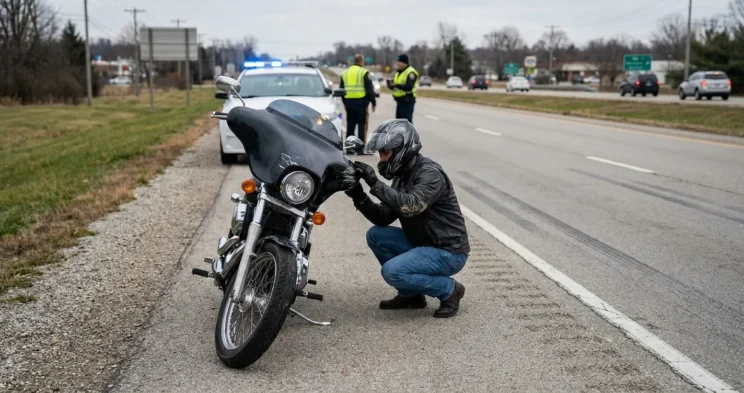
You were stopped at a light on the Katy Freeway when a pickup truck drifted into your lane and clipped your rear wheel. In the seconds after hitting the pavement, you probably weren’t thinking about statistics, but as the shock wore off and the medical bills started arriving, it became harder to ignore the question of how common this really is. The answer depends on how you measure it.
The Annual Crash Rate for Motorcycle Riders
About 1 in every 100 registered motorcycles is involved in a reported crash in the United States each year. That estimate comes from comparing annual injury and fatality data against the total number of registered motorcycles.
In 2024, the NHTSA reported that 6,228 motorcyclists were killed in motorcycle crashes. With more than 8 million registered motorcycles on U.S. roads that year, the reported crash rate works out to just under 1% annually.
The real exposure is higher than the official number suggests, since the 1% figure counts only reported crashes. Minor incidents that don’t generate a police report or insurance claim go uncounted.
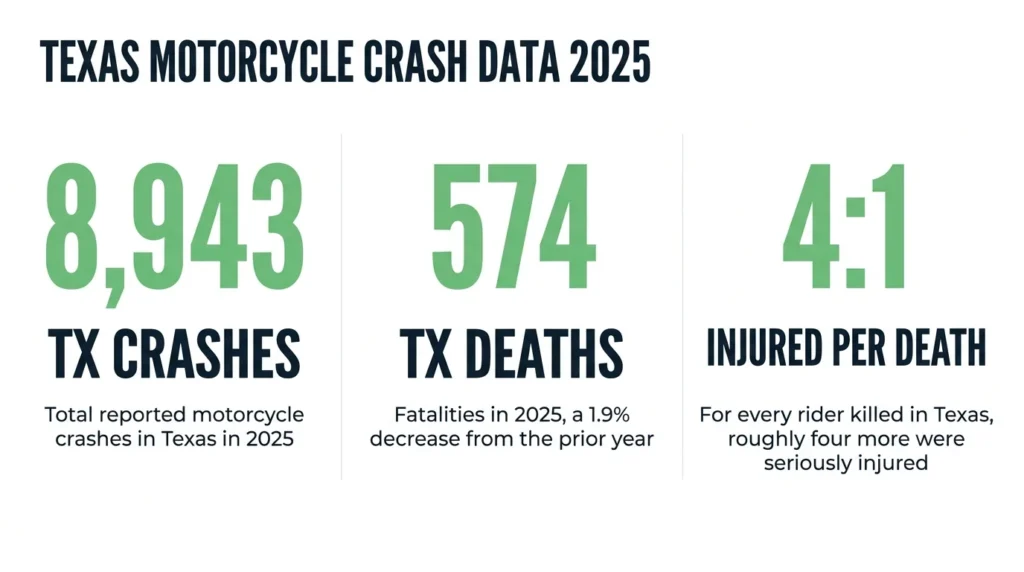
In Texas, TxDOT’s Crash Records Information System logged 8,943 motorcycle crashes in 2025, resulting in 574 deaths and thousands more with serious injuries.
Per-Mile Risk vs. Total Crash Count
The 1% annual figure can mislead in one important direction. It reflects the low absolute number of crashes, which exists partly because motorcycles are a small fraction of registered vehicles; it does not reflect how dangerous any given mile on a motorcycle is compared to a mile in a car. A low annual crash count does not mean low risk. It means fewer people ride.
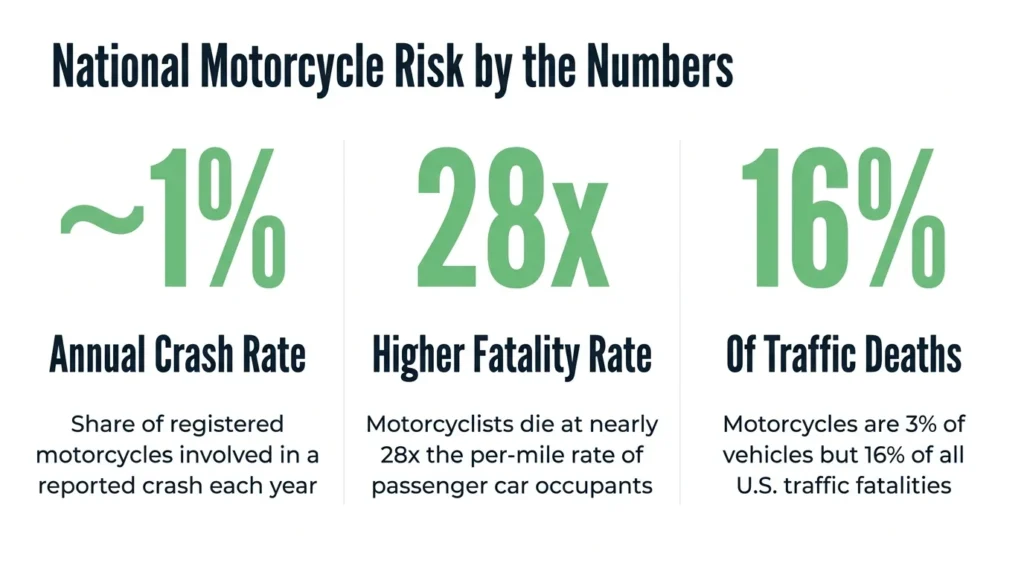
Motorcycles make up only 3% of registered vehicles in the U.S. yet account for 16% of all traffic fatalities. That overrepresentation is the clearest signal of how dangerous riding is relative to other modes of travel.
NHTSA’s 2024 motorcycle safety data shows that motorcyclists died at a rate of 28.00 per 100 million vehicle miles traveled, roughly 28 times higher than the passenger car occupant rate of 1.13. Even with this decrease, a severe risk gap remains; the injury rate per mile tells a similar story, with motorcyclists being injured at roughly five times the rate of car occupants per mile traveled.
Riders who understand this gap are better positioned to protect themselves if a crash does happen. Texas motorcycle accident claims follow different rules than standard car crashes. At the injury costs common to serious motorcycle crashes, those differences directly affect how much a rider can recover.
What the Texas Numbers Show
Texas consistently ranks among states with the highest total motorcycle fatality counts. In 2025, those 574 deaths marked a 1.9% decrease over the prior year. The Texas motorcycle accident statistics page breaks down those trends in more detail.
More than a third of all Texas motorcycle fatalities in 2025 occurred at intersections; left-turning vehicles pulling across a rider’s path is the most common scenario. Riders traveling straight through an intersection have the right of way. That right of way offers no physical protection when a driver fails to see them.
For every motorcyclist killed in Texas that year, roughly four more were seriously injured. Serious injuries include traumatic brain injuries, spinal cord damage, and multiple fractures–these are not recoveries measured in days. They take months, sometimes years, and the costs accumulate accordingly.
For a closer look at the fatality side of this data, see what percentage of motorcycle accidents are fatal.
Why Motorcycle Crashes Produce Serious Injury Claims
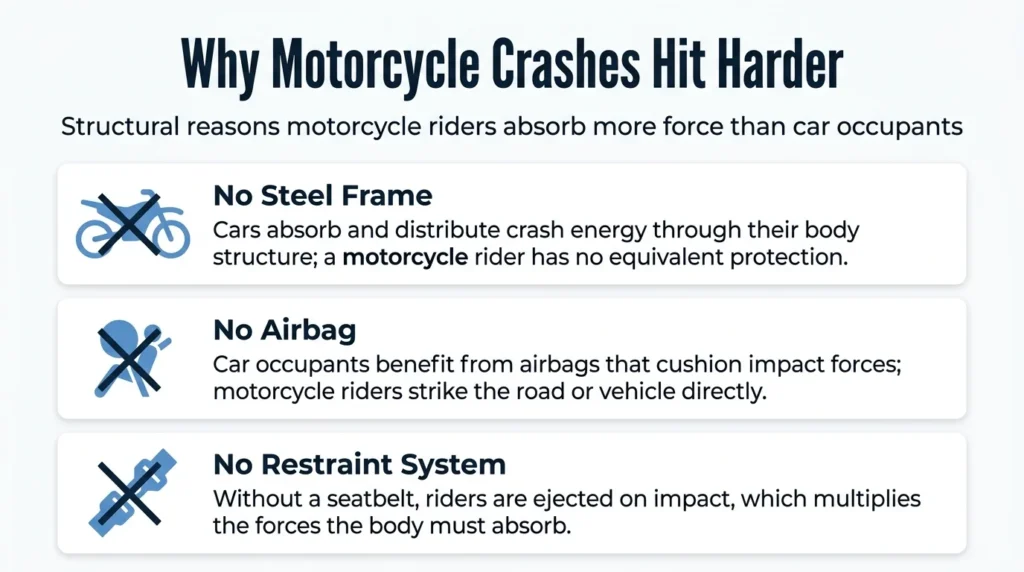
A car crash at 40 miles per hour is often survivable with bruising and soft tissue injuries. A motorcycle crash at the same speed often results in a different outcome, since the rider has no metal frame to absorb impact, no airbag, and no restraint system. Their body absorbs the full energy of the collision.
Motorcycle crashes are far more likely to result in injury or death than passenger vehicle crashes. The absence of a steel frame, airbag, or seatbelt means the rider absorbs forces that a car body would otherwise distribute and dissipate. On a motorcycle, serious outcomes are far more common at the same speeds where a car occupant would walk away.
Medical costs after a serious motorcycle crash often run well into six figures: traumatic brain injuries require ongoing care, and spinal injuries can eliminate earning capacity. When crashes happen at highway speed, the injuries routinely exceed what standard insurance coverage will pay.
Riders who want a fuller picture of what crash injuries actually look like can review the common injuries in motorcycle accidents covered on this site.
Under the Texas Civil Practice and Remedies Code (CPRC) § 16.003, injured riders have two years from the date of the crash to file a lawsuit. Miss that deadline and the right to sue is gone, regardless of how clear the other driver’s fault was. Understanding how motorcycle accident settlements work in Texas is a useful next step once the immediate medical situation is stabilized.
Talk to a Texas Motorcycle Injury Attorney
The crash rate data puts a number on a risk most riders carry with them every time they ride. When that risk becomes a reality, the injury costs are real, and the legal window to act is finite. Angel Reyes & Associates has represented injured riders across Texas for over 30 years, recovering more than $1 billion for our clients.
Our team of more than 600 dedicated professionals offers service in both English and Spanish across more than 20 offices in Texas. We are available 24/7 to help, and you can read what our previous clients have to say about our work.
We work on contingency, so there is no fee unless we win. If you were injured in a crash, contact us for a free consultation.
Past results do not guarantee future outcomes.
Motorcycle Crash Rate FAQs
Does Texas require motorcycle riders to wear helmets?
Texas requires helmets for riders under 21. Riders 21 and older may ride without a helmet if they have completed a state-approved motorcycle safety course or carry at least $10,000 in medical insurance coverage.
What are the minimum insurance requirements for motorcycles in Texas?
Texas requires motorcycle riders to carry at least $30,000 in bodily injury liability per person, $60,000 per accident, and $25,000 in property damage liability. These minimums are often not enough to cover serious crash costs, and most riders who understand the risk carry higher limits.
How does Texas's fault system affect what a rider can recover after a crash?
Texas uses a modified comparative fault rule: if you are found 51% or more at fault, you recover nothing. If your fault is 50% or less, your compensation is reduced by your share, so a $100,000 claim with 25% fault assigned to you pays out $75,000.
Does uninsured motorist coverage apply to motorcycle crashes in Texas?
Yes, if the at-fault driver has no insurance or insufficient coverage, your own uninsured or underinsured motorist (UM/UIM) coverage can pay for your injuries. Texas requires insurers to offer this coverage, though riders can reject it in writing.
How does a rider's lifetime crash risk compare to the annual 1% rate?
A 1% annual crash rate means that over a 10-year riding career, roughly 1 in 10 riders will be involved in at least one reported crash. Riders who log more miles, ride at night, or ride frequently on highways face a higher cumulative risk than casual weekend riders.
About the Authors

Alex Ivanov
Writer
Alex Ivanov is a personal injury attorney at Angel Reyes & Associates, focused on car, truck, and motorcycle accident cases. Licensed in Texas and multiple federal districts, Alex brings international legal experience and a global education to his practice. He earned his LL.M. from Texas A&M University School of Law after graduating from Belarussian State University in 2016. Alex is fluent in Russian, English, Ukrainian, and Belarussian, and is recognized by multiple national trial lawyer associations for his results and leadership under 40.

Kyle Nicolas
Editor
Kyle Nicolas is the Web Content & SEO Manager at Angel Reyes & Associates. He has more than 10 years of experience as a marketing co...

Angel Reyes
Reviewer
Angel L. Reyes, III is the Founder and Managing Partner of Angel Reyes & Associates. A nationally recognized trial attorney and business...