How Speeding Affects Motorcycle Accident Claims in Texas


Every article on this site is researched by our internal team, reviewed for legal accuracy against current Texas law, and held to State Bar of Texas advertising standards before publication. We do not publish content that overstates outcomes or makes promises about results.
Learn more about our
editorial standards .
Key Takeaways
- Texas riders recover nothing once their own fault for the crash passes 50%.
- A speeding citation against the other driver creates a negligence per se advantage.
- You have two years from the motorcycle crash date to file your injury lawsuit.
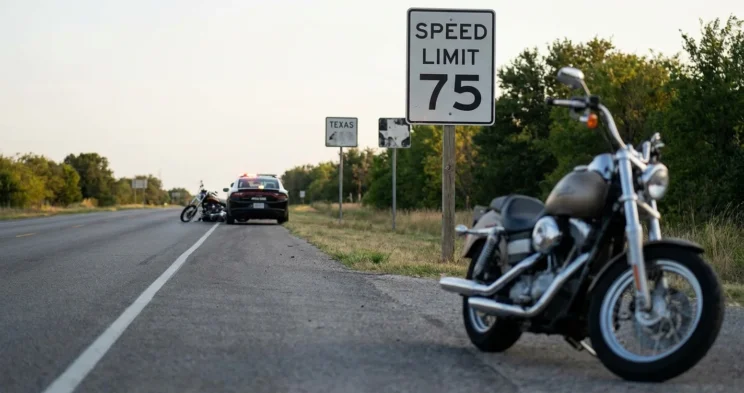
You were riding home down Camp Bowie Boulevard when a car cut across your lane and clipped your front wheel. Now the other driver’s insurer keeps circling back to one question: how fast were you going?
You can feel where this is headed, and you are worried your own speed will be turned into a reason to pay you nothing.
Speed as a Claim Factor in Texas
Speed shapes a Texas motorcycle accident claim in two separate ways. It makes physical injuries worse, and it directly decides how fault gets split between you and the other driver under Texas law.
That second part is where most claims are won or lost. A finding about who was speeding can move money toward you or away from you, depending on the answer.
The numbers explain why insurers fixate on it. NHTSA 2023 crash data shows riders in fatal crashes were speeding at roughly one and a half times the rate of passenger car drivers, 36% percent of motorcyclists versus 22% of passenger car drivers. That pattern makes speed one of the most fought-over facts in any rider injury claim.
The detail most fault guides miss is that speed cuts both ways. If the other driver was speeding, that helps your claim. If you were speeding, the same fact can be used against you. Knowing which side of that line you fall on changes everything about your strategy.
Adjusters raise speed early for exactly this reason. A speed finding can shrink your payout or wipe it out, so you want to understand the rules before that first phone call. The local rider data in our breakdown of Texas motorcycle accident statistics shows how often speed enters the picture.
Negligence Per Se When the Other Driver Was Speeding
When the other driver was speeding and got cited for it, Texas law gives you a powerful head start called negligence per se. A driver who breaks a traffic statute, like the speed laws, is presumed negligent if that violation caused your injuries.
A speeding citation is strong early evidence in your favor. It shifts the conversation toward the other driver before you ever argue the finer points.
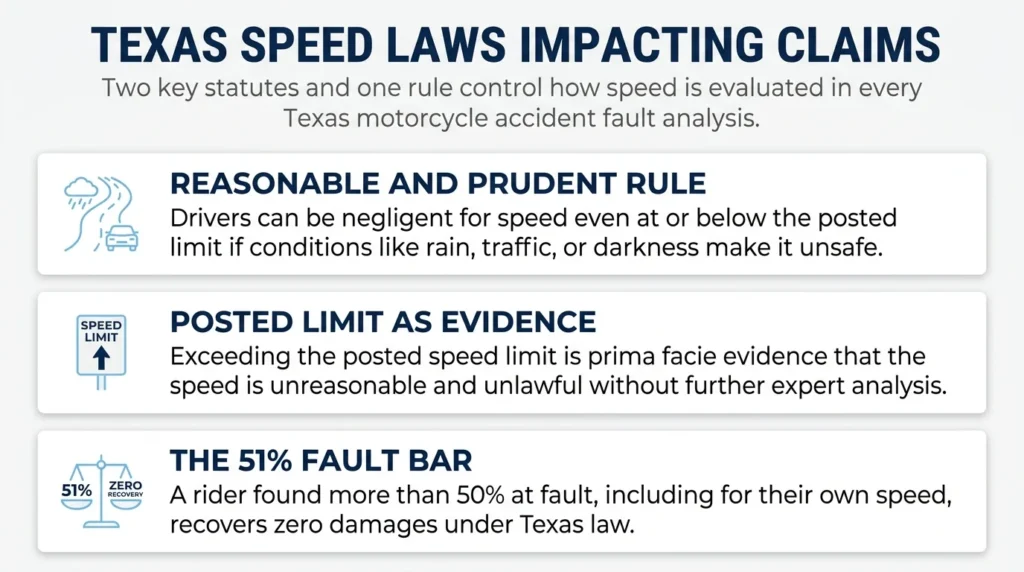
The speed rules sit in two statutes worth knowing. The Texas Transportation Code § 545.351 bars anyone from driving faster than is reasonable and prudent for the conditions. A driver can be negligent for speed even at or below the posted limit, if rain, traffic, or darkness called for slowing down.
The posted limit carries legal weight too. Under § 545.352, driving faster than that limit is prima facie evidence that the speed is not reasonable and prudent, and that it is unlawful. No additional proof of unreasonableness is needed once a driver exceeds the posted number.
No ticket does not mean no case. Even when officers issue no citation, physical and digital evidence can still establish the other driver’s speed on its own. Riders who want broader context on how a speeding violation affects a specific claim can review our motorcycle accident practice overview.
How Speed Is Proven in a Texas Motorcycle Accident
Speed gets proven through evidence at the scene, data inside the vehicles, and the people who saw it happen. The strongest motorcycle accident speed evidence in Texas usually combines several of these sources into one clear picture.
Skid marks, gouge marks, and scattered debris let reconstruction specialists calculate pre-impact speed using settled physics. Longer skid marks point to higher entry speeds. This is how speed is proven in a motorcycle accident even when no one was clocked.
Modern vehicles also record their own data. An event data recorder, often called a black box, logs speed, throttle position, and braking in the seconds before impact. Most newer vehicles carry one, and that data is legally accessible during litigation.
That data does not wait around for you. It can be overwritten or lost when the vehicle gets repaired or scrapped. Acting fast is the difference between having proof and losing it.
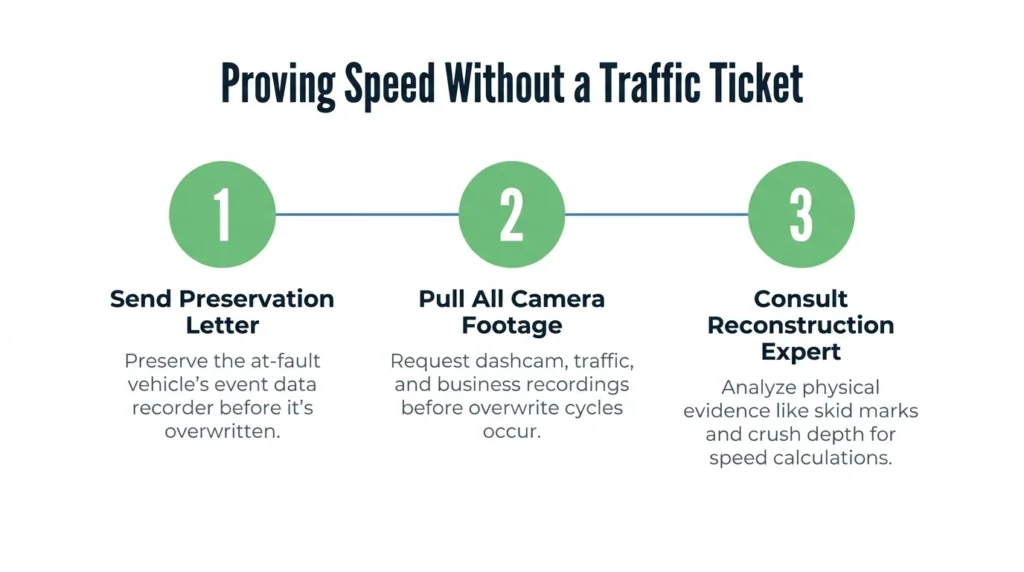
Step 1: Send a preservation letter early. This puts the at-fault driver and their insurer on notice to keep the vehicle and its black box data intact before either disappears.
Step 2: Pull every corroborating recording. Dashcam footage, traffic camera video, and eyewitness accounts fill the gaps when physical or electronic evidence runs thin.
Step 3: Bring in a reconstruction expert. They combine all the evidence into a single speed estimate you can use in settlement talks or present at trial.
How that proof translates into a number you actually receive is its own subject, which our guide on how motorcycle accident settlements work in Texas walks through in detail.
Texas Proportionate Responsibility When the Rider Was Speeding
Your own speed does not automatically end your claim. Texas law lets you recover as long as your share of the fault stays at or below 50%, though your payout shrinks by whatever percentage you carry.

How Fault Percentage Reduces Recovery
The Texas Civil Practice and Remedies Code (CPRC) § 33.001 controls how your own speed cuts into your damages. This proportionate responsibility framework reduces your award by your fault percentage. Cross more than 50%, and you recover nothing at all.
Texas motorcycle accident comparative fault works on simple math once the percentages land. Say you have $200,000 in damages and the rider is found 25% at fault for speeding. That rider collects $150,000.
Push that same rider to 55% at fault and the recovery drops to zero. The 51% rule decides who walks away with money, and our explainer on the Texas comparative negligence 51% rule breaks down where that line comes from.
Insurer Tactics to Shift Fault Above 50 Percent
Adjusters work to push your fault percentage past the 50% bar, because clearing it means they owe you nothing. Spotting these moves before you talk to them protects your leverage.
Recorded statements are the first tool. An adjuster asks for one early, then uses your words about your own speed to justify a high fault number, all without giving you room to explain the context.
The questions often spread wide on purpose. An adjuster may ask about your lane position, the road conditions, and your reaction time to assemble a fault picture that reaches the 51% threshold.
You are not stuck with whatever number they assign. An attorney can challenge it with independent speed evidence and a competing reconstruction, since the adjuster does not get the final word on fault. The mechanics of how Texas modified comparative negligence laws operate are worth a closer look before that call.
If you are worried your own speed will erase your recovery, see how Texas partial-fault rules apply to accident claims.
Filing Deadlines and Next Steps for Texas Riders
You have two years from the crash date to file. The Texas Civil Practice and Remedies Code § 16.003 gives injured riders that two-year window, and missing it usually bars any recovery no matter how strong your claim.
Early action protects a speed-related claim more than almost anything else. Secure the accident report, photograph the skid marks and debris, and identify witnesses while memories are fresh. Send a preservation letter for the at-fault vehicle’s black box data right away.
One move carries outsized risk when speed is the central issue. Avoid giving a recorded statement to the opposing insurer before you speak with legal counsel. The attorneys who handle these claims can step in before a careless answer reshapes your case.
Talk to a Lawyer If You Were Hurt in an Accident
Speed turns motorcycle claims into a fight over percentages, and the difference between 49 and 51% fault can decide whether you recover anything at all. You do not have to sort that out alone.
Angel Reyes & Associates has represented Texas riders for more than 30 years. We work on a contingency basis, which means no fee unless we win, and we have recovered more than $1 billion for clients across the state.
If you have questions about how speed will affect your claim, reach out to us for a free consultation.
Past results do not guarantee future outcomes.
Motorcycle Speeding FAQs
What happens if both my motorcycle and the other vehicle were speeding at the time of the crash?
Texas assigns a fault percentage to each party separately. As long as your share stays at 50 percent or below, you can still recover damages, though your payout is reduced by your own fault percentage.
Can not wearing a helmet affect my motorcycle accident claim in Texas?
Texas requires riders under 21, or those who have not completed an approved safety course, to wear a helmet. If you were required to wear one and did not, an insurer may argue that your choice made your injuries worse and use it to raise your fault percentage.
Does my motorcycle insurance still cover an accident if I was speeding?
Standard liability policies generally cover accidents even when the insured was speeding, since speeding is a traffic violation rather than an excluded act. Racing events and extreme reckless driving may be excluded under some policies, so checking your policy language is worth doing.
If a motorcycle rider was killed in a crash and was speeding, can the family still file a wrongful death claim in Texas?
Yes, Texas wrongful death claims follow the same proportionate responsibility rules. If the rider’s fault was 50 percent or less, the family can still recover damages, reduced by that fault percentage.
Can GPS data from a phone or navigation app be used to prove speed in a Texas motorcycle accident case?
Yes. GPS data from navigation apps and fitness trackers can record speed at regular intervals, and courts in Texas have allowed this type of data as evidence when it is obtained legally and authenticated.
About the Authors

Angel Reyes
Writer
Angel L. Reyes, III is the Founder and Managing Partner of Angel Reyes & Associates. A nationally recognized trial attorney and business leader, Angel has helped over 70,000 injury victims recover more than $1 billion since founding the firm in 1993. Named to the Texas Super Lawyers list annually since 2008, Angel brings Wall Street experience, Ivy League education, and a deep commitment to client advocacy. He is a frequent legal commentator and published author with extensive contributions to legal scholarship, trial strategy, and consumer protection.

Kyle Nicolas
Editor
Kyle Nicolas is the Web Content & SEO Manager at Angel Reyes & Associates. He has more than 10 years of experience as a marketing co...

Angel Reyes
Reviewer
Angel L. Reyes, III is the Founder and Managing Partner of Angel Reyes & Associates. A nationally recognized trial attorney and business...