Motorcycle Accident Neck & Back Injuries in Texas

Every article on this site is researched by our internal team, reviewed for legal accuracy against current Texas law, and held to State Bar of Texas advertising standards before publication. We do not publish content that overstates outcomes or makes promises about results.
Learn more about our
editorial standards .

You were heading home on a Tuesday evening when a driver ran a stop sign on a side street near Loop 410 in San Antonio and clipped your rear tire.
You went down hard, your helmet saved your head, and now you’re three days out from the crash with shooting pain down your left arm and a lower back that won’t let you stand for more than a few minutes.
The insurance adjuster has already called. They mentioned your age and asked whether you’ve ever had back problems before.
You need to understand what’s actually happening to your spine, why that question is a legal issue, and what your treatment path means for any claim you pursue.
The Neck & Back Injury Spectrum in Motorcycle Crashes
Cervical and lumbar spine injuries are among the most frequently litigated injury types in motorcycle accident claims, and the reason comes down to how crashes transfer force. When a rider is thrown or struck, the spine absorbs energy that a car’s frame and crumple zones would otherwise deal with.
The result is a predictable pattern of injuries that ranges from disc damage to vertebral fractures to nerve compression.
The most litigated of these is the herniated disc. A crash compresses or twists the spine with enough force to push disc material out of its normal position and into the spinal canal, where it presses on nerves. This produces the radiating pain, numbness, and weakness that injured riders often describe as their most disabling symptom.
You may have heard it called a ruptured disc or a slipped disc. These terms describe the same structural event.
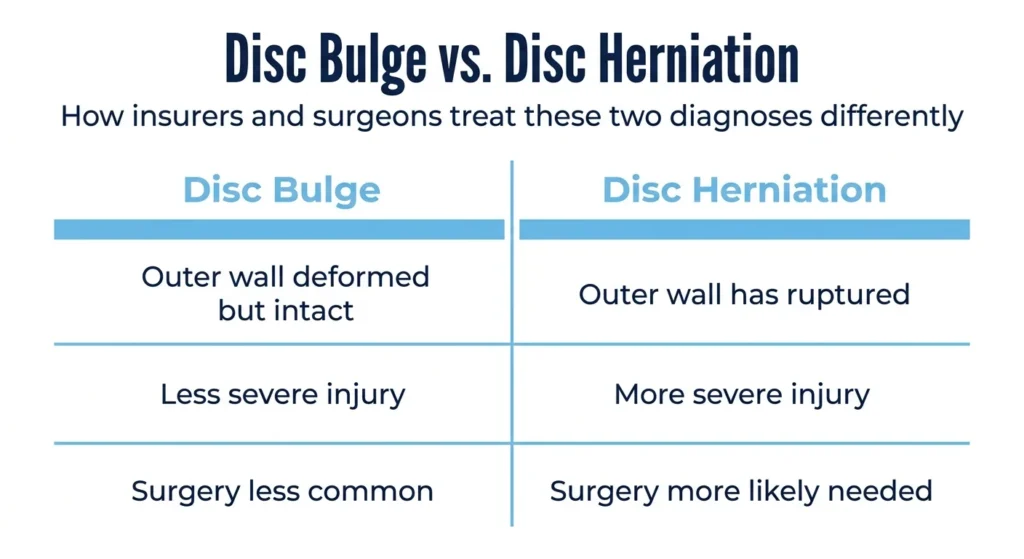
A disc bulge is different. In a bulge, the outer wall of the disc has deformed but remains intact. In a herniation, that outer wall has ruptured.
Insurers treat these two diagnoses differently during settlement negotiations, because surgery is less common for bulges than for herniations.
High-impact crashes can also fracture spinal vertebral sections. Compression fractures are common when a rider is thrown and lands with the spine absorbing the impact axially. These injuries show up on CT imaging, not MRI, and they carry a different treatment and compensation profile than disc injuries.
When a herniated disc presses on a spinal nerve root, it produces a condition called radiculopathy. In the cervical spine, or higher part of the spine, that pressure sends pain, numbness, or weakness into the arms and hands. In the lumbar spine, or lower part of the spine, it travels down the legs.
Radiculopathy documented in your medical records is a separate compensable injury from the disc damage itself.
Why Imaging Determines Your Claim’s Foundation
An X-ray taken after your crash is useful for ruling out bone injuries, but it cannot show your discs, your ligaments, or nerve compression. A negative X-ray does not mean you have no injuries. Insurers understand this, and they still use the absence of early imaging to argue that your pain appeared after the crash for reasons unrelated to it.
An MRI is the standard tool for diagnosing disc and nerve injuries. It produces cross-sectional views of soft tissue, identifies the exact spinal level where herniation has occurred, and documents whether disc material is pressing on a nerve root. That last detail is what your treating physician uses to explain your symptoms in a written report.
CT scans are the standard for bone injuries. If your doctor suspects a vertebral fracture, a CT scan provides detailed cross-sectional views of bone structure that an MRI cannot match.
Getting imaging done quickly after the crash strengthens your position. When a gap of weeks separates your crash from your first MRI, an insurer’s adjuster will point to that gap and argue that the disc damage could have come from something else entirely.
NHTSA’s motorcycle safety data documents that motorcyclists face a disproportionately high rate of serious injury compared to other vehicle occupants, which is part of why spine injuries in these crashes receive the level of medical and legal scrutiny that they do.
How Insurers Dispute Neck & Back Injury Claims
The pre-existing condition argument is the insurer’s first line of defense in any neck or back injury claim. When your adjuster asked whether you’ve had back problems before, they were laying the groundwork for this argument. They will pull your prior medical records, look for old MRIs, and search for any prior chiropractic visits or complaints of back pain.
The goal is to argue that your current pain predates the crash.
Texas law directly addresses this situation. The “eggshell plaintiff doctrine” requires at-fault parties to take injured people as they find them. If you had a degenerative disc condition or an old lumbar injury before the crash, the other driver is still responsible for the aggravation the crash caused, even if a healthier person would have walked away without injury.
The legal question shifts from “Did the crash cause the disc problem?” to “Did the crash make an existing condition measurably worse?” You must show new or increased symptoms, additional treatment needs, or a measurable decline in function that didn’t exist before. You can review how insurers build these pre-existing condition arguments, and how to counter them.
When an attorney obtains your pre-accident imaging and places it side-by-side with your post-accident imaging, the difference in disc position, herniation level, or nerve compression becomes something a treating physician can describe objectively. That comparison is often what separates a contested claim from a successful one.
Texas proportionate responsibility law, under the Texas Civil Practice and Remedies Code Chapter 33, allows an insurer to argue that you bore some portion of fault for the crash itself. Any percentage of fault assigned to you reduces your recovery by that amount. If your fault is determined to exceed 50%, you cannot recover anything under Texas law.
Surgical vs. Non-Surgical Treatment & Settlement Value
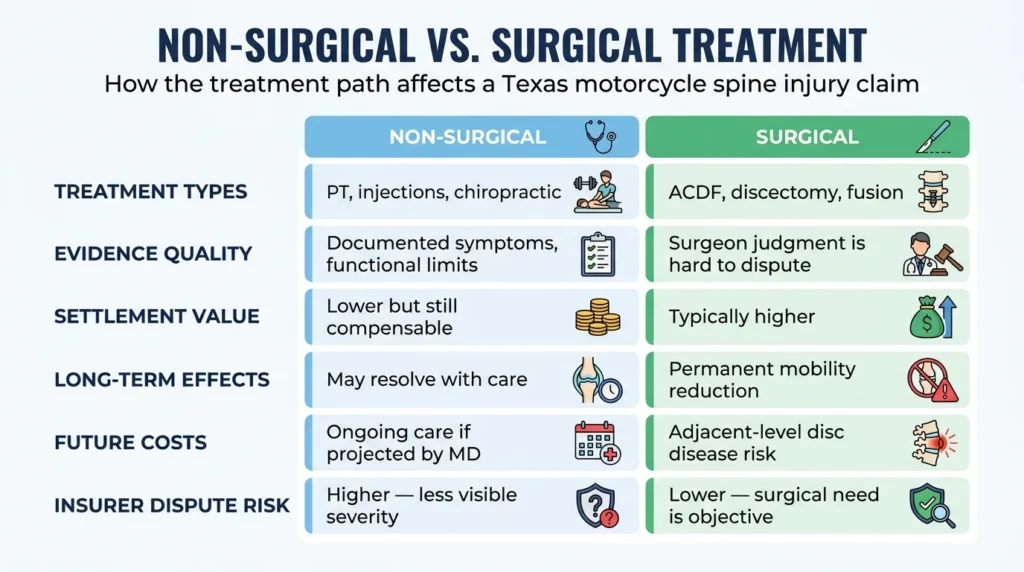
The single factor that most consistently affects the value of a neck or back injury claim is whether you require surgery. This is not because non-surgical injuries are less real or less painful, but because surgery creates clear, documented evidence of severity that is difficult for an insurer to dismiss.
Non-Surgical Treatment Paths
Non-surgical management typically includes physical therapy, epidural steroid injections, chiropractic care, and pain management. These treatments are medically recognized interventions, and they produce compensable losses.
Physical therapy and chiropractic records document ongoing symptoms and functional limitations across weeks and months. That consistency builds the non-economic damage component of your claim, because it shows the injury affected how you work, sleep, and move through daily life.
Epidural steroid injections occupy a useful middle tier. Insurers recognize these injections as objective evidence that a disc injury is serious enough to warrant an invasive intervention. They typically push settlement values meaningfully above soft-tissue-only claims.
If your treating physician documents that ongoing non-surgical management will be needed for years, those future treatment costs are recoverable. The projection of the amount you require must come from the medical record, not from an estimate you construct on your own.
Understanding how motorcycle accident settlements work in Texas means knowing how insurers evaluate these future costs when calculating offers.
Surgical Treatment Paths
When conservative care fails to control symptoms, a surgeon may recommend anterior cervical discectomy and fusion (ACDF) for cervical injuries, lumbar discectomy, laminectomy, or spinal fusion for lumbar injuries.
Surgical cases produce higher settlement outcomes because a surgeon willing to operate has concluded that the injury is serious enough to justify significant medical risk. That professional judgment is difficult for an insurer to challenge with pre-existing condition arguments alone.
ACDF and spinal fusion carry permanent consequences. These procedures reduce spinal mobility and increase the likelihood of adjacent-level disc disease in the years following surgery. An attorney building your damages case will document these long-term consequences with medical expert support, which drives the future medical cost component of your claim.
Before surgery, insurers will demand documentation showing that conservative treatment was tried and failed. Your medical records need to show a clear progression: initial conservative care, measured lack of improvement, physician recommendation for surgery. A clean record trail from injury through failed conservative care through surgical recommendation is the foundation of a well-documented surgical claim.
For a broader view of how disc injuries affect settlement values across treatment types, you can review the average settlement for herniated disc settlements in Texas.
Filing a Motorcycle Accident Injury Claim in Texas
Texas gives you two years from the date of the crash to file a personal injury lawsuit. The Texas Civil Practice and Remedies Code (CPRC) section 16.003 sets this deadline, and missing it almost certainly ends your right to recover, regardless of how strong the underlying case is. The clock does not pause while you wait to see if conservative treatment resolves your symptoms.
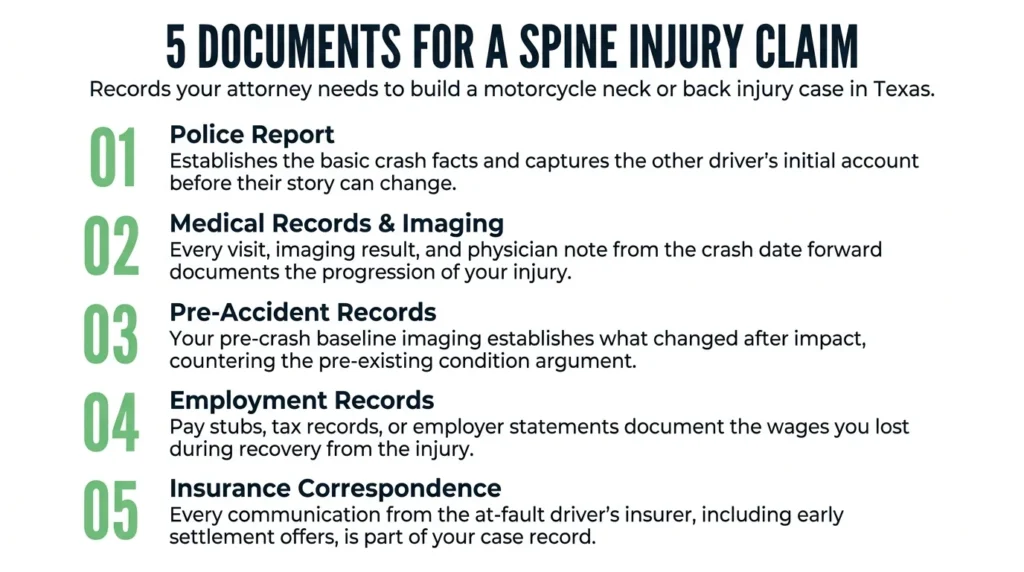
Building a well-documented claim requires gathering the right records from the start. The documents your attorney will need include:
- Police report: Request a copy from the responding agency or online through the department’s records portal. The report establishes the basic crash facts.
- Medical records and imaging reports: Collect every visit, every imaging result, and every physician note from the date of the crash forward.
- Pre-accident medical records: Obtain these records to establish your pre-crash baseline, which is the foundation of any aggravation argument.
- Employment records: Gather pay stubs, tax records, or employer statements documenting the wages you lost during recovery.
- Insurance correspondence: Save every communication from the at-fault driver’s insurer, including settlement offers.
Texas Transportation Code Chapter 661 governs motorcycle helmet requirements. Riders 21 and older may ride without a helmet only if they have completed an approved motorcycle operator training and safety course or carry qualifying health insurance that covers motorcycle accident injuries. Insurers sometimes raise helmet non-use to argue comparative fault, but this argument is most relevant to head injuries, not cervical or lumbar injuries.
Texas courts evaluate that argument narrowly in the context of the actual injuries sustained.
Speak With an Experienced Attorney
Neck and back injuries from a motorcycle crash carry medical complexity, insurer scrutiny, and legal nuance that most injured riders are not equipped to handle on their own.
Angel Reyes & Associates has guided injured Texans through motorcycle accident claims for over 30 years. We handle these cases on a contingency basis, meaning you pay nothing unless we recover compensation for you. Our attorneys are familiar with the pre-existing condition defenses insurers use in disc and spine injury claims, and we know how to build the medical record and imaging documentation that counters them.
We have recovered more than $1 billion for our clients across Texas. If you’ve been hurt in a motorcycle crash and are facing questions from an insurance adjuster about your prior medical history, contact us for a free consultation.
Past results do not guarantee future outcomes.
About the Authors

Angel Reyes
Writer
Angel L. Reyes, III is the Founder and Managing Partner of Angel Reyes & Associates. A nationally recognized trial attorney and business leader, Angel has helped over 55,000 injury victims recover more than $1 billion since founding the firm in 1993. Named to the Texas Super Lawyers list annually since 2008, Angel brings Wall Street experience, Ivy League education, and a deep commitment to client advocacy. He is a frequent legal commentator and published author with extensive contributions to legal scholarship, trial strategy, and consumer protection.

Graham Griffin
Editor
Graham Griffin is the editorial director responsible for accuracy and legal compliance across all firm content.
Graham Griffin
Reviewer
Graham Griffin also serves as legal reviewer, ensuring all claims and advice reflect current Texas statutes and case law.