Can Road Design Cause a Motorcycle Accident in Texas?


Every article on this site is researched by our internal team, reviewed for legal accuracy against current Texas law, and held to State Bar of Texas advertising standards before publication. We do not publish content that overstates outcomes or makes promises about results.
Learn more about our
editorial standards .
Key Takeaways
- Texas riders get just six months to file written notice of a road defect claim.
- State and city road claims cap at $250,000 per person, and county claims cap at $100,000.
- Premise and special defects impose different duties that change what your case must prove.
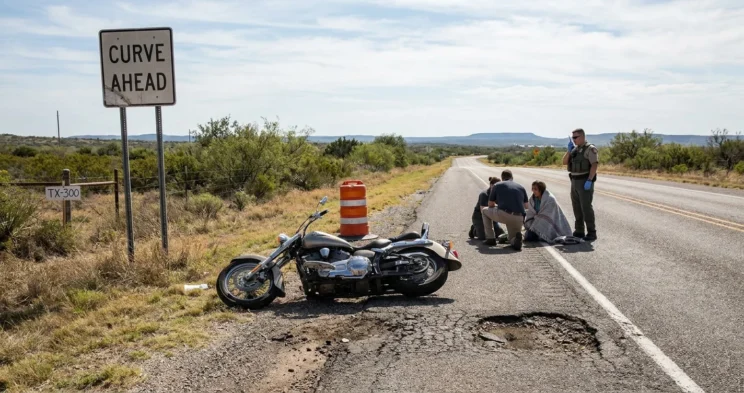
You were riding home on Harry Hines Boulevard one night when your front wheel hit a pothole you couldn’t see. The bike pitched, you went down, and now you’re looking at medical bills because of something the road might have caused. Was the crash your fault, or did the people responsible for the road let you down?
Road Defects That Cause Motorcycle Crashes
A road hazard that a car shrugs off can put a motorcycle rider on the pavement in an instant. With two wheels, your bike only has two contact points with the road. Something a passenger car absorbs can take your front wheel out from under you.
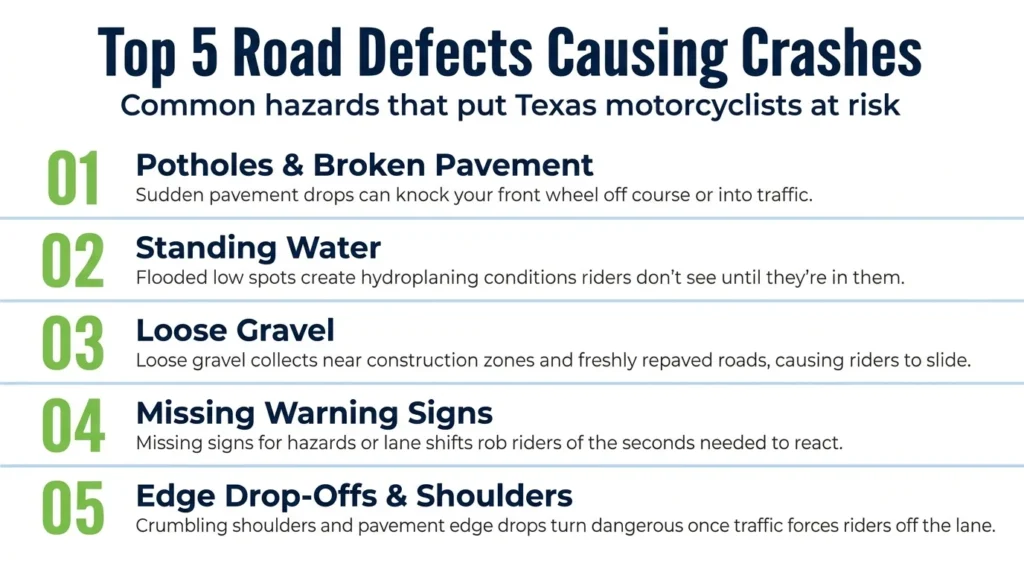
Potholes and broken pavement are classic examples. A sudden drop can force your front wheel off course or send you swerving into traffic before you can react.
Standing water is another quiet danger. Low sections of road that flood after it rains create hydroplaning conditions you can’t see until you’re driving through them.
Loose gravel also causes more crashes than riders expect. It collects around construction zones and on freshly repaved roads, making you slide at a routine turn.
Hidden or missing warning signs leave you blind to what’s coming. When no one posts advance notice of a hazard, lane shift, or odd intersection, you lose the seconds you need to slow down.
Pavement edge drop-offs and crumbling shoulders become dangerous the moment traffic forces you off the main lane. Even poorly placed rumble strips can grab a motorcycle tire in ways they never affect a car. Riders who want to know how often these crashes occur can review the Texas motorcycle crash numbers.
Who Is Responsible for Texas Roads?
The answer depends on which road you were on, because no single agency maintains every mile of pavement in the state. State highways, city streets, and county roads each fall to a different government body that decides who you can hold accountable.
The Texas Department of Transportation designs, builds, and maintains state highways, including the interstates and U.S. routes. When a defect is present on one of these roads, TxDOT is the entity responsible for its condition. TxDOT also publishes guidance on motorcycle safety and roadway risks.
Cities maintain their own streets inside city limits. A pothole or drainage problem on a residential street or city arterial is a municipal responsibility.
Counties handle county roads and farm-to-market roads outside the city limits. These rural stretches are usually inspected less frequently, which can matter to your case.
Some crashes blur the lines. When a state highway runs through a city, both TxDOT and the city may share responsibility, depending on which one controlled the feature that caused your crash.
Pinning down who’s responsible early is not a formality. If you send your required notice to the wrong office, it doesn’t stop the clock. Our guide on how to pursue a government entity can help you avoid a costly mistake.
The Texas Tort Claims Act & Sovereign Immunity
Texas government bodies are normally protected from lawsuits by a rule called sovereign immunity, but this protection is not absolute. The Texas Civil Practice and Remedies Code (CPRC) Chapter 101 waives this immunity in specific situations, including some dangerous road conditions, which opens the door to your claim.
How far that door opens depends on what defect injured you. The law splits road hazards into two categories that carry very different duties.
Premise Defects
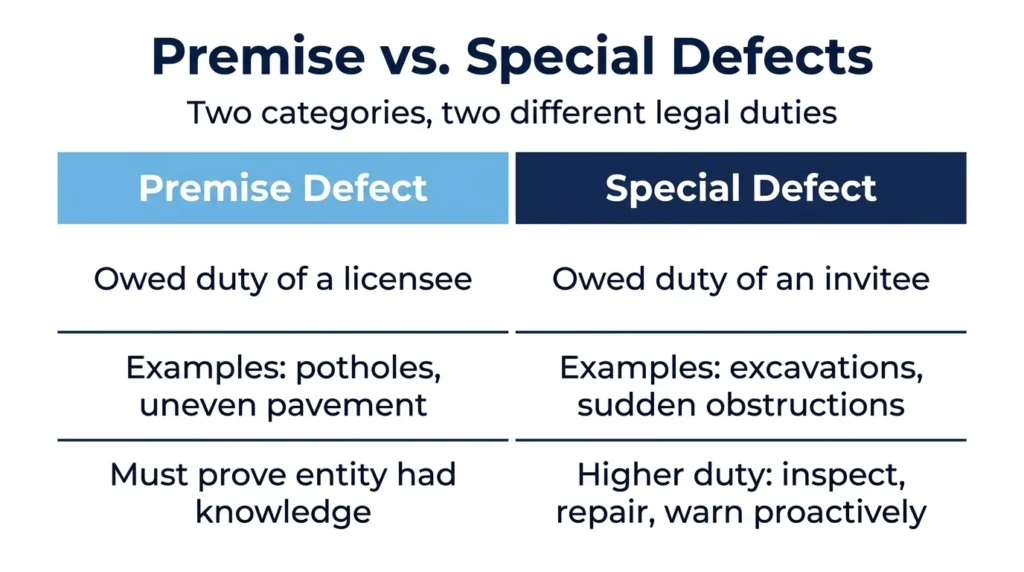
A premise defect is a general unsafe property condition, including for a road. For this category, the government only owes you the limited duty owed to a licensee under CPRC § 101.022. The government must warn you about any known dangers, but it doesn’t have to hunt for problems it doesn’t know exist.
Potholes, uneven pavement, and ongoing drainage troubles usually fall under this code. To win, you have to show the government actually knew about the specific condition and still failed to fix it or warn you.
Special Defects
A special defect is a condition that creates an unreasonable risk, like an excavation or sudden obstruction blocking the road. Here the government owes the higher duty owed to an invitee under CPRC § 101.022(b), meaning the government must inspect, repair, and warn about the defect.
Sudden pavement failures, large objects in the roadway, and dead or malfunctioning traffic signals often qualify. If an unexpected obstruction or sudden road collapse caused your crash, rather than a slow-developing pothole, this higher standard may work in your favor. You can see how this same framework played out in a Texas Tort Claims Act case involving a bus crash.
The 6-Month Notice Deadline Explained
You must give the government entity written notice of your claim within six months of the crash under CPRC § 101.101. If you miss it, your claim is usually barred no matter how badly you were hurt or how clearly the government was at fault.
The clock starts the day of the crash. It doesn’t wait until your treatment ends or you fully grasp how serious your injuries are. Many riders lose valid claims simply because they focused on healing and let the window slip by.
Worse, six months is only the outer limit. Plenty of cities and counties set shorter deadlines through their own charters or ordinances, so confirm your specific deadline right away.
Step 1: Identify the responsible entity. Figure out whether the road belongs to the state, a city, or a county, because this determines where notice goes and how long you have.
Step 2: Check for a shorter local deadline. Houston and several other large Texas cities require notice within 90 days, and some smaller towns allow as little as 45 days.
Step 3: Put the notice in writing. It must state the injury, date, location, and nature of the incident clearly so the entity can investigate what happened.
Step 4: Serve it before the deadline. The standard two-year deadline under CPRC § 16.003 still governs lawsuits, but it means nothing if you’ve already missed the notice window.
An attorney who handles Texas government claims can pin down the exact deadline for your city or county and get your notice filed on time.
What a Road Defect Claim Requires
A road defect claim stands on three pillars: a dangerous condition, government knowledge of the condition, and a clear link to your injuries. Build all three and you have a case the government must answer.
First, you have to show that a genuinely dangerous condition existed on a road the government maintained. A worn patch of asphalt isn’t enough on its own; the hazard has to be one that put riders at real risk.
Second, you have to show the entity knew, or should have known, about the condition before your crash. Constructive notice means the defect sat there long enough that a reasonable inspection would have caught it.
Third, you have to show that the government failed to repair the condition, or warn you within a reasonable time, and this failure caused your injuries. Photographs, video, the police report, witness statements, and engineering analysis all strengthen this connection. A look at how motorcycle settlements actually come together in Texas can set realistic expectations.
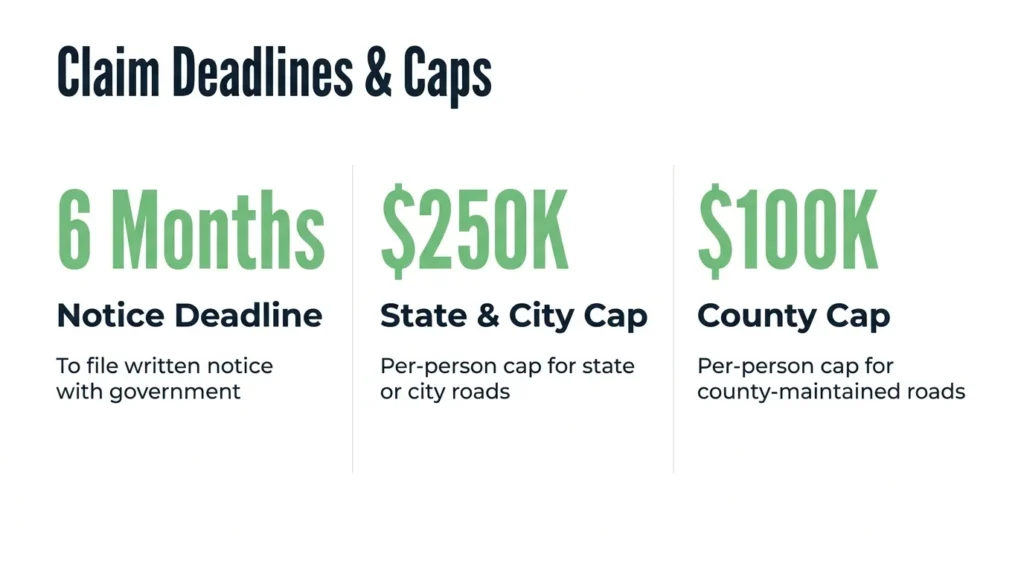
One hard reality shapes every government claim: your recovery is capped. Claims against a state agency or city cap at $250,000 per person and $500,000 per occurrence, while claims against a county or other local government unit cap at $100,000 per person and $300,000 per occurrence.
Knowing what to preserve and which entity to pursue early can make or break the outcome. Practical guidance on protecting your rights after a motorcycle crash walks you through those first moves.
Talk to a Texas Motorcycle Accident Attorney
A road that was never safe to ride shouldn’t cost you your recovery, but government claims punish delay harder than almost any other case. The notice deadline can close before you have even finished treatment. Once it passes, a strong claim can vanish overnight.
Angel Reyes & Associates has handled motorcycle crash claims across Texas for over 30 years, and we know how to move fast on the deadlines that decide these cases. We offer free initial consultations, work on contingency so you pay no fee unless we win, and you can reach us 24/7. Our team of attorneys can review what happened and explain your options, and you can learn more about how we handle motorcycle injury cases anytime.
Reach out for a free consultation so you understand your options before the clock runs out.
Past results do not guarantee future outcomes.
Road Design Accident FAQs
What if a private construction contractor created the road hazard and not the government?
If a contractor working under a government contract caused the hazard, you may have a direct negligence claim against the contractor rather than, or in addition to, a TTCA claim against the government. Private contractors don’t have sovereign immunity, so the standard two-year statute of limitations applies to claims against them.
Does Texas's proportionate responsibility rule apply to road defect claims?
Yes. If you were partly at fault, for example by speeding or riding with a known tire defect, your damages are reduced by your share of responsibility. You can’t recover anything if your own fault reaches 51% or more.
How does a government agency's prior knowledge of a pothole get proven in court?
One common method is a prior complaint record. When a rider or another driver reported the same defect to TxDOT, a city, or a county before the crash, that complaint log is evidence the agency had actual notice. Obtaining those records early, before they are purged, can be decisive.
Does the 6-month notice deadline still apply if another driver also caused the crash?
Yes. If a government road defect and a private driver both contributed to your crash, you must still serve written notice on the government entity within the applicable deadline. Your claim against the private driver follows the regular two-year limit, but those two deadlines run independently.
Can a family file a road defect claim if the rider died from the crash?
Yes. Under the Texas Wrongful Death Act, certain family members, including spouses, children, and parents, can bring a wrongful death claim against a government entity. The same TTCA notice deadline applies, so the family must act within the same window given for any government claim.
About the Authors

Angel Reyes
Writer
Angel L. Reyes, III is the Founder and Managing Partner of Angel Reyes & Associates. A nationally recognized trial attorney and business leader, Angel has helped over 55,000 injury victims recover more than $1 billion since founding the firm in 1993. Named to the Texas Super Lawyers list annually since 2008, Angel brings Wall Street experience, Ivy League education, and a deep commitment to client advocacy. He is a frequent legal commentator and published author with extensive contributions to legal scholarship, trial strategy, and consumer protection.

Kyle Nicolas
Editor
Kyle Nicolas is the Web Content & SEO Manager at Angel Reyes & Associates. He has more than 10 years of experience as a marketing co...

Angel Reyes
Reviewer
Angel L. Reyes, III is the Founder and Managing Partner of Angel Reyes & Associates. A nationally recognized trial attorney and business...