Who Is Liable for an E-bike Accident in Texas?


Every article on this site is researched by our internal team, reviewed for legal accuracy against current Texas law, and held to State Bar of Texas advertising standards before publication. We do not publish content that overstates outcomes or makes promises about results.
Learn more about our
editorial standards .
Key Takeaways
- Texas law classifies Sur-Ron and Talaria as motor vehicles, not e-bikes, affecting your liability options.
- You may pursue the other driver, the rider, the manufacturer, or a government entity after a crash.
- Texas gives you two years to file, but government claims require written notice within six months.
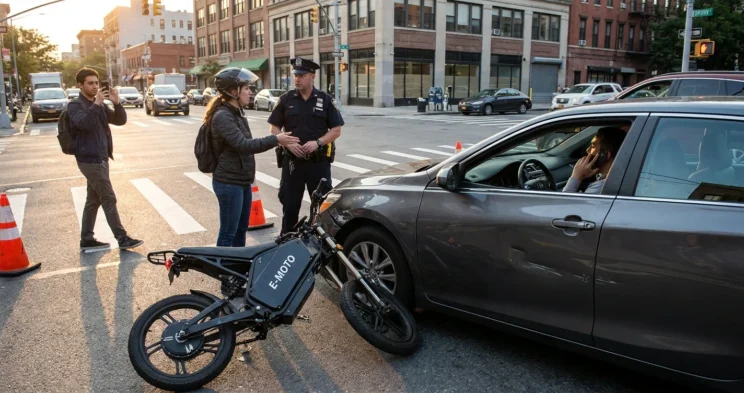
You were stopped at a light on US-290 when a rider on what looked like a dirt bike blew through the intersection and clipped your rear bumper. The vehicle was electric, nearly silent, and moving fast. Now you are dealing with a damaged car, a sore neck, and an insurance company that isn’t sure what kind of vehicle was actually involved.
The confusion is understandable. Riders, news reports, and even lawyers sometimes use “e-moto,” “electric motorcycle,” “Sur-Ron,” “electric dirt bike,” and “electric bike” as if they all mean the same thing. Under Texas law, they do not.
What Is an Electric Motorcycle Under Texas Law?
Texas law draws a hard line between electric bicycles and electric motorcycles, and the vehicle’s legal classification shapes which rules apply to the crash. Those rules determine who you can hold responsible.
The Texas Transportation Code Chapter 664, Standards for Electric Bicycles, defines an e-bike by three criteria. The vehicle must have:
- Pedals
- A motor under 750 watts
- A top assisted speed of 28 mph or less
Vehicles meeting those criteria fall into Class 1, 2, or 3, depending on how the motor assists the rider.
Sur-Ron and Talaria models routinely exceed both the wattage and speed limits for electric bicycles. They are not e-bikes under Texas law. They are classified as motor vehicles or motorcycles.
That means you need a driver’s license to operate one, the vehicles need registration, and the liability rules that apply after a collision are the same rules that apply to any motor vehicle crash.
You might have heard manufacturers use the term “electric dirt bike” or “electric motorcycle” for these machines. When you look up “electric bike accident,” you’ll often find these vehicles. The legal category matters more than the marketing label.
That category controls which insurance regime applies, which regulations you must follow as a rider, and which theories of liability are available if you get hurt.
Who Can Be Held Liable After an Electric Motorcycle Crash?
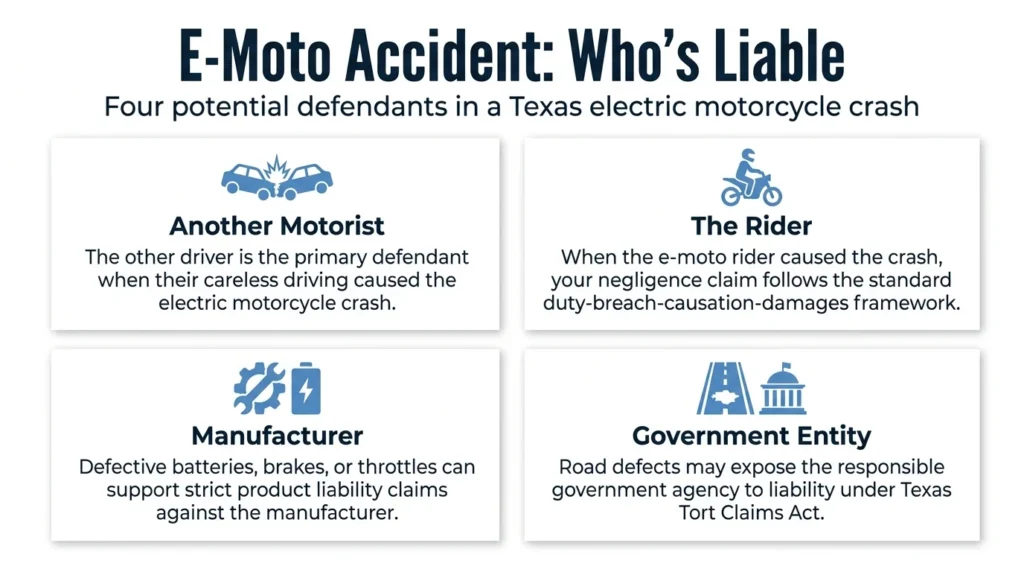
A single electric motorcycle crash can generate liability claims against more than one party. The correct defendant depends on what caused the crash and who had control of the relevant risk.
Another Driver on the Road
When another motorist causes the crash through careless or reckless driving, they are the primary at-fault party. Duty of care applies regardless of what type of electric vehicle was involved in the collision. A driver who runs a red light owes the same duty to an e-moto rider as to the driver of a pickup truck.
The Electric Motorcycle Rider
When you are the injured party and the e-moto rider caused the crash, the rider is the defendant. Your claims against the rider follow the same negligence framework: duty, breach, causation, and damages. Riding without proper licensing or registration can factor into the fault analysis.
An attorney can evaluate which party bears the most fault and whether additional defendants belong in your Texas motorcycle accident claim alongside the rider.
The Manufacturer in a Defect Case
When a mechanical failure in the electric motorcycle itself contributed to the crash, the manufacturer may be liable. Texas products liability law allows strict liability claims for defective design, defective manufacturing, or failure to warn. Under the Texas Civil Practice and Remedies Code Chapter 82, you can file claims against manufacturers and sellers.
You do not need to prove the manufacturer was careless. You need to show the product was defective when it left the manufacturer’s hands and that the defect caused your injury.
Common defect claims in electric motorcycle cases involve:
- Battery fires
- Brake malfunctions
- Throttle failures
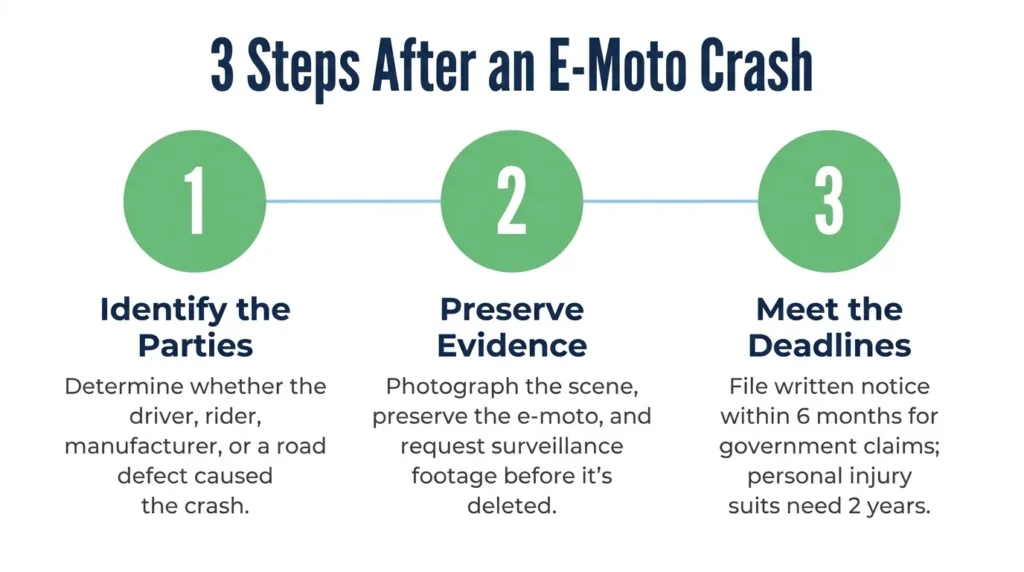
Electric vehicle components are relatively new, and the failure modes are not always well-documented. If you believe a defect caused your crash, preserving the vehicle as evidence is one of the most important steps you can take before the vehicle is repaired or discarded.
A Government Entity for a Dangerous Road
When a road defect contributed to the crash, the government agency that maintains that road may share liability. Potholes, missing guardrails, absent signage, and poorly designed intersections can all create dangerous conditions for electric motorcycle riders.
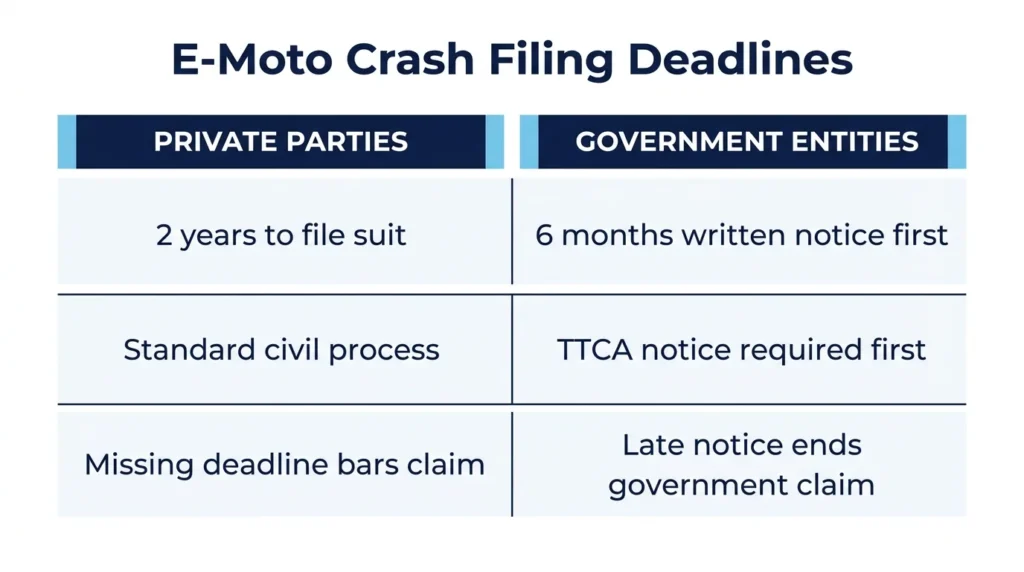
Claims against government entities in Texas are governed by the Texas Civil Practice and Remedies Code Chapter 101, the Texas Tort Claims Act. Government liability claims carry additional procedural requirements that private-party claims do not. You must file written notice with the responsible agency within six months of the injury.
Some cities and counties require even shorter notice periods. Missing that deadline can end your government claim before it starts. Your claims against private parties remain separate and unaffected.
Texas Fault Rules & Your Right to Recover
Texas fault rules give you options, even when the crash is not entirely someone else’s fault.
Texas uses proportionate responsibility to allocate fault among everyone involved. Under the Texas Civil Practice and Remedies Code (CPRC) Chapter 33, your compensation is reduced by your own percentage of fault.
If the other driver is found 70% responsible and you are 30% responsible, you recover 70% of your total damages. If your fault exceeds 50%, you cannot recover anything under Texas law.
Operating an electric motorcycle illegally can affect how fault is assigned. It does not automatically eliminate your claim.
The clock on your case starts the moment you are injured. You have two years from the date of the crash to file a personal injury lawsuit under Texas Civil Practice and Remedies Code Section 16.003. For claims against government entities, the six-month written notice requirement creates a much earlier internal deadline.
You can review how Texas motorcycle accident settlements work to understand what the claims process typically involves.
Get Legal Help for Your Electric Motorcycle Claim
Electric motorcycle crashes involve vehicle classification disputes, multi-party liability questions, and sometimes product defect claims that run parallel to standard negligence cases. Getting the legal theory right from the start affects the outcome.
Angel Reyes & Associates has spent over 30 years helping injured Texans through situations exactly like this. We offer free consultations and work on contingency, meaning you pay nothing unless we win your case. Our attorneys can evaluate which parties are liable, which legal theories apply, and what compensation you may be able to recover.
Contact us today to start your free consultation.
Past results do not guarantee future outcomes.
Frequently Asked Questions
Can a passenger on an electric motorcycle sue the rider after a crash?
Yes. A passenger injured on an electric motorcycle has a claim against the rider if the rider’s negligence caused the crash, the same as a passenger in any other motor vehicle. Texas fault rules and the two-year statute of limitations apply to passenger claims the same way they apply to third-party claims.
What if the electric motorcycle rider who hit me had no insurance?
If the at-fault rider carried no insurance, your own uninsured motorist coverage may cover your losses if you carry that policy. Uninsured motorist coverage is optional in Texas, but if you purchased it, it can step in when the responsible party cannot pay.
Does Texas require a helmet on an electric motorcycle?
Riders who are 21 or older and carry proof of completing an approved motorcycle safety course or hold a qualifying health insurance policy may legally ride without a helmet in Texas. Riders under 21 are required to wear a helmet. The helmet law applies to vehicles classified as motorcycles, which includes most high-power electric motorcycles.
What happens if the government road defect caused my e-moto crash but I missed the six-month notice deadline?
Missing the written notice deadline to a government entity generally bars the claim against that defendant, even if the defect clearly caused your crash. However, some exceptions exist, such as when the government had actual notice of the hazard. An attorney can evaluate whether any exception applies to your situation.
About the Authors

Angel Reyes
Writer
Angel L. Reyes, III is the Founder and Managing Partner of Angel Reyes & Associates. A nationally recognized trial attorney and business leader, Angel has helped over 70,000 injury victims recover more than $1 billion since founding the firm in 1993. Named to the Texas Super Lawyers list annually since 2008, Angel brings Wall Street experience, Ivy League education, and a deep commitment to client advocacy. He is a frequent legal commentator and published author with extensive contributions to legal scholarship, trial strategy, and consumer protection.

Kyle Nicolas
Editor
Kyle Nicolas is the Web Content & SEO Manager at Angel Reyes & Associates. He has more than 10 years of experience as a marketing co...

Angel Reyes
Reviewer
Angel L. Reyes, III is the Founder and Managing Partner of Angel Reyes & Associates. A nationally recognized trial attorney and business...