Do You Need Insurance for an Electric Bike in Texas?


Every article on this site is researched by our internal team, reviewed for legal accuracy against current Texas law, and held to State Bar of Texas advertising standards before publication. We do not publish content that overstates outcomes or makes promises about results.
Learn more about our
editorial standards .
Key Takeaways
- Class 1, 2, and 3 electric bikes under Texas Transportation Code Chapter 664 require no registration or insurance.
- Electric motorcycles and over-limit e-motos must carry Texas minimum liability coverage of 30/60/25.
- If an uninsured e-moto rider injures you, your own UM coverage may be your best recovery path.
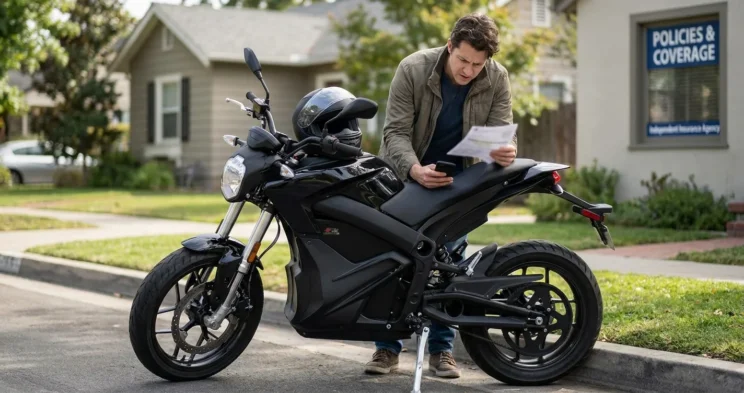
You bought the bike, charged it up, and took it out on the road. Then someone asked whether you needed insurance, and you realized you were not entirely sure because the answer in Texas is not a simple yes or no. It depends on what your bike actually is under state law.
How Texas Classifies Electric Bikes & Electric Motorcycles
Texas law sorts electric two-wheelers into two legal buckets (electric bikes and electric motorcycles), and your insurance and registration obligations fall entirely on which side of that line your bike lands.
True Electric Bikes (Class 1, 2, & 3)
Texas Transportation Code Chapter 664 defines three classes of electric bicycles.
- Class 1 bikes assist the rider only while pedaling, with a top speed of 20 mph.
- Class 2 bikes can propel the rider without pedaling, also capped at 20 mph.
- Class 3 bikes are pedal-assist only but can reach just under 28 mph.
All three classes share one key feature: they are not motor vehicles under Texas law.
Motor vehicle status is what triggers registration, insurance, and a motorcycle license; without it, those requirements do not apply. If your bike falls within Chapter 664, you do not need to register it, carry insurance, or hold a license to ride it. There is no license plate, no proof of insurance, and no annual inspection.
One age restriction applies to Class 3 bikes: riders must be at least 15 years old. Class 1 and 2 have no minimum age requirement under state law, though local ordinances can add restrictions.
True Electric Motorcycles
A full electric motorcycle, whether it is a Zero SR, an Energica, or any other high-speed electric bike built without pedals, is treated exactly like a gas motorcycle under Texas law.
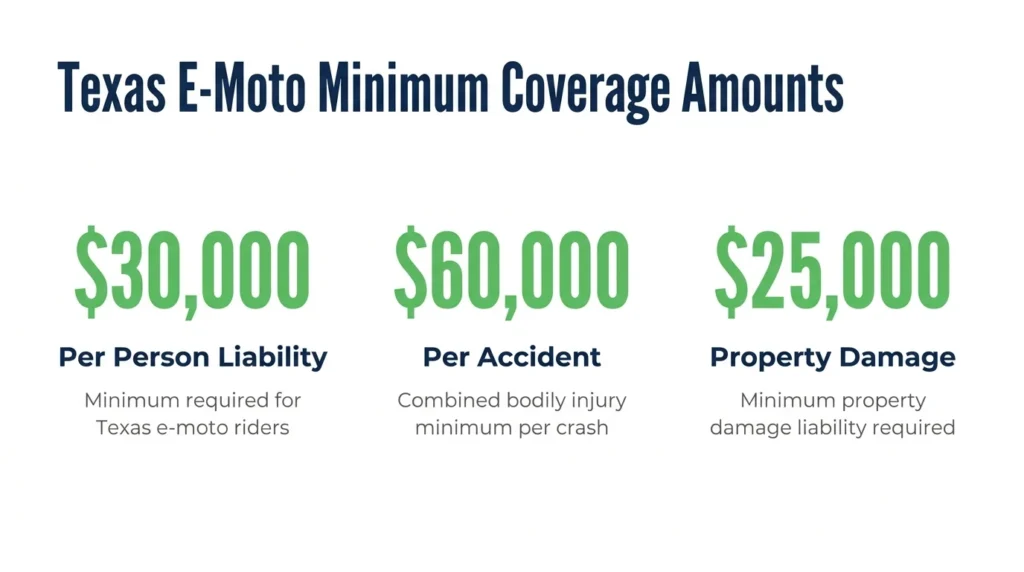
You must register it with TxDMV, carry a Class M motorcycle license, and maintain the same 30/60/25 minimum liability coverage under the Texas Transportation Code § 601.072, where that minimum is $30,000 per injured person, $60,000 per accident, and $25,000 in property damage.
The cost of an electric motorcycle policy varies by model, rider history, and coverage level. A basic liability-only policy for a standard electric motorcycle typically runs in the same range as a comparable gas bike.
The Gray Zone: Surrons, Talarias & E-Motos
This is where most riders get caught off guard. A growing category of vehicles sits between a legal e-bike and a true electric motorcycle, and Texas law does not have a dedicated label for them.
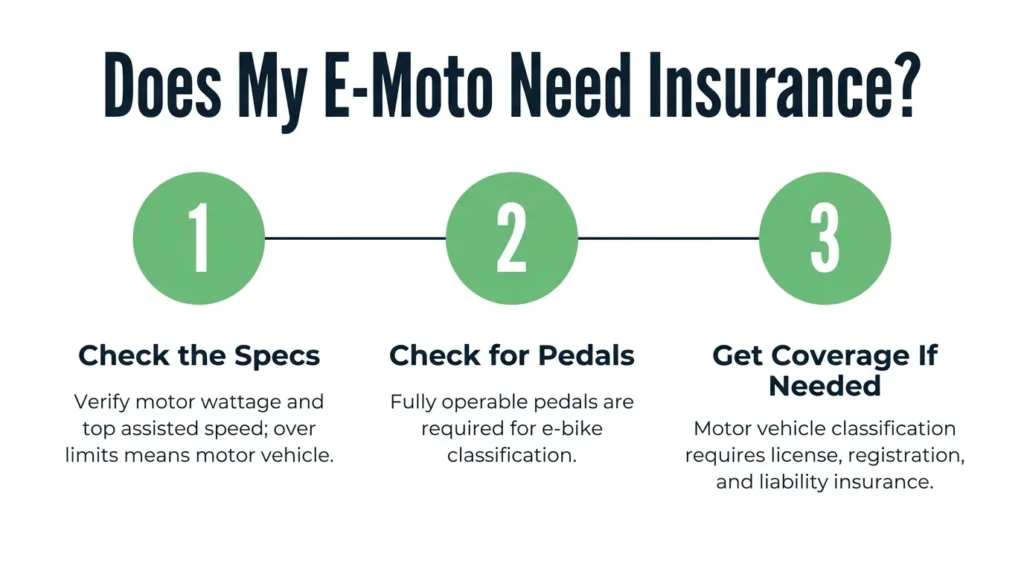
Models like the Surron Light Bee X and the Talaria Sting are designed for off-road use but are widely ridden on public streets. Their classification under Texas law depends on their actual specifications: motor power, top speed, and whether they have fully operable pedals.
A stock Surron Light Bee X that tops out under 28 mph with operable pedals and a motor under 750 watts may qualify as a Chapter 664 Class 2 or Class 3 e-bike, making it registration-free. A modified version tuned for higher speed or power almost certainly does not meet those limits. Once it crosses the Chapter 664 threshold, it becomes a motor vehicle in Texas, and the full motorcycle compliance stack applies.
Riders who assume their e-moto is street-legal as a bicycle without checking the actual specs are taking a real legal risk. The practical comparison is instructive: Texas e-scooter laws and liability follow a similar classification-based framework, and the consequences of misclassification are the same.
If an e-moto is classified as a motor vehicle but ridden on public roads without registration or insurance, the rider faces fines and rides without any policy to cover injuries or damages they cause. Riders unsure of their vehicle’s classification can speak with an attorney who handles electric vehicle accident cases before an incident puts the question to a real-world test.
Three Coverage Scenarios on Texas Roads
Once you know your vehicle’s classification, the insurance picture becomes clearer. Three scenarios cover most situations riders and injured parties encounter.
Scenario 1: The rider carries a proper motorcycle policy. An e-moto or electric motorcycle with a valid insurance policy works just like any other motorcycle crash, allowing the injured party to file a liability claim against that policy. Understanding how motorcycle accident settlements work in Texas is the same whether the bike runs on gas or electricity.
Scenario 2: The rider has no motorcycle policy but has homeowners or renters insurance. Some homeowners policies extend limited personal property coverage to bicycles or low-speed vehicles used on private property, whereas personal auto policies typically exclude vehicles not listed on the policy by name or category. Whether any coverage applies to a crash on a public road depends entirely on the specific policy language.
In most cases, homeowners coverage is narrow and will not cover injuries to third parties on public streets.
Scenario 3: The at-fault e-moto rider is uninsured and unregistered. The injured party has no direct policy to claim against. Recovery options narrow considerably, and the path forward depends on the injured party’s own coverage.
What You Can Pursue When the At-Fault Rider Has No Insurance
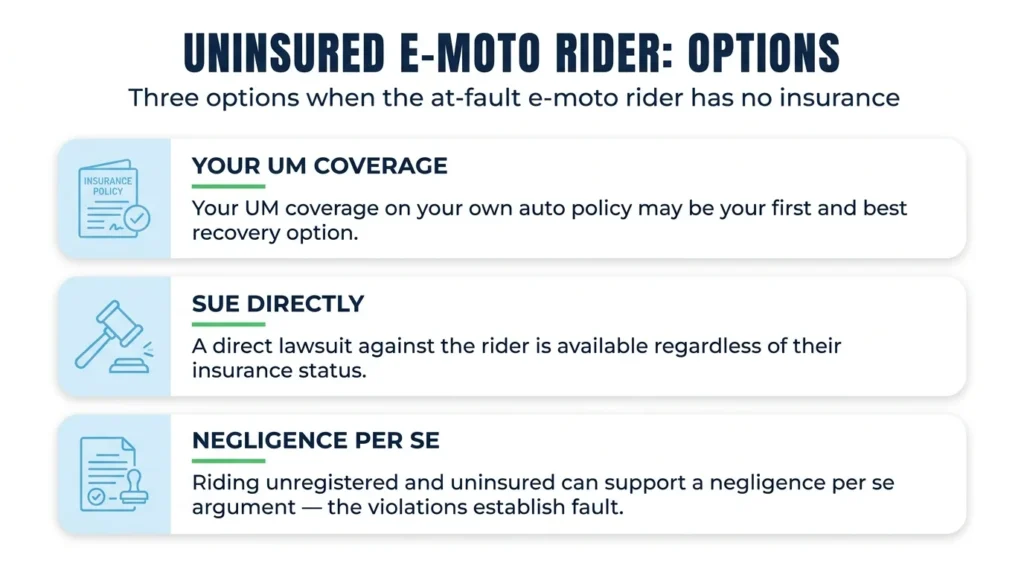
Your own uninsured motorist (UM) coverage may be your first and best option. Under Texas Insurance Code § 1952.101, UM coverage protects you when you are legally entitled to recover from the owner or operator of an uninsured motor vehicle. Whether a misclassified e-moto triggers UM coverage depends on your policy language and how the vehicle is legally classified.
If UM coverage does not apply or falls short, you can pursue the at-fault rider directly through a personal injury lawsuit. A court judgment in your favor is a valid legal outcome, but collecting on it is a separate challenge. A rider who was operating without registration or insurance often has limited assets to satisfy a judgment.
A rider’s failure to register and insure a vehicle that legally required both may support a negligence per se argument, meaning the legal violation itself becomes evidence of fault, without needing to establish carelessness through separate proof.
Your options for uninsured situation recovery are explained in more detail in the Texas Uninsured Motorist Accident Guide. For a closer look at what UM, UIM (underinsured motorist), and PIP (personal injury protection) coverage actually do in practice, see this breakdown of UM, UIM, and PIP insurance coverage.
Get Legal Guidance After an E-Bike or E-Moto Crash
The classification question is not always simple, and a crash makes it more complicated. Whether you are a rider trying to understand your obligations or someone injured by an e-moto rider who had no policy, the legal path forward depends on specific facts.
Angel Reyes & Associates has helped injured Texans work through situations like this for over 30 years. Our dedicated team of more than 600 professionals handles motorcycle and electric vehicle accident cases where coverage status is disputed or unclear.
Our trial-ready Texas attorneys can review and handle most of your case remotely. We offer free initial consultations and work on contingency, meaning you pay no fee unless we win your case, and free consultations are available 24/7. Schedule a free consultation to review your options.
Past results do not guarantee future outcomes.
Electric Bike Insurance FAQs
Does a Surron require a motorcycle license in Texas?
It depends on the bike’s specifications. If the Surron meets the Texas Transportation Code Chapter 664 definition of an electric bicycle, no license is required. If its power output or top speed exceeds those limits, the rider needs a Class M motorcycle license.
Can I get a dedicated insurance policy for my electric bike?
Yes. Standalone e-bike insurance is available from specialty carriers, with policies typically starting around $100 per year for basic coverage. These policies often include theft protection, damage coverage, and third-party liability options that standard homeowners policies do not provide.
Does homeowners insurance cover my e-bike if it is stolen?
It depends on the policy. Some homeowners and renters policies extend personal property coverage to e-bikes up to a sublimit, but many explicitly exclude motorized vehicles or limit coverage to theft occurring on your property. Checking your policy’s definitions and exclusions before assuming coverage is the safest approach.
What happens if an uninsured e-moto rider injures me as a pedestrian?
You may be able to file a claim under your own uninsured motorist coverage if the vehicle qualifies as a motor vehicle under your policy terms. If UM coverage does not apply, you can pursue the rider personally through a lawsuit, though collecting on a judgment against an uninsured rider can be difficult.
Do electric motorcycles in Texas still need a safety inspection?
As of January 1, 2025, Texas eliminated the mandatory annual safety inspection for most non-commercial vehicles, including motorcycles, under House Bill 3297. Registered motorcycles now pay a small annual Inspection Program Replacement Fee instead, though the legal requirement to maintain safe, functioning equipment remains in effect.
About the Authors

Angel Reyes
Writer
Angel L. Reyes, III is the Founder and Managing Partner of Angel Reyes & Associates. A nationally recognized trial attorney and business leader, Angel has helped over 70,000 injury victims recover more than $1 billion since founding the firm in 1993. Named to the Texas Super Lawyers list annually since 2008, Angel brings Wall Street experience, Ivy League education, and a deep commitment to client advocacy. He is a frequent legal commentator and published author with extensive contributions to legal scholarship, trial strategy, and consumer protection.

Kyle Nicolas
Editor
Kyle Nicolas is the Web Content & SEO Manager at Angel Reyes & Associates. He has more than 10 years of experience as a marketing co...

Alex Ivanov
Reviewer
Alex Ivanov is a personal injury attorney at Angel Reyes & Associates, focused on car, truck, and motorcycle accident cases. Licensed in...