Party Bus Accident Liability in Texas


Every article on this site is researched by our internal team, reviewed for legal accuracy against current Texas law, and held to State Bar of Texas advertising standards before publication. We do not publish content that overstates outcomes or makes promises about results.
Learn more about our
editorial standards .
Key Takeaways
- Party bus operators owe passengers a high degree of care as commercial carriers under Texas law.
- Texas dram shop liability hits licensed alcohol vendors on a party bus, not unlicensed social hosts.
- You have two years to file and can still recover if you are 50 percent or less at fault.
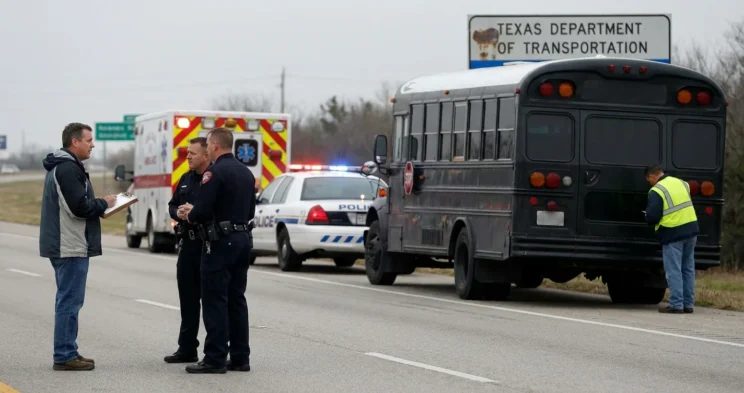
You booked the party bus for a friend’s birthday and climbed on near downtown Austin, music going, drinks flowing. Somewhere along Lamar Boulevard the driver took a turn too fast, and you hit the floor hard. Now you are hurting, the medical bills are piling up, and you cannot tell who is actually responsible.
Party Bus Operators & Texas Law
The company that owns and runs the party bus is usually the first place to look for responsibility. Any party bus company operating for hire in Texas must register as a motor carrier under Texas Transportation Code Chapter 643, which sets safety and compliance duties as a condition of doing business.
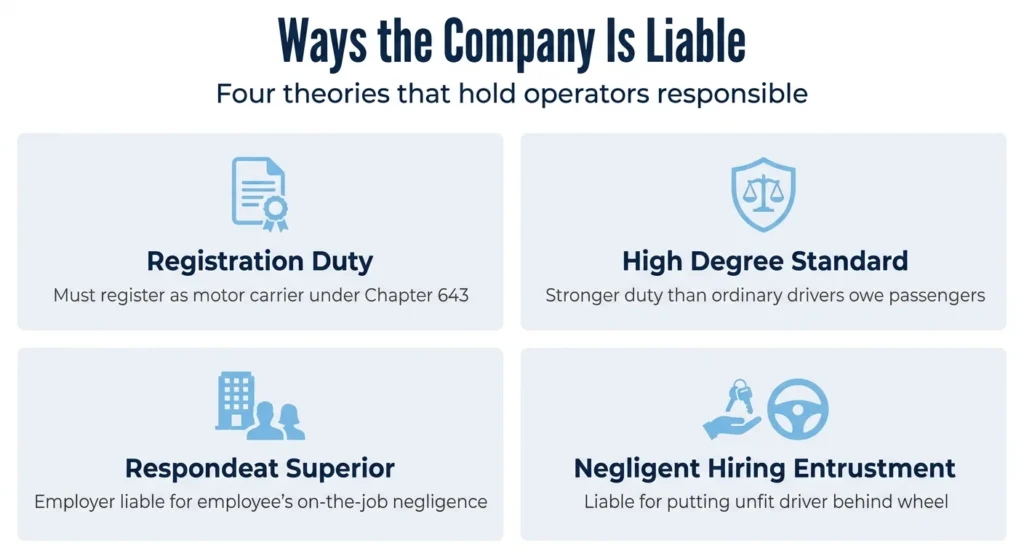
Registration is only one part of it. As a commercial carrier, the operator owes you a heightened duty of care, which Texas courts call the high degree of care standard. That standard is stronger than what an ordinary driver owes you on the road.
When the driver causes the crash, the company often shares the blame. Under a rule called respondeat superior, an employer is responsible for an employee’s negligence on the job. So the operating company can be liable for what its driver did behind the wheel.
The company can also be on the hook for its own choices. If it puts an unfit or unqualified driver behind the wheel, you may have a negligent hiring or negligent entrustment claim against the company directly. These are separate from the driver’s own fault.
If the crash kills someone you love, the path changes. Surviving family members may bring a wrongful death claim under Texas Civil Practice and Remedies Code (CPRC) Chapter 71.
Dram Shop Liability for Alcohol on Party Buses
When alcohol is served on board, the business that served it can be liable too. Under Texas Alcoholic Beverage Code Chapter 2, known as the Dram Shop Act, a commercial provider can be responsible if it serves someone who is obviously intoxicated to the point of presenting a clear danger to themselves or others, and that intoxication then causes injury.
The key question is who poured the drinks and whether they were licensed. That single fact decides whether a dram shop claim exists at all.
Commercial Provider vs. Social Host
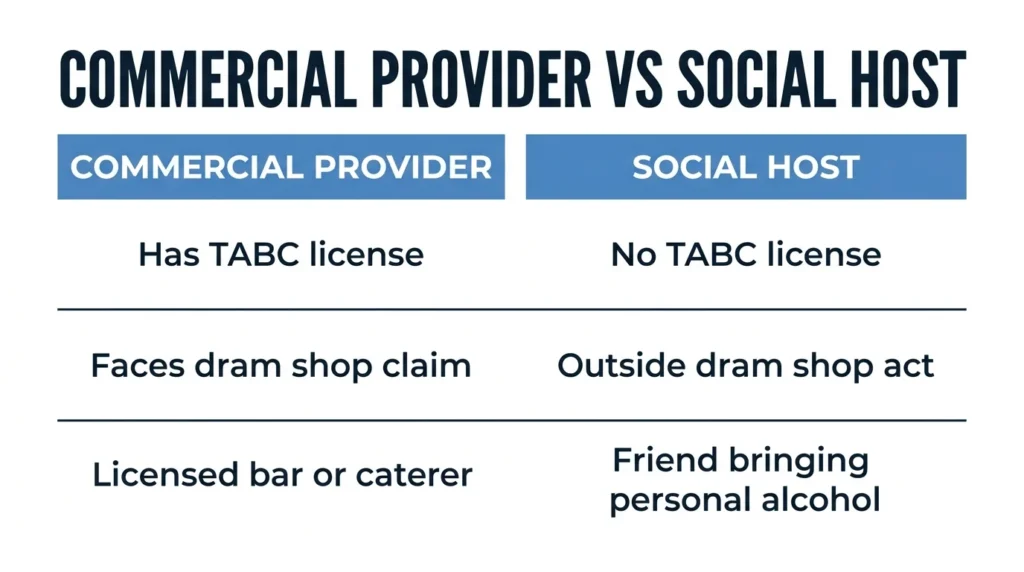
Texas dram shop liability applies only to commercial providers of alcohol, not to social hosts. A licensed vendor that stocks and serves drinks aboard the bus can face a dram shop claim if it overserved an obviously intoxicated rider.
A bar-on-wheels operation, a catering company serving alcohol, or an event organizer holding a TABC permit all count as commercial providers. Each can be liable under the Dram Shop Act.
A private person is different. If a friend brings a cooler of beer for a bachelorette party with no TABC license, that person is a social host and falls outside the Dram Shop Act. The amount served does not change that result.
That distinction often surprises injured passengers, because the law treats a licensed bar and a generous friend in completely different ways.
Event Host & Charter Organizer Liability
A host or charter organizer can be liable even when no dram shop claim exists. When a company or person charters the bus and controls the alcohol environment, separate negligence theories can attach.
A corporate event planner who books the bus, picks the vendor, and runs the drink service is a good example. That planner may face direct negligence liability for poor supervision or for allowing underage drinking, independent of dram shop law.
Do not assume a waiver ends the discussion. Contractual indemnity clauses and liability waivers that you sign before boarding generally do not erase the operator’s or host’s duty of care under Texas law. If you are dealing with an injury that crosses operator, host, and vendor lines, it helps to understand how Texas bus accident liability works before you decide who to pursue.
Insurance Requirements & Coverage Gaps
Insurance is where many party bus claims quietly fall apart. Under 49 CFR Part 387, a for-hire passenger carrier in interstate commerce must carry at least $5 million in liability coverage for vehicles built to carry 16 or more passengers. That floor drops to $1.5 million for vehicles carrying 15 or fewer.
A party bus running only inside Texas is a different story. Intrastate operators follow Texas registration and insurance thresholds under Chapter 643 rather than the federal $5 million floor. Those state minimums are generally lower, which can leave a real gap when injuries are severe.
That gap is the trap for seriously injured passengers. An operator carrying only minimum coverage may not have enough to cover what your injuries are actually worth.
This is why naming every responsible party matters so much. Reaching the operator, the alcohol vendor, and the host together can build the recovery that one thin policy cannot.
Passenger Fault & Proportionate Responsibility
You can still recover even if you were drinking, as long as you were not mostly to blame. Texas follows a system called proportionate responsibility under Texas Civil Practice and Remedies Code (CPRC) Chapter 33. Your recovery shrinks by your share of fault, and you recover nothing only if you are found more than 50 percent at fault.
Operators and hosts lean on this rule hard. Expect them to argue that your drinking or your decision to stand up while moving caused the injury. Those arguments can lower your recovery, but they rarely erase it.
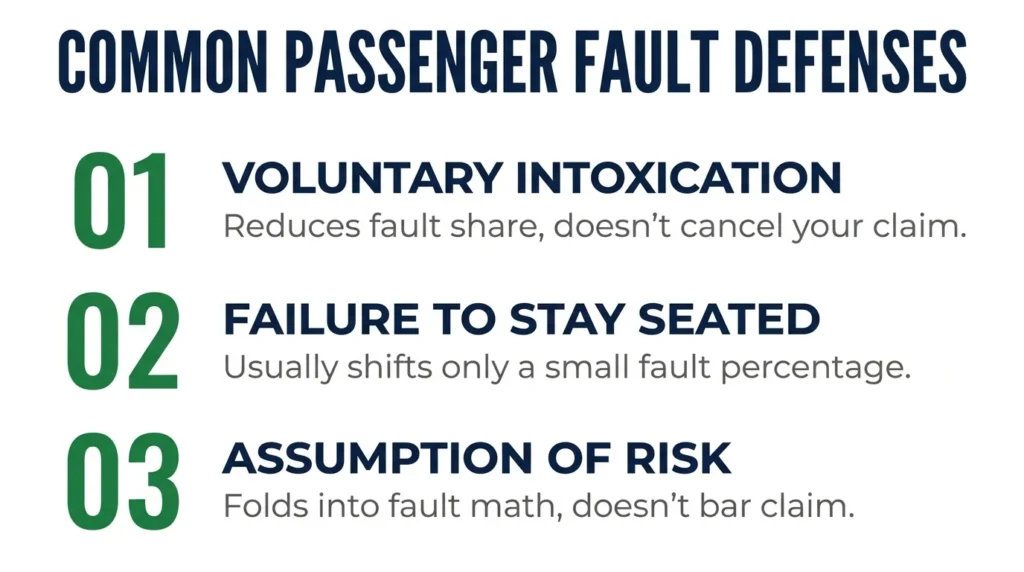
Here is what often surprises passengers about the defenses they will face.
- Voluntary intoxication: The defense will say you chose to drink, but that choice reduces your share of fault rather than canceling your claim.
- Failure to stay seated: Moving around on a party bus is expected, so this argument usually shifts a small percentage at most.
- Assumption of risk: Accepting some risk of the party bus setting does not bar your claim in Texas; it folds into the fault math.
As long as your fault share stays at 50 percent or less, you keep the right to recover something. If a drunk driver was involved, the rules around drunk driving accident victim rights can also shape what you recover.
Filing a Party Bus Injury Claim in Texas
You have two years to act, and the clock is already running. Under Texas Civil Practice and Remedies Code (CPRC) § 16.003, you have two years from the date of the crash to file a personal injury claim against a private party bus operator. Miss that two-year deadline and your right to sue is almost certainly gone.
Evidence fades faster than the deadline arrives. Records get overwritten (deleted), vehicles get repaired, and witnesses scatter, so preserving proof early protects your claim.
Identifying every defendant before the deadline lets you consolidate the operator, driver, host, vendor, and any other motorist into one coordinated case.
Talk to an Experienced Attorney
A party bus crash can leave you chasing several companies at once while you are still trying to heal.
Angel Reyes & Associates has spent more than 30 years handling commercial vehicle and bus accident claims across Texas, and we know how to find every party who should pay. We work on contingency, so there is no fee unless we win, and your first consultation is free.
We have more than $1 billion recovered for clients, and we can handle most, if not all, of your case remotely so it never derails your schedule. You can see what former clients say and learn more about our attorneys. When you are ready, reach out for a free consultation.
Past results do not guarantee future outcomes.
Party Bus Accident Liability FAQs
Can I still sue the party bus company if I signed a liability waiver before boarding?
Signing a waiver does not automatically end your claim. Texas courts require waivers to spell out negligence in plain, unmistakable language and to display that language conspicuously, and even a valid waiver cannot cover gross negligence or intentional misconduct.
What if a different driver caused the crash, not the party bus driver?
You can file a claim against the other driver’s insurance, and that driver can be added as a defendant in the same lawsuit. The jury will then divide fault among every party, including the bus company, the other driver, and anyone else who contributed to the crash.
What types of compensation can an injured party bus passenger recover in Texas?
You can pursue medical bills, lost wages, pain and suffering, and mental anguish. If the driver was grossly negligent, such as driving drunk, Texas law also allows a claim for exemplary damages on top of those amounts.
Can an adult who brings alcohol onto a party bus be liable if a minor drinks it and causes harm?
Yes. Under Texas Alcoholic Beverage Code Section 2.02, an adult who is not the minor’s parent and who knowingly provides alcohol to a person under 18, or knowingly allows it to be served on their premises, can be held civilly liable for damages caused by that minor’s intoxication.
How can I check whether a Texas party bus company is properly registered and insured?
For companies operating only inside Texas, you can search the Texas Department of Motor Vehicles Motor Carrier Credentialing System. For operators that cross state lines, the FMCSA Licensing and Insurance Carrier Search tool shows current registration status and insurance filings.
About the Authors

Angel Reyes
Writer
Angel L. Reyes, III is the Founder and Managing Partner of Angel Reyes & Associates. A nationally recognized trial attorney and business leader, Angel has helped over 70,000 injury victims recover more than $1 billion since founding the firm in 1993. Named to the Texas Super Lawyers list annually since 2008, Angel brings Wall Street experience, Ivy League education, and a deep commitment to client advocacy. He is a frequent legal commentator and published author with extensive contributions to legal scholarship, trial strategy, and consumer protection.

Kyle Nicolas
Editor
Kyle Nicolas is the Web Content & SEO Manager at Angel Reyes & Associates. He has more than 10 years of experience as a marketing co...

Angel Reyes
Reviewer
Angel L. Reyes, III is the Founder and Managing Partner of Angel Reyes & Associates. A nationally recognized trial attorney and business...