FMCSA Regulations and Bus Passenger Safety


Every article on this site is researched by our internal team, reviewed for legal accuracy against current Texas law, and held to State Bar of Texas advertising standards before publication. We do not publish content that overstates outcomes or makes promises about results.
Learn more about our
editorial standards .
Key Takeaways
- FMCSA rules govern buses built for 16 or more riders on driver, vehicle, and insurance standards.
- Interstate for-hire bus carriers must carry at least $5 million in federal liability coverage.
- Most Texas bus injury claims must be filed within two years of the crash date to stay valid.
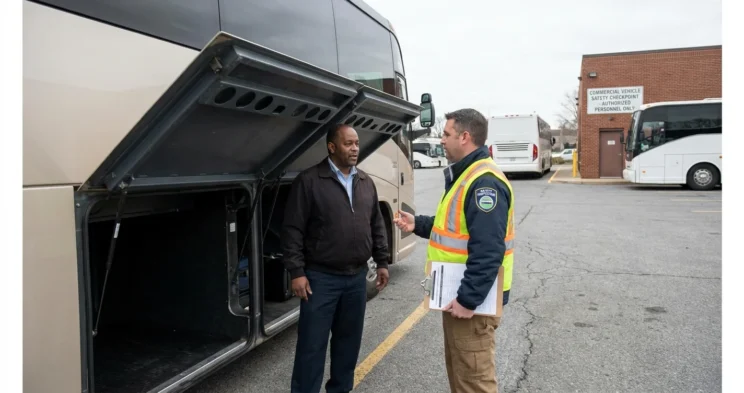
You were riding a charter bus back from a weekend trip, merging onto I-10 near the Katy Freeway, when the driver drifted across a lane and clipped another vehicle. Now you are hurt, the medical bills are stacking up, and the bus company keeps saying the crash was just an accident. What you may not know is that federal rules governed that bus, and those rules may have been broken.
What Is the FMCSA & Who Does It Cover
The Federal Motor Carrier Safety Administration sets and enforces the safety rules for commercial passenger carriers. For-hire buses and vans designed to carry 9 or more passengers fall under FMCSA oversight, and the agency’s strictest rules (including the $5 million insurance floor discussed below) apply to vehicles built for 16 or more seats. These FMCSA bus safety regulations cover the company that owns the bus, the driver behind the wheel, and the vehicle itself.
Interstate bus carriers must get operating authority from the agency and carry a USDOT number. That number is public. You can enter it in the FMCSA SAFER Company Snapshot to pull a carrier’s inspection history, crash records, and safety rating.
The full rulebook lives at 49 CFR Parts 380 to 399. The general framework at 49 CFR Part 390 defines which carriers and vehicles fall under federal oversight.
Some Texas buses that only run inside the state answer to a parallel rulebook. The Texas Transportation Code Chapter 643 sets registration rules for intrastate carriers alongside the federal system.
These rules are not just paperwork. When a company breaks one of them, that violation can serve as evidence of negligence in a Texas bus accident claim. We explain how below.
Bus Driver Qualifications Under FMCSA
The driver of your bus had to clear several federal hurdles before ever picking you up. Under 49 CFR Part 391, commercial bus drivers must be at least 21 for interstate routes, hold a valid commercial driver’s license, and pass a medical exam from a licensed examiner.
The company cannot simply take a driver’s word for it. Carriers must keep a driver qualification file for every driver. That file holds the CDL copy, medical certificate, driving history, and road test results.
If a company never built that file or let a certificate lapse, that gap is itself a violation. It can also point to a company that was not paying attention to who was driving its buses.
Federal rules also require drug and alcohol testing after certain crashes. If there is a fatality, every surviving driver who was performing safety-sensitive functions must be tested automatically. If someone was injured and needed medical transport away from the scene, or if a vehicle was so badly damaged it had to be towed, testing is required only if the driver received a citation for a moving violation within eight hours of the crash. A positive result, or a refusal to test, can strengthen a claim against the carrier.
If a driver was unlicensed, too young, or lacked a current medical card at the time of your crash, that failure can support a negligence claim under Texas law. An attorney can subpoena the driver qualification file and any drug test records to find out who is liable for the crash.
FMCSA Hours of Service for Bus Drivers
A tired driver is a dangerous driver, and federal law caps how long yours could stay on the road. Under 49 CFR Part 395, a passenger-carrying driver may not drive more than 10 hours after 8 hours off duty. That driver also may not drive at all after being on duty for 15 hours.
To prove they followed the limits, drivers must keep logs of their on-duty and off-duty time. These run on paper or an electronic logging device. Falsified or missing hours of service logs are a violation on their own.
Those logs are important for your case because they are discoverable. An attorney can subpoena them and the electronic data behind them to show whether fatigue played a role. That same evidence often shapes how you file a bus accident claim.
Hours violations rank among the most common problems FMCSA finds during audits. That track record makes driver fatigue one of the first things a good investigation checks after a bus crash.
Vehicle Maintenance Requirements for Bus Carriers
The bus you rode had to be inspected, repaired, and documented on a strict federal schedule. Under 49 CFR Part 396, a carrier’s maintenance duties are specific and ongoing.
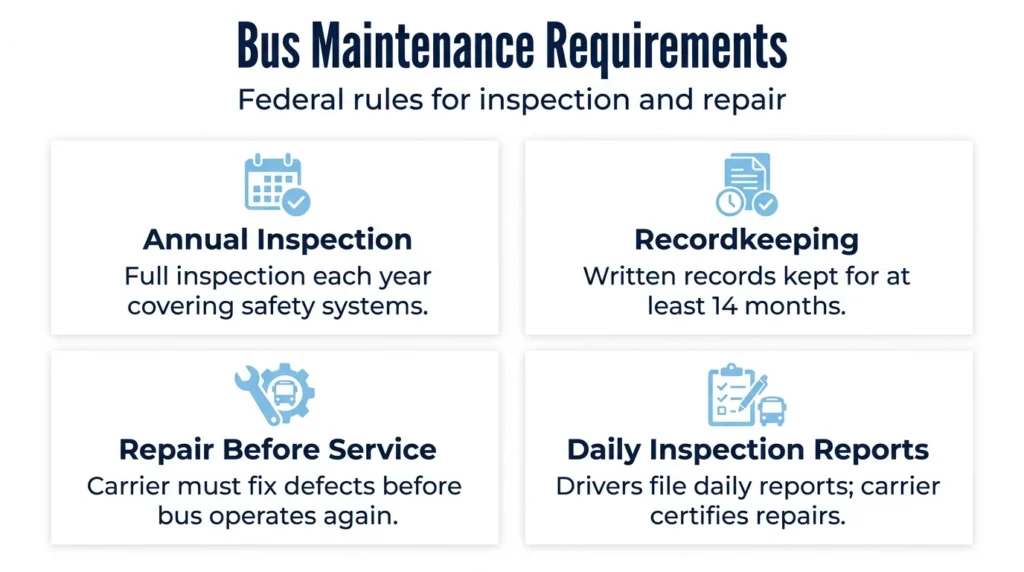
Annual inspection. Every bus must pass a full inspection at least once a year, covering brakes, steering, tires, and other safety systems.
Recordkeeping. Carriers must keep written inspection and maintenance records for each vehicle for at least 14 months.
Repair before service. A company must fix any defect that would make a bus unsafe before that bus carries passengers again.
Daily inspection reports. Drivers must file a driver vehicle inspection report at the end of each day, and the carrier must certify that listed defects were repaired.
Those records are discoverable when you bring a claim. Gaps in the paperwork, a missed inspection, or proof that a known defect went unfixed before your crash are strong signs of carrier negligence. If a defect may have caused your crash, an attorney can review the carrier’s records and your next steps as an injured passenger.
Federal data backs up why this is so important. FMCSA crash statistics show vehicle defects turn up again and again in large bus crashes, which is why maintenance is a primary focus of federal reviews.
Insurance Requirements & Federal Bus Liability
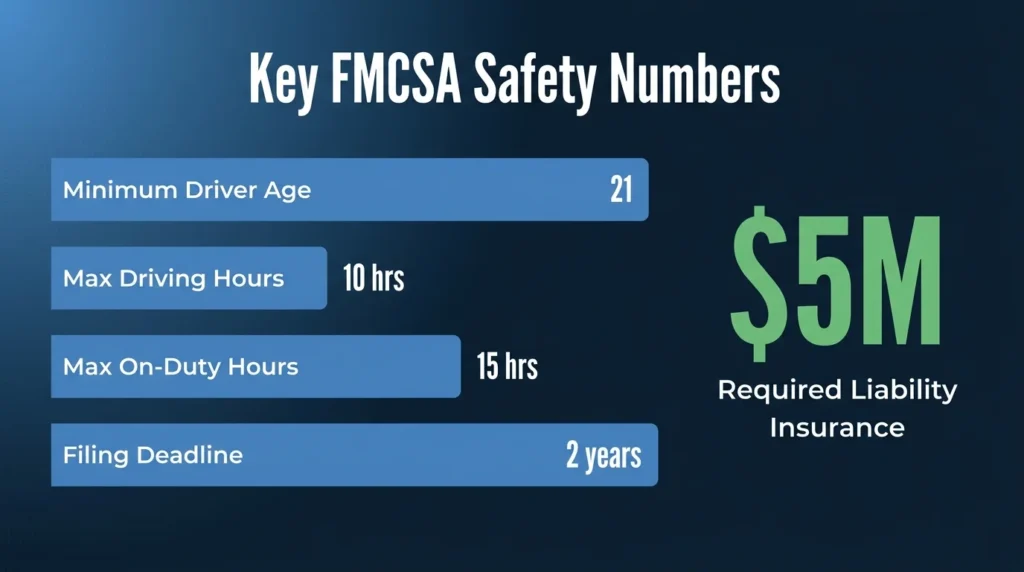
Federal law forces interstate bus companies to carry heavy insurance because a full bus can produce many serious injuries at once. Under 49 CFR Part 387, for-hire carriers running buses built for 16 or more passengers must hold at least $5 million in liability coverage. The FMCSA licensing and insurance page confirms that floor for passenger carriers.
This coverage is crucial because it is the pool your compensation may come from. A serious bus crash can leave several passengers with bills that quickly climb into the millions.
Texas law connects a broken federal rule to your right to recover. When a carrier violates an FMCSA safety regulation, that breach can help prove negligence. You must still show the violation caused the crash and that you suffered real harm. Because more than one party can share fault, the Texas Civil Practice and Remedies Code Chapter 33 governs how responsibility gets divided.
Timing is where many strong claims fall apart. Most Texas bus injury claims must be filed within two years of the crash under the Texas Civil Practice and Remedies Code § 16.003. Wait too long and your right to recover can vanish, no matter how clear the violation.
Government-run buses follow a different path. A city or transit bus may fall under the Texas Tort Claims Act, which caps damages and shortens deadlines, so the rules for government bus claims can change your options completely.
A carrier with a history of violations also faces greater exposure. Prior audit failures and repeat deficiencies can be admissible to show the company knew about its own safety problems. Our attorneys know how to pull that history and put it to work.
Injured in a Bus Crash? Talk to an Attorney
When a bus company breaks a federal rule and you get hurt, you should not have to untangle 49 CFR on your own. Angel Reyes & Associates has spent over 30 years helping injured Texans hold carriers accountable. We know how to request FMCSA compliance records, driver qualification files, and maintenance logs, then use them to build your case.
We work on contingency, so there is no fee unless we win, and your first consultation is always free. We have more than $1 billion recovered for clients across Texas, and we are available 24/7 whenever you are ready to talk.
If you or a loved one was hurt on a bus, reach out for a free consultation and let us review what happened.
Past results do not guarantee future outcomes.
Frequently Asked Questions
Does it matter if the bus driver was an independent contractor rather than a company employee?
No. FMCSA regulations treat independent contractor drivers the same as direct employees for compliance purposes, and carriers cannot transfer that responsibility to the contractor. If a crash happens, the carrier that holds the operating authority is still on the hook for the driver’s compliance with federal safety rules.
What do the safety ratings on the FMCSA SAFER database actually mean?
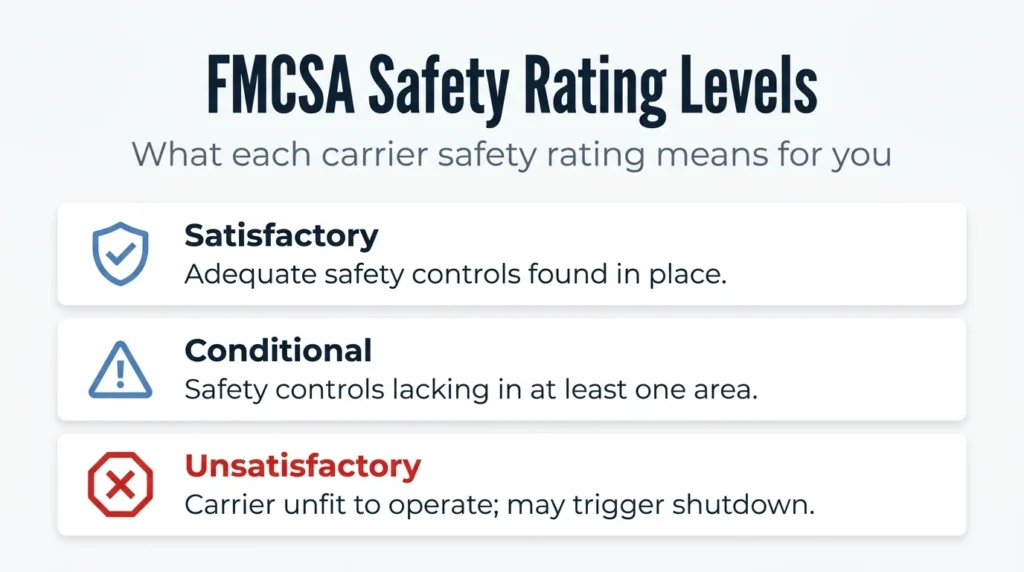
A “Satisfactory” rating means the agency found adequate safety controls in place. “Conditional” means controls were lacking in at least one area, and “Unsatisfactory” means the carrier has been formally determined unfit to operate, which can trigger a shutdown order if the problems are not fixed within 45 days. A carrier with a Conditional or Unsatisfactory rating at the time of your crash is a significant detail for your claim.
Can the FMCSA actually shut down a bus company for safety violations?
Yes. If a compliance review results in an Unsatisfactory safety rating, the carrier has 45 days to show corrective action before a federal out-of-service order takes effect. The FMCSA can also issue an immediate order if a carrier’s operations pose an imminent hazard, such as a pattern of drug or alcohol violations tied to fatal crashes.
Are school buses covered by the same FMCSA rules as charter or intercity buses?
It depends on the trip. School buses that run only between home and school on regular routes are largely exempt from FMCSA rules. When a school bus crosses state lines for a field trip, athletic event, or similar activity, it must comply with the full set of federal safety standards, including driver qualification, hours of service, and maintenance rules.
What happens to my claim if I was partly at fault for the bus crash?
Texas follows a modified comparative fault rule. Your compensation is reduced by your share of the fault, but you can still recover as long as you are not found more than 50% responsible. If your percentage reaches 51% or higher, you lose the right to recover anything at all.
About the Authors

Angel Reyes
Writer
Angel L. Reyes, III is the Founder and Managing Partner of Angel Reyes & Associates. A nationally recognized trial attorney and business leader, Angel has helped over 70,000 injury victims recover more than $1 billion since founding the firm in 1993. Named to the Texas Super Lawyers list annually since 2008, Angel brings Wall Street experience, Ivy League education, and a deep commitment to client advocacy. He is a frequent legal commentator and published author with extensive contributions to legal scholarship, trial strategy, and consumer protection.

Graham Griffin
Editor
Graham Griffin is the Web & Content Manager at Angel Reyes & Associates, where he oversees content strategy, AI-powered workflows, a...

Angel Reyes
Reviewer
Angel L. Reyes, III is the Founder and Managing Partner of Angel Reyes & Associates. A nationally recognized trial attorney and business...