Tour Bus Accident Claims in Texas


Every article on this site is researched by our internal team, reviewed for legal accuracy against current Texas law, and held to State Bar of Texas advertising standards before publication. We do not publish content that overstates outcomes or makes promises about results.
Learn more about our
editorial standards .
Key Takeaways
- A private tour bus claim follows Texas rules, not the government Tort Claims Act.
- Texas's long-arm statute can let you sue an out-of-state tour operator here.
- You have two years to file a tour bus accident lawsuit against a private operator.
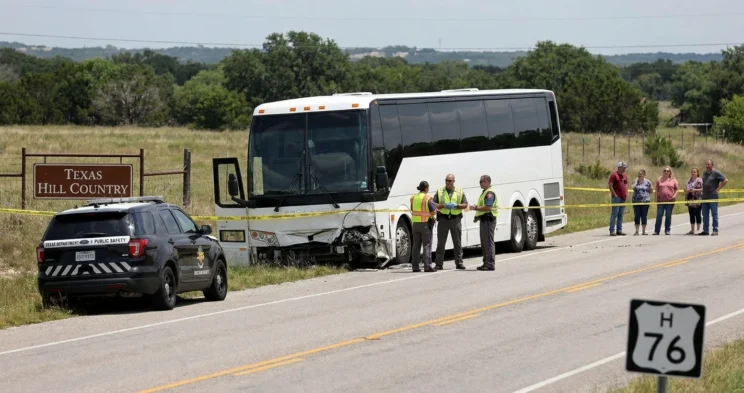
You booked the trip months ago: a multi-day sightseeing tour that picked you up near the River Walk in San Antonio and headed out toward the Hill Country. Somewhere past Boerne, the driver drifted onto the shoulder, and the coach lurched hard enough to throw you into the seat ahead of you.
Now you are home with a neck injury, a stack of medical bills, and a tour company you cannot even confirm is based in Texas. Who is actually responsible?
Tour Bus Accidents vs. Public Transit Claims
A sightseeing bus accident in Texas follows private-carrier rules, not the government claims process that covers city and school buses. That difference decides who you can sue and how long you have to act.
Large bus crashes are a documented federal safety concern, which is part of why the liability rules for private operators matter to an injured passenger. The FMCSA publishes large bus and truck crash data showing how often these wrecks cause serious harm.
Private Tour & Charter Operators
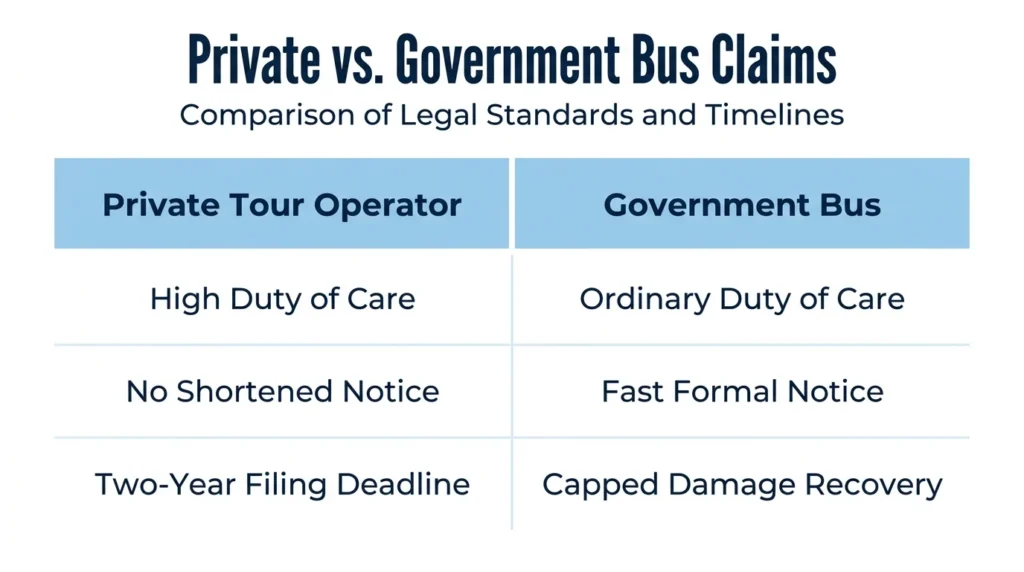
A private tour or charter company owes you a common carrier’s high duty of care. That duty is stricter than the ordinary care most drivers owe, and it grows out of the booking relationship, not any government rule.
This holds whether you booked a single afternoon sightseeing tour or a multi-day trip crossing several state lines. The operator’s obligation to carry you safely does not shrink because the itinerary got longer.
Government Buses & the Tort Claims Act
City buses and school buses work differently. They belong to a government entity, so the Texas Tort Claims Act controls those claims instead.
That law limits how much you can recover and forces you to give formal notice fast, long before a private claim would expire. A private tour operator gets none of those protections, which usually helps your case.
Who Is Liable in a Tour Bus Accident?
More than one party can share the blame for a tour bus crash. Working out who is liable in a tour bus accident in Texas usually starts with everyone whose choices put you on that bus:
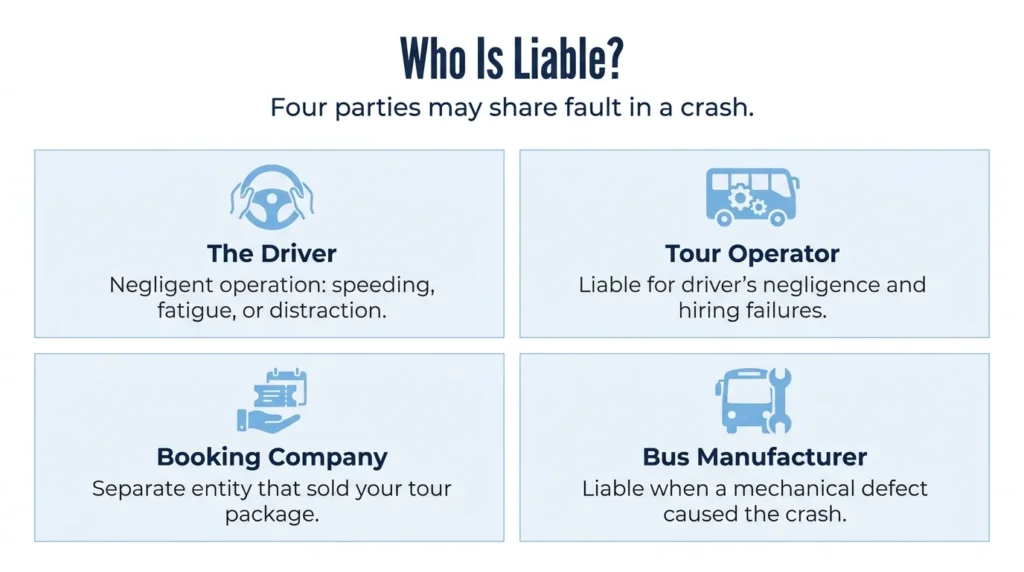
- The driver: for negligent operation of the bus, such as speeding, fatigue, or distraction behind the wheel.
- The tour or charter operator: responsible for an employee driver’s negligence, and for its own choices in hiring, training, or keeping that driver. This is where charter and tour bus operator responsibility often becomes the heart of the case.
- A separate leasing or booking company: when the business that sold your tour package is legally distinct from the one operating the bus.
- The bus or a parts manufacturer: when a mechanical defect, like failed brakes, helped cause the crash.
Texas divides fault among those parties under Texas Civil Practice and Remedies Code (CPRC) Chapter 33, the proportionate responsibility statute. Each party answers for its own share of the blame, and your financial recovery drops if you are found partly at fault.
Because records like driver logs and lease agreements get harder to obtain over time, it helps to understand how bus accident liability works in Texas before that evidence disappears.
Can You Sue an Out-of-State Tour Operator?
Often, yes. A Texas court can hear your claim when the operator has enough connection to Texas, regardless of where the trip began or ended.
Texas Civil Practice and Remedies Code § 17.042, the long-arm statute, lets a Texas court reach an out-of-state operator that sells tours to Texas residents or picks passengers up here. Marketing trips to Texans or putting a Texas stop on the route can settle the out of state tour bus accident jurisdiction question in your favor.
When you and the operator live in different states, you may also file in or move the case to federal court under 28 U.S.C. § 1332, the diversity jurisdiction statute. Which court fits your claim depends on the facts of your specific trip.
These questions get complicated quickly, so choosing a team with a long track record in Texas injury cases can shape how smoothly your claim moves.
Tour Bus Insurance & Safety Rules
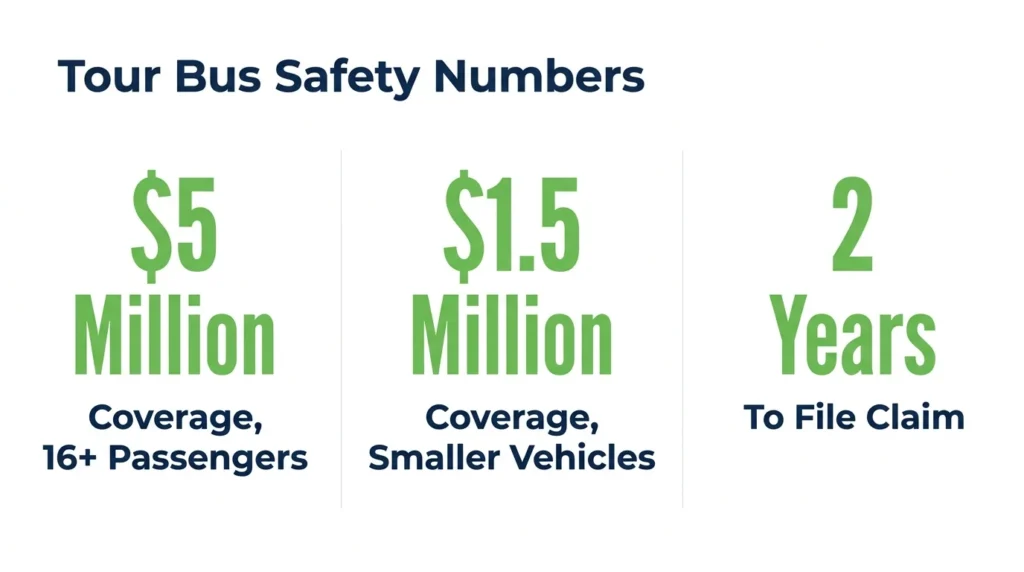
Interstate tour operators carry far more insurance than an ordinary driver, and federal law sets the floor. Under 49 C.F.R. Part 387, a bus built for 16 or more passengers must carry at least $5 million in liability coverage, and smaller vehicles at least $1.5 million.
Those federal rules reach past insurance, too. Federal passenger carrier safety standards govern driver qualifications, hours-of-service limits, and vehicle inspections for interstate operators.
Those records become evidence in your claim. Driver logs, inspection reports, and maintenance files can show whether the operator cut corners, the same kinds of records that drive large commercial vehicle injury cases.
Filing a Tour Bus Accident Lawsuit in Texas
You generally have two years from the date of the crash to file a tour bus accident lawsuit in Texas against a private operator. That deadline comes from Texas Civil Practice and Remedies Code § 16.003, the personal injury statute of limitations.
Miss that window, and a court will almost certainly refuse your case, no matter how strong it is.
Private tour claims carry no shortened notice period, unlike claims against government buses.
The process itself mirrors other serious injury claims. Reviewing what to do as an injured bus passenger early, before the deadline nears and evidence fades, gives your claim its strongest footing.
Work with an Experienced Attorney
A tour bus crash can leave you facing an operator, its insurer, and sometimes a booking company that may not even be based in Texas. Angel Reyes & Associates has spent over 30 years helping injured Texans across the state hold those parties accountable, with more than $1 billion recovered for clients.
We work on contingency, so you pay no fee unless we win, and your first consultation is free. When you are ready, schedule a free consultation and we will review your options and every party that may share the blame.
Past results do not guarantee future outcomes.
Tour Bus Accident Claim FAQs
What is the difference between a tour bus and a charter bus?
Both operate under the same federal and Texas motor carrier rules. A charter bus is rented by one group for a custom trip, while a tour bus usually follows a set sightseeing route with multiple stops.
Does travel insurance cover injuries from a tour bus accident?
Many travel insurance policies include medical or accident benefits that can help pay for a tour bus injury, but coverage limits and exclusions vary by policy. Filing a travel insurance claim does not replace a separate injury claim against the tour operator.
What types of compensation can I recover after a tour bus accident?
You can typically pursue medical expenses, lost income, and pain and suffering as part of your claim. In cases involving reckless conduct, a court may also award punitive damages.
What should I do right after a tour bus accident to protect my claim?
Get medical care right away, photograph the scene and your injuries, and get contact information from other passengers who saw the crash. Keep your ticket, itinerary, or booking confirmation, since these help identify the operator and other responsible parties.
If I signed a waiver when I booked the tour, can I still file a claim?
Often yes. Waivers must meet strict language and formatting rules under Texas law, and they usually do not protect an operator from gross negligence or claims outside what they cover.
About the Authors

Angel Reyes
Writer
Angel L. Reyes, III is the Founder and Managing Partner of Angel Reyes & Associates. A nationally recognized trial attorney and business leader, Angel has helped over 70,000 injury victims recover more than $1 billion since founding the firm in 1993. Named to the Texas Super Lawyers list annually since 2008, Angel brings Wall Street experience, Ivy League education, and a deep commitment to client advocacy. He is a frequent legal commentator and published author with extensive contributions to legal scholarship, trial strategy, and consumer protection.

Kyle Nicolas
Editor
Kyle Nicolas is the Web Content & SEO Manager at Angel Reyes & Associates. He has more than 10 years of experience as a marketing co...

Angel Reyes
Reviewer
Angel L. Reyes, III is the Founder and Managing Partner of Angel Reyes & Associates. A nationally recognized trial attorney and business...