Bus Accident Evidence to Strengthen Your Claim


Every article on this site is researched by our internal team, reviewed for legal accuracy against current Texas law, and held to State Bar of Texas advertising standards before publication. We do not publish content that overstates outcomes or makes promises about results.
Learn more about our
editorial standards .
Key Takeaways
- Bus camera footage can be overwritten within 30 to 72 hours of a crash.
- Government-bus claims require written notice within six months of the incident.
- ELD logs, driver files, and maintenance records can prove carrier negligence.
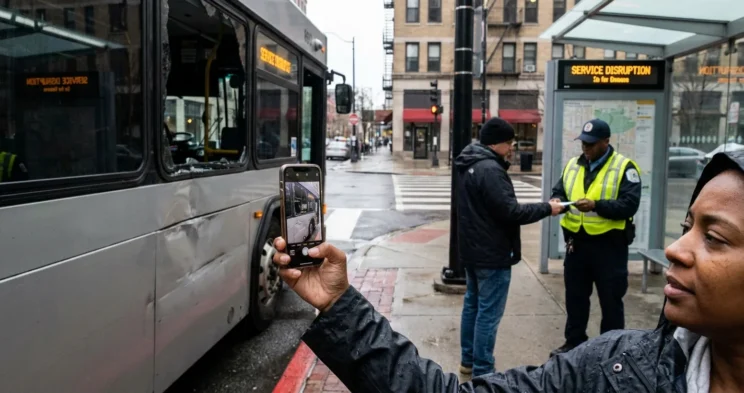
You were riding a city bus home through Deep Ellum when the driver ran the light on Commerce Street and slammed into cross traffic. Now you are hurt, the medical bills are stacking up, and a large transit agency is on the other side. The evidence that proves what happened is already at risk, and some of it can vanish in a matter of days.
Evidence Unique to Bus Accident Cases
Bus and commercial transit crashes leave behind records that ordinary car wrecks never generate. These sources often carry the most weight in your case, and knowing they exist is the first step to protecting them:
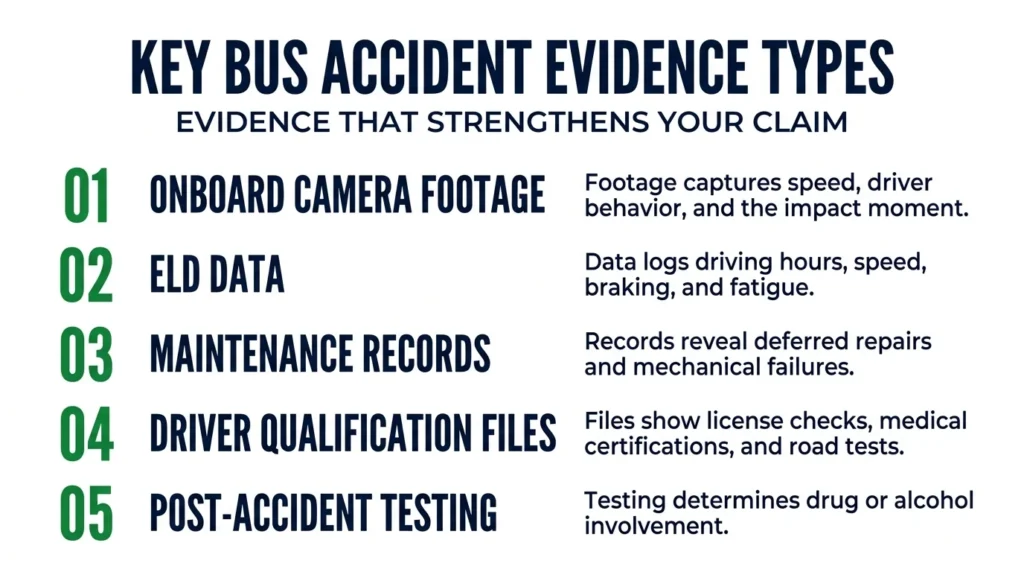
- Onboard camera footage: Most commercial buses run several cameras covering the driver’s cab, the passenger cabin, and the road outside. This footage can show speed, driver behavior, road conditions, and the moment of impact.
- Electronic logging device data: Federal law requires most commercial bus operators to run electronic logging devices, known as ELDs. These devices record hours of service, speed, braking, and route data. That record can prove driver fatigue or hours-of-service violations at the time of the crash, and federal rules on this data appear in FMCSA hours-of-service records under 49 CFR Part 395.
- Passenger manifest: This is a list of ticketed or registered riders on board when the crash happened. It helps establish who was there and can serve as a ready-made witness list.
- Maintenance records: Bus operators must document routine inspections and repairs. Records that show deferred maintenance or repeated mechanical failures can help prove the company was negligent.
- Driver qualification files: Federal rules require commercial bus carriers to keep employment applications, driving record checks, medical certifications, and road test results for every driver.
- Post-accident drug and alcohol testing: Federal rules require covered operators to test drivers after qualifying crashes. For FTA-funded public transit agencies, that obligation appears in the FTA post-accident testing rule at 49 CFR § 655.44; for private motor carriers such as charter and intercity bus companies, the parallel requirement is 49 CFR Part 382. A positive result, or a failure to test at all, is powerful evidence on its own.
- Police and crash reports: The official TxDOT crash report captures the officer’s findings, road conditions, any citations issued, and driver statements. It is one of the first documents you should request when you want to obtain your bus crash evidence for a claim.
- Carrier safety history: The bus company’s public safety record, including past inspections, out-of-service orders, and crash data, is available through federal databases. When you are trying to understand who is liable in a bus accident, that history often points straight to the answer.
Requesting Bus Records in Texas
You have real legal tools to force records out of the parties who hold them. The path you use depends on whether the bus belongs to a government agency or a private company.
When a government transit agency runs the bus, Texas Government Code Chapter 552 gives you the right to request its records. That includes maintenance logs, driver files, incident reports, and camera footage. Submit your request in writing to start the agency’s 10-business-day response window.
Private carriers work differently. You can still check any federal carrier through the free FMCSA company safety records lookup, which returns inspection history, crash data, and safety ratings by carrier name or USDOT number.
Name specific records so nothing gets skipped. Ask for the accident register, which carriers must keep for three years under the FMCSA accident register rule, along with ELD data files, driver qualification files, and maintenance records.
An attorney can send a litigation hold letter the moment you hire them. That letter formally tells the bus company to preserve every relevant record, including data it would otherwise overwrite or purge.
When it comes to how bus accident claims develop, that early hold is often what keeps the case alive.
Preservation Deadlines That Affect Your Claim
Time is the biggest threat to your evidence. Some of it disappears in days, and some deadlines can end your claim no matter how strong it is.
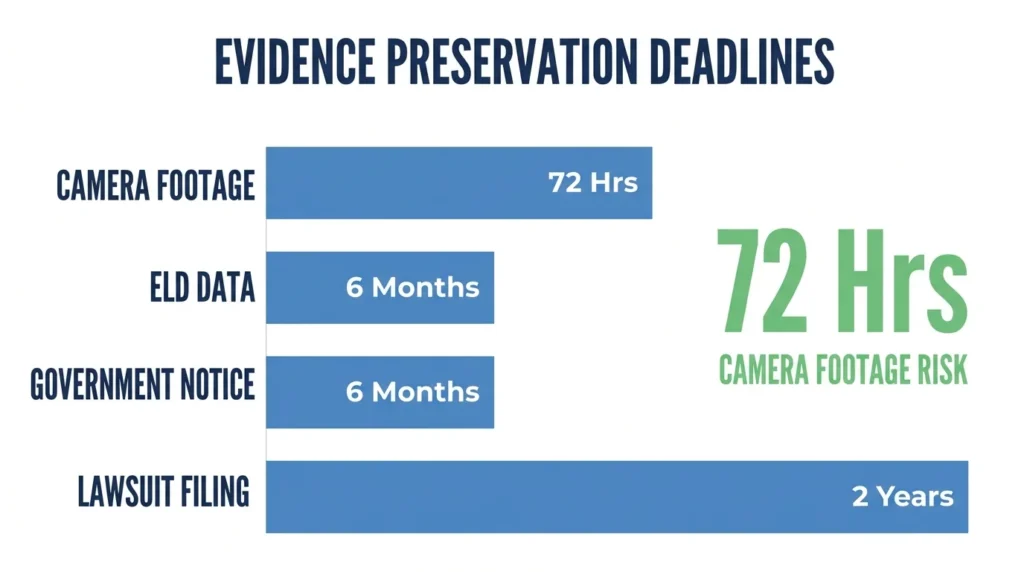
Onboard camera footage is the most fragile. Retention periods vary by agency and carrier; some get deleted as quickly as 72 hours, while others keep footage for 30 days or more.
Without a preservation demand or litigation hold, the footage from your crash can disappear in days.
ELD data lasts longer but still runs out. Federal rules keep these records for about six months. The driver’s hours-of-service data from the day of your crash can disappear at the six-month mark unless someone locks it down.
When a government entity operates the bus, one deadline stands above the rest. Texas Civil Practice and Remedies Code (CPRC) § 101.101 requires written notice of your claim within six months of the incident. Miss it and your claim can end entirely, regardless of merit.
A separate clock also runs. Texas Civil Practice and Remedies Code (CPRC) § 16.003 sets a two-year deadline to file a personal injury lawsuit. The notice deadline for government buses is shorter, so victims in those cases face two distinct deadlines at once.
Witness memory fades on its own schedule. Passengers, bystanders, and other drivers recall the details most clearly in the first days and weeks. Gathering contact information and written statements early protects this evidence layer.
Government vs. Private Bus Defendants
The identity of the bus operator decides which rules govern your claim and which evidence carries the most weight. Readers confuse these two paths more than almost any other point in bus cases.
Claims Against Public Transit Agencies
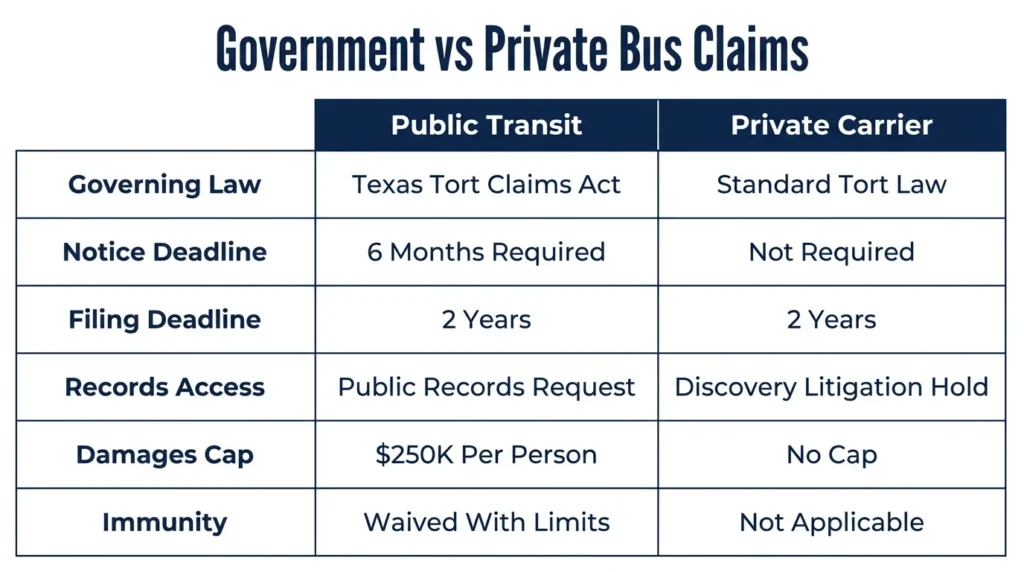
Public transit agencies are government entities, so the Texas Tort Claims Act applies to your claim. The six-month notice deadline, the immunity limits, and the public records process all come into play when the defendant runs city buses, metro connectors, or other publicly funded routes.
The Act waives governmental immunity for injuries caused by an employee’s negligent operation of a motor vehicle, but only within the limits set by Texas Civil Practice and Remedies Code (CPRC) § 101.021.
Because these agencies fall under Chapter 552, their records are often easier to compel than a private carrier’s. Your notice must land within six months and must describe the incident, the damages you claim, and who you are.
Claims Against Private Bus Carriers
Private bus companies, including charter operators, school bus contractors, and intercity carriers, are not covered by the Texas Tort Claims Act. The standard two-year deadline applies instead, and federal FMCSA rules govern how you reach their records.
Private carriers must follow FMCSA rules on ELDs, driver qualification files, post-accident testing, and accident register retention. You reach these records through discovery or a litigation hold, not a public records request.
You can check a private carrier’s safety rating and inspection history before you file. Pull it from the FMCSA company snapshot tool, or review a carrier’s record through the FMCSA bus safety search.
The rules split so sharply that the wrong assumption can cost you the case. Sorting out how to file a bus accident claim in Texas starts with confirming which framework applies.
Talk to an Experienced Attorney
Bus cases move fast, and the evidence that proves them moves faster. Angel Reyes & Associates has spent over 30 years helping injured Texans hold transit agencies and bus companies accountable, with more than $1 billion recovered for clients.
We offer free initial consultations, and you pay no fee unless we win. Our team is available 24/7 and serves the entire state of Texas, so you can reach us the moment you need answers.
Do not wait for critical footage to be deleted. Schedule a free consultation with us and let us review your options. You can also read our client reviews and testimonials or find our office locations across Texas to see how we work.
Past results do not guarantee future outcomes.
Bus Accident Evidence FAQs
Can I file a claim if another vehicle caused the bus accident?
Yes. If a third-party driver’s negligence caused or contributed to the crash, you may have a claim against that driver and their insurer in addition to any claim against the bus operator. Texas allows you to pursue multiple at-fault parties in the same lawsuit.
What medical records should I keep after a bus accident?
Hold onto every emergency room visit record, diagnosis, imaging result, prescription, and follow-up appointment note from the date of the crash forward. These documents link your injuries directly to the accident and are the foundation of your damages claim.
Who pays my medical bills while the bus accident claim is still open?
Your own health insurance or any personal injury protection coverage on the vehicle you were in may cover costs while the claim is pending. A settlement or judgment from the bus operator typically comes later, often after treatment is complete or ongoing costs are better established.
Can a school bus accident be filed the same way as a city transit claim?
It depends on who operates the school bus. Buses run by a public school district are government-owned, so the Texas Tort Claims Act applies along with its six-month notice requirement. Buses operated by a private contractor for the district are not government property, so standard tort rules and the two-year statute of limitations apply instead.
Does Texas limit how much I can recover from a government transit agency?
The Texas Tort Claims Act caps damages against government entities. For personal injury claims involving a government-operated vehicle, the cap is $250,000 per person and $500,000 per occurrence, with a separate $100,000 cap on property damage per occurrence. These limits apply regardless of the full extent of your losses.
About the Authors

Angel Reyes
Writer
Angel L. Reyes, III is the Founder and Managing Partner of Angel Reyes & Associates. A nationally recognized trial attorney and business leader, Angel has helped over 70,000 injury victims recover more than $1 billion since founding the firm in 1993. Named to the Texas Super Lawyers list annually since 2008, Angel brings Wall Street experience, Ivy League education, and a deep commitment to client advocacy. He is a frequent legal commentator and published author with extensive contributions to legal scholarship, trial strategy, and consumer protection.

Kyle Nicolas
Editor
Kyle Nicolas is the Web Content & SEO Manager at Angel Reyes & Associates. He has more than 10 years of experience as a marketing co...

Angel Reyes
Reviewer
Angel L. Reyes, III is the Founder and Managing Partner of Angel Reyes & Associates. A nationally recognized trial attorney and business...