Rideshare Driver Criminal History & Your Claim


Every article on this site is researched by our internal team, reviewed for legal accuracy against current Texas law, and held to State Bar of Texas advertising standards before publication. We do not publish content that overstates outcomes or makes promises about results.
Learn more about our
editorial standards .
Key Takeaways
- Texas law requires TNCs to run national criminal background checks before drivers go live.
- A background check failure can open a negligent hiring claim against the rideshare company.
- Texas gives you two years from the accident date to file a personal injury lawsuit.
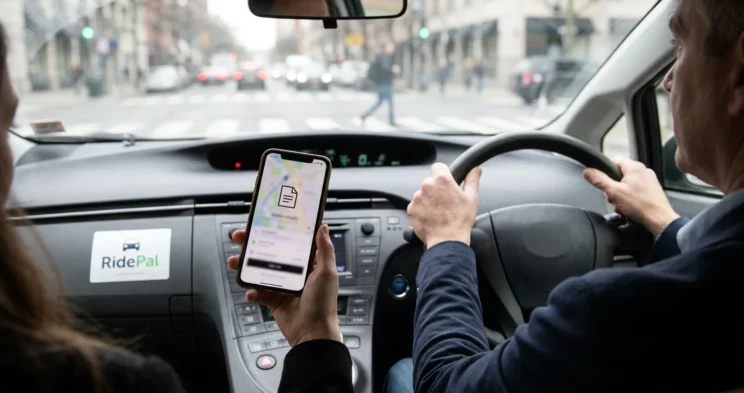
You were riding home from the Montrose area when the Uber driver ran a stoplight on Shepherd Drive and T-boned another car. You ended up in the hospital, and now you’re finding out the driver had a prior felony conviction that should have kept them off the platform entirely. You want to know if Uber is on the hook for putting them on the road.
The answer depends on what Uber was supposed to check and whether it actually checked.
What Uber & Lyft Are Required to Check
Texas law sets specific screening requirements for every rideshare company operating in the state. Under Texas Occupations Code § 2402.107, a transportation network company must conduct a national criminal background check and a driving record review before any driver logs onto the platform. That check must use a commercial multistate and multijurisdiction criminal records database and include the national sex offender registry maintained by the U.S. Department of Justice.
The statute does not let a company run one check and call it done. Annual re-screening is required for every active driver. If Uber or Lyft learns of a new arrest or conviction between annual checks, that information can trigger additional review and possible deactivation.
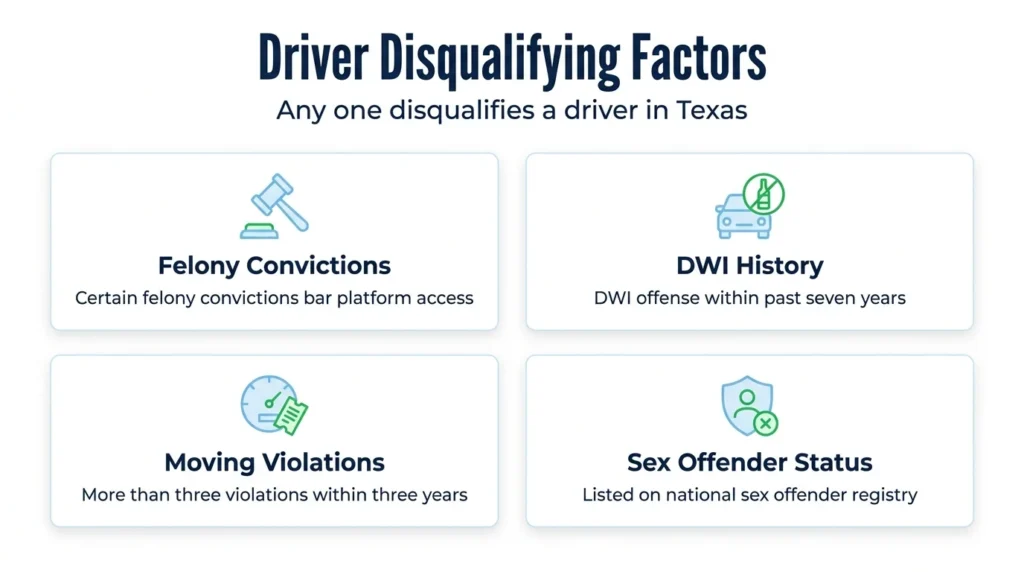
Disqualifying factors include certain felony convictions, DWI (Driving While Intoxicated) offenses within the preceding seven years, more than three qualifying moving violations within the preceding three years, and sex offender registry status. A driver who meets any of those criteria cannot legally log onto the platform under Texas Occupations Code Chapter 2402. The Texas Department of Licensing and Regulation oversees Transportation Network Company (TNC) compliance in the state.
What Negligent Hiring Means in Practice
Negligent hiring is the theory that holds the company, not just the driver, responsible for a crash. It applies when the company failed to do what it was supposed to do during the screening process, and that failure put a dangerous person behind the wheel. You can find a broader overview of when you can sue Uber directly for an accident on our blog.
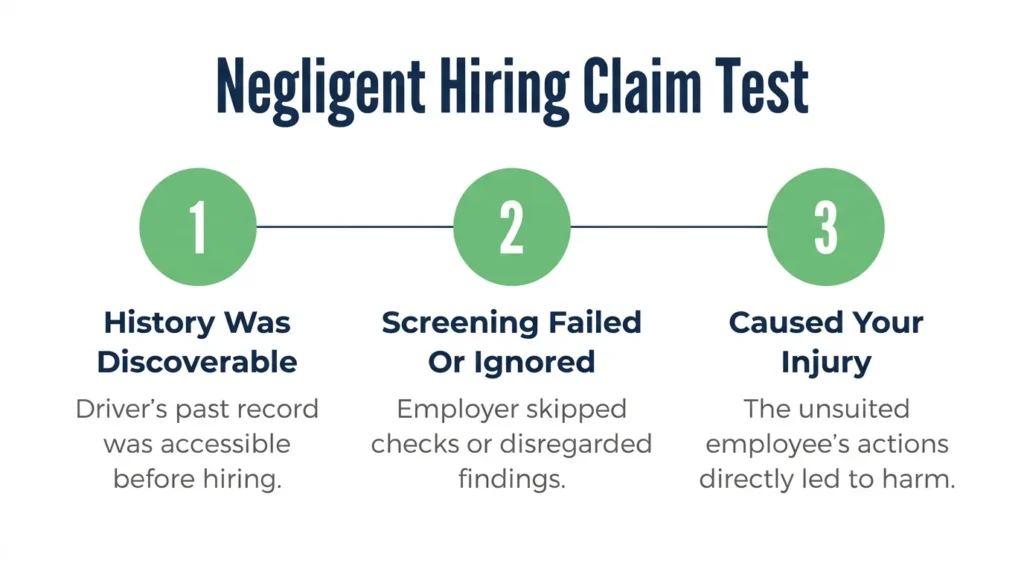
Three things must be true for a negligent hiring claim to hold.
- The driver’s disqualifying history had to be discoverable through the screening that was required.
- The company either failed to run the check, ran an incomplete one, or ignored what came back.
- The disqualifying history had to be a proximate cause of your injury.
If the driver had a prior DWI conviction and caused your crash while intoxicated, the connection is direct. If the prior conviction involved an unrelated offense, connecting it to the crash requires more analysis.
Negligent retention is a closely related theory to negligent hiring. Where negligent hiring targets what happened before the driver was approved, negligent retention targets what happened after. If Uber received complaints about a driver’s behavior after onboarding, and kept the driver active anyway, that failure can support a separate claim, even if the original background check was clean.
Because rideshare companies classify their drivers as independent contractors, you generally cannot use respondeat superior, the legal doctrine that holds employers liable for an employee’s on-the-job actions. Negligent hiring fills that gap by focusing on the company’s own conduct rather than the driver’s.
If you were hurt by a rideshare driver and the screening process may have failed, an attorney who handles TNC claims can evaluate whether negligent hiring applies to your situation.
Lyft Driver Criminal History & Screening Gaps
Lyft faces the same obligations under Texas Occupations Code Chapter 2402, as the statute makes no distinction between the two platforms. Both must run the same checks, both must re-screen annually, and both face direct liability when they approve a driver who should have been disqualified. Consequently, if you were a Lyft passenger, you have the same potential negligent hiring claim against Lyft that a rider against Uber would have, and our blog covers when you can sue Lyft for a rideshare accident if you want to understand how those claims develop.
Documented gaps in TNC screening systems include incomplete multistate database coverage, lag time between an incident report and deactivation, and failure to act on in-app complaints from other riders. When those gaps allow a driver with disqualifying history to stay on the platform, the company cannot point to its general screening process as a defense since the process itself broke down.
When Lyft has actual knowledge that a driver was disqualified and fails to deactivate, the statute opens a path to direct corporate liability. That is separate from, and can stack on top of, the common law negligent hiring claim.
How a Screening Failure Strengthens Your Claim
A standard rideshare accident claim focuses on the driver’s negligence: who caused the crash and what injuries resulted from the crash. Adding a negligent hiring theory opens a direct claim against the TNC itself, which typically carries far more insurance and assets than the individual driver.
While your compensable damages do not change, your recovery options expand to include medical expenses, lost wages, and pain and suffering from both the driver and the company, with courts considering punitive damages if the TNC’s conduct was egregious enough. Under Texas Civil Practice and Remedies Code (CPRC) Chapter 33, fault can be apportioned among everyone whose conduct contributed to your injury. If the driver is found 60% responsible and the TNC is found 40% responsible for the screening failure, you can recover from both.
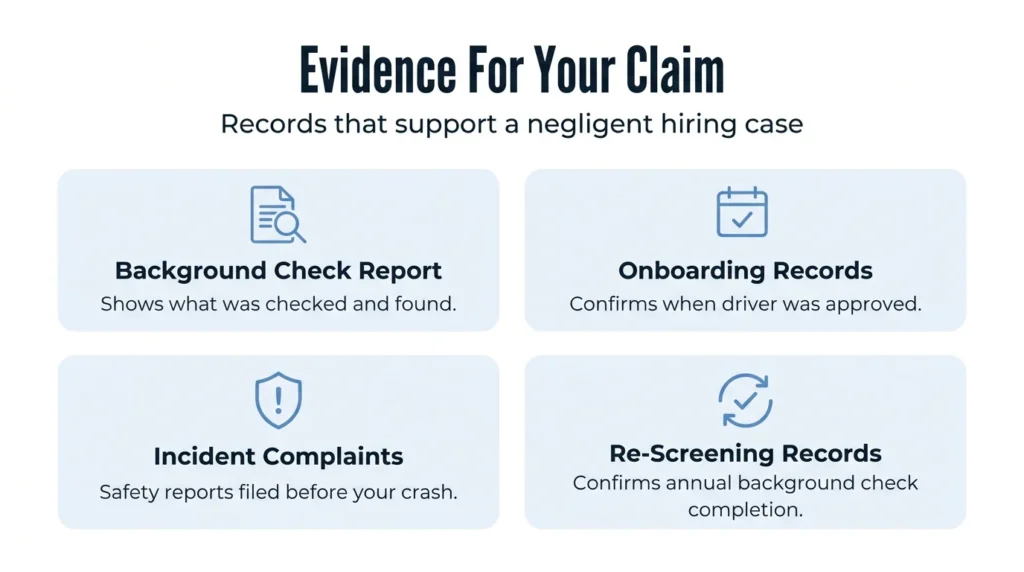
The evidence that supports a negligent hiring claim goes beyond the police report. Here is what an attorney will typically pursue:
- Background check report: The actual report Uber or Lyft received, showing what was checked and what came back.
- Onboarding records: Documents confirming when the driver was approved and what criteria were reviewed.
- Prior incident complaints: In-app complaints, safety reports, or internal notes about the driver that the company received before your crash.
- Re-screening records: Documentation confirming whether the required annual background check was completed.
Timing is a hard constraint because the Texas Civil Practice and Remedies Code § 16.003 gives you two years from the date of your accident to file a personal injury lawsuit, meaning a negligent hiring claim against the TNC falls under the same deadline. Waiting reduces the chance of obtaining internal records before they are overwritten or purged. Furthermore, understanding how Uber and Lyft insurance coverage periods work is also part of this analysis, since the app status at the time of the crash determines which insurance layer applies.
Talk to an Attorney About Your Rideshare Claim
If a rideshare driver’s criminal record or a failed background check contributed to your accident, you may have a claim not just against the driver but against the company itself. Before your consultation, gather what you have: the police report, any screenshots from the rideshare app, and notes about what the driver told you at the scene. Our team can help you understand what additional records to request and what to do after a rideshare accident in Texas to protect your claim.
To learn more about how we handle rideshare accident cases, visit our Texas rideshare accident practice page. Angel Reyes & Associates has spent over 30 years helping injured Texans work through claims exactly like this, offering free initial consultations with no fee unless we win.
With more than 20 offices statewide, our team is available 24/7, proudly provides services in both English and Spanish, and is ready when you are to reach out and schedule a free consultation.
Past results do not guarantee future outcomes.
Rideshare Driver History & Your Claim FAQs
Do Uber and Lyft background checks include fingerprinting?
No. Texas state law does not require rideshare companies to use fingerprint-based checks. Uber and Lyft use name-based commercial background check databases instead.
Can a negligent hiring claim still hold if the driver's criminal record was older than seven years?
Possibly. While the standard lookback is seven years, some crimes, including sexual assault and murder, disqualify a driver permanently under Uber’s own policies. If an older conviction falls into a permanently disqualifying category and the company approved the driver anyway, the failure may still support a claim.
Does the negligent hiring theory apply if the driver was logged off the app at the time of the crash?
Generally no. Negligent hiring targets the company’s decision to put a driver on the platform, but the TNC’s liability coverage only applies when the driver is logged into the app. An off-app crash is handled as a standard personal injury claim against the individual driver.
What if the background check was accurate but the driver got a DWI after being approved?
That shifts the theory from negligent hiring to negligent retention. If Uber or Lyft received notice of a new conviction or complaint and kept the driver active without re-screening, the company can face liability for that failure under Texas law.
Can the rideshare company destroy screening records before a lawsuit is filed?
Companies have a legal duty to preserve relevant records once they know litigation is likely. An attorney can send a formal preservation demand early in the process to put the company on notice and reduce the chance that background check data is deleted or overwritten before your case is built.
About the Authors

Angel Reyes
Writer
Angel L. Reyes, III is the Founder and Managing Partner of Angel Reyes & Associates. A nationally recognized trial attorney and business leader, Angel has helped over 70,000 injury victims recover more than $1 billion since founding the firm in 1993. Named to the Texas Super Lawyers list annually since 2008, Angel brings Wall Street experience, Ivy League education, and a deep commitment to client advocacy. He is a frequent legal commentator and published author with extensive contributions to legal scholarship, trial strategy, and consumer protection.

Graham Griffin
Editor
Graham Griffin is the Web & Content Manager at Angel Reyes & Associates, where he oversees content strategy, AI-powered workflows, a...

Angel Reyes
Reviewer
Angel L. Reyes, III is the Founder and Managing Partner of Angel Reyes & Associates. A nationally recognized trial attorney and business...