Pedestrian Hit by an Uber or Lyft in Texas


Every article on this site is researched by our internal team, reviewed for legal accuracy against current Texas law, and held to State Bar of Texas advertising standards before publication. We do not publish content that overstates outcomes or makes promises about results.
Learn more about our
editorial standards .
Key Takeaways
- Rideshare coverage for pedestrians depends on the driver's app status at impact.
- Periods 2 and 3 trigger a $1,000,000 primary policy covering injured pedestrians.
- Texas gives you two years to file your pedestrian injury claim under CPRC 16.003.
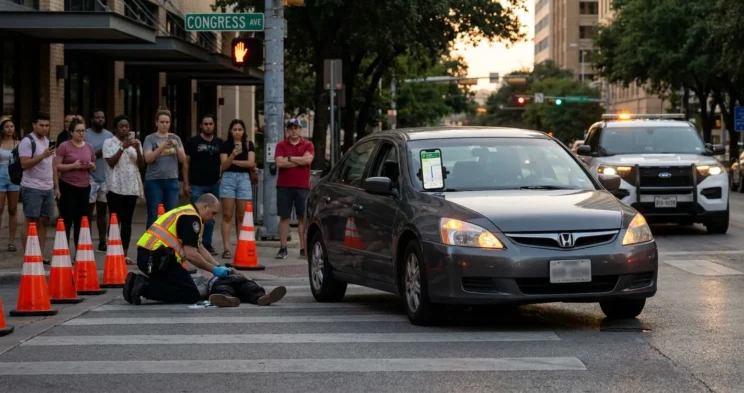
You were crossing the street near your job in downtown Houston when a car turned without yielding and clipped you in the crosswalk. As you steadied yourself, you noticed a small decal in the windshield and wondered if the driver was working for a rideshare app.
Now you are facing medical bills, and you’re left wondering: Does that company’s insurance still cover you?
How to Identify the Rideshare Company After a Crash
The fastest way to confirm whether the driver was working for Uber or Lyft is to look at the vehicle before the driver leaves. Both companies require an active driver to display a visible decal, an illuminated dashboard sign, or an in-app marker on the windshield.
If you are a pedestrian who was hit by a rideshare driver, that visual proof matters because it points to which insurance policy may apply to you. Get it while the scene is fresh.
Photograph the license plate right away. That plate lets law enforcement or your attorney later confirm the driver’s transportation network company registration through the Texas Department of Licensing and Regulation’s TNC operations records.
Ask the driver directly which platform they were using. Request their name, their insurance information, and the company they drive for.
If the driver leaves before you can exchange information, you still have options. Ask any witnesses for a description of the car, then pull the crash report from the investigating officer, who often notes the rideshare affiliation when it is visible.
A hit-and-run does not always end your recovery. If the rideshare vehicle cannot be identified, your own uninsured motorist (UM) coverage may still apply to your injuries.
If you were hit and cannot confirm the driver’s rideshare status, an attorney familiar with what to do after a rideshare accident can help you trace the vehicle and preserve evidence.
Texas Rideshare Insurance Tiers for Pedestrians
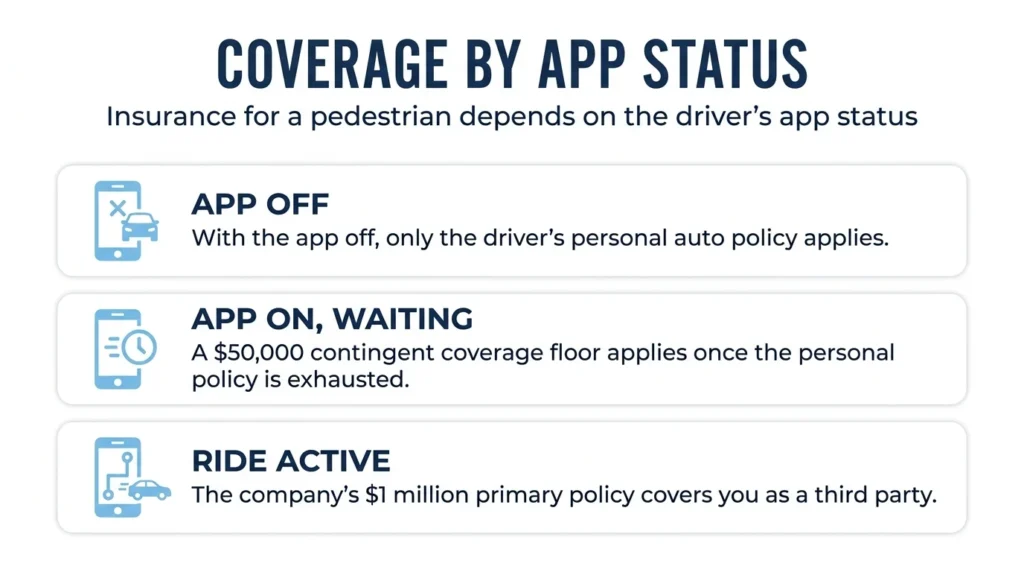
Whether a rideshare company owes you anything depends on one thing: what the driver’s app was doing at the moment of impact. Texas law ties coverage to four distinct app periods, and the gap between them is the difference between full protection and almost none.
Period 0: App Off at Time of Crash
When the driver’s app was completely off, Uber and Lyft owe you nothing. Only the driver’s personal auto policy applies to your injuries.
Texas does not require rideshare companies to cover crashes that happen entirely outside app use. That leaves the driver’s personal policy as your only source, and many personal policies exclude commercial driving, which can create a coverage gap.
If that policy is too small or denies the claim, your own UM/UIM (underinsured motorist) coverage becomes your next option.
Period 1: App On, No Ride Accepted
When the driver was logged in but had not yet accepted a ride, a contingent coverage floor applies under Texas Insurance Code § 1954.052.
That floor provides $50,000 per person for bodily injury, $100,000 per occurrence, and $25,000 for property damage. It activates only when the driver’s personal policy does not respond first.
This tier provides lower limits than the full-ride periods. The driver’s personal policy and the rideshare carrier’s coverage may both apply, and neither is required by law to wait for the other to deny a claim first. Disputes over which policy pays can still arise in practice.
Period 1 is the most contested tier. Insurers fight over whether the driver was genuinely available or simply had the app open in the background, a distinction the existing breakdown of Uber and Lyft coverage periods explains in more detail.
Periods 2 & 3: Ride Accepted through Trip End
Once the driver accepts a ride or has a passenger on board, the company’s primary policy covers you. Insurance Code § 1954.053 requires at least $1,000,000 in coverage per incident for death, injury, and property damage.
As a pedestrian, you count as a third party under that policy. It protects you even though you were never part of the ride in any way.
Confirming which period applied is one of the first things an attorney checks. The company’s own ride logs and GPS timestamps establish the driver’s app status at the exact second you were hit, which is why these records often decide whether you can sue Lyft or Uber for an accident.
Filing a Claim as a Pedestrian Third Party
A pedestrian hit by a rideshare driver has the same legal rights as any other injured third party in Texas. The claim process has a clear order, and following it protects the evidence that decides your case.
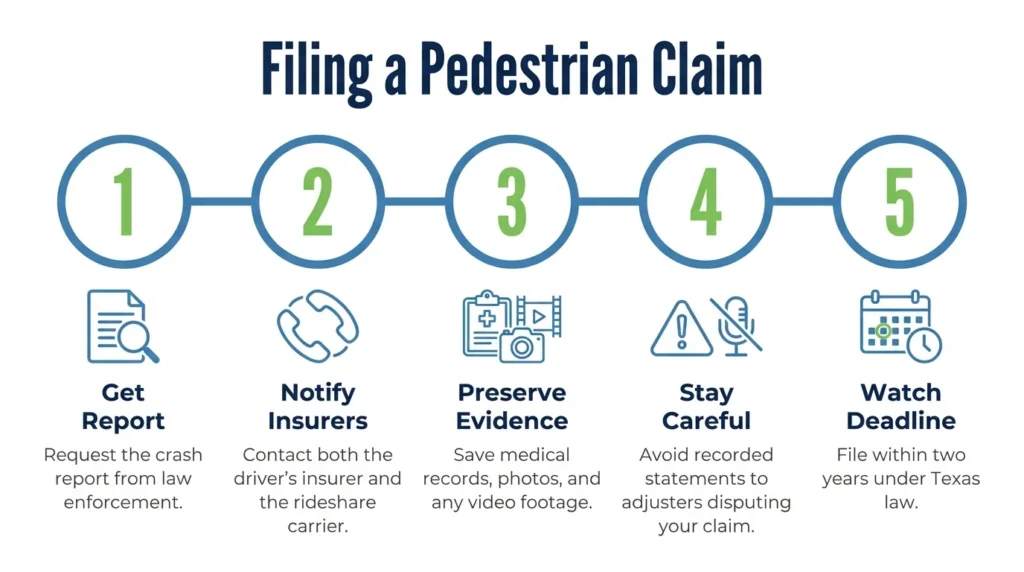
Step 1: Get the crash report. Request it from the law enforcement agency that responded. The report documents the rideshare affiliation, the driver’s identity, and the officer’s preliminary fault findings.
Step 2: Notify both insurers. Contact the driver’s personal auto insurer and the rideshare company’s carrier. Do not file with only one, because which policy pays depends on the period determination.
Step 3: Preserve your evidence. Save medical records, bills, photos of your injuries, and any dashcam or surveillance footage. Rideshare platforms keep driver GPS and app-status logs, but that data can disappear without a legal hold request.
Step 4: Handle insurer contact carefully. Adjusters for rideshare carriers are experienced at disputing pedestrian claims, often by arguing the driver was in Period 0 or Period 1. An attorney can request the rideshare records on your behalf before they are purged, which is one reason injured pedestrians benefit from understanding Texas pedestrian accident claims early.
Step 5: Watch the deadline. Texas gives you two years to file a personal injury claim under Texas Civil Practice and Remedies Code (CPRC) § 16.003. Waiting too long can cost you the right to recover anything.
Texas Fault Rules & What the TNC May Argue
Texas lets you recover damages as long as your share of the fault stays at 50 percent or less. Under proportionate responsibility in Civil Practice and Remedies Code Chapter 33, reaching 51 percent or more bars your recovery entirely.
That rule is exactly why rideshare insurers work to pin fault on you. The Texas 51 percent comparative negligence rule gives them a financial reason to shift blame onto the pedestrian.
Their common arguments are predictable. They claim you crossed outside a crosswalk, that you were looking at your phone, that you stepped into the road without looking, or that dark clothing at night made you hard to see.
These claims are not the last word. Texas law does not automatically fault you for crossing outside a marked crosswalk, and it weighs all the circumstances, including the driver’s own duty to yield.
When a pedestrian is killed, the same fault framework governs the family’s case. Relatives can pursue survival and wrongful death damages under these same proportionate responsibility rules.
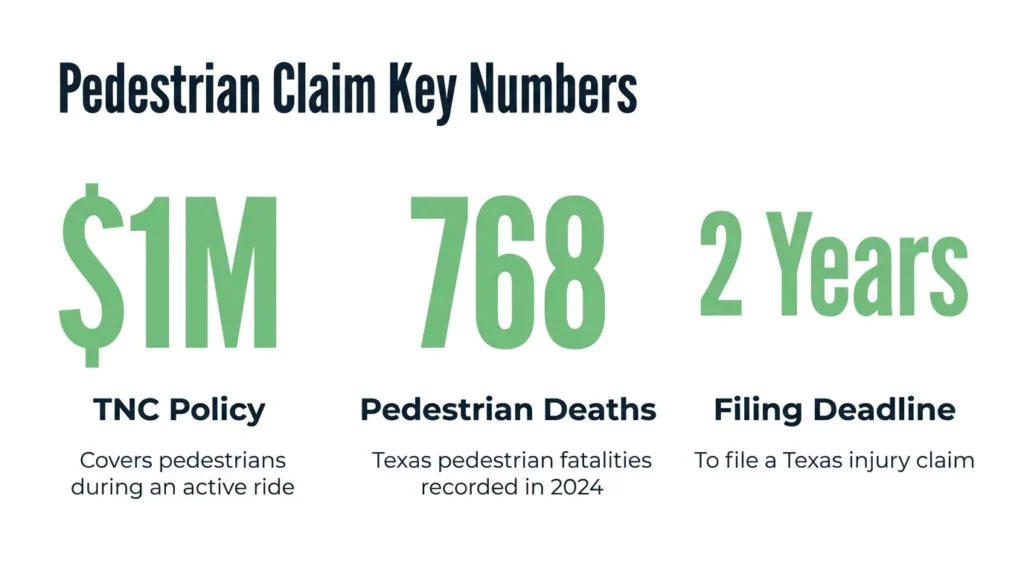
The stakes are real. TxDOT crash data recorded 768 pedestrian fatalities in Texas in 2024, which shows how serious these collisions become when fault is in dispute.
Injured Pedestrian? Talk to a Texas Rideshare Lawyer
Sorting out which period applied, which insurer pays, and how much fault the other side will try to assign is hard to do alone while you are healing. Angel Reyes & Associates has spent more than 30 years handling rideshare accident claims for injured people across the entire state of Texas.
We work on a no-fee-unless-we-win basis; your first consultation is free, and we have recovered more than $1 billion for clients over the years. You can see how we have handled cases like yours through our client reviews and testimonials.
We are available 24/7 in both English and Spanish to start reviewing your options. Reach out for your free consultation and let us handle the insurers while you focus on recovering.
Past results do not guarantee future outcomes.
Pedestrian Hit by a Rideshare in Texas
Can a pedestrian sue Uber or Lyft directly if their driver caused the crash?
Texas classifies rideshare drivers as independent contractors, which limits a company’s direct liability in most cases. In practice, injured pedestrians typically recover through the Transportation Network Company’s (TNC) $1,000,000 insurance policy rather than a direct lawsuit against the company.
What types of damages can a pedestrian injured by a rideshare driver recover in Texas?
A pedestrian may recover medical expenses, lost wages, reduced earning capacity, and pain and suffering. Property damage, such as a broken bicycle or damaged personal items, may also be claimed.
Does a pedestrian need to own a car or carry their own auto insurance to file a claim after being hit by a rideshare driver?
No. As a third party, a pedestrian can file a claim directly against the rideshare driver’s applicable insurance policy without having any auto insurance of their own. Your own coverage only becomes relevant if the at-fault driver’s policy is insufficient or denied.
Does Texas require rideshare companies to carry uninsured motorist coverage that protects pedestrians?
Texas Insurance Code Chapter 1954 does not mandate that TNCs carry uninsured motorist coverage for third parties such as pedestrians. If the rideshare driver’s personal policy and the TNC’s contingent coverage are both unavailable, your own UM/UIM policy is the primary safety net.
If a pedestrian's health insurance paid for treatment after a rideshare crash, does that money have to be repaid from a settlement?
In many cases, yes. Health insurers and government programs such as Medicaid or Medicare often have subrogation rights that allow them to recover what they paid from any injury settlement. The amount subject to repayment depends on the plan’s terms and the applicable Texas law.
About the Authors

Angel Reyes
Writer
Angel L. Reyes, III is the Founder and Managing Partner of Angel Reyes & Associates. A nationally recognized trial attorney and business leader, Angel has helped over 70,000 injury victims recover more than $1 billion since founding the firm in 1993. Named to the Texas Super Lawyers list annually since 2008, Angel brings Wall Street experience, Ivy League education, and a deep commitment to client advocacy. He is a frequent legal commentator and published author with extensive contributions to legal scholarship, trial strategy, and consumer protection.

Kyle Nicolas
Editor
Kyle Nicolas is the Web Content & SEO Manager at Angel Reyes & Associates. He has more than 10 years of experience as a marketing co...

Angel Reyes
Reviewer
Angel L. Reyes, III is the Founder and Managing Partner of Angel Reyes & Associates. A nationally recognized trial attorney and business...