Uber Accidents When the Rideshare Driver Is Not at Fault


Every article on this site is researched by our internal team, reviewed for legal accuracy against current Texas law, and held to State Bar of Texas advertising standards before publication. We do not publish content that overstates outcomes or makes promises about results.
Learn more about our
editorial standards .
Key Takeaways
- The at-fault driver's insurer pays first when a third party causes your Uber crash.
- Uber must carry UM/UIM coverage during your ride when the at-fault driver cannot pay.
- Texas gives you two years from the crash date to file your Uber injury claim.
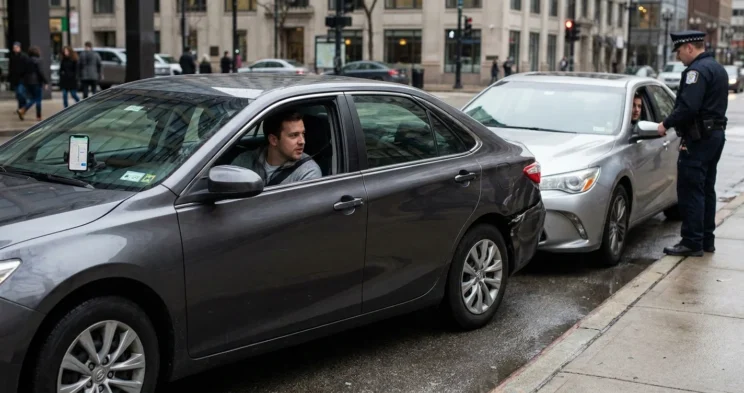
You were riding home from a late dinner in Montrose when another car ran a stop sign and slammed into your Uber. Your driver did nothing wrong, but you are the one sitting in the emergency room. Now the bills are coming, and you have no idea whose insurance is supposed to pay for any of this.
Uber’s Coverage Periods & What They Mean
Uber’s insurance obligations change based on your ride’s status at the moment of the crash. The same trip can carry very different coverage depending on whether a passenger is in the car.
Two coverage windows matter most when a third party causes the wreck. They look like a simple numbering scheme, but the dollar amounts and protections behind them are not the same.
Period 2 Coverage (Driver En Route to Pickup)
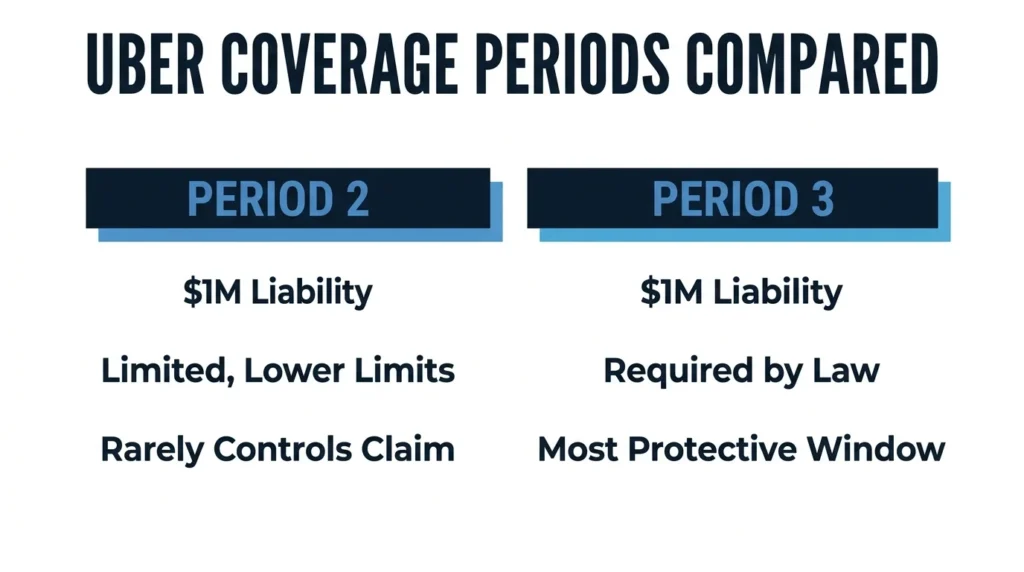
Period 2 covers the stretch after your driver accepts a ride but before you climb in. Uber provides up to $1 million in third-party liability coverage during this window.
Uninsured and underinsured motorist protection works differently here. It applies only in limited situations and at lower limits than the next period. Because you are not yet in the car, Period 2 rarely controls your claim, but it sets up the contrast.
Period 3 Coverage (Passenger in the Vehicle)
Period 3 runs from the moment you enter the vehicle until your trip ends. Uber’s commercial liability policy provides up to $1 million per incident during this window, and that coverage applies no matter which driver caused the crash.
This is the most protective window for an injured passenger. Texas Insurance Code § 1954.053 also requires Uber to carry uninsured and underinsured motorist coverage during a prearranged ride like yours.
Who Pays When a Third Party Causes the Crash?
When another driver causes the wreck, that driver’s insurance pays first. Texas uses a fault-based system, so the insurer of the person who caused the crash carries primary responsibility for your injuries.
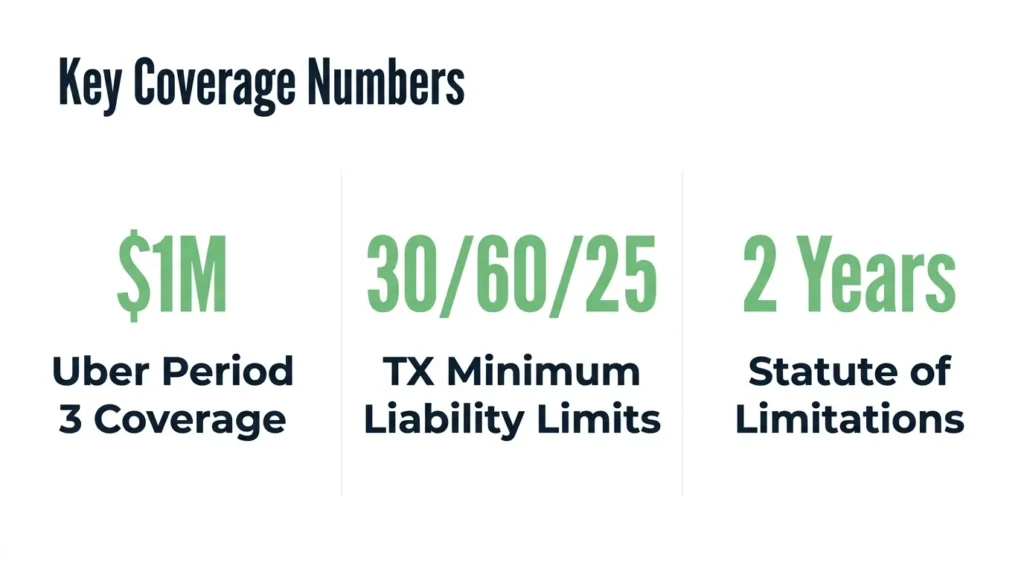
Your first claim goes to the at-fault driver’s personal auto liability policy. Texas sets minimum limits at 30/60/25 under Texas Transportation Code § 601.072. Those minimums often fall far short of covering serious injuries from a multi-vehicle crash.
Uber’s $1 million policy is active during Period 3, but it does not jump in as the primary payer when a separate at-fault driver exists. Uber’s own insurance terms confirm the at-fault party’s insurer comes first in that sequence.
Fault can still become an issue if an insurer tries to shift blame. Under Texas Civil Practice and Remedies Code (CPRC) § 33.001, your compensation decreases if you are assigned part of the fault. Passengers are rarely blamed in these crashes because you were not driving.
A skilled advocate can map out every coverage layer that applies to a passenger injury claim before you accept any offer.
When Uber’s UM/UIM Coverage Steps In
Uber’s uninsured and underinsured motorist coverage activates when the at-fault driver cannot cover your losses. That happens when the driver carries no insurance at all, or carries limits too low to pay for your injuries.
The at-fault driver’s policy still goes first. You typically must use up that driver’s available liability limits before Uber’s underinsured motorist coverage contributes anything. A completely uninsured driver has no policy to exhaust, so Uber’s uninsured motorist coverage responds directly.
Texas law requires this backup. Texas Insurance Code Chapter 1954 sets the specific coverage obligations for rideshare companies, and Texas Insurance Code § 1952.101 establishes the broader uninsured motorist requirements behind it.
Keep records of every conversation with both insurers. Save your emails and notes from the at-fault driver’s insurer and from Uber’s claims representative. That paper trail protects your underinsured claim if talks with the first insurer break down.
A rideshare injury advocate can review whether a settlement from the first insurer truly covers all your losses before you sign anything away.
Steps to Take After a Third-Party Uber Crash
Your health and your claim both depend on what you do in the first hours and days. Move through these steps in order to protect them.
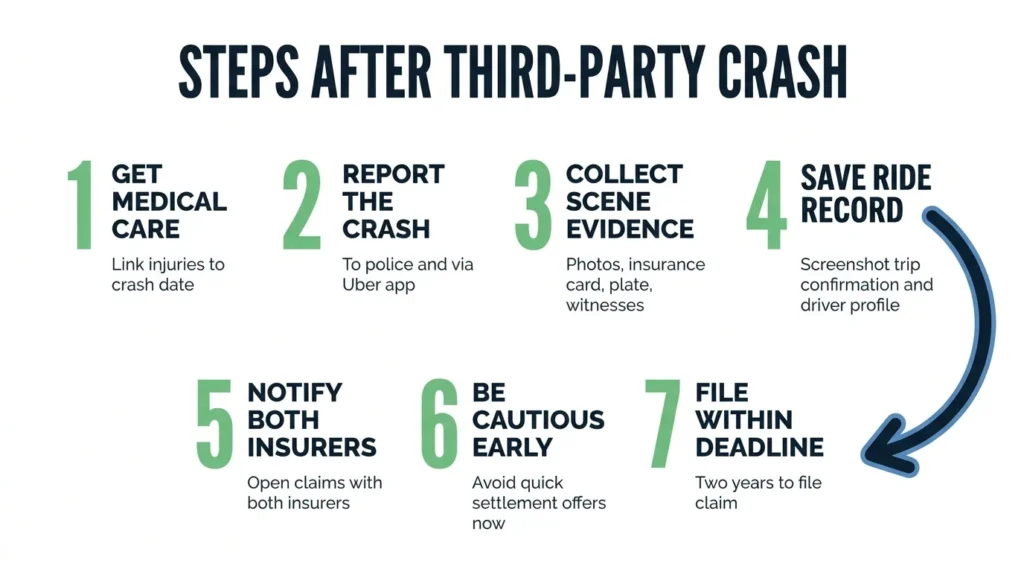
Step 1: Get medical care the same day. A same-day exam ties your injuries to the crash date. Insurers look for that link before they accept that the wreck caused your injuries.
Step 2: Report the crash to police and through the Uber app. The police report records the at-fault driver’s details, which you need before you can file against that driver’s insurer.
Step 3: Collect evidence at the scene. Photograph the vehicle positions, the at-fault driver’s insurance card, and the license plate. Get contact information from any witnesses while they are still there.
Step 4: Save your ride record. Screenshot the completed trip confirmation and your driver’s profile right away, even though the app stores the trip details.
Step 5: Notify both insurers. Open a claim with the at-fault driver’s auto insurer and with Uber’s commercial insurer. Do not wait for one to resolve before opening the other.
Step 6: Be cautious with early offers. The at-fault driver’s insurer may float a quick settlement before you know the full extent of your injuries. Accepting it usually releases every claim you have against that driver.
Step 7: File within the two-year deadline. Texas Civil Practice and Remedies Code § 16.003 gives you two years from the crash to file a personal injury claim. Miss it, and you forfeit the right to recover.
Knowing what to do after a rideshare accident makes the coming days significantly easier.
Work with an Attorney Today
A crash you did not cause should not leave you fighting two insurers alone. Angel Reyes & Associates has spent over 30 years helping injured Texans untangle exactly these multi-insurer rideshare claims, statewide.
We work on contingency, so there is no fee unless we win, with more than $1 billion recovered for clients. You can learn more about our firm and read what our clients say about working with us.
If a third party hurt you during an Uber ride, let us sort out who owes you. Reach out for a free consultation and we will walk you through every coverage layer that applies.
Past results do not guarantee future outcomes.
FAQs About Uber Accidents When the Rideshare Driver Isn't at Fault
Does a passenger need their own auto insurance to use Uber's UM/UIM coverage?
No. Uber’s uninsured and underinsured motorist coverage applies to all occupants of the vehicle during an active trip, so passengers without a personal auto policy are still covered. You do not need to own a car or carry your own insurance to access this protection.
Can a passenger's personal UM/UIM policy add a third layer of coverage on top of Uber's?
If your losses exceed both the at-fault driver’s policy limits and Uber’s UM/UIM payout, your own personal auto insurance UM/UIM coverage may apply as an additional layer, depending on your policy terms. This stacking possibility is worth reviewing before you accept any settlement.
What types of damages can an injured Uber passenger recover from the at-fault driver?
A passenger can seek compensation for medical bills, lost wages, and pain and suffering from the at-fault driver’s liability policy. If that policy falls short, the same categories of damages can be pursued through Uber’s UM/UIM coverage.
Will the at-fault driver's insurance cover personal property damaged in the crash?
The at-fault driver’s liability policy covers property damage, which can include personal belongings like a laptop or phone broken in the collision. File that property damage claim with the at-fault driver’s insurer at the same time you open your injury claim.
How long does it typically take for a third-party Uber accident claim to resolve in Texas?
Clear-liability cases where Uber’s commercial policy is involved often settle within three to six months, while disputed cases can take longer. The settlement clock starts once all medical treatment is complete and both insurers have finished their investigations.
About the Authors

Angel Reyes
Writer
Angel L. Reyes, III is the Founder and Managing Partner of Angel Reyes & Associates. A nationally recognized trial attorney and business leader, Angel has helped over 70,000 injury victims recover more than $1 billion since founding the firm in 1993. Named to the Texas Super Lawyers list annually since 2008, Angel brings Wall Street experience, Ivy League education, and a deep commitment to client advocacy. He is a frequent legal commentator and published author with extensive contributions to legal scholarship, trial strategy, and consumer protection.

Kyle Nicolas
Editor
Kyle Nicolas is the Web Content & SEO Manager at Angel Reyes & Associates. He has more than 10 years of experience as a marketing co...

Angel Reyes
Reviewer
Angel L. Reyes, III is the Founder and Managing Partner of Angel Reyes & Associates. A nationally recognized trial attorney and business...