How to Deal with Uber or Lyft’s Insurance Company After an Accident


Every article on this site is researched by our internal team, reviewed for legal accuracy against current Texas law, and held to State Bar of Texas advertising standards before publication. We do not publish content that overstates outcomes or makes promises about results.
Learn more about our
editorial standards .
Key Takeaways
- You are never required to give a rideshare insurer a recorded statement in Texas.
- Texas Insurance Code Chapter 542 forces insurers to meet strict claim deadlines.
- You have two years from the injury date to file a Texas personal injury lawsuit.
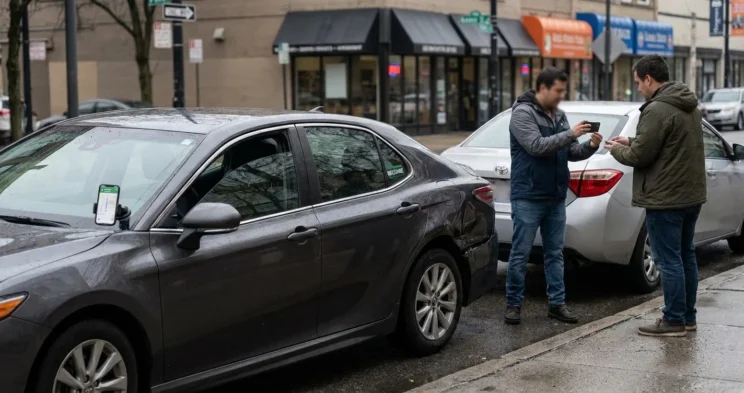
You were riding home from Deep Ellum on a Friday night when your Uber driver got rear-ended on Commerce Street. Now your phone keeps lighting up with calls from an insurance adjuster you have never met. The questions feel friendly, but something about them makes you uneasy.
You are right to slow down before you answer.
How Rideshare Claims Get Started
A rideshare claim starts the moment someone reports the crash, but the company you signed up with is not the one who handles it. Both Uber and Lyft give riders and drivers in-app tools to report a crash. If you are a pedestrian or another driver and do not use the app, you file through a separate online claims portal instead.
Once that report goes in, the platform hands the claim to its commercial insurance carrier. The carrier assigns an adjuster and oversees the claim from there. Uber works with third-party carriers such as Progressive, Farmers, and Allstate depending on the market. Lyft uses third-party commercial carriers whose assignment varies by state and market.
Which coverage period was active at the time of the crash decides which policy applies and how much coverage is available.
One thing surprises most claimants. The portal confirms that your report was received, but it usually shows nothing about coverage limits, adjuster notes, or where your investigation stands. You are working in the dark while the carrier sees everything.
Recorded Statements: Your Rights & Risks
You do not have to give the rideshare insurer a recorded statement, and Texas law does not penalize you for saying no. An adjuster will often ask for one early, framing it as a routine step needed to move your claim forward. That framing is misleading.
Adjusters are trained to use recorded statements to lock in your early account of what happened. They want a baseline of your symptoms while you may still feel the adrenaline and before the real pain sets in. They also listen for anything they can use later to question or shrink your claim.
A comment that you “feel fine” or are “not sure” who caused the crash can come back during negotiations. Carriers use those words to justify a lower offer. Your account before a full medical exam is almost always incomplete, and insurers know it.
You can decline the request and point the adjuster to your attorney instead.
The situation changes if you were the rideshare driver. Your own policy may give your personal insurer a contractual right to a statement. That is separate from what you owe an insurer on the other side of your claim, which is nothing.
An attorney can handle these calls so you never have to field a request for a recorded statement on your own.
Adjuster Tactics Rideshare Claimants Face
Most tactics share one goal: paying you less than your claim is worth. Recognizing these tactics early protects you when an adjuster tries them.
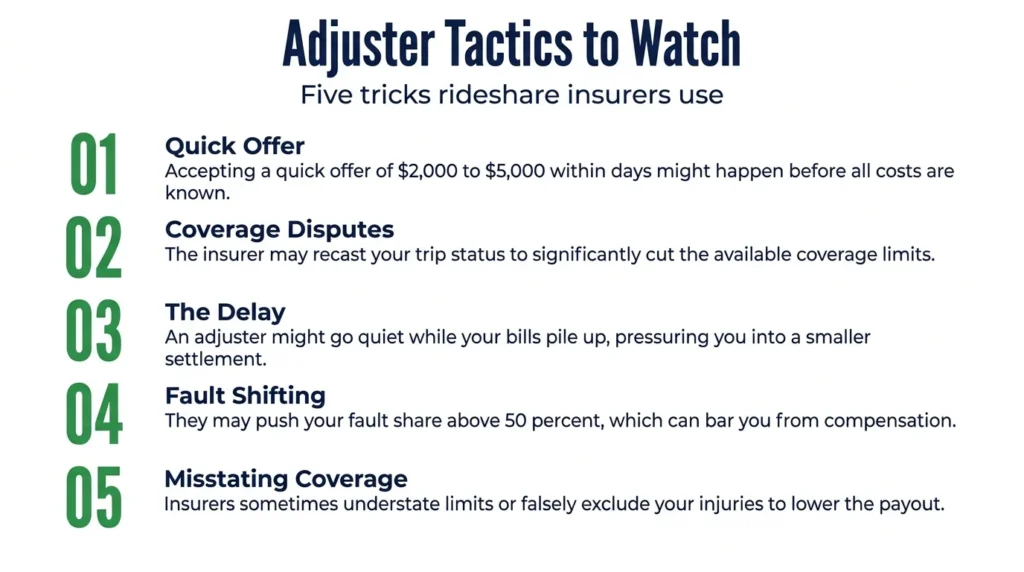
The first is the quick offer. Rideshare insurers routinely float $2,000 to $5,000 on serious-injury claims within days of the crash, long before anyone knows the full cost of your treatment and lost wages. Accepting that check usually closes the door on any future money for the same accident.
Coverage period disputes are a second tactic. An adjuster may recast an active-trip crash as an “app on, no ride requested” crash, which slashes the available limit. That is a financial move, not paperwork.
Then comes the delay. The adjuster goes quiet for weeks while your medical bills pile up. The pressure builds, and a low offer starts to look acceptable when they finally call back.
Adjusters also lean on fault. Texas uses a modified comparative negligence rule, meaning you can recover damages only if your share of fault is 50 percent or less. An adjuster may point to a minor pre-crash detail to push your percentage above that line and eliminate your compensation entirely.
Some go further and misstate the coverage itself. An adjuster might describe your limits as lower than they are or claim your injuries fall outside covered losses. Texas law treats that kind of misrepresentation as an unfair claims practice, which is where your statutory protections come in.
Texas Law Protections for Rideshare Claimants
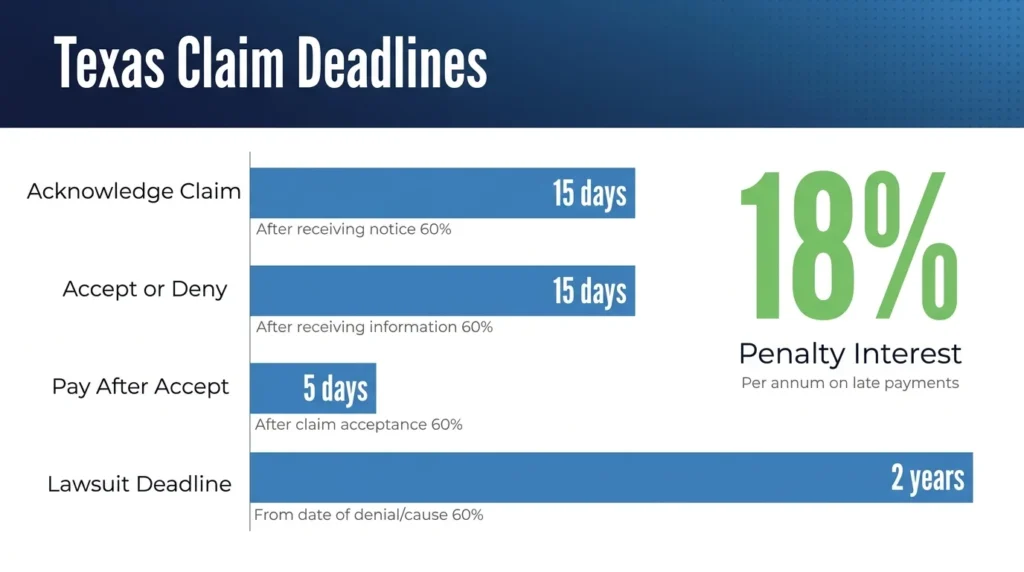
Texas gives you real leverage against a rideshare insurer, starting with strict deadlines. Texas Insurance Code (Insurance Code) Chapter 542, known as the Prompt Payment of Claims Act, requires an insurer to act on a schedule. It must acknowledge your claim within 15 days, accept or deny it within 15 business days of getting the information it needs, and pay within 5 business days of accepting.
Miss those deadlines and the insurer owes 18 percent annual penalty interest plus attorney fees.
The code also limits how an adjuster can treat you. Texas Insurance Code Chapter 541 prevents unfair or deceptive practices in the insurance business. That includes false statements about policy terms, misrepresenting a settlement’s value, and unreasonable delay. If an insurer does this to you, you have a private right of action.
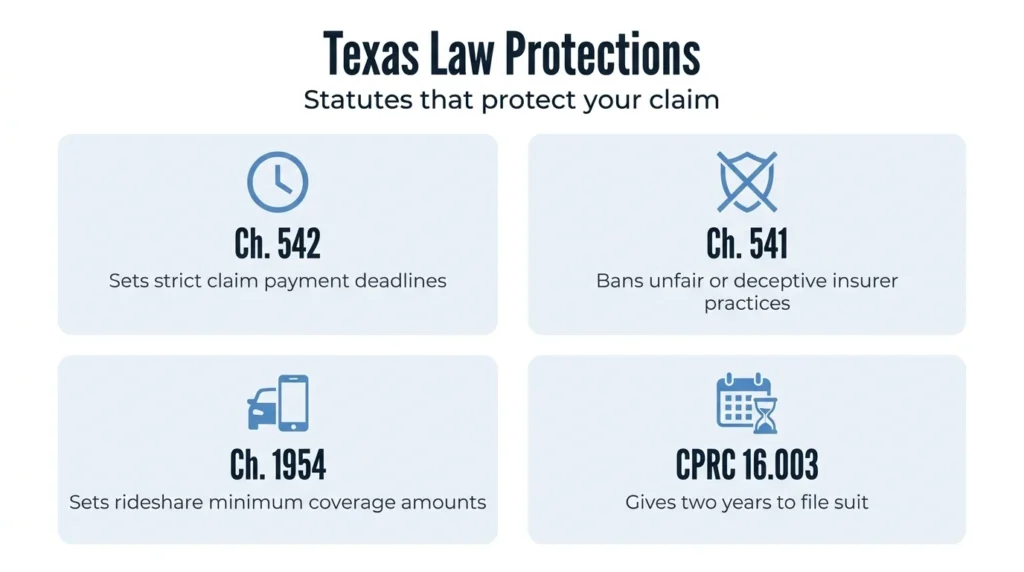
Coverage minimums are set by law too. Texas Insurance Code Chapter 1954 governs rideshare insurance statewide and fixes the minimum coverage that must be in place during each period of a trip. Knowing those floors helps you spot when an adjuster’s coverage-limit story does not add up.
You also face a hard clock of your own. Texas Civil Practice and Remedies Code (CPRC) § 16.003 gives you two years from the date of injury to file a personal injury suit. Spend months negotiating alone and you can run out that clock without realizing it.
Knowing these deadlines protects your claim, and an attorney familiar with Texas insurance law can track every one of them for you.
If a company-level problem warrants it, the Texas Department of Licensing and Regulation oversees rideshare compliance in the state.
Work with an Experienced Attorney Today
The claims process is built to serve the insurer, not you. That is exactly why having someone in your corner changes the math.
Angel Reyes & Associates has spent over 30 years guiding injured Texans through personal injury claims, including rideshare crashes involving Uber and Lyft. We have more than $1 billion recovered for clients, and you can read our client reviews and testimonials to see how we have handled cases like yours.
Learn more about how we approach rideshare accident claims and what we can do for you.
We work on contingency, so there is no fee unless we win, and your first consultation is free. Our team is available 24/7 whenever you are ready to talk. Contact us for a free consultation before you say another word to the adjuster.
Past results do not guarantee future outcomes.
FAQs on Dealing With Uber or Lyft Insurance After an Accident
What happens if the Uber or Lyft driver's app was off when the crash occurred?
If the driver’s app was completely off, the rideshare company’s insurance does not apply at all. Only the driver’s personal auto policy would be in play, and personal policies often exclude commercial activity, which can leave injured parties with limited options.
Can I sue Uber or Lyft directly, or only the driver?
Uber and Lyft classify their drivers as independent contractors, which they use to limit direct company liability. In most Texas cases, claims go through the driver and the TNC’s commercial insurance carrier rather than against the company itself, though the specific facts of your case can affect this analysis.
What if a different driver caused the crash and the Uber or Lyft vehicle was just hit?
You would have a claim against the at-fault driver’s personal auto liability policy first. If that policy is insufficient to cover your injuries, Uber’s or Lyft’s underinsured motorist coverage may apply during an active trip period under Texas Insurance Code Chapter 1954.
Does my own auto insurance cover me when I'm a passenger in a rideshare vehicle?
If your personal auto policy includes medical payments coverage, it can pay for your medical bills regardless of who caused the crash and regardless of which vehicle you were riding in. Texas does not require this coverage, so check your declarations page to see if you have it.
About the Authors

Angel Reyes
Writer
Angel L. Reyes, III is the Founder and Managing Partner of Angel Reyes & Associates. A nationally recognized trial attorney and business leader, Angel has helped over 70,000 injury victims recover more than $1 billion since founding the firm in 1993. Named to the Texas Super Lawyers list annually since 2008, Angel brings Wall Street experience, Ivy League education, and a deep commitment to client advocacy. He is a frequent legal commentator and published author with extensive contributions to legal scholarship, trial strategy, and consumer protection.

Kyle Nicolas
Editor
Kyle Nicolas is the Web Content & SEO Manager at Angel Reyes & Associates. He has more than 10 years of experience as a marketing co...

Angel Reyes
Reviewer
Angel L. Reyes, III is the Founder and Managing Partner of Angel Reyes & Associates. A nationally recognized trial attorney and business...