What Is Intoxication Manslaughter in Texas?


Every article on this site is researched by our internal team, reviewed for legal accuracy against current Texas law, and held to State Bar of Texas advertising standards before publication. We do not publish content that overstates outcomes or makes promises about results.
Learn more about our
editorial standards .
Key Takeaways
- Intoxication manslaughter is a second-degree felony carrying 2 to 20 years in prison.
- The criminal case and your family's civil wrongful death claim move on separate tracks.
- A surviving spouse, children, or parents can file a Texas wrongful death claim.

The phone call came just after midnight. Your husband was driving home on Camp Bowie Boulevard in Fort Worth when a driver who had been drinking ran a red light and hit him. Now you are holding a police report full of terms you never expected to learn, and one of them is intoxication manslaughter.
What Intoxication Manslaughter Means Under Texas Law
Intoxication manslaughter happens when a person causes someone else’s death while driving intoxicated, even by accident or mistake. The Texas Penal Code § 49.08 defines the crime and applies to a motor vehicle, aircraft, watercraft, or amusement ride.
Most of these cases in Texas begin with a vehicle, which is why you may see the charge written as intoxication manslaughter with a vehicle. The driver did not have to intend any harm; causing the death while intoxicated is enough.
The whole charge turns on one word: intoxicated. Under Penal Code § 49.01, a driver meets that definition in two ways.
The first is losing the normal use of mental or physical faculties from alcohol or drugs. The second is a blood alcohol level of 0.08 or higher.
This charge almost always grows out of a deadly drunk driving crash. It sits among the most serious car accident cases on Texas roads.
Manslaughter vs. Intoxication Manslaughter
Ordinary manslaughter and intoxication manslaughter are different charges, even though news coverage often blurs the two. To convict someone of ordinary manslaughter, a prosecutor must prove the person acted recklessly.
Intoxication manslaughter works differently. The prosecutor does not have to prove recklessness at all, only that the driver was intoxicated and caused the death. That lower bar is one reason you may hear the case called vehicular manslaughter in Texas.
Intoxication Manslaughter Penalty in Texas
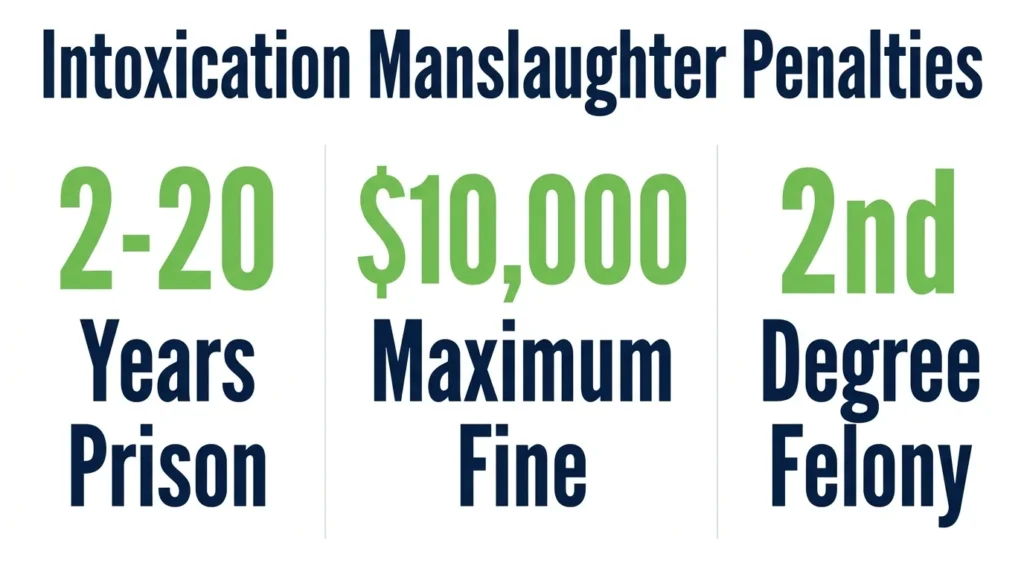
Intoxication manslaughter is a second-degree felony in Texas. A conviction carries 2 to 20 years in prison and a fine of up to $10,000 under Penal Code § 12.33.
The charge can climb to a first-degree felony in certain situations. Under Penal Code § 49.09, that happens in a few specific cases.
- When the person killed was a peace officer, firefighter, EMS worker, or judge on duty.
- When the crash caused more than one death in the same event.
- A prior intoxication-related conviction can also raise the level, but only if the driver was also violating a license restriction or ignition interlock requirement tied to that earlier case at the time of the crash.
The 2-to-20-year range is only the starting point, not a promise of any single outcome. The actual sentence depends on the driver’s record, plea negotiations, and the specific facts a judge or jury weighs.
Filing a Civil Claim After Intoxication Manslaughter
The criminal case against the driver and your family’s civil claim are two separate legal tracks. The result of the criminal case does not decide whether you can recover compensation for your loss.
A conviction sends the driver to prison, but it does not put anything in your family’s hands. That is the purpose of a civil wrongful death claim after a fatal crash.
You do not have to wait for a conviction, a plea, or a sentencing hearing to act. Families can start protecting their rights after a drunk driving death on their own timeline, whatever the criminal case does.
The driver may not be the only one who owes your family. A bar or restaurant that kept serving an obviously drunk customer can share liability under Texas dram shop rules for drunk driving crashes.
Criminal Case vs. Civil Wrongful Death Claim
Criminal cases and civil wrongful death cases also use different standards of proof.
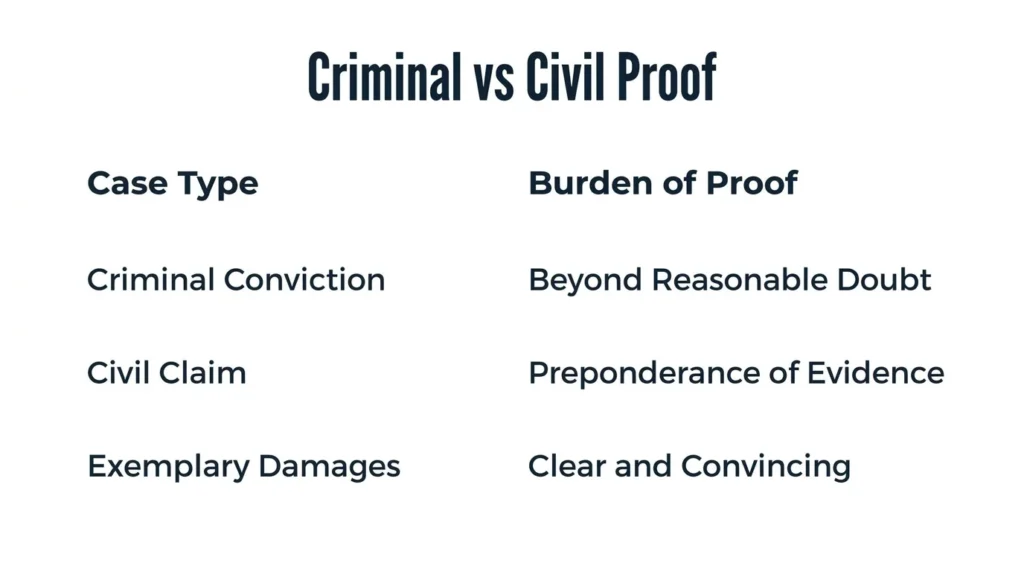
- Criminal Conviction: A criminal conviction requires proof beyond a reasonable doubt, the highest bar in the legal system.
- Civil Claim: Your civil claim uses a lower standard called preponderance of the evidence; that means showing the driver was more likely than not responsible for the death.
- Exemplary Damages: Exemplary damages, sometimes called punitive damages, sit in the middle. The Texas Civil Practice and Remedies Code (CPRC) § 41.003 requires clear and convincing evidence for those damages, which is a higher bar than an ordinary civil claim, though still lower than the criminal standard.
Compensation Available Through a Wrongful Death Claim
Texas law gives your family its own claim, separate from anything the prosecutor does. The CPRC § 71.002 creates the wrongful death action that lets close family members recover for their loss.
Not everyone can file. Under CPRC § 71.004, only a surviving spouse, children, or parents may bring the claim, and they divide any recovery.

A wrongful death claim can cover lost financial support, lost companionship, and the mental anguish of losing someone you love. A closer look at the damages in a wrongful death lawsuit shows the full range.
Our wrongful death representation covers each of these losses from the first filing through resolution.
Work with a Texas Wrongful Death Attorney
Losing someone to a drunk driver leaves your family with grief and questions no one prepared you for. You do not have to face them alone.
Angel Reyes & Associates has guided Texas families through the aftermath of fatal crashes for over 30 years. It does not matter where in Texas the crash happened; we have more than 20 offices across Texas and can help your family from wherever you are. You can learn more about our team and history before you decide anything.
We work on a contingency basis, which means no fee unless we win. Our record includes more than $1 billion recovered for clients.
You can reach out for a free consultation whenever you are ready. Your path forward moves on its own schedule, no matter what happens in the driver’s criminal case.
Past results do not guarantee future outcomes.
Intoxication Manslaughter in Texas FAQs
What is the difference between intoxication manslaughter and intoxication assault in Texas?
Intoxication assault applies when the victim survives but suffers serious injury, and it is charged as a third-degree felony. Intoxication manslaughter applies when the victim dies, which carries a higher penalty range.
How long do you have to file a wrongful death lawsuit in Texas after a fatal drunk driving crash?
Texas law generally gives a family two years from the date of death to file a wrongful death lawsuit. Missing that deadline can bar the claim entirely.
Can a family still file a wrongful death claim if the drunk driver also died in the crash?
Yes. Texas law lets the claim proceed against the driver’s estate, even when no criminal case is possible because the driver died too.
Does Texas cap how much a family can recover in a wrongful death case against a drunk driver?
No. Texas does not cap actual damages such as lost income or loss of companionship in most wrongful death cases, since caps mainly apply in narrower contexts like medical malpractice.
About the Authors

Angel Reyes
Writer
Angel L. Reyes, III is the Founder and Managing Partner of Angel Reyes & Associates. A nationally recognized trial attorney and business leader, Angel has helped over 70,000 injury victims recover more than $1 billion since founding the firm in 1993. Named to the Texas Super Lawyers list annually since 2008, Angel brings Wall Street experience, Ivy League education, and a deep commitment to client advocacy. He is a frequent legal commentator and published author with extensive contributions to legal scholarship, trial strategy, and consumer protection.

Kyle Nicolas
Editor
Kyle Nicolas is the Web Content & SEO Manager at Angel Reyes & Associates. He has more than 10 years of experience as a marketing co...

Angel Reyes
Reviewer
Angel L. Reyes, III is the Founder and Managing Partner of Angel Reyes & Associates. A nationally recognized trial attorney and business...