What to Do If a Drunk Driver Killed Your Family Member in Texas


Every article on this site is researched by our internal team, reviewed for legal accuracy against current Texas law, and held to State Bar of Texas advertising standards before publication. We do not publish content that overstates outcomes or makes promises about results.
Learn more about our
editorial standards .
Key Takeaways
- You can file a wrongful death claim without waiting for the criminal case to end.
- Texas gives families two years from the date of death to file a wrongful death claim.
- A bar that over-served the driver may share liability under Texas dram shop law.

The call came late on a Friday, and your world has not felt steady since. A drunk driver crossed into oncoming traffic on the Katy Freeway and took your husband, your daughter, or your father in an instant. Now the insurance company is calling, the funeral home needs decisions, and no one has told you what to do next.
Immediate Steps After a Drunk Driving Death
When a drunk driver kills your family member, the other side starts protecting itself right away. A few clear steps protect your family’s rights in return. Take them in order.
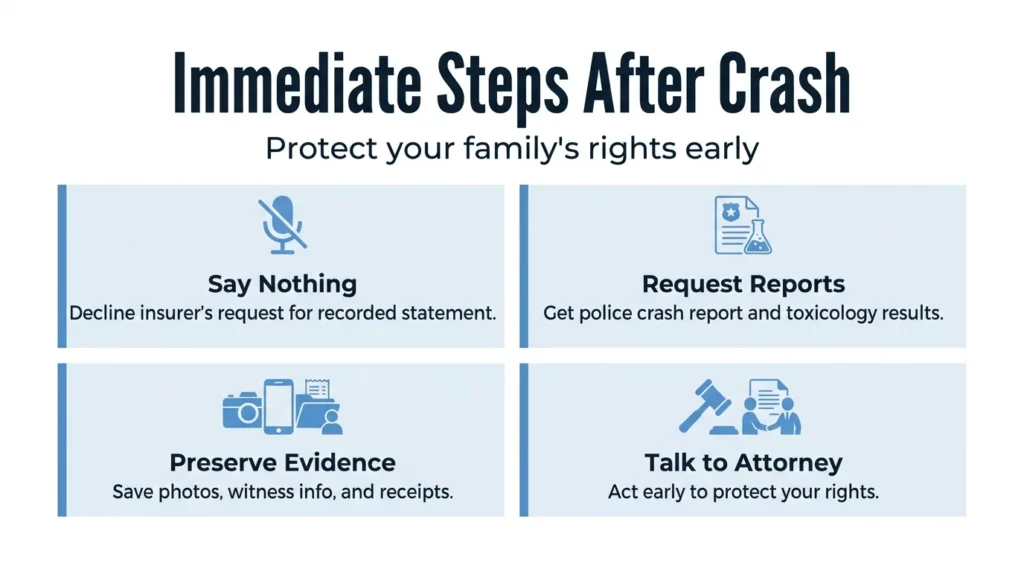
Step 1: Say nothing to the at-fault driver’s insurer. An adjuster may call within days asking for a recorded statement. Decline politely until you have talked with an attorney.
Step 2: Request the police crash report and any toxicology results. These records document what happened and confirm the driver’s intoxication. Ask the investigating agency for this information once the report is ready.
Step 3: Preserve every piece of evidence you can. Save photos, witness names and numbers, and receipts for funeral and medical costs. Keep them together in one place.
Step 4: Talk with an attorney early. Acting quickly protects evidence and keeps your options open before key windows close. If you are unsure where to begin, how we handle cases like yours can help you decide.
Alcohol-impaired crashes are a leading cause of traffic deaths, according to national drunk driving data. Texas sees that same devastating pattern, as state transportation officials report each year.
Must You Wait for the Criminal Case?
No. You do not have to wait for the criminal case to finish before you pursue compensation. The two cases run on separate tracks, with different goals and different rules.
The Criminal Case Against the Driver
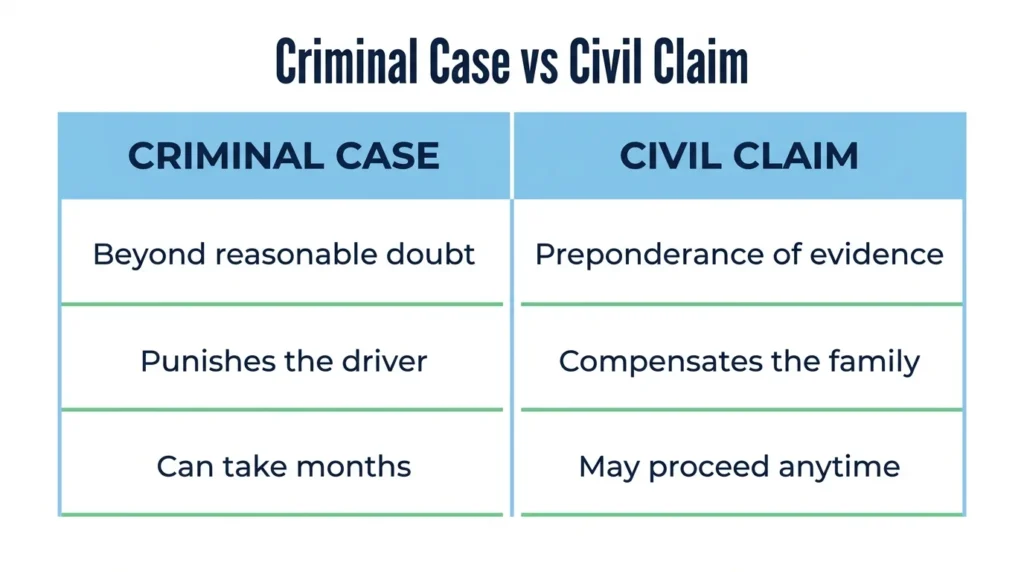
When an intoxicated driver causes a fatal crash, the state prosecutes them for intoxication manslaughter under Texas Penal Code § 49.08. While a conviction focuses on criminal punishments rather than direct family compensation, a 2023 restitution law known as Bentley’s Law creates a narrow exception. Under Texas Code of Criminal Procedure Article 42.0375, courts can order a convicted driver to pay child support to surviving children of the victim.
The criminal case also carries the highest burden in the law. Prosecutors must prove guilt beyond a reasonable doubt, and that can take many months to resolve.
Your Civil Wrongful Death Claim
Your wrongful death claim is separate. You can file it whether the criminal case is pending, delayed, or ends without a conviction.
Your civil claim uses a lower standard called preponderance of the evidence, which means more likely than not. That is an easier bar to clear than the criminal court’s standard. Filing early also preserves the evidence your claim depends on.
If you want to understand the road ahead, our overview of how a wrongful death claim works walks through what to expect. A drunk driving crash also raises liability questions a routine collision does not, which is why drunk driving crash claims often involve more than one responsible party.
Who Can File a Wrongful Death Claim
Texas law limits a wrongful death claim to the spouse, children, and parents of the person killed. A surviving spouse comes first. When a drunk driver killed your husband or wife, you have the clearest right to file.
Children can file too, including adult children. If a drunk driver killed your father or mother, you can bring a claim as their child.
Parents also qualify. When a drunk driver killed your son or daughter, you can file as a surviving parent. All three groups appear in the Texas Civil Practice and Remedies Code (CPRC) § 71.004.
Your loved one’s estate can bring a separate survival claim. It covers losses your family member could have claimed had they lived, such as the pain they suffered before death, under CPRC § 71.021.
A wrongful death lawsuit against a drunk driver in Texas can recover funeral and burial costs, medical bills, lost income and support, and the loss of your loved one’s companionship.
If your family member survived the crash instead, the rights and deadlines differ, and our guide to a drunk driving victim’s rights covers that situation. Our page on how wrongful death claims work explains what goes into the broader framework behind a claim like yours.
Families often want a sense of what these cases are worth, and our look at settlements in drunk driving cases sets realistic expectations.
Can You Sue the Bar That Served Alcohol?
Sometimes, yes. Texas dram shop law lets you hold a bar or restaurant responsible for over-serving a customer who was already visibly drunk and then killed someone.
Under the Texas Alcoholic Beverage Code § 2.02, a licensed provider can share liability when it serves alcohol to an obviously intoxicated person. That opens a second source of recovery beyond the driver.
When the driver’s conduct rises to gross negligence, your family may also seek exemplary damages. These are extra damages meant to punish reckless behavior, and they require clear and convincing evidence under CPRC § 41.003.
Dram shop and gross negligence claims are complex, and they reward an attorney who has handled them before. You can see how we have helped families in similar cases before deciding who to trust.
Some fatal DWI crashes raise added questions, such as what happens when the at-fault driver also dies in the same crash.
How Long Do You Have to File?
You generally have two years from the date of death to file a wrongful death or dram shop claim in Texas. That deadline comes from the CPRC § 16.003.
Miss that window, and you almost always lose the claim, no matter how the criminal case turns out. The two-year clock runs on its own, so acting sooner keeps every option open.

Work with a Wrongful Death Attorney
Money will never undo your loss. However, it can steady your family through funeral costs, lost income, and the months of grief ahead.
Angel Reyes & Associates has guided grieving Texans for over 30 years, with more than 20 offices across the state. That work includes more than $1 billion recovered for clients, and we handle claims like yours on a contingency basis.
You owe no attorney fee unless we win. We advance the costs of building your case, and you repay those expenses only from a recovery, never out of pocket up front.
When you are ready, you can schedule a free consultation and let us carry the legal weight while you focus on your family.
Past results do not guarantee future outcomes.
Steps After a Fatal Texas DUI Crash FAQs
Is there a limit on the extra damages my family can recover from a drunk driver in Texas?
Yes. Texas generally caps these damages at the greater of $200,000 or twice your economic damages plus up to $750,000 for non-economic damages, and this cap still applies in drunk driving death cases.
What if the drunk driver did not have enough insurance to cover our losses?
Your family member’s own auto policy may include uninsured or underinsured motorist coverage, which can pay out when the at-fault driver’s insurance is too low or does not exist.
How is a wrongful death settlement divided among surviving family members in Texas?
Texas law does not set a fixed formula. Family members usually agree on a split themselves, and if the case goes to trial instead, the jury decides each person’s share.
Will my family owe taxes on a wrongful death settlement in Texas?
Money that compensates you for the loss itself, such as lost income or loss of companionship, is generally not taxable. Any portion that is awarded to punish the driver is usually taxable income.
How long does a wrongful death lawsuit usually take to resolve in Texas?
Straightforward cases with clear fault can settle in about six months to a year, but cases that go to trial often take two years or longer.
About the Authors

Angel Reyes
Writer
Angel L. Reyes, III is the Founder and Managing Partner of Angel Reyes & Associates. A nationally recognized trial attorney and business leader, Angel has helped over 70,000 injury victims recover more than $1 billion since founding the firm in 1993. Named to the Texas Super Lawyers list annually since 2008, Angel brings Wall Street experience, Ivy League education, and a deep commitment to client advocacy. He is a frequent legal commentator and published author with extensive contributions to legal scholarship, trial strategy, and consumer protection.

Kyle Nicolas
Editor
Kyle Nicolas is the Web Content & SEO Manager at Angel Reyes & Associates. He has more than 10 years of experience as a marketing co...

Angel Reyes
Reviewer
Angel L. Reyes, III is the Founder and Managing Partner of Angel Reyes & Associates. A nationally recognized trial attorney and business...