How Does PIP Insurance Work in Texas?


Every article on this site is researched by our internal team, reviewed for legal accuracy against current Texas law, and held to State Bar of Texas advertising standards before publication. We do not publish content that overstates outcomes or makes promises about results.
Learn more about our
editorial standards .
Key Takeaways
- Texas policies include PIP unless a named insured rejects it in writing under §1952.152.
- PIP shares one policy limit across eligible medical, lost-income, and service benefits.
- Save your declarations page, any rejection record, claim letters, and a PIP payment ledger.
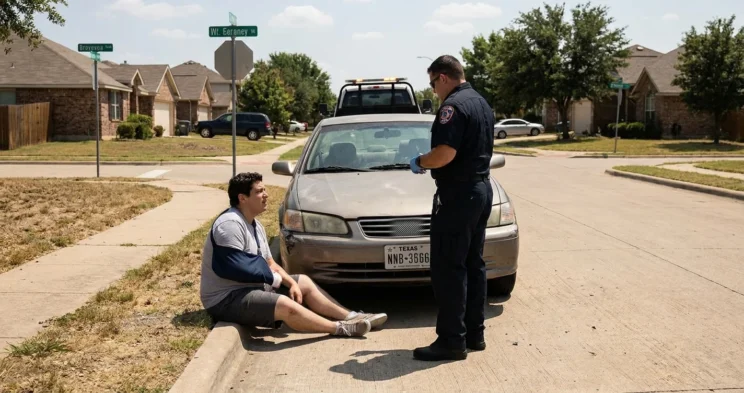
Personal injury protection (PIP) can pay eligible accident-related expenses regardless of who caused the crash. Under Texas Insurance Code § 1952.152, Texas auto liability policies must include it unless a named insured rejects it in writing.
When medical bills arrive while you are missing work, PIP can help before the other driver’s insurer decides fault. Benefits include reasonable medical expenses, a portion of lost income for qualifying earners, and qualifying household-service costs for people who were not earning wages or other income when injured.
Is PIP Insurance Required in Texas?
PIP is first-party coverage. You request benefits under the policy covering you without first proving another driver’s fault.
Texas law requires insurers to include PIP in an auto liability policy. A named insured may turn it down, but only in writing.
How Written Rejection Works
Any named insured on the policy can reject PIP in writing. An earlier rejection can carry over to a renewal or reinstatement with the same or an affiliated insurer unless the named insured requests coverage in writing.
The Texas Department of Insurance personal auto checklist notes that PIP selection and rejection forms are not subject to state approval and are not part of the policy itself. Insurers do not have to use one statewide rejection form.
A missing PIP entry on the declarations page does not prove that someone legally rejected the coverage. Ask the insurer for the actual signed or electronic rejection record before you assume you have no PIP.
What Texas PIP Pays & the Limits That Apply
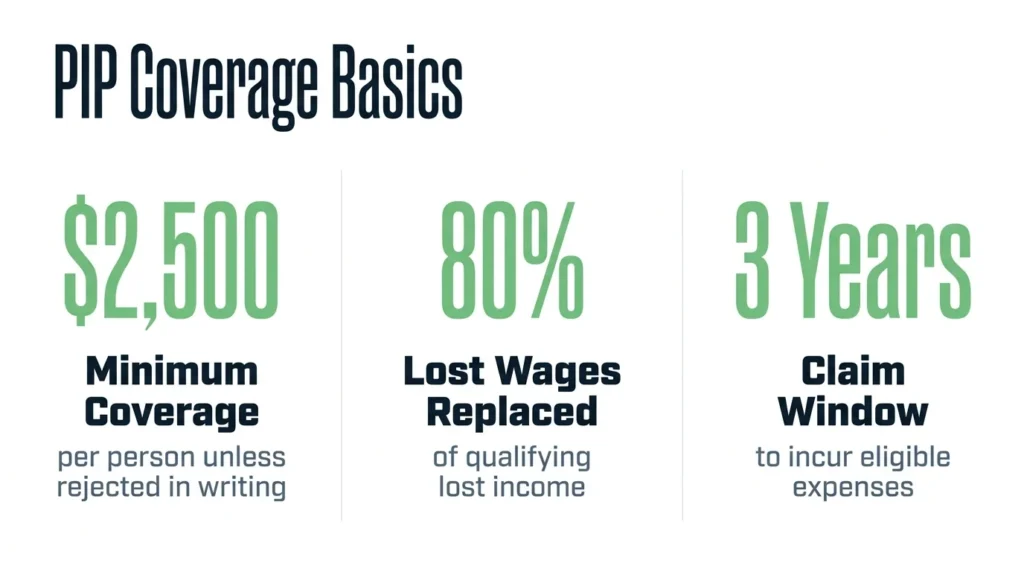
PIP can help with several categories of accident-related loss, including some of the medical bills that follow a Texas car accident, all subject to your policy’s per-person limit. The Office of Public Insurance Counsel (OPIC) identifies reasonable accident-related medical and funeral expenses, 80% of lost wages when applicable, and qualifying essential services.
The household-services benefit applies to an injured person who was not producing wages or income. Under Texas Insurance Code § 1952.151, it covers necessary and reasonable expenses to replace essential family or household services the person ordinarily performed. OPIC gives childcare and lawn care as examples.
Lost-income replacement and household-service reimbursement apply to different claimant categories.
Limits & Who Is Covered
OPIC states that insurers must provide at least $2,500 per person in PIP coverage unless a named insured rejects it in writing. Check your policy limit, which caps total benefits. Each expense category does not get its own separate limit.
PIP may cover the policyholder, resident family members, permitted drivers, and passengers, subject to the policy terms. Eligible expenses generally must arise within three years of the crash. That window refers to when the expenses occur and does not allow you to delay reporting the claim.
Medical Review & How PIP Differs From Med-Pay
PIP does not pay every bill automatically. TDI Bulletin B-0040-07 expects insurers to review medical expenses fairly and in good faith, so a provider’s charge can still be questioned.
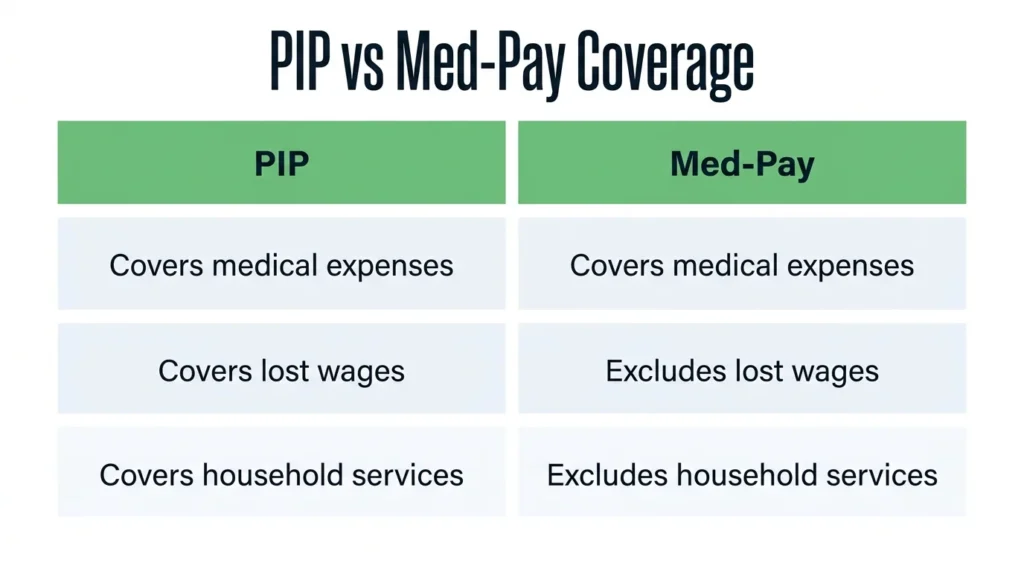
PIP and Medical Payments coverage (Med-Pay) are not the same. Med-Pay does not cover lost wages or essential household services. Check which coverage your policy lists before relying on it for those expenses.
How to Confirm Your PIP Coverage & Document a Claim
Start with the declarations page in effect on the crash date. The TDI auto insurance guide explains that this page summarizes your coverages, dollar limits, and deductibles. Look for PIP by name because a broad label like “full coverage” does not identify your actual coverage.
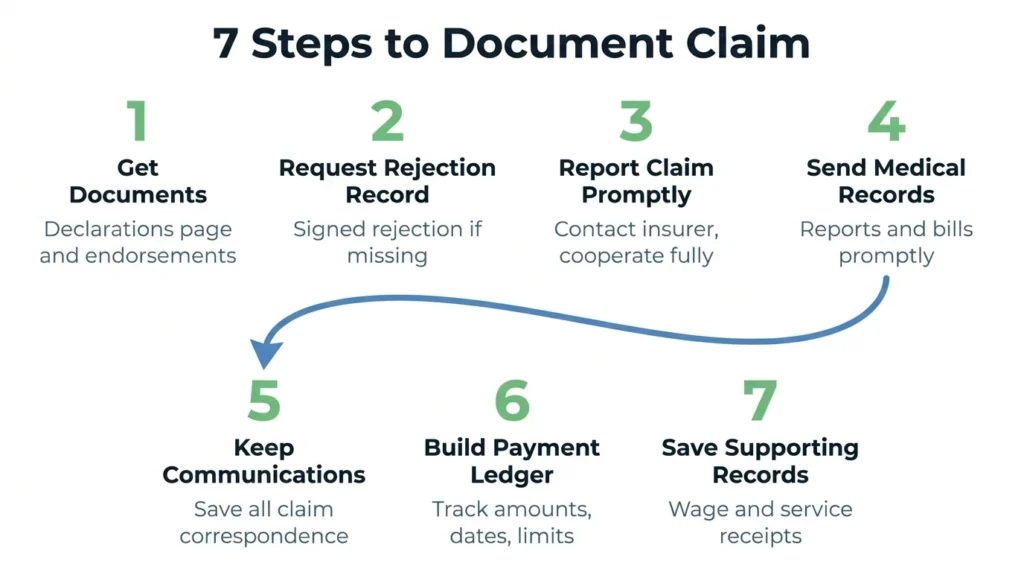
You can organize the claim with these steps:
1. Get the right documents. Request the declarations page and endorsements for the crash date and read them together.
2. Ask for any rejection record. If PIP seems missing or the insurer denies it exists, request the signed or electronic rejection.
3. Report the claim promptly. OPIC’s first-party claims guidance recommends prompt contact and cooperation. Ask the insurer for its PIP claim instructions.
4. Send medical reports and bills. TDI recommends furnishing these when you are injured.
5. Keep every communication. Save PIP claim requests, emails, responses, and denial letters.
6. Build a payment ledger. For each expense, record the submission date, amount billed, amount paid, payee, any reduction, and the remaining limit.
7. Save supporting records. Keep wage records and replacement-service receipts when those benefits apply.
When a Charge Is Reduced or Denied
Ask the insurer for the reason and relevant policy provision in writing. You can talk with the adjuster or a supervisor about the decision. OPIC also identifies legal advice and a TDI complaint as options.
How PIP Works Alongside a Claim Against the At-Fault Driver
Your PIP claim can move forward while the other driver’s insurer is still deciding fault. Whether the crash happened on I-35 or a rural Texas highway, the two claims have different requirements.
PIP Claims & Liability Claims
A PIP claim falls under your policy and doesn’t require proving fault. A third-party liability claim is made against the at-fault driver’s insurer, which investigates responsibility before deciding whether to pay. OPIC’s third-party claims guidance explains the process.
Signing an injury release can end your right to further recovery. An attorney can review the release and the related Texas car accident claim before you sign.
When a PIP Insurer Can Seek Recovery
Under Texas Insurance Code § 1952.155, a PIP insurer generally cannot seek reimbursement from another person or insurer merely because that person caused the crash.
An exception applies when the person who caused or contributed to the collision was operating an involved vehicle for which the required financial responsibility had not been established. In that situation, the PIP insurer may pursue that operator. The rule does not create a general right to recover PIP benefits from every recipient.
When a Passenger’s Award May Be Reduced
Under Texas Insurance Code § 1952.159, a passenger’s award may be reduced when the passenger makes a liability claim against the owner or operator of the vehicle they occupied, or that party’s insurer, and one of those parties paid PIP benefits to the passenger. The reduction equals the qualifying PIP payment.
These rules apply to PIP specifically. If an insurer requests repayment or applies a credit, ask it to identify the policy provision and statute supporting the request.
Get Help Reviewing Your Texas PIP Coverage & Injury Claim
Before your consultation, gather your declarations page and endorsements, any rejection record, PIP claim correspondence, and payment history.
Angel Reyes & Associates can review those documents along with your related injury claim. Contact Angel Reyes & Associates for a free consultation about your options.
Past results do not guarantee future outcomes.
Texas PIP Insurance FAQs
Does Texas PIP Insurance Cover Hit-and-Run Accidents?
Yes. Texas PIP coverage can pay eligible expenses after a hit-and-run accident even if the other driver is never identified, provided the injured person qualifies for benefits under the policy.
Can You Use PIP Insurance If You Were Injured as a Pedestrian in Texas?
Yes. Texas PIP may cover an insured person injured as a pedestrian when a motor vehicle is involved, depending on the circumstances and applicable policy coverage.
Does PIP Insurance Cover Injuries Caused by an Excluded Driver in Texas?
Coverage may depend on the policy’s exclusions and the circumstances of the accident. Texas Insurance Code § 1952.154 limits certain PIP exclusions, so an insurer cannot necessarily deny benefits solely because the driver was excluded from other coverage.
Can You Receive Texas PIP Benefits If You Have Health Insurance?
Yes. Having health insurance does not automatically disqualify you from receiving Texas PIP benefits, although coordination between insurers and medical providers may affect how bills are processed.
Does Texas PIP Insurance Cover Pain and Suffering After a Car Accident?
No. PIP does not compensate injured people for physical pain, emotional distress, or loss of enjoyment of life, but those damages may be recoverable through a separate personal injury claim.
About the Authors

Angel Reyes
Writer
Angel L. Reyes, III is the Founder and Managing Partner of Angel Reyes & Associates. A nationally recognized trial attorney and business leader, Angel has helped over 70,000 injury victims recover more than $1 billion since founding the firm in 1993. Named to the Texas Super Lawyers list annually since 2008, Angel brings Wall Street experience, Ivy League education, and a deep commitment to client advocacy. He is a frequent legal commentator and published author with extensive contributions to legal scholarship, trial strategy, and consumer protection.

Graham Griffin
Editor
Graham Griffin is the Web & Content Manager at Angel Reyes & Associates, where he oversees content strategy, AI-powered workflows, a...

Angel Reyes
Reviewer
Angel L. Reyes, III is the Founder and Managing Partner of Angel Reyes & Associates. A nationally recognized trial attorney and business...