When Must You File a UM/UIM Claim?


Every article on this site is researched by our internal team, reviewed for legal accuracy against current Texas law, and held to State Bar of Texas advertising standards before publication. We do not publish content that overstates outcomes or makes promises about results.
Learn more about our
editorial standards .
Key Takeaways
- Report a UM/UIM claim to your insurer promptly. Reporting and suing are separate steps.
- Texas UM/UIM suits generally get four years from accrual, but your policy may shorten it.
- Missing the two-year deadline against the at-fault driver can still hurt your UIM claim.
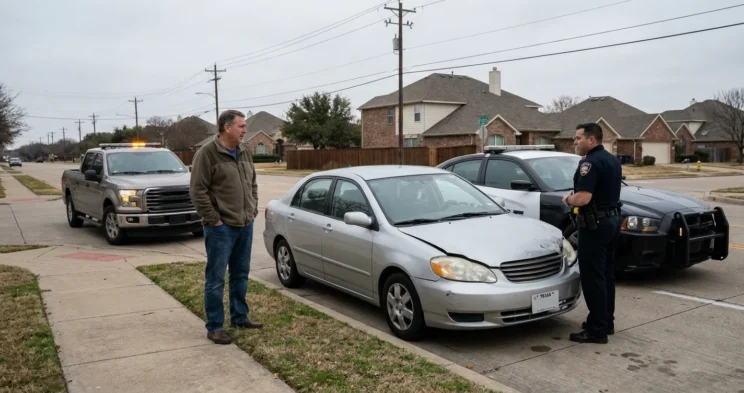
In Texas, a lawsuit for UM/UIM benefits generally has a strict contract limitations period, measured from when the claim accrues. A personal injury lawsuit against the at-fault driver runs on a separate clock. Report the crash and your potential uninsured or underinsured motorist (UM/UIM) claim to your own insurer promptly.
Your policy can also shorten the time to sue. When you are recovering from a crash and facing medical bills, separating these deadlines helps you protect your options.
How Long Do You Have to Bring a Texas UM/UIM Claim?
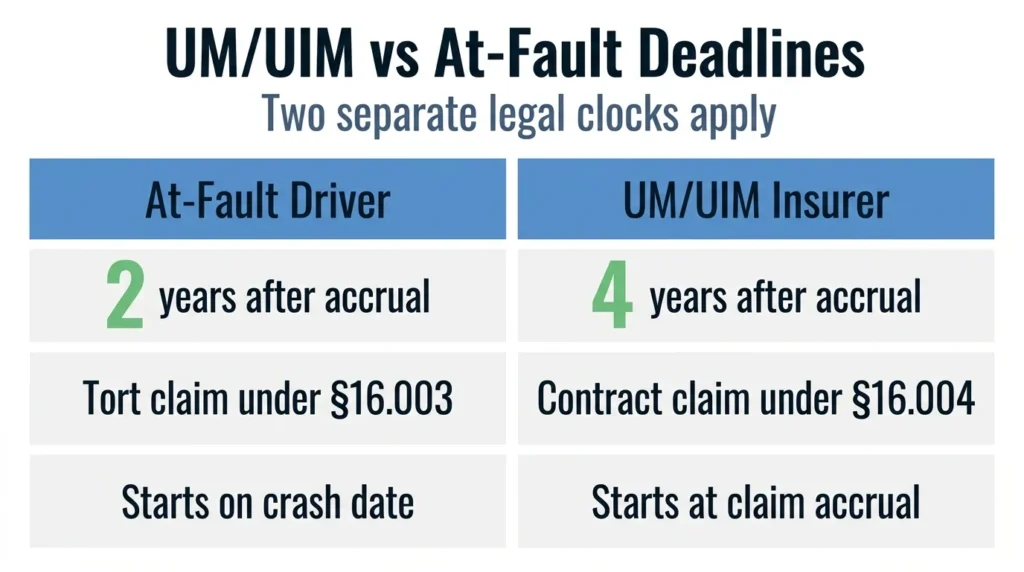
Texas generally gives you four years after accrual to sue your own insurer for UM/UIM benefits. You generally have two years to sue the at-fault driver for personal injury. These are separate deadlines against different parties:
- Suit against the at-fault driver: Generally two years after the claim accrues under Texas Civil Practice and Remedies Code §16.003. For an ordinary crash injury, the clock generally starts on the crash date.
- Suit against your UM/UIM insurer: Generally four years after accrual. Texas courts treat this as a contract claim, and §16.004 provides four years after accrual for debt actions.
The two periods differ because of what each claim is based on. In Franco v. Allstate Insurance Co., the Texas Supreme Court held that a UM claim rests on the written insurance policy. The four-year contract period applies even though you still must prove the other driver’s fault and your damages.
The court also rejected the idea that the end of the two-year tort deadline automatically wipes out your UM claim.
Two cautions apply to the UM claim statute of limitations in Texas. First, reporting a claim to your insurer and filing a lawsuit are different acts. Second, four years does not automatically run from the crash, or from any other single event, for every claimant.
The UIM statute of limitations in Texas depends on when your claim accrued and what your policy says. Accrual means the point when the legal right to bring the claim arises.
When Does the Clock Start for a UM/UIM Suit?
The limitations clock for a UM/UIM suit can start when your insurer denies the claim. It does not necessarily wait until a court decides the other driver’s liability. The insurer’s duty to pay is a separate issue.
In Brainard v. Trinity Universal Insurance Co., the Texas Supreme Court held that an insurer’s contractual duty to pay UIM benefits does not arise until the other driver’s liability and underinsured status are established. Asking for benefits or filing suit does not trigger that payment duty on its own.
The judgment that establishes those facts does not have to be against the other driver. You can settle with that driver and litigate entitlement directly with your insurer. A settlement or the driver’s admission alone does not bind the UIM carrier, though.
The Supreme Court later confirmed in Allstate Insurance Co. v. Irwin that an injured person can bring a direct action against the UIM insurer to establish entitlement to benefits. You do not have to wait for a separate judgment against the driver first.
Brainard does not give every claimant four years after a judgment to sue. In Allstate Insurance Co. v. Jordan, a Texas appeals court separated the payment duty from limitations accrual. The court identified the insurer’s denial as the event that starts the clock and rejected reading Brainard to delay accrual until a court established liability and damages.
The next question is what counts as a denial. In Redwood Fire and Casualty Insurance Co. v. Reyna, a 2026 federal trial court applying Texas law refused to rule that limitations had run. The evidence did not conclusively show an outright or constructive denial.
A third-party agent closing its own file and referring the matter to the insurer was not enough. That ruling does not bind every Texas court, but it shows why your actual letters and claim history matter.
A low offer is not automatically a denial, and silence does not mean the clock has stopped. Have your policy and the insurer’s communications reviewed to determine your deadline.
Why Does the Deadline Against the At-Fault Driver Still Matter?
Missing the two-year deadline to sue the at-fault driver does not automatically end your UM/UIM claim. It can still hurt you. Letting that deadline pass can eliminate a direct recovery route and may complicate your insurer’s right to recover from the driver.
That second point involves subrogation, which is your insurer’s right to pursue the at-fault driver for what it pays you. In Hernandez v. Gulf Group Lloyds, the Texas Supreme Court held that an insurer relying on a settlement-without-consent exclusion had to show actual prejudice to avoid paying.
A settlement can destroy a valuable subrogation right. Destroying a worthless right did not prejudice the insurer in that case. The court also warned that delay in presenting a claim may cause prejudice in other circumstances.
The date of any settlement or judgment with the driver affects how you prove entitlement and how your insurer’s rights are protected. That date does not automatically start the limitations clock for every claimant.
Before you release the driver, accept a settlement, or let the tort deadline pass, get advice on your specific policy. If a date has already passed, have your situation reviewed promptly instead of assuming the claim is gone.
What Policy Deadlines & Conditions Should You Check?
Read your complete UM/UIM policy and every endorsement early, because the policy can shorten the time to sue and set notice and consent conditions. The Texas Department of Insurance Personal Automobile Review Requirements Checklist describes a general two-year minimum for contractual suit limitations in Texas auto policies. It also recognizes a clause allowing two years and one day measured from accrual.
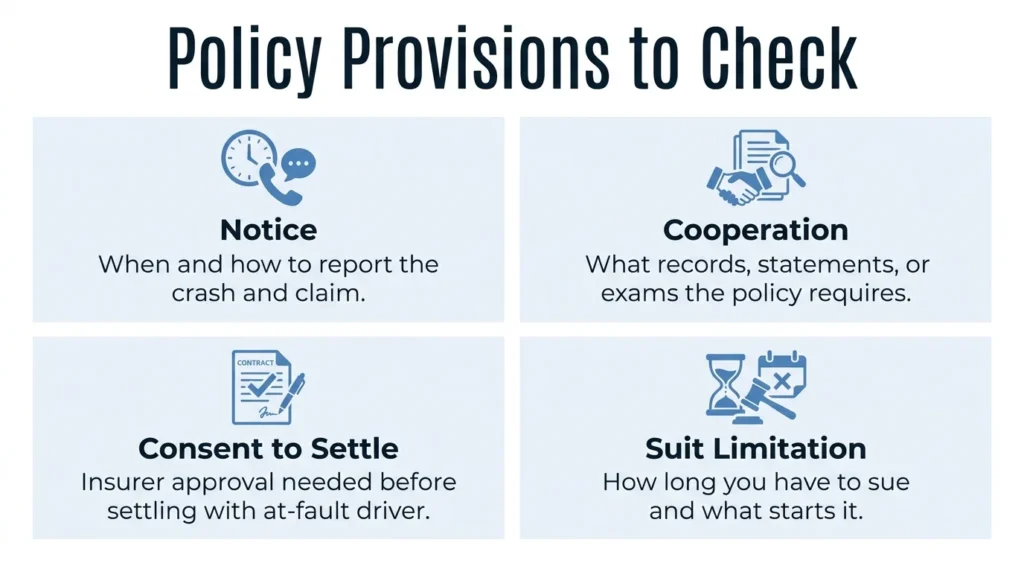
Some policies, then, give you less than four years. Check these provisions:
- Notice: When and how you must tell the insurer about the crash and claim. TDI’s checklist says contractual notice required as a condition of suit must be reasonable. A four-year lawsuit period does not mean you have four years to give notice.
- Cooperation: What records, statements, or examinations the policy requires.
- Consent to settle: Whether you need the insurer’s approval before settling with or releasing the at-fault driver.
- Suit limitation: How long the policy gives you to sue and what event starts that period.
TDI’s post-wreck guidance tells drivers to report the accident to their own insurer and keep adjuster information, medical records, and bills. Prompt reporting starts the claim process and helps preserve
your records.
Do not accept a settlement or sign a release until you have addressed any consent requirement in your policy.
Which Dates & Documents Help Determine Your Deadline?
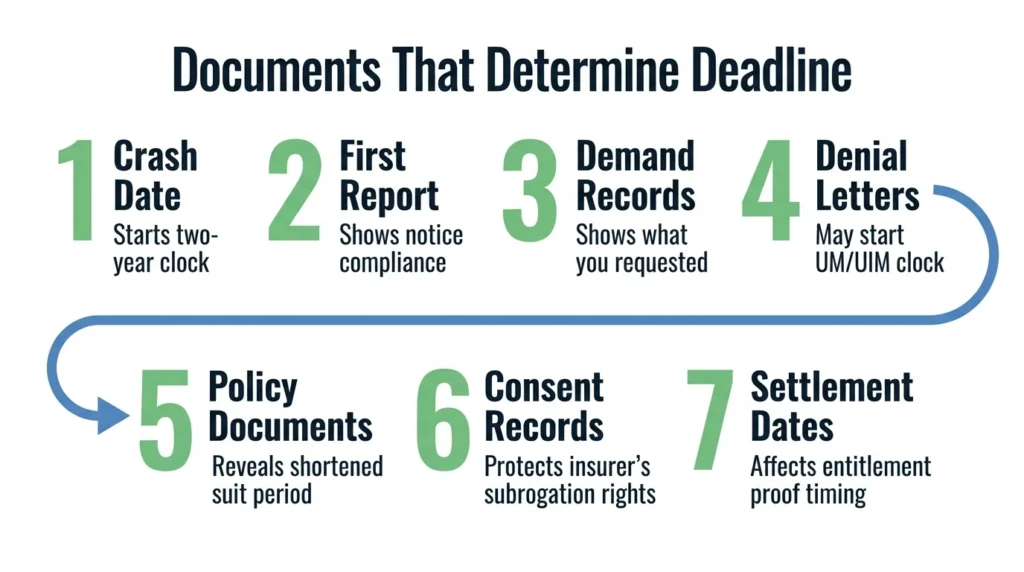
A lawyer needs your policy and claim history to identify each deadline. Negotiations with the insurer do not automatically pause limitations, so start collecting these records now:
- Crash date. This generally starts the two-year clock against the at-fault driver.
- First report to your insurer and claim number. These help assess compliance with the policy’s notice condition.
- Your demand and supporting records. These show what you requested and when.
- Every dated denial, offer, or file-closure letter. These help show whether and when a denial may have started the UM/UIM clock, as the Reyna decision illustrates.
- Complete policy and endorsements. These reveal any shortened suit period and other conditions.
- Consent requests and the insurer’s responses. These help assess whether you protected the insurer’s rights before settling.
- Settlement, release, or judgment dates. These bear on establishing your entitlement to benefits.
If you think a deadline has already passed, have the dates reviewed as soon as possible.
Talk With Angel Reyes & Associates About Your UM/UIM Deadline
You should not have to work out separate legal clocks while recovering from a crash. Angel Reyes & Associates has served injured Texans for over 30 years, and you can reach the firm 24/7.
Contact Angel Reyes & Associates for a free consultation. The team can review your policy, your insurer’s letters, and the dates that shape your deadline, then walk you through your options.
Past results do not guarantee future outcomes.
UM/UIM Claim Filing FAQs
Can you file a UM/UIM claim if the at-fault driver has no assets?
Yes. Uninsured or underinsured motorist coverage may provide compensation when the at-fault driver lacks insurance or sufficient coverage, subject to your policy’s requirements and proof of eligibility. The driver’s financial resources and the available insurance coverage are separate considerations.
Can you recover pain and suffering through a Texas UM/UIM claim?
Potentially. If the policy covers the loss and the evidence establishes the necessary elements, UM/UIM benefits may include compensation for pain and suffering as well as qualifying medical expenses and lost income, subject to applicable limits.
Does Texas UM/UIM coverage pay for lost wages after a car accident?
UM/UIM bodily injury coverage may compensate you for lost income and reduced earning capacity when supported by evidence and covered under the policy. Pay records, employer statements, and medical documentation can help establish the amount of the loss.
About the Authors

Angel Reyes
Writer
Angel L. Reyes, III is the Founder and Managing Partner of Angel Reyes & Associates. A nationally recognized trial attorney and business leader, Angel has helped over 70,000 injury victims recover more than $1 billion since founding the firm in 1993. Named to the Texas Super Lawyers list annually since 2008, Angel brings Wall Street experience, Ivy League education, and a deep commitment to client advocacy. He is a frequent legal commentator and published author with extensive contributions to legal scholarship, trial strategy, and consumer protection.

Graham Griffin
Editor
Graham Griffin is the Web & Content Manager at Angel Reyes & Associates, where he oversees content strategy, AI-powered workflows, a...

Angel Reyes
Reviewer
Angel L. Reyes, III is the Founder and Managing Partner of Angel Reyes & Associates. A nationally recognized trial attorney and business...