How Are Knee Injuries Valued After a Car Accident?


Every article on this site is researched by our internal team, reviewed for legal accuracy against current Texas law, and held to State Bar of Texas advertising standards before publication. We do not publish content that overstates outcomes or makes promises about results.
Learn more about our
editorial standards .
Key Takeaways
- Dashboard impact drives the tibia backward, injuring the PCL, meniscus, and kneecap.
- Insurers blame age, so a symptom-free history and MRI tear pattern carry the claim.
- Texas allows two years to file, and fault above 50 percent bars recovery entirely.
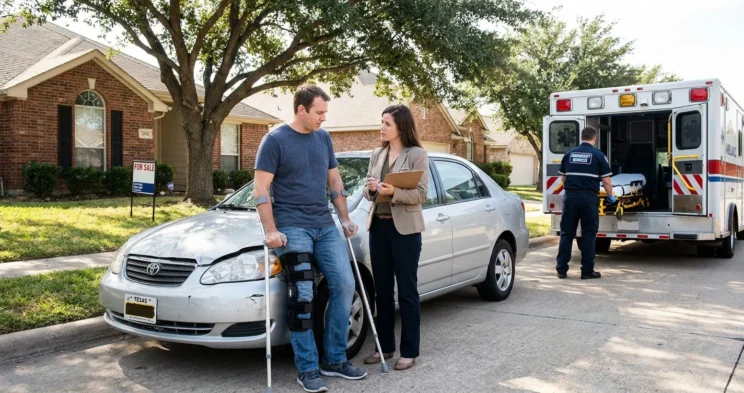
Your knee hit the dashboard, and weeks later it still gives out when you take the stairs. Then the adjuster calls and says the MRI shows wear and tear, not a crash injury.
The value of a knee injury car accident settlement depends on how the injury occurred, what the imaging shows, and whether your medical records connect the damage to the collision rather than age-related changes.
How the Dashboard Knee Injury Happens in a Car Accident
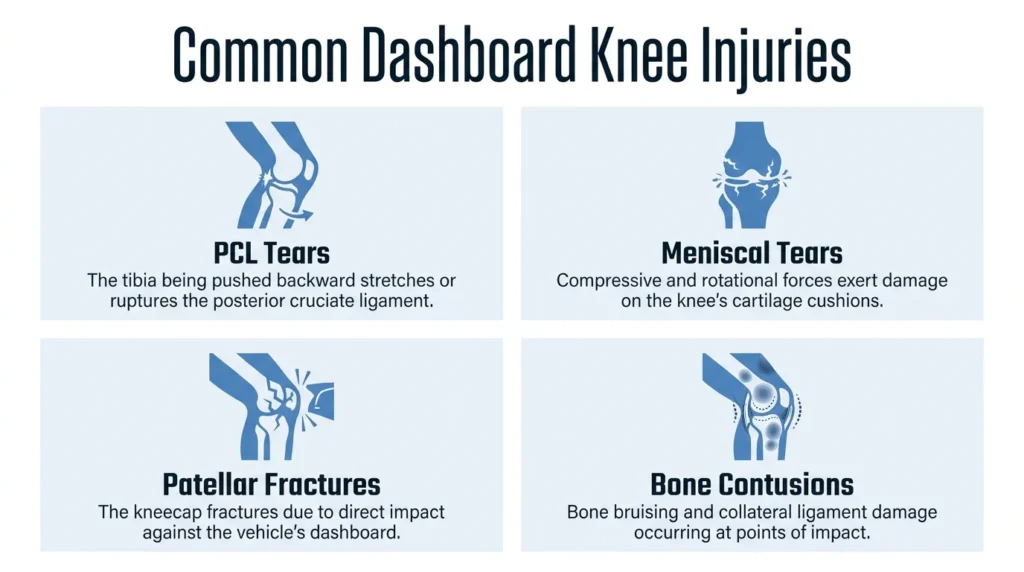
When a bent knee strikes the dashboard in a frontal collision, the impact can drive the tibia backward relative to the thigh bone. That movement may stretch, partially tear, or rupture the posterior cruciate ligament and damage nearby structures.
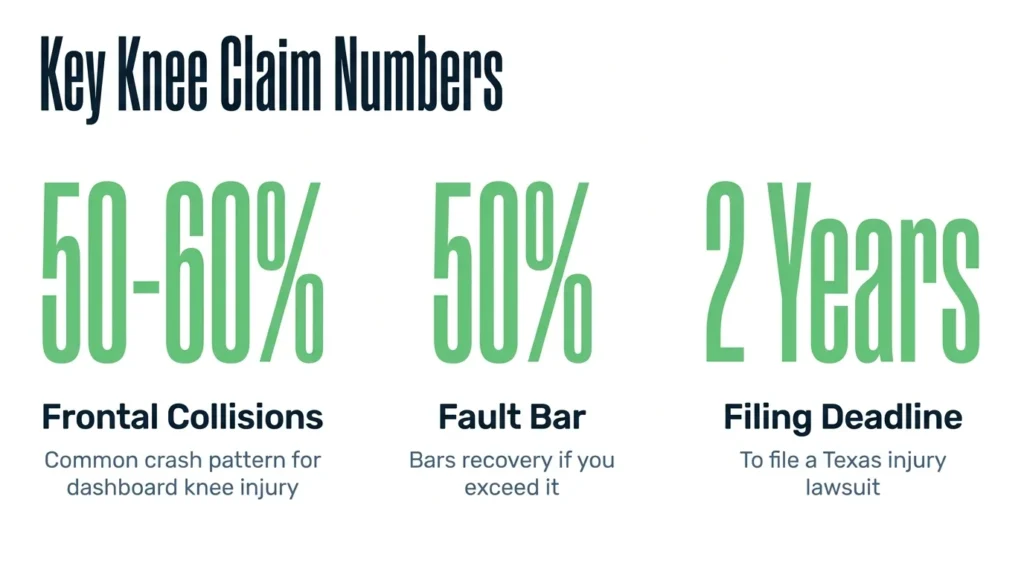
Frontal collisions make up roughly 50% to 60% of all motor vehicle collisions, which makes this one of the more common crash patterns on I-35 and the LBJ Freeway. (Dashboard Knee: Injury Mechanisms, Diagnostic Challenges, and Treatment Outcomes)
Common injuries include:
- Posterior cruciate ligament tears, from the tibia being pushed backward
- Meniscal tears, from the same compressive and rotational forces
- Patellar fractures, from the kneecap taking direct impact
- Bone contusions and collateral ligament damage at the points of contact
The American Academy of Orthopaedic Surgeons notes that a posterior cruciate ligament injury comes from a direct blow to the front of the knee, such as a bent knee hitting a dashboard, and that a simple misstep rarely causes these injuries. (OrthoInfo)
The PCL also has thicker, stronger fibers than the ACL, so injuring it generally points to a higher-energy impact rather than an ordinary twist. (StatPearls)
A kneecap fracture may occur alongside hip socket or other lower-extremity fractures on the same side. Doctors may examine more than the knee after a high-energy dashboard impact. (StatPearls, Patella Fractures) Documenting those related injuries can help establish the full extent of your car accident claim.
Why Insurers Blame Knee Injuries on Age
Meniscal changes show up on knee MRI in a large share of middle-aged and older adults with no knee complaints at all.
A 2008 New England Journal of Medicine study examined knee MRIs from adults ages 50 to 90. (Incidental Meniscal Findings on Knee MRI in Middle-Aged and Elderly Persons)
The researchers found that meniscal tears became steadily more common with age, rising from roughly one in five women in their fifties to more than half of men in their seventies and eighties. They also found that a clear majority of the people whose scans showed a meniscal tear had reported no knee pain, aching, or stiffness in the previous month.
Insurers often review earlier medical records, claims, and imaging when checking for pre-existing injuries after a car accident. That research gives the insurer a basis to argue the tear existed before the crash. Your response cannot rely only on saying your knee felt fine beforehand.
The stronger response combines your pre-crash medical history, the tear pattern shown on the MRI, and records of what your knee could do before the collision. Together, that evidence can show whether the crash caused a new injury or made a previously silent condition symptomatic.
How to Prove the Crash Caused the Injury, Not Age
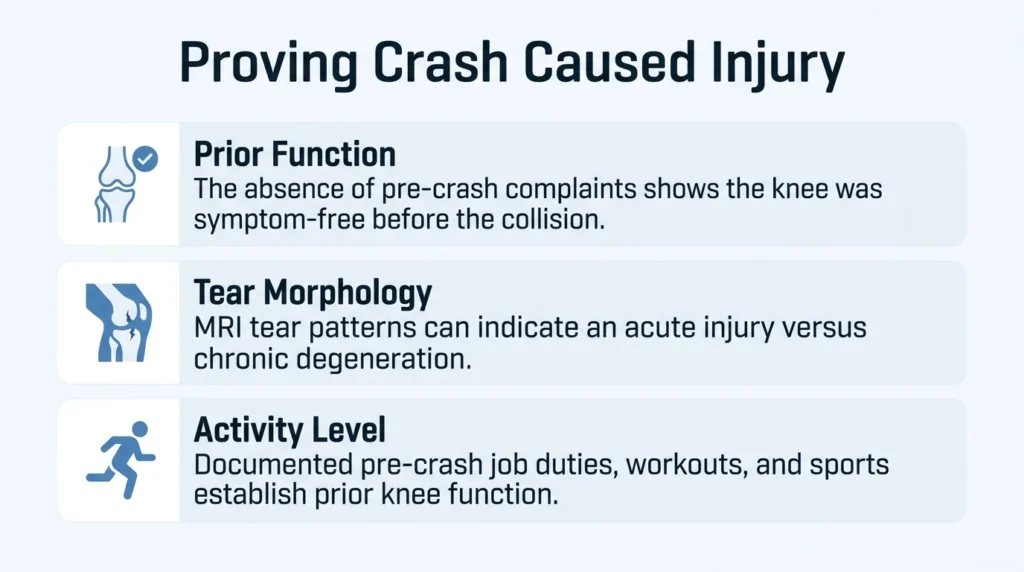
Three types of evidence can help connect your knee injury to your crash.
- Prior symptom-free function. Because tears are common yet frequently silent, the absence of pre-crash knee complaints, physical therapy, injections, or imaging in your medical record is genuinely probative. It shows your knee was symptom-free right up until the collision.
- Tear morphology on MRI. Acute tears often appear as vertical, longitudinal, radial, or bucket-handle patterns. Chronic degenerative tears more commonly show fragmentation at the posterior horn of the medial meniscus. (Radiopaedia; Radsource) A radiologist considers the tear pattern along with the rest of your medical history.
- Documented pre-crash activity level. Your job duties, workouts, weekend sports, and time on your feet establish what your knee could do before the wreck. Coworkers, gym records, and family members may help document that activity.
A bone bruise on an MRI can support a forceful impact, but it does not prove a meniscal tear occurred in the crash.
One study of 175 patients under 45 with acute knee trauma found that bone bruising was associated with a lower rate of medial meniscus tears and a higher rate of ACL and MCL tears. (PMC) A bone bruise is one piece of medical evidence, not standalone proof of when the meniscal tear happened.
What Texas Law Says About Pre-Existing Conditions, Fault, & Deadlines
Texas law allows you to recover for a knee injury even if age-related changes were already present. Compensation may cover a new injury caused by the crash or the worsening of an existing condition.
Texas Pattern Jury Charges on general negligence, published by the State Bar of Texas, address this situation through three instructions. PJC 28.8A covers a pre-existing condition that the incident did not aggravate. PJC 28.8B covers a condition that was already symptomatic and was made worse by the crash, meaning the defendant answers for the worsening. PJC 28.8C is the thin-skull instruction, which applies when a condition was silent before the collision but left you more susceptible to injury.
Two additional Texas rules can affect your claim:
- Comparative fault. Under Texas Civil Practice and Remedies Code § 33.001, you cannot recover damages if you are found more than 50 percent responsible for the crash. A lower percentage reduces your compensation by the same amount.
- Filing deadline. Under Texas Civil Practice and Remedies Code § 16.003, you generally have two years from the date of the crash to file a personal injury lawsuit.
That two-year window closes whether the insurance company is still negotiating with you or not.
Talk to a Car Accident Attorney About Your Knee Injury Claim
The longer you wait, the harder it gets to gather your prior medical history, imaging, and proof of what your knee could do before the crash.
Angel Reyes & Associates has guided injured Texans through this process for over 30 years, with board-certified personal injury attorneys, investigators, and accident reconstruction specialists on the team. The firm works on contingency, so there is no upfront cost, and you can reach us 24/7.
Contact Angel Reyes & Associates for a free consultation and a straight assessment of your knee injury claim.
Past results do not guarantee future outcomes.
Knee Injury Claim FAQs
How much is a knee injury settlement worth after a car accident in Texas?
A knee injury settlement may include compensation for medical expenses, lost wages, pain and suffering, and physical limitations caused by the collision. The amount depends on the severity of the injury, the treatment required, its long-term effects, and the available insurance coverage.
Can you recover compensation for future knee replacement surgery after a car accident?
If a car accident causes knee damage that may require replacement surgery, you may be able to recover compensation for the anticipated procedure and related medical expenses. Medical evidence must establish that the future treatment is reasonably probable and connected to the collision.
Does having knee surgery increase the value of a car accident settlement?
Knee surgery can affect settlement value because it may involve additional medical expenses, rehabilitation, time away from work, and lasting physical limitations. However, undergoing surgery does not guarantee a higher settlement, and the procedure must be medically necessary and related to the crash.
Can you receive compensation for a knee injury if you did not miss work after the accident?
You may still recover compensation for medical expenses, physical pain, and limitations on your daily activities even if you continued working after the collision. Under Texas law, lost wages are only one category of damages available in a personal injury claim.
How does health insurance affect a knee injury settlement in Texas?
Under Texas Civil Practice and Remedies Code § 41.0105, you can generally recover only the amounts actually paid or incurred, not the full amount originally billed by healthcare providers. Your health insurer may also have a right to reimbursement from your settlement, depending on your insurance plan and applicable law.
About the Authors

Angel Reyes
Writer
Angel L. Reyes, III is the Founder and Managing Partner of Angel Reyes & Associates. A nationally recognized trial attorney and business leader, Angel has helped over 70,000 injury victims recover more than $1 billion since founding the firm in 1993. Named to the Texas Super Lawyers list annually since 2008, Angel brings Wall Street experience, Ivy League education, and a deep commitment to client advocacy. He is a frequent legal commentator and published author with extensive contributions to legal scholarship, trial strategy, and consumer protection.

Kyle Nicolas
Editor
Kyle Nicolas is the Web Content & SEO Manager at Angel Reyes & Associates. He has more than 10 years of experience as a marketing co...

Angel Reyes
Reviewer
Angel L. Reyes, III is the Founder and Managing Partner of Angel Reyes & Associates. A nationally recognized trial attorney and business...