Should an Injury Settlement Be Structured?


Every article on this site is researched by our internal team, reviewed for legal accuracy against current Texas law, and held to State Bar of Texas advertising standards before publication. We do not publish content that overstates outcomes or makes promises about results.
Learn more about our
editorial standards .
Key Takeaways
- Qualifying physical-injury damages can be tax-free as a lump sum or as periodic payments.
- Match any payment schedule to your life-care or benefits plan and keep cash for now.
- Selling payments later in Texas needs court approval and can mean far less cash.

A structured settlement can make sense when its payment schedule matches your future care and living costs while leaving enough cash for immediate bills. After an injury, deciding how to pay for years of care can feel as difficult as resolving the claim. Predictable payments come with less flexibility, so compare your options before signing.
If you later decide to sell payment rights under Texas law, the sale requires court approval and may provide far less cash than the payment stream is worth.
How Does a Structured Injury Settlement Work?
A structured settlement resolves your injury claim with future payments, either instead of a single check or alongside one. Those payments can be regular installments, scheduled future lump sums, or both. Texas Civil Practice and Remedies Code § 141.002 includes both within periodic payments.
In the settlement agreement, the defendant or its insurer agrees to a payment schedule. That party can transfer its payment obligation to another company through a qualified assignment under 26 U.S.C. §130. The assignee funds the payments with an annuity from a licensed insurer or a qualifying U.S. government obligation.
Your paperwork may identify the settlement obligor, the assignee, and the annuity issuer. Check which entity owes each payment and which one funds it.
Section 130 requires fixed and determinable payment amounts and dates that you cannot elect to accelerate, defer, increase, or decrease. The schedule can include increases or future lump sums negotiated before the settlement becomes final.
A qualified assignment moves the payer’s obligation when you create the structure. A later sale transfers your right to receive payments and is regulated separately under Texas law.
Before signing, have your attorney reconcile the settlement agreement, qualified assignment, annuity contract, and any applicable court order. Together, those documents set your terms.
Are Structured Settlement Payments Tax-Free?
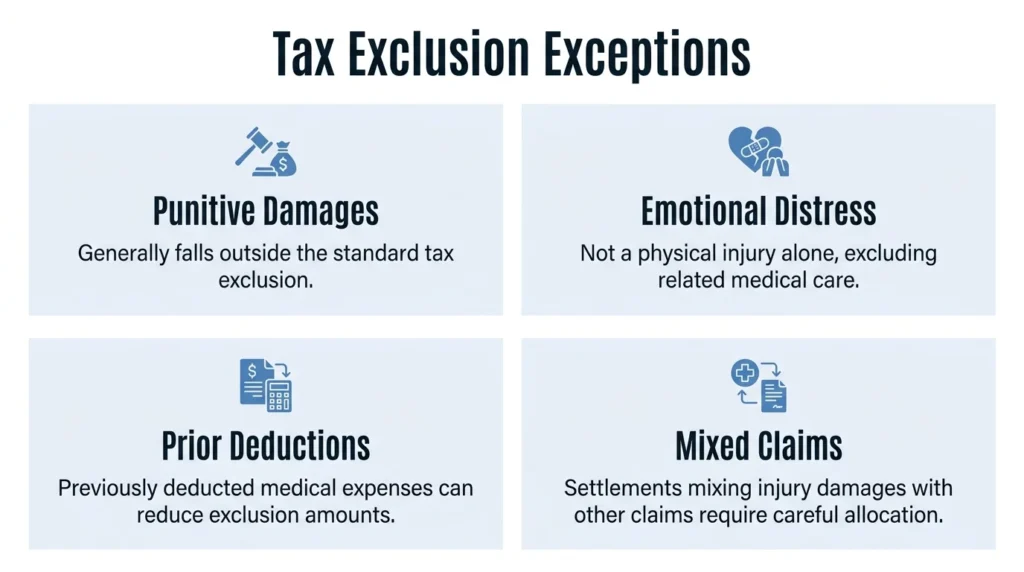
Qualifying physical-injury damages can be excluded from federal gross income whether you choose a lump sum or a structure. Internal Revenue Code §104(a)(2) covers compensatory damages received because of personal physical injuries or physical sickness, whether paid as a lump sum or periodically.
Choosing periodic payments does not make otherwise taxable damages tax-free. Section 130 separately addresses the assignee’s tax treatment. Your injury-damages exclusion rests on §104.
Some settlement components fall outside the exclusion or require closer review:
- Punitive damages generally fall outside the exclusion.
- Emotional distress alone is not a physical injury, subject to a limited exception for related medical care.
- Previously deducted medical expenses can affect what you may exclude.
- Settlements combining physical-injury damages with other claims need careful allocation.
IRS settlement guidance looks at what each payment replaces. Lost wages tied to a physical injury can qualify for exclusion. Ordinary employment claims for lost pay do not become tax-free because someone pays them over time.
If your settlement mixes damage categories, review the allocation with a tax professional before the agreement becomes final.
When Might Spreading the Payments Make Sense?
Spreading payments may make sense when a reliable schedule aligns with years of care or living costs and enough cash remains for current needs.
Compare large recoveries meant to fund long-term care with a life-care plan projecting future medical and living costs. No settlement amount automatically calls for a structure.
Minors and incapacitated people may benefit from court-supervised planning. Under Texas Property Code §§ 142.008 and 142.009, a court can, on the parties’ motion, provide a structure when a next friend or appointed guardian ad litem represents a minor or incapacitated person without a legal guardian. Those sections also address funding documents and qualifying annuity issuers. They do not require every minor’s recovery to be structured.
People receiving SSI also need to review the payment destination and schedule. Social Security generally treats settlements as unearned income. Still, its awards and settlements policy recognizes qualifying payments made directly into a special-needs trust or pooled-trust account that is not a countable resource.
A structure alone does not protect benefits eligibility. Coordinate the settlement, assignment, payee designation, and trust or benefits plan before signing. SSI rules do not automatically carry over to every Medicaid program, so review those needs with a benefits professional.
What Flexibility Would You Give Up Compared With a Lump Sum?
The main tradeoff is access. Once you commit money to a qualified payment schedule, you generally cannot request an extra withdrawal when an unexpected bill or new treatment comes up.
Compare the proposed structure with the net amount you would receive from a lump sum. Ask whether the parties can negotiate some cash for current bills and an emergency reserve, along with scheduled payments for ongoing care.
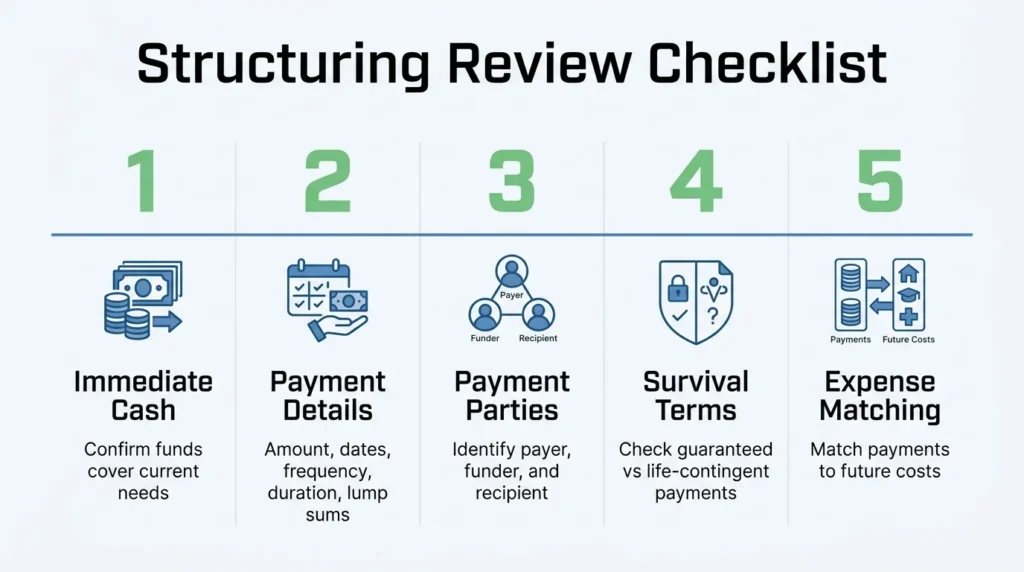
Review these points with your attorney:
- Confirm the cash available now and whether it covers immediate needs.
- Check each payment’s amount, start date, frequency, duration, and any scheduled future lump sums.
- Identify who owes and funds each payment and who receives it if a trust is involved.
- Distinguish guaranteed payments from those dependent on your survival, and check who receives any payments after death.
- Match payments to projected expenses and assess how rising costs or changing care needs would affect the plan.
Check whether the contract includes inflation adjustments or death benefits before committing money to future payments.
What Happens If You Need to Sell Payments Later in Texas?
A sale covered by the Texas Structured Settlement Protection Act requires advance court approval. The cash you receive can be much less than the payment stream is worth, so consider the possibility and cost of a later sale when structuring the original settlement.
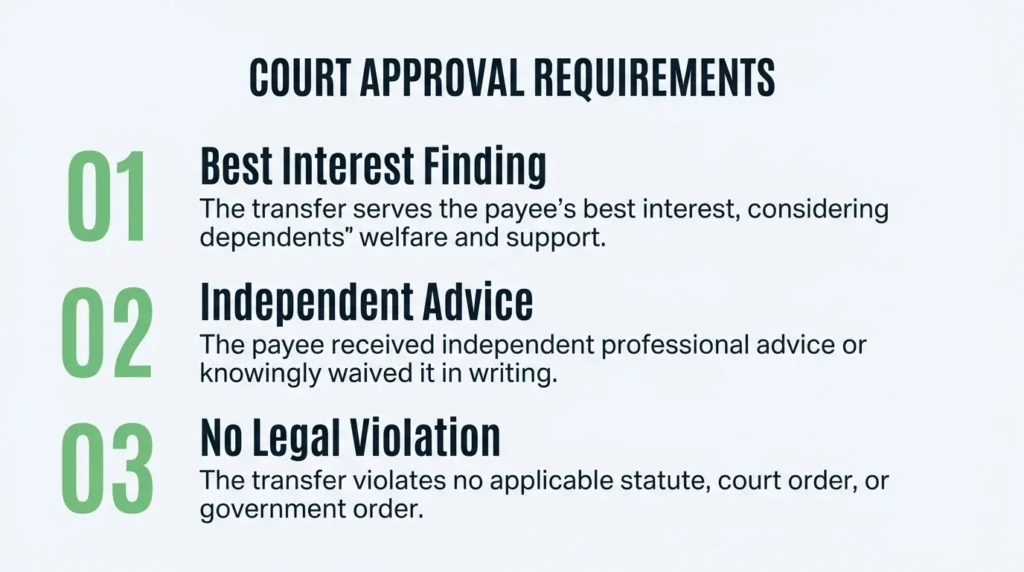
The Act applies to structured-settlement payment rights that meet its definitions and Texas requirements. Under § 141.004, a covered transfer requires a final court order finding that:
- The transfer serves the payee’s best interest, considering the welfare and support of dependents.
- The payee received independent professional advice or knowingly waived it in writing.
- The transfer violates no applicable statute or court or government order.
Under § 141.003, the buyer must provide disclosures at least three days before you sign. These include the payment amounts and dates, the total payments being transferred, their discounted present value using the Applicable Federal Rate, the gross and net cash advances, and any transfer expenses. You must also receive notice of your right to cancel by the third business day after signing.
Compare those figures carefully. Part of the difference between the future payment total and the cash offer reflects the present-value discount. Transfer expenses may further reduce the net amount. The CFPB warns that sellers may receive much less than the payment stream is worth and permanently give up the payments they sell.
Court review does not guarantee a sale will go through. Section 141.007 also does not make a transfer valid if the law prohibits it. Have an attorney review the proposed transfer and the terms of your settlement agreement before you proceed.
Discuss Your Settlement Options With Angel Reyes & Associates
Before choosing a structured settlement or lump sum, gather the proposed settlement agreement, any qualified assignment and annuity documents, and your life-care or benefits plan.
Angel Reyes & Associates has guided injured Texans for over 30 years. Our team can review your proposed payment schedule, immediate needs, and future care or benefits planning.
Contact Angel Reyes & Associates for a free consultation.
Past results do not guarantee future outcomes.
Structured Settlement FAQs
Can a structured settlement be used to pay off existing medical debt?
A structured settlement can include an upfront cash payment to address outstanding medical bills, but future installments may not satisfy creditors seeking immediate payment. Under Texas law, certain hospital and emergency medical services liens may also need to be resolved before distributing settlement funds.
Are structured settlement payments protected from creditors in Texas?
Texas Insurance Code § 1108.051 generally protects certain annuity benefits from creditors, subject to statutory exceptions. Whether that protection applies to a particular structured settlement depends on the ownership arrangement, payment rights, and applicable law.
What happens if the insurance company funding a structured settlement goes bankrupt?
If the annuity insurer becomes insolvent, the Texas Life and Health Insurance Guaranty Association may provide limited protection for eligible annuity benefits. Coverage depends on statutory eligibility requirements and limits, so the insurer’s financial strength matters when establishing the settlement.
Can a structured settlement affect eligibility for Social Security Disability Insurance (SSDI)?
Personal injury settlement payments generally do not reduce SSDI benefits because SSDI is not based on financial need. However, settlements involving workers’ compensation or certain public disability benefits may trigger different offset rules.
Can you change the beneficiary of a structured settlement after signing?
Whether you can change a structured settlement beneficiary depends on the settlement documents, annuity terms, and any applicable court order. Some agreements permit beneficiary changes, while others establish irrevocable designations that cannot be modified unilaterally.
About the Authors

Angel Reyes
Writer
Angel L. Reyes, III is the Founder and Managing Partner of Angel Reyes & Associates. A nationally recognized trial attorney and business leader, Angel has helped over 70,000 injury victims recover more than $1 billion since founding the firm in 1993. Named to the Texas Super Lawyers list annually since 2008, Angel brings Wall Street experience, Ivy League education, and a deep commitment to client advocacy. He is a frequent legal commentator and published author with extensive contributions to legal scholarship, trial strategy, and consumer protection.

Graham Griffin
Editor
Graham Griffin is the Web & Content Manager at Angel Reyes & Associates, where he oversees content strategy, AI-powered workflows, a...

Angel Reyes
Reviewer
Angel L. Reyes, III is the Founder and Managing Partner of Angel Reyes & Associates. A nationally recognized trial attorney and business...