How Old Do Kids Have to Be to Sit in the Front Seat in Texas?


Every article on this site is researched by our internal team, reviewed for legal accuracy against current Texas law, and held to State Bar of Texas advertising standards before publication. We do not publish content that overstates outcomes or makes promises about results.
Learn more about our
editorial standards .
Key Takeaways
- Texas requires a car seat or booster until age 8 or a height of 4 feet 9 inches.
- Booster and car seat weight limits come from manufacturers, not Texas state law.
- NHTSA and pediatricians recommend the back seat for children under age 13.

As a parent, keeping your children safe in the car is one of the most important responsibilities you have on the road. Texas child passenger safety laws are clear, and following them, along with manufacturer guidelines, can significantly reduce the risk of injury in a crash. Understanding when your child can safely sit in the front seat is part of that responsibility.
Texas Child Passenger Safety Law: What It Requires
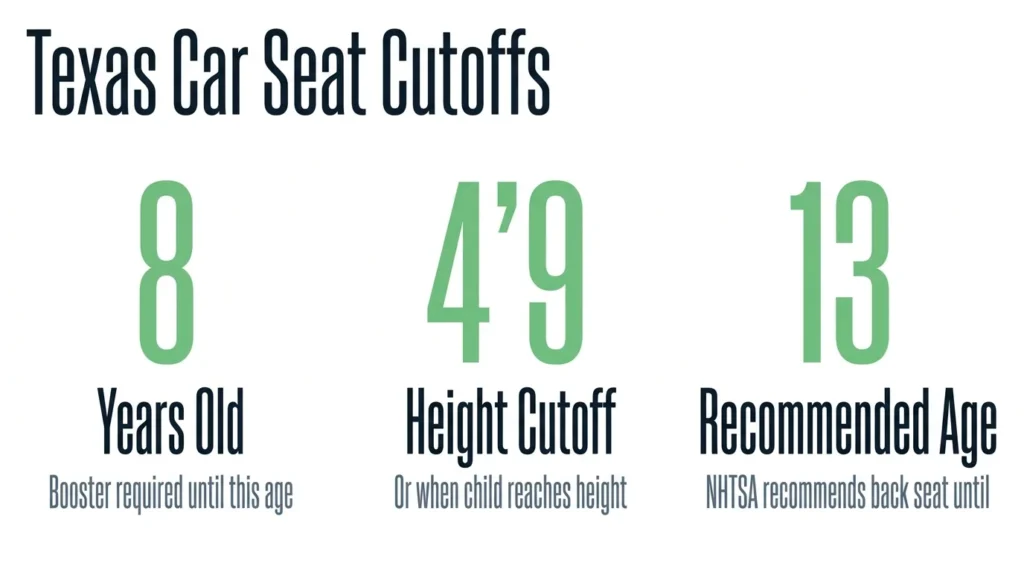
Under Texas Transportation Code Section 545.412, children younger than 8 years old, unless they are taller than 4 feet 9 inches, must be secured in an appropriate child safety seat system any time they ride in a passenger vehicle. Best practice is to keep using a booster seat past that point until a regular seatbelt fits your child correctly on its own.
Texas law does not specify a legal age or height requirement for when a child can ride in the front seat itself. The law only requires that every child safety seat system be used according to the manufacturer’s instructions.
If your child’s seat is rear-facing and your car has a front passenger airbag, placing that seat up front is against those instructions unless your vehicle allows the passenger airbag to be manually turned off, which only some vehicles allow.
More importantly, the National Highway Traffic Safety Administration and the American Academy of
Pediatrics recommend keeping children under age 13 in the back seat, properly restrained, for maximum protection, even once Texas law no longer requires it. The back seat stays statistically safer for children in a crash.
How Height, Weight & Booster Requirements Work in Texas
Texas measures the booster-seat requirement by height and age, not by weight: a child must ride in a booster or other child safety seat until turning 8 or reaching 4 feet 9 inches, whichever happens first. There is no separate state weight cutoff.
The weight numbers parents usually ask about, often somewhere between 40 and 100 pounds depending on the seat, come from the booster or car seat manufacturer, not from Texas law. Always follow the manufacturer’s own height and weight limits for the specific seat you own, since a seat’s actual limits can fall inside or outside that range.
A wearable travel vest is one legal Texas alternative to a bulky booster for a child who has outgrown one seat type but is not yet ready for a regular belt. Check the manufacturer’s own weight and height range before buying one, since it varies by model.
This is also where the law and safety guidance pull apart the most. Once a child meets the 8-year or 4-foot-9-inch mark, Texas law no longer requires a booster or restricts where they sit. The National Highway Traffic Safety Administration and the American Academy of Pediatrics still recommend the back seat for another several years, until age 13, regardless of height or weight.
Age-by-Age Guidance for Car Seats & Boosters
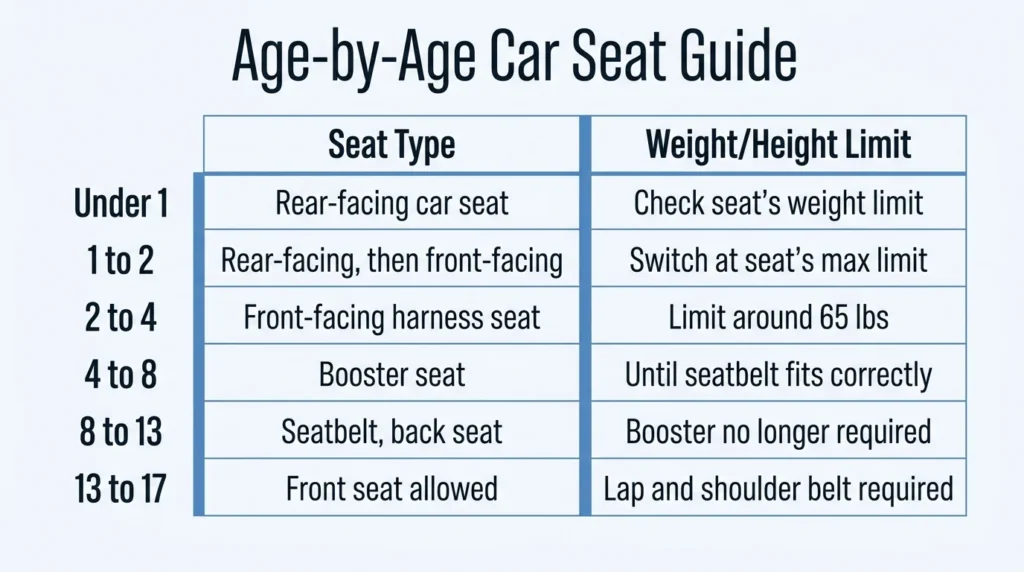
Texas car seat requirements change as your child grows, and the right seat depends on your child’s actual size, not just their age.
- Under 1 year. Keep infants in a rear-facing car seat. Many rear-facing seats carry a lower weight limit somewhere around 20 to 22 pounds, so check your specific seat before moving to a front-facing model. Choose a seat based on your child’s weight and stick with it until they reach its maximum limit.
- 1 to 2 years. Children in this age range should ideally stay rear-facing. Once they exceed their seat’s maximum height or weight limit, you can move them to a front-facing seat with a harness.
- 2 to 4 years. Most children this age ride in a front-facing seat with a harness. Stick with that seat until your child reaches its maximum limit, generally in the neighborhood of 65 pounds, though every manufacturer sets its own number.
- 4 to 8 years. Once your child outgrows the front-facing seat, move them to a booster. Keep using the booster until your child is tall enough for a regular seatbelt to fit correctly on its own.
- 8 to 13 years. By age 8, or once they reach 4 feet 9 inches, whichever comes first, Texas law no longer requires a booster or child seat, and a regular seatbelt becomes legal. Always double check that the belt fits correctly: the shoulder belt should cross the chest and shoulder, never the neck or face. (Safety experts still recommend the back seat through age 13, so legal and safest are not the same thing yet at this stage.)
- 13 to 17 years. How old do you have to be to sit in the front seat in Texas? Once your child is over 13, they can start sitting in the front passenger seat. Any child riding in front should still wear both the lap and shoulder belt every time.
The Five-Step Belt Fit Test
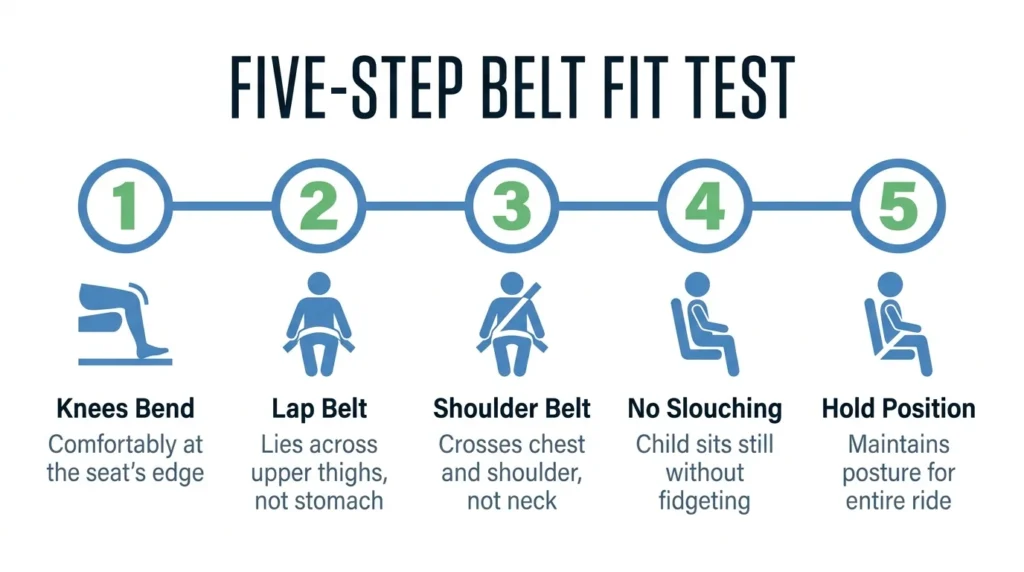
Before moving your child out of a booster seat for good, check these five things while they sit all the way back against the seat.
- Their knees bend comfortably at the seat’s edge.
- The lap belt lies across the upper thighs, not the stomach.
- The shoulder belt crosses the center of the chest and shoulder, not the neck or face.
- Your child can sit like this without slouching or fidgeting.
- They can hold that position for the entire ride.
If the answer is no to any of these, keep your child in the booster seat a while longer.
Exceptions & Penalties Under Texas Law
A few narrow exceptions apply to the booster and car-seat rules:
- Height over 4 feet 9 inches. A child taller than 4 feet 9 inches can ride without a child seat, and even in the front seat, though we still recommend the back seat below age 13.
- Emergencies. Officers may waive penalties when a genuine emergency, like a trip to the hospital, requires a child to ride without the usual restraint. Routine errands do not qualify.
- Taxis and rideshares. Commercial ride services are generally not equipped with car seats for children. Bring your own whenever possible; without one, a seat belt alone is best reserved for children who are already several years old.
Violating the car-seat requirement carries a fine of $25 to $250 and can bring a misdemeanor charge. Seat belt violations run separately, generally lower for an adult driver than for a minor passenger, and the driver, not the child, is the one who pays.
If your child is hurt in a Texas car crash despite being properly restrained, understanding how insurance coverage and settlements work when a minor is injured can help protect their rights.
Work with an Experienced Attorney
Angel Reyes & Associates has helped Texas families for more than 30 years when a crash leaves a child hurt, even when every seat and seatbelt rule was followed correctly. We handle the insurance company so you can focus on your child’s recovery.
Our case results reflect more than $1 billion recovered for clients, and you pay nothing unless we win. Contact us today for a free consultation.
Past results do not guarantee future outcomes.
Texas Car Seat Law FAQs
Can a 10-year-old legally sit in the front seat in Texas?
Yes. Texas law sets no minimum age for front-seat riding, though the National Highway Traffic Safety Administration still recommends the back seat until age 13.
Does Texas give an injured child extra time to file a car accident claim?
Usually yes. Under Texas Civil Practice and Remedies Code Section 16.001, the standard filing deadline generally does not start running until the injured child turns 18.
Should a car seat be replaced after a crash?
The National Highway Traffic Safety Administration recommends replacing a car seat after any moderate or severe crash, since hidden stress on the harness or shell can make it less protective.
Are mirrors, strap covers, and other car seat accessories legal in Texas?
Only if the seat’s manufacturer allows them. Texas requires child seats to be used according to the manufacturer’s instructions, and many aftermarket accessories are not covered by the seat’s federal crash testing.
About the Authors

Spencer Browne
Writer
Spencer Browne is a partner at Angel Reyes & Associates and a Board Certified personal injury trial lawyer with nearly 100 jury trials across Texas. He focuses on car, truck, and wrongful death cases, with notable verdicts including a landmark win in the Choctaw Casino bus crash case. A recognized speaker and legal educator, Spencer is a member of the American Board of Trial Advocates and has been honored as a Texas Super Lawyer and one of D Magazine’s Best Lawyers in Dallas. He brings deep trial experience and relentless advocacy to every client he represents.

Kyle Nicolas
Editor
Kyle Nicolas is the Web Content & SEO Manager at Angel Reyes & Associates. He has more than 10 years of experience as a marketing co...

Angel Reyes
Reviewer
Angel L. Reyes, III is the Founder and Managing Partner of Angel Reyes & Associates. A nationally recognized trial attorney and business...