How Insurance Companies Fight UM/UIM Claims in Texas


Every article on this site is researched by our internal team, reviewed for legal accuracy against current Texas law, and held to State Bar of Texas advertising standards before publication. We do not publish content that overstates outcomes or makes promises about results.
Learn more about our
editorial standards .
Key Takeaways
- Texas UM/UIM claims hinge on whether you are "legally entitled to recover" from the at-fault driver.
- Insurers must acknowledge claims in 15 days or face 18% penalty interest under Chapter 542.
- Bad faith conduct under Chapter 541 can unlock up to triple damages plus attorney fees when the insurer acted knowingly.
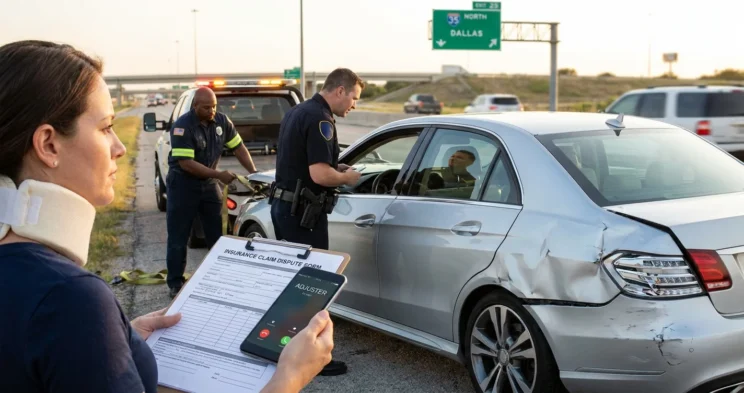
You were rear-ended on I-35 heading home from a shift, and the other driver had no insurance card to hand over, so you filed a claim with your own carrier because that is what your uninsured motorist coverage is for. Now your adjuster is asking for recorded statements, second medical opinions, and more paperwork, and the offer on the table will not cover your ER bill. Why is your own insurance company fighting you?
What Texas UM/UIM Coverage Actually Requires
Texas law requires every auto insurer to offer uninsured (UM) and underinsured (UIM) motorist coverage. When the at-fault driver has no insurance or not enough to cover your losses, your own policy is supposed to fill the gap. But your insurer can contest the claim almost like a defendant would in court, which is where most disputes start.
UM coverage applies when the at-fault driver carries no insurance, and it also covers certain hit-and-run scenarios. UIM kicks in when the other driver has insurance, but the policy limits fall short of your actual damages.
The pivot point is a single phrase in the Texas Insurance Code Chapter 1952: you must be “legally entitled to recover” from the at-fault driver. That standard lets your insurer challenge both fault and damages, not just the shortfall amount. If you want a deeper breakdown of how these policies stack with Personal Injury Protection (PIP), our explainer on UM, UIM, and PIP insurance coverage walks through the differences.
Tactics Insurers Use to Fight UM/UIM Claims
Insurers use a recognizable playbook to delay, reduce, or deny UM/UIM claims. Most tactics fall into a handful of categories: disputing liability, attacking your injuries, exploiting policy clauses, and lowballing valuation. Recognizing the move is the first step to pushing back.
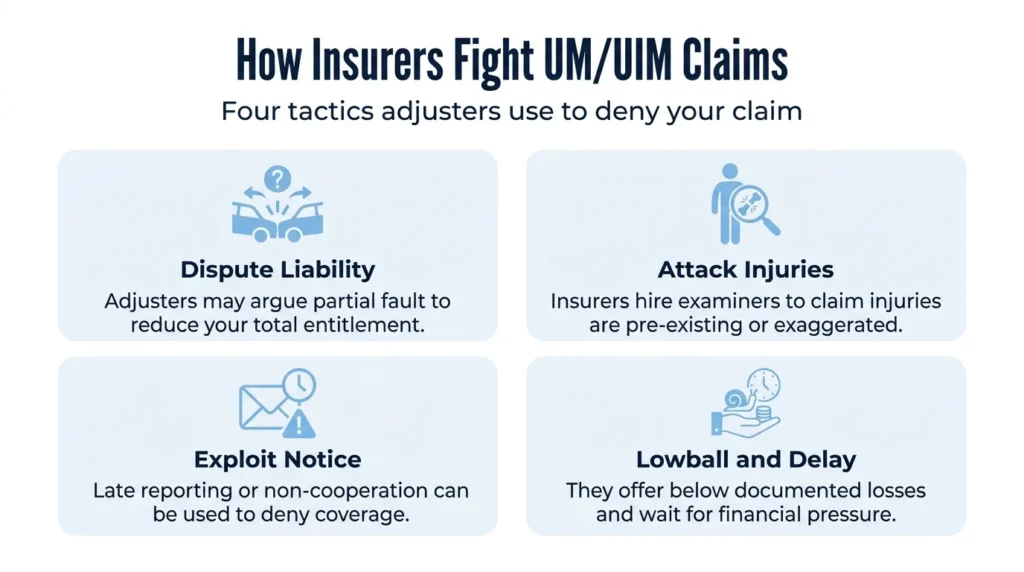
Disputing liability is common even when the police report clearly favors you. The adjuster may argue that you were partly at fault, which can reduce or eliminate the “legally entitled” threshold.
Attacking your injuries usually means hiring a medical examiner who reviews your file and concludes your injuries are pre-existing, exaggerated, or unrelated to the crash. These opinions routinely conflict with what your treating doctor wrote.
Exploiting policy clauses is another favorite. Insurers may claim you reported the crash too late or failed to cooperate, then use that as a coverage defense. Recorded statements taken early in the process get used the same way, with the adjuster looking for any inconsistency to undercut your damages.
Lowballing valuation combined with delay is the slow-burn tactic. The insurer presents an offer well below your documented bills and lost wages, then waits while pressure builds. If you can spot these patterns early, our overview of the insurance investigation process in Texas explains what adjusters look for behind the scenes.
Hit-and-run claims face an extra hurdle, as many Texas policies require either physical contact with the phantom vehicle or independent corroboration before UM coverage triggers. If you were sideswiped by a driver who fled, our hit-and-run accident blog explains how those cases are built. Reviewing a detailed uninsured motorist claims guide can help you see where your case fits.
Texas Law Limits How Far Insurers Can Go
Texas does not leave policyholders defenseless. Two chapters of the Insurance Code set the rules for how insurers must handle claims, and violations carry real financial consequences. Knowing what each one covers helps you tell a legitimate dispute from misconduct.
Chapter 541: Unfair & Deceptive Insurance Practices
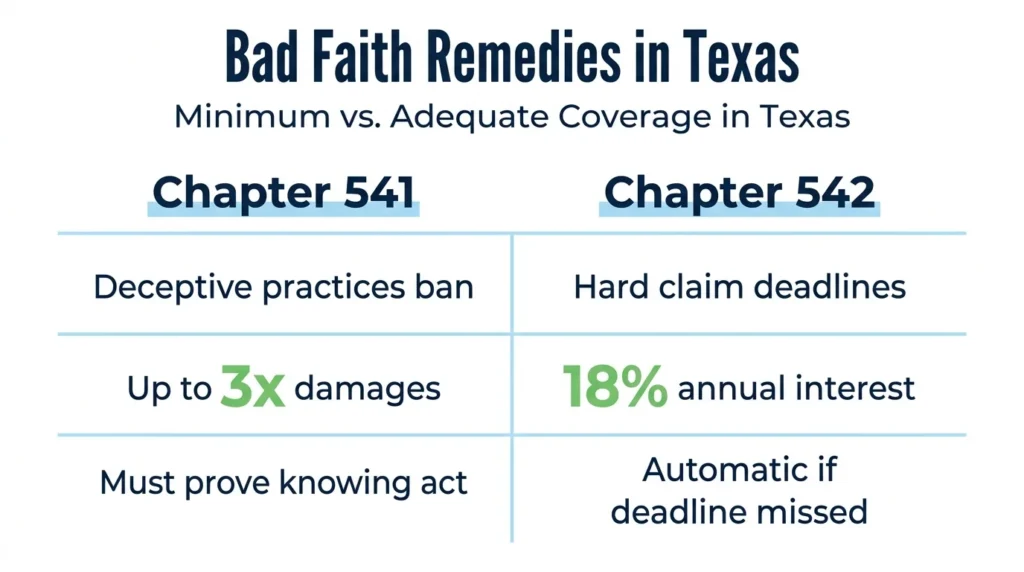
Texas Insurance Code Chapter 541 bans specific insurer conduct, which includes misrepresenting policy terms, making claims decisions without a reasonable investigation, and refusing to settle when liability is reasonably clear.
The remedy has teeth. A claimant who proves a Chapter 541 violation can recover actual damages, and up to three times those damages if the trier of fact finds the conduct was knowing. This is the qualitative bad faith standard, focused on how the insurer behaved.
Chapter 542: Prompt Payment of Claims
Texas Insurance Code Chapter 542 sets hard deadlines. The insurer has 15 days to acknowledge your claim, 15 business days to accept or reject after receiving all requested items, and 5 business days to pay after accepting.
Miss the deadline, and the penalty is automatic. Chapter 542 adds 18 percent annual interest on top of the judgment, plus reasonable attorney fees. Even a meritorious investigation can create Chapter 542 liability if the insurer stretches it past the statutory clock.
Options After a UM/UIM Denial or Underpayment
You have more options than the adjuster lets on. The path runs from informal pressure to formal litigation, and each step builds a record for the next one.
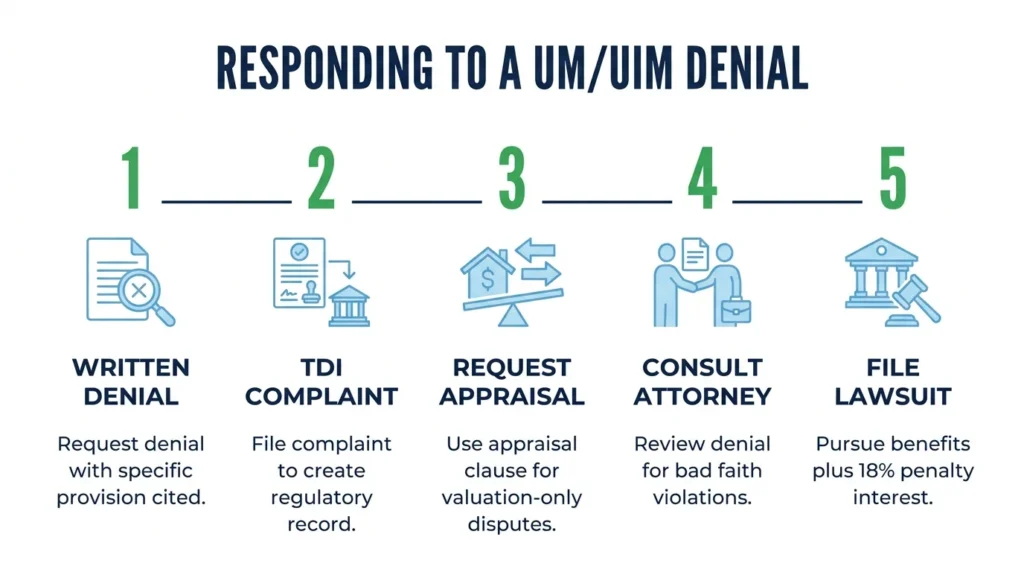
Start by demanding a written denial that cites the specific policy provision and factual basis. A vague denial letter is itself a yellow flag and becomes evidence in any later dispute.
File a complaint with the Texas Department of Insurance (TDI). TDI investigates insurer conduct, can impose regulatory consequences, and creates a public record of how your claim was handled.
If the fight is over the dollar amount rather than coverage itself, demand an appraisal. Many Texas auto policies include an appraisal clause that resolves valuation disputes without going to court. Our case results show what those resolutions can look like in practice.
When informal steps fail, you can sue. A successful suit recovers your policy benefits plus Chapter 542 penalty interest, Chapter 541 enhanced damages, and attorney fees. For the early steps after a crash with an uninsured driver, our guide on what to do after being hit by an uninsured driver covers the immediate actions, and our Texas car accident practice page explains how these claims fit into a broader injury case.
Talk to a Texas UM/UIM Attorney About Your Claim
Angel Reyes & Associates has over 30 years of experience handling UM/UIM disputes and bad faith claims across Texas. Backed by a team of more than 600 dedicated professionals across more than 20 offices statewide, we have recovered more than $1 billion for clients. We work on contingency, meaning no fee unless we win.
If your claim has been denied, delayed, or underpaid, our Texas injury attorneys can review the denial letter and explain your options. We offer service in both English and Spanish to ensure you feel supported through the process. Contact us today for a free consultation, with team members available 24/7 to take your call.
Past results do not guarantee future outcomes.
How Insurers Fight UM/UIM Claims FAQs
Can I use my UM/UIM coverage if the at-fault driver is later identified after I file my claim?
Yes, if a hit-and-run driver is identified after you file a UM claim, your insurer may shift the claim to the at-fault driver’s liability policy instead. Whether your UM benefits have already been paid out will affect how any recovery is offset, depending on your policy’s language.
Does Texas allow stacking of UM/UIM coverage across multiple vehicles on the same policy?
Texas does not require insurers to allow stacking, and most personal auto policies include anti-stacking language that limits recovery to the single highest applicable limit. Some older policies or multi-policy households may have different terms, so checking your declarations page is the only reliable way to know.
Will filing a UM/UIM claim raise my auto insurance rates in Texas?
Texas law does not prohibit insurers from raising rates after a UM/UIM claim, even when you were not at fault. Whether your premium increases depends on your insurer’s rating practices and the terms of your policy.
What happens to my UM/UIM claim if I also have a personal injury lawsuit pending against the at-fault driver?
Pursuing both at the same time is possible, but any amount you recover directly from the at-fault driver typically reduces what your UIM carrier owes by the same amount. Texas courts have confirmed this offset rule, and most policies require you to notify your insurer before settling with the at-fault driver to protect your UIM rights.
Can a minor child make a UM/UIM claim under a parent's Texas auto policy?
A child who is a resident of the household is generally covered as insured under a parent’s UM/UIM policy when injured while occupying a covered vehicle. A guardian or parent would typically manage the claim on the child’s behalf, and any settlement for a minor may require court approval under Texas law.
About the Authors

Angel Reyes
Writer
Angel L. Reyes, III is the Founder and Managing Partner of Angel Reyes & Associates. A nationally recognized trial attorney and business leader, Angel has helped over 70,000 injury victims recover more than $1 billion since founding the firm in 1993. Named to the Texas Super Lawyers list annually since 2008, Angel brings Wall Street experience, Ivy League education, and a deep commitment to client advocacy. He is a frequent legal commentator and published author with extensive contributions to legal scholarship, trial strategy, and consumer protection.

Kyle Nicolas
Editor
Kyle Nicolas is the Web Content & SEO Manager at Angel Reyes & Associates. He has more than 10 years of experience as a marketing co...

Alex Ivanov
Reviewer
Alex Ivanov is a personal injury attorney at Angel Reyes & Associates, focused on car, truck, and motorcycle accident cases. Licensed in...