How “Biker Bias” Affects Texas Motorcycle Accident Claims


Every article on this site is researched by our internal team, reviewed for legal accuracy against current Texas law, and held to State Bar of Texas advertising standards before publication. We do not publish content that overstates outcomes or makes promises about results.
Learn more about our
editorial standards .
Key Takeaways
- Biker bias makes adjusters assume you rode recklessly before reviewing any evidence.
- Texas bars all recovery once your assigned fault reaches 51 percent or more.
- Safety certificates, a Class M license, and crash photos counter the rider stereotype.

You were riding home from work on I-35 near downtown Austin when a driver turned left across your lane and clipped your front wheel.
The motorcycle crash was not your fault, and you have the dashcam footage to prove it. Yet the adjuster keeps circling back to your speed, and their chosen language feels like they are blaming you for being on a bike at all.
If you’ve heard stories about bikers facing an uphill battle to recover compensation on an accident, you’ve likely heard about “biker bias.” Here’s what to do about it.
What is Biker Bias?
Biker bias is the tendency of adjusters, witnesses, and jurors to assume a motorcyclist was riding recklessly, no matter what the evidence shows. Researchers call the underlying mechanism attribution bias. When something goes wrong involving a rider, observers blame the rider’s character instead of the actual circumstances.
The stereotypes around this bias are familiar.
Riders are thrill-seekers.
Riding is dangerous by nature.
Motorcycles are toys, not real transportation.
A rider who gets hurt was somehow asking for it.
These assumptions circulate among adjusters and jurors before anyone reviews a single fact. They shape how your claim is read from the very first phone call.
This is not a hypothetical problem. It works at the scene of the crash through skewed witness perceptions, in the adjuster’s office during fault assignment, and in the courtroom as jurors form opinions. The pattern shows up in the broader picture of Texas motorcycle accident data.
This bias does not care how you actually rode. A fully licensed, safety-trained rider who follows every traffic law can face the same suspicion as someone who rode recklessly. However, your record does not shield you from pre-conceived assumptions.
How Bias Inflates Fault in Texas Claims
Biker bias turns into real money the moment an adjuster assigns fault. An inflated fault percentage does not just shrink your payout. Under Texas law, it can erase your compensation completely.
Adjuster Bias & Fault Assignment
Adjusters are not neutral referees. They are trained to keep payouts low, and biker bias gives them cover to raise your assigned fault without backing it up with evidence.
You can usually spot the pattern. The adjuster emphasizes your speed without any data to support it.
A routine lane change gets recast as reckless, while the other driver’s position goes unexamined. Your injuries get downplayed because, in their words, motorcyclists take risks.
What you are seeing is an assumption dressed up as an evaluation. A clear understanding of how fault is determined in Texas helps you recognize when an adjuster is guessing rather than proving.
The 51 Percent Bar Under Texas Law
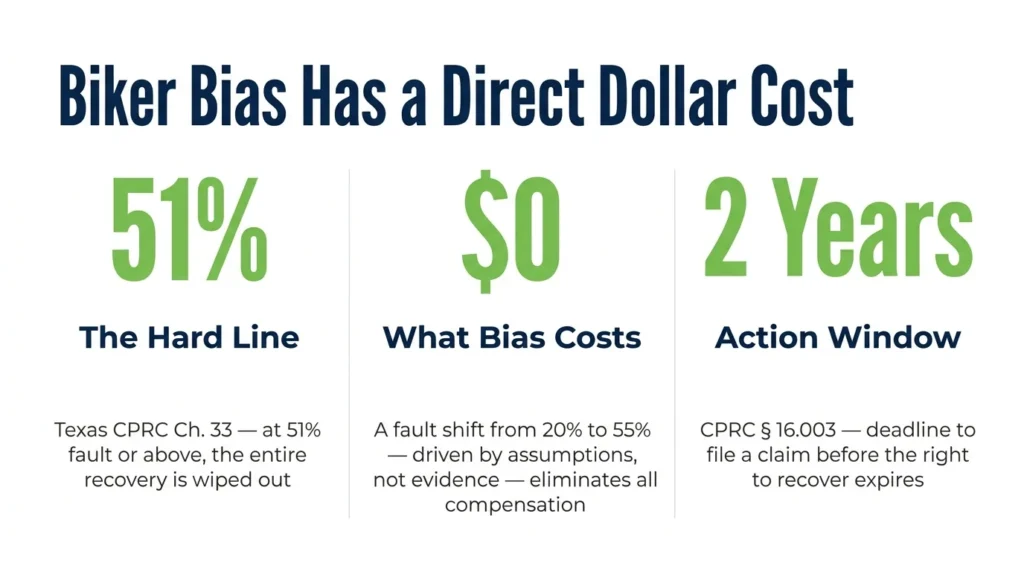
The stakes here are higher than most riders realize. The Texas Civil Practice and Remedies Code (CPRC) Chapter 33 sets a hard line. If you are assigned 51 percent or more of the fault, you recover nothing at all.
If your share of blame lands at 50 percent or less, you still recover, but the court reduces your damages, or compensation, by your percentage of fault. That single point between 50 and 51 decides whether you walk away with compensation or with nothing.
Say bias pushes your fault from 20 percent up to 55 percent. The result is not a smaller check. It is zero. That single shift is the legal consequence of unchecked biker bias in a Texas motorcycle claim.
This is why fault inflation hurts riders more in Texas than in states that follow contributory negligence or pure comparative fault rules. A handful of percentage points can flip a strong claim into nothing. If you suspect your fault percentage is because of bias rather than evidence, having an attorney review the adjuster’s reasoning before you accept any offer can protect that margin.
Evidence That Counters Biker Bias
The most effective answer to biker bias is documentation that contradicts the reckless-rider story directly. Each item below works as a counter-narrative, so gather what applies to you.
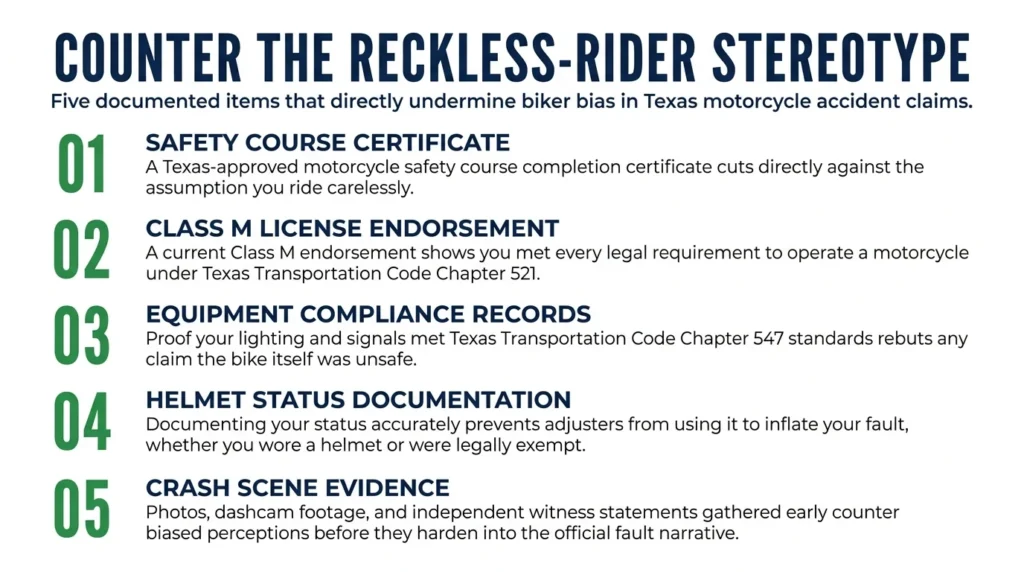
- Safety course certificate. Texas Transportation Code Chapter 662 governs the approved motorcycle safety course. A completion certificate is documented and verifiable, and it cuts straight against the idea that you ride carelessly.
- Class M license endorsement. Texas Transportation Code Chapter 521 sets the licensing rules. A valid, current Class M endorsement shows you met every legal requirement to operate a motorcycle.
- Equipment compliance records. Texas Transportation Code Chapter 547 lays out the safety equipment a motorcycle must carry. Proof that your lighting, signals, and equipment met the standard rebuts any claim that the bike itself was unsafe.
- Helmet status documentation. Riders 21 and older are exempt from the helmet requirement under Texas Transportation Code section 661.003 if they completed an approved safety course or carry qualifying medical coverage. Whether you wore a helmet by choice or were legally exempt, get that status documented accurately.
- Crash scene evidence. Collect photos, dashcam or traffic camera footage, and independent eyewitness statements as early as you can, before biased perceptions harden. Physical evidence often rebuts witness accounts colored by assumptions, and it can also clarify how your injuries actually happened.
How Attorneys Counter Biker Bias
An experienced attorney changes the dynamic by controlling the fault narrative before it sets. In negotiations, that means presenting your counter-evidence package early, before the adjuster anchors on an inflated fault number. A low first offer becomes the baseline if no one challenges it, so early action keeps it from sticking.
An attorney also documents the adjuster’s conduct itself. Written messages that mention the motorcycle without tying it to any fact, fault numbers that clash with the physical evidence, and injury assessments that minimize severity all become part of the record.
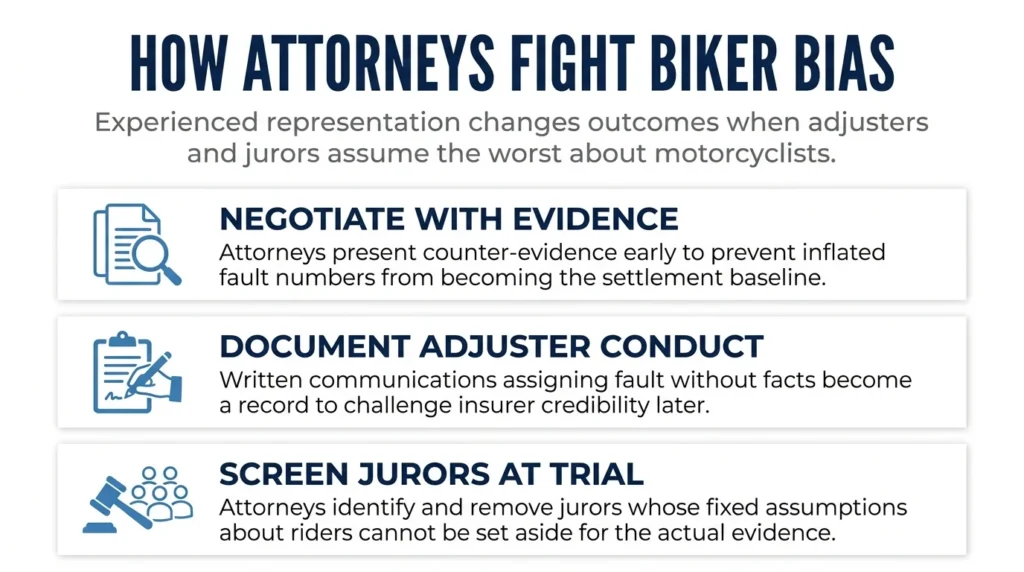
The courtroom calls for a different tool. Jury bias surfaces during voir dire, or the questioning that screens potential jurors. Through that process, an attorney can identify and remove jurors whose fixed beliefs about riders cannot be set aside. A rider handling a claim alone has no access to that protection.
Expert witnesses can take on the bias directly. They explain to a jury how attribution bias works and why a witness’s interpretation of a rider’s behavior may be unreliable without supporting evidence. Riders managing an active claim without representation may be accepting a fault percentage that reflects an adjuster’s assumptions rather than the facts, which is where seasoned legal guidance is most important.
Work with an Experienced Attorney
Biker bias is a documented problem in Texas claims, and your instinct to question your fault percentage may be exactly right. Angel Reyes & Associates has spent over 30 years helping riders facing this bias, including those who were blamed for crashes that were not their fault. We have recovered more than $1 billion for clients, and we work on a no-fee-unless-we-win basis, so you owe us nothing unless we recover for you.
Our consultations are free, and we are available 24/7 to review what happened and explain your options. Reach out to us for a free consultation before you accept any offer.
Past results do not guarantee future outcomes.
Motorcycle Accident Claims & Biker Bias FAQs
Does riding without an MSF safety course certificate hurt my motorcycle accident claim in Texas?
It can. Insurance adjusters often argue that a rider without a completion certificate lacked the training to avoid the crash, which can be used to push your fault percentage higher. The absence of the certificate is not proof of negligence, but it removes a key piece of counter-evidence that directly affects the reckless-rider narrative.
How long do I have to file a motorcycle accident lawsuit in Texas?
Texas gives you two years from the date of the crash to file a personal injury lawsuit, under Texas Civil Practice and Remedies Code section 16.003. Missing that deadline generally ends your right to recover, regardless of how strong your case is.
Can biker bias affect my pain and suffering damages, not just my fault percentage?
Yes. Adjusters and jurors who assume a rider accepted the risks of injury may discount non-economic damages like chronic pain, emotional distress, and loss of enjoyment of life. Pain and suffering is often the largest part of a motorcycle settlement, so bias-driven minimization can cut the total value of a claim significantly even when fault is not disputed.
Does biker bias still apply when I file a claim against my own insurance company for an uninsured driver?
Yes. Uninsured and underinsured motorist (UM/UIM) claims go through your own insurer, but that insurer still evaluates fault and injury severity. The same bias-driven reasoning used by an opposing adjuster can appear in a UM/UIM review, meaning riders often need to document their counter-evidence just as carefully for these claims as for claims against the at-fault driver.
Can I challenge a biased crash report in a Texas motorcycle accident case?
Yes. You can request an amendment to the Texas Peace Officer’s Crash Report (CR-3) by submitting evidence that contradicts the report’s facts or narrative. Officers rarely change reports without compelling evidence like surveillance footage or additional witness statements, but creating a documented objection builds a record you can use later.
About the Authors

Angel Reyes
Writer
Angel L. Reyes, III is the Founder and Managing Partner of Angel Reyes & Associates. A nationally recognized trial attorney and business leader, Angel has helped over 70,000 injury victims recover more than $1 billion since founding the firm in 1993. Named to the Texas Super Lawyers list annually since 2008, Angel brings Wall Street experience, Ivy League education, and a deep commitment to client advocacy. He is a frequent legal commentator and published author with extensive contributions to legal scholarship, trial strategy, and consumer protection.

Kyle Nicolas
Editor
Kyle Nicolas is the Web Content & SEO Manager at Angel Reyes & Associates. He has more than 10 years of experience as a marketing co...

Angel Reyes
Reviewer
Angel L. Reyes, III is the Founder and Managing Partner of Angel Reyes & Associates. A nationally recognized trial attorney and business...