Bus Accident Claim Without a Police Report


Every article on this site is researched by our internal team, reviewed for legal accuracy against current Texas law, and held to State Bar of Texas advertising standards before publication. We do not publish content that overstates outcomes or makes promises about results.
Learn more about our
editorial standards .
Key Takeaways
- Texas law lets you file a bus accident claim even when no police report was ever filed.
- Government bus claims demand written notice within six months under the Tort Claims Act.
- Incident reports, bus camera footage, and witness statements can replace a missing report.
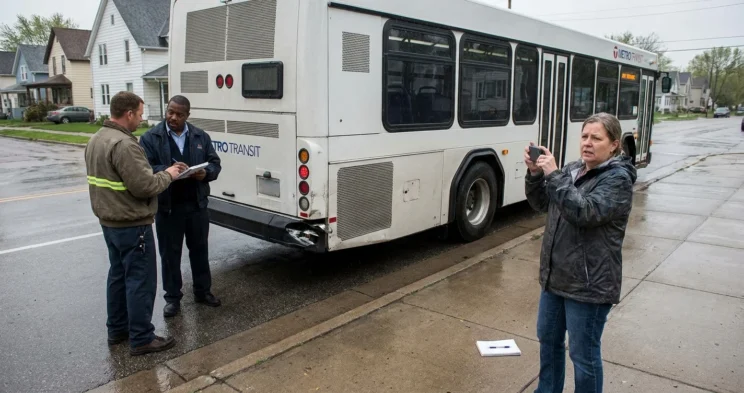
You were riding the bus home through Midtown when the driver braked hard and threw you into the seat ahead. No officer ever showed up, and no report was filed. Now an adjuster says your claim is weak without one, and the medical bills are already piling up.
Can You File a Bus Accident Claim Without a Police Report?
Yes, you can still file a claim without a police report. Texas law does not require one before you pursue a personal injury claim, and insurers and courts will accept other evidence when no report exists.
A police report still helps, which is why insurers prefer it. The report captures an officer’s fault observations and gathers witness contact details in one place. Without it, you carry a heavier burden to prove what happened, but that burden is one you can meet.
Whether a report should have existed depends on the crash itself. A report becomes mandatory when the accident involves injury, death, or damage to a vehicle severe enough that it cannot be safely driven under Texas Transportation Code § 550.026. If anyone was hurt, an officer should have filed a report.
Sometimes a report is filed but has not finished processing yet. Before you assume none exists, confirm it through the TxDOT crash report records system.
Understanding what the report would have given you also explains what you now need to replace.
Alternative Evidence for a Bus Accident Claim
Several types of evidence can replace or strengthen a missing police report, and some are unique to bus crashes. The goal is to recreate the facts an officer would have recorded: who was involved, what happened, and how badly you were hurt.
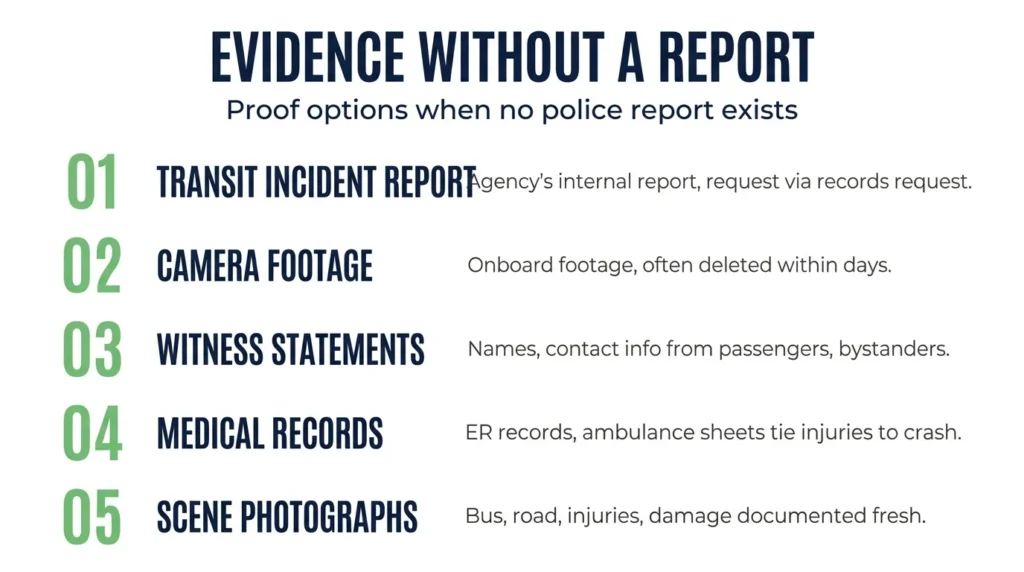
Start gathering this evidence as soon as you can, because some of it disappears within days:
- Transit authority incident report. When a government-operated bus is involved, the agency files its own internal report. You can request a copy through an open records request under the Texas Public Information Act.
- Surveillance and dashcam footage. Most buses carry onboard cameras that record the cabin and the road. This footage often gets overwritten, aka deleted, within days, so a fast preservation request matters.
- Witness statements. Names and contact details from fellow passengers, other drivers, or bystanders can replace much of what a report would have captured.
- Medical records. Emergency room records, ambulance run sheets, and your doctor’s notes tie your injuries to the date of the crash.
- Scene photographs. Pictures of the bus, the road, your injuries, and any property damage document conditions while they are still fresh.
If you are not sure how to request transit agency records, an attorney familiar with Texas public transportation claims can explain when you can sue a transit provider and how to start.
Government Bus Claims Require Extra Steps
If a government entity like DART, METRO, or VIA operated the bus, your claim follows the Texas Tort Claims Act. That law waives some sovereign immunity but limits both the damages you can recover and the parties you can sue.
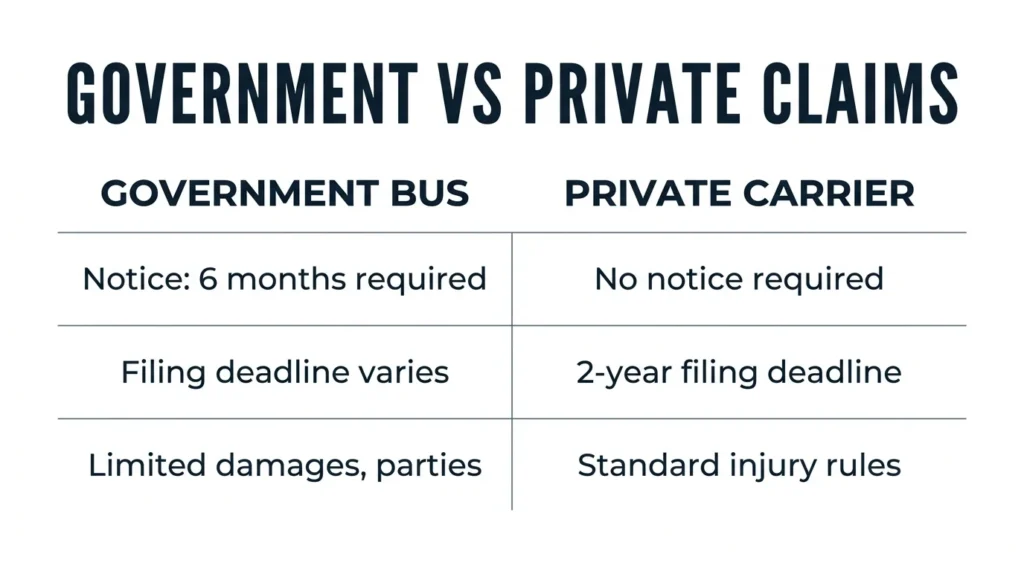
The biggest difference is the deadline. Texas Civil Practice and Remedies Code (CPRC) § 101.101 requires written notice to the government unit within six months of the incident. Miss that window and your claim cannot move forward, whether or not a police report was ever filed.
Some agencies set even tighter deadlines. METRO and DART each follow their own procedural rules, so you need to identify which agency ran the bus before you count your days.
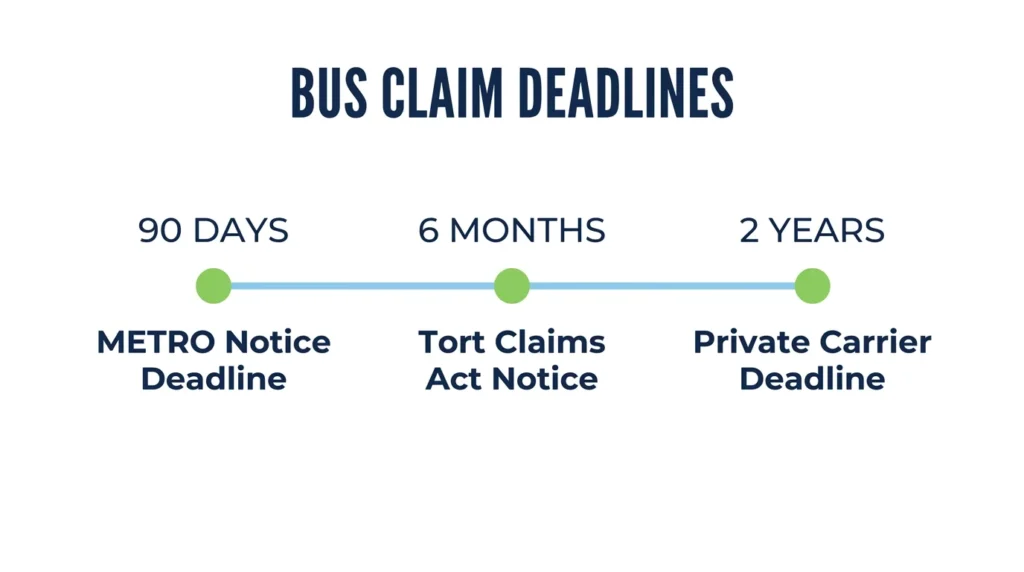
A private carrier claim is different. It follows standard injury rules with a two-year filing deadline under Texas Civil Practice and Remedies Code § 16.003, and no pre-suit notice requirement applies.
Who Is Liable When a Bus Causes an Accident?
Liability in a bus crash can fall on several parties at once. The bus driver, the operating company or transit authority, a third-party driver, a parts manufacturer, or a road maintenance authority may all share fault for a single accident.
Without a police report naming a driver or assigning blame, you establish fault through the evidence covered above. Incident reports, camera footage, witness accounts, and crash reconstruction can together show what happened and who caused it.
Private bus operators owe passengers a heightened duty of care as common carriers under Texas law. That higher standard can work in your favor even when your documentation is thin.
An attorney handling these claims can pinpoint the right defendants and collect the evidence to prove liability before your deadlines pass.
Discuss Your Bus Accident With an Attorney Today
A missing police report does not end your claim, but it does mean a compressed timeline and a heightened evidence burden than a routine crash. Angel Reyes & Associates has handled Texas bus accident claims, including cases against government transit agencies, for over 30 years.
We offer free consultations, and we charge no fee unless we win, with court costs and case expenses recovered from your settlement only if we do. We have more than $1 billion recovered for clients across Texas. You can contact us for a free consultation to review your options at no cost.
Past results do not guarantee future outcomes.
Bus Accident Claim Without a Police Report FAQs
Can I file my own crash report if no police officer came to the scene?
Yes. Texas Transportation Code § 550.026 requires drivers involved in a reportable crash to report the accident to law enforcement if an officer is not present. You can also submit a Driver’s Crash Report (Form CR-2) directly to TxDOT to create an official record.
How quickly can bus camera footage be deleted after an accident?
Bus and transit system cameras typically overwrite recordings within 7 to 30 days, and some systems delete footage within 24 to 72 hours. Send a written preservation request to the transit agency as soon as possible after the crash to stop the footage from being destroyed.
Does Houston's METRO have a shorter notice deadline than the standard six months?
Yes. The City of Houston’s charter requires written notice of a claim within 90 days of the incident, which is shorter than the six-month window under the Texas Tort Claims Act. Missing that 90-day deadline can bar your claim against METRO entirely.
What if I felt fine after the accident and did not see a doctor right away?
You can still file a claim, but the gap between the crash date and your first medical visit will be an issue for the insurer. Injuries like whiplash and back trauma often show full symptoms days or weeks later, so getting checked out quickly creates a medical record that connects your injuries to the accident.
What insurance covers passengers on a private charter bus?
Federal law requires private charter bus operators carrying 16 or more passengers to carry at least $5 million in liability insurance. That commercial policy is the primary source of compensation if you are hurt on a private charter, and it applies whether or not a police report was filed.
About the Authors

Angel Reyes
Writer
Angel L. Reyes, III is the Founder and Managing Partner of Angel Reyes & Associates. A nationally recognized trial attorney and business leader, Angel has helped over 70,000 injury victims recover more than $1 billion since founding the firm in 1993. Named to the Texas Super Lawyers list annually since 2008, Angel brings Wall Street experience, Ivy League education, and a deep commitment to client advocacy. He is a frequent legal commentator and published author with extensive contributions to legal scholarship, trial strategy, and consumer protection.

Kyle Nicolas
Editor
Kyle Nicolas is the Web Content & SEO Manager at Angel Reyes & Associates. He has more than 10 years of experience as a marketing co...

Alex Ivanov
Reviewer
Alex Ivanov is a personal injury attorney at Angel Reyes & Associates, focused on car, truck, and motorcycle accident cases. Licensed in...