Bus Accident Insurance Coverage in Texas


Every article on this site is researched by our internal team, reviewed for legal accuracy against current Texas law, and held to State Bar of Texas advertising standards before publication. We do not publish content that overstates outcomes or makes promises about results.
Learn more about our
editorial standards .
Key Takeaways
- Who pays after a Texas bus crash depends on whether it was public, school, or charter.
- The Texas Tort Claims Act caps public bus recovery at $250,000 per injured person.
- Your own PIP coverage can pay medical bills first, no matter who caused the crash.
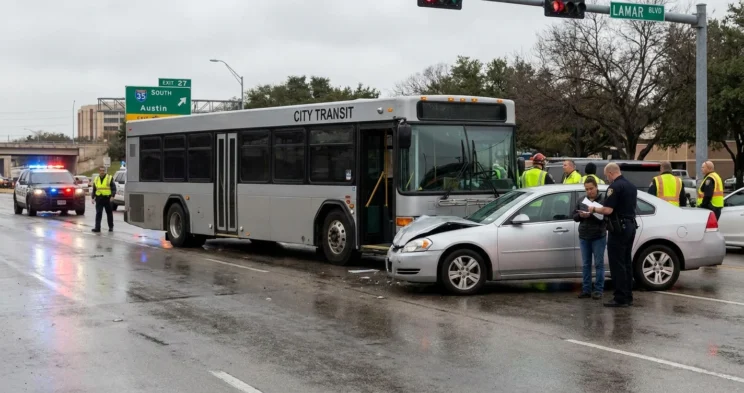
You were riding the bus home along Westheimer Road in Houston when another car cut across two lanes and clipped the front bumper. Now you are in an emergency room, watching the bills start to pile up. No one can tell you whose insurance is supposed to pay: the transit agency, the other driver, or your own auto policy.
Who Pays After a Texas Bus Accident?
Who pays for your injuries depends on one thing: who was operating the bus. Three kinds of operators cover their risk in very different ways:
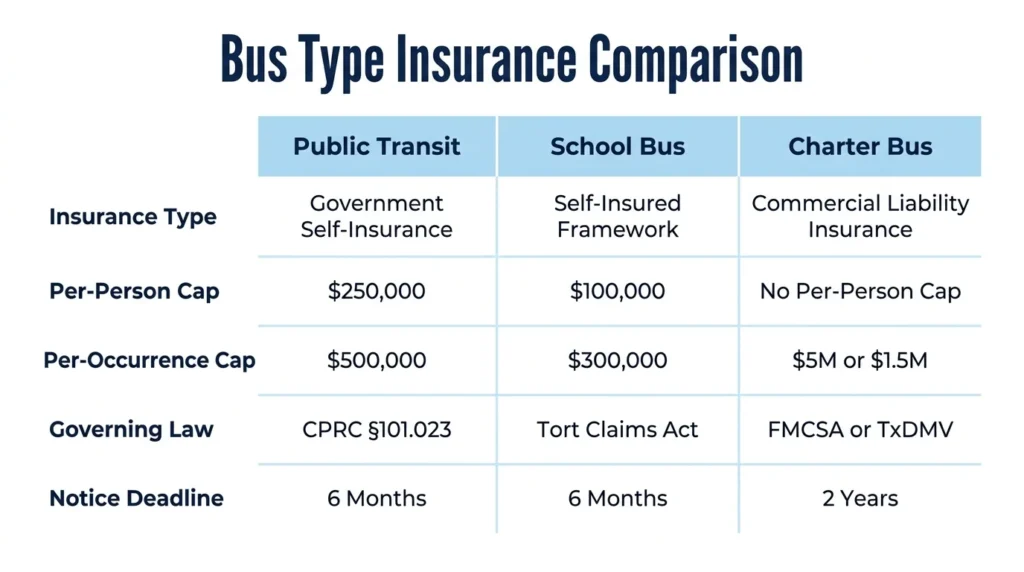
- Public transit buses. City and regional transit authorities usually rely on government self-insurance instead of a standard commercial policy.
- School buses. Independent school districts sit under a similar self-insurance and immunity framework, with a separate damage limit.
- Charter and private tour buses. These companies carry commercial liability insurance that federal or state regulators require.
Figuring out which category fits is the first step in any Texas bus accident claim. More than one party can also share the blame.
Under Texas Civil Practice and Remedies Code (CPRC) Chapter 33, the law splits fault by percentage across everyone responsible. The bus operator, another driver, or a maintenance contractor might each carry a share.
Assigning fault this way can open more than one insurance policy to your claim.
Buses are a small share of all crashes. But their size and passenger load make injuries serious, according to federal truck and bus crash data.
Texas Tort Claims Act Coverage for Public Buses
Public transit and school bus claims fall under the Texas Tort Claims Act. That law limits what you can financially recover, and the limit depends on who owns the bus.
State and Municipal Transit Coverage
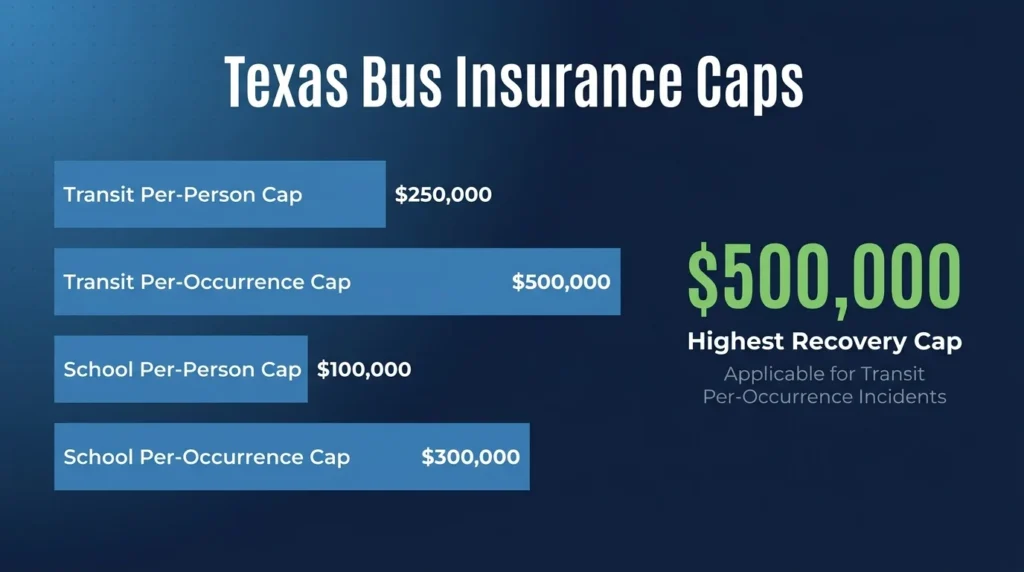
If a city or regional transit bus hurts you, state law limits what you can recover. The limit is $250,000 per person and $500,000 per occurrence under Texas Civil Practice and Remedies Code (CPRC) § 101.023.
Because this cap applies per person and per occurrence, a crash that injures a full bus can split one fixed amount among every passenger.
When a crash injures a full bus of riders, how the caps divide among claimants can decide what everyone receives.
School District Coverage
School districts and similar local governmental units answer to a lower limit: $100,000 per person and $300,000 per occurrence.
Charter Bus Insurance Requirements in Texas
Charter and private tour buses do not get the government caps. They carry commercial liability insurance instead, set by federal or Texas minimums depending on where they operate.
Federal FMCSA Minimums for Interstate Carriers
A charter or tour bus that crosses state lines and seats 16 or more falls under 49 CFR § 387.33. It must carry at least $5,000,000 in liability coverage. Smaller for-hire passenger carriers must keep at least $1,500,000.
These are shared, per-crash limits, not a separate pool for each injured passenger, under the federal insurance rules for passenger carriers.
TxDMV Requirements for Intrastate Carriers
A charter bus that never leaves Texas answers to TxDMV rules instead of the federal thresholds. Under Texas Transportation Code §§ 643.101–643.103, an intrastate motor carrier must file proof of insurance or qualify as a self-insurer.
The TxDMV motor carrier registration system is the practical place to check which filing a specific company has on record. The line between federal and Texas insurance rules decides which minimum applies to your bus.
The same registration framework covers other commercial vehicles, such as the trucks behind commercial truck accident claims.
PIP Coverage After a Bus Accident
Separate from whatever covers the bus, your own auto policy may pay the first round of medical bills. Texas requires every auto liability policy to include Personal Injury Protection, or PIP, under Texas Insurance Code § 1952.152.
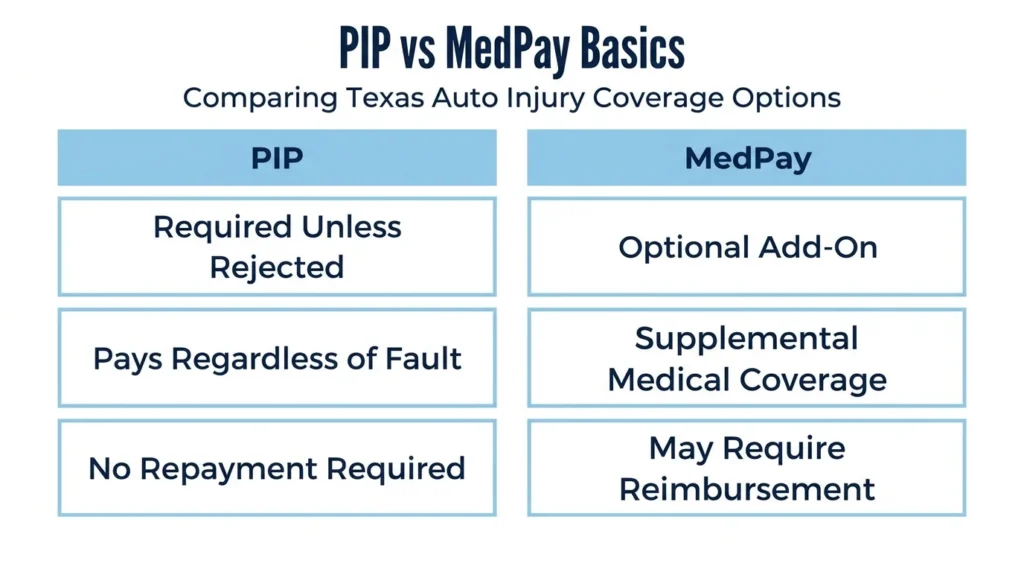
PIP pays your medical costs and lost income regardless of fault, unless you rejected it in writing. The differences between PIP, MedPay, and uninsured motorist coverage decide which one responds first.
Medical Payments coverage, or MedPay, is an optional add-on. Texas does not require it the way it requires PIP.
Your own PIP or MedPay usually pays sooner than a liability payout from the bus operator or carrier. That helps while you wait for everyone to sort out fault and coverage.
Texas also sets a baseline liability minimum for private drivers under Transportation Code § 601.072. That minimum is a useful yardstick against the far larger commercial limits that buses must carry.
Once you know which coverage layers apply, the next move is filing your bus accident claim correctly and on time.
Work with an Experienced Attorney Today
Sorting through layered insurance policies is hard while you are still recovering from a crash. Angel Reyes & Associates has guided injured Texans through this kind of layered claim for more than 30 years.
You can read what past clients say about our work. You can also learn more about who we are and how we work.
We work on contingency for clients all over the state, so you pay no fee unless we win. Our results include more than $1 billion recovered for clients.
Schedule a free consultation so you understand your options before any deadline passes.
Past results do not guarantee future outcomes.
Bus Accident Insurance Coverage FAQs
How long do I have to file a claim after a Texas bus accident?
Texas law gives you two years from the crash date to file a personal injury lawsuit. If a government agency owns the bus, such as a city transit system or school district, you must send a written notice within six months instead.
Does PIP cover me if I was hit by a bus while walking or driving another car, not riding as a passenger?
Yes, in many cases. PIP coverage follows the policyholder, so your own auto policy can still pay if you were a pedestrian or in another vehicle when the bus hit you.
If I signed a waiver before boarding a charter or tour bus, can I still file a claim?
Often yes. Texas courts only enforce these waivers when they clearly spell out negligence in specific terms, and many will not enforce a waiver against gross negligence at all.
Do I have to repay my health insurer or MedPay after a bus accident settlement?
PIP benefits do not have to be repaid under Texas law. Health insurance and MedPay often do have reimbursement rights, though a Texas law caps how much a health plan can recover from your settlement.
About the Authors

Angel Reyes
Writer
Angel L. Reyes, III is the Founder and Managing Partner of Angel Reyes & Associates. A nationally recognized trial attorney and business leader, Angel has helped over 70,000 injury victims recover more than $1 billion since founding the firm in 1993. Named to the Texas Super Lawyers list annually since 2008, Angel brings Wall Street experience, Ivy League education, and a deep commitment to client advocacy. He is a frequent legal commentator and published author with extensive contributions to legal scholarship, trial strategy, and consumer protection.

Graham Griffin
Editor
Graham Griffin is the Web & Content Manager at Angel Reyes & Associates, where he oversees content strategy, AI-powered workflows, a...

Angel Reyes
Reviewer
Angel L. Reyes, III is the Founder and Managing Partner of Angel Reyes & Associates. A nationally recognized trial attorney and business...