Bus Accident Involving an Emergency Vehicle in Texas


Every article on this site is researched by our internal team, reviewed for legal accuracy against current Texas law, and held to State Bar of Texas advertising standards before publication. We do not publish content that overstates outcomes or makes promises about results.
Learn more about our
editorial standards .
Key Takeaways
- A bus-emergency vehicle crash can make two Texas government entities liable at once.
- You must give each government unit written notice within six months of the crash.
- Damage caps apply separately to each entity, which can raise your total recovery.
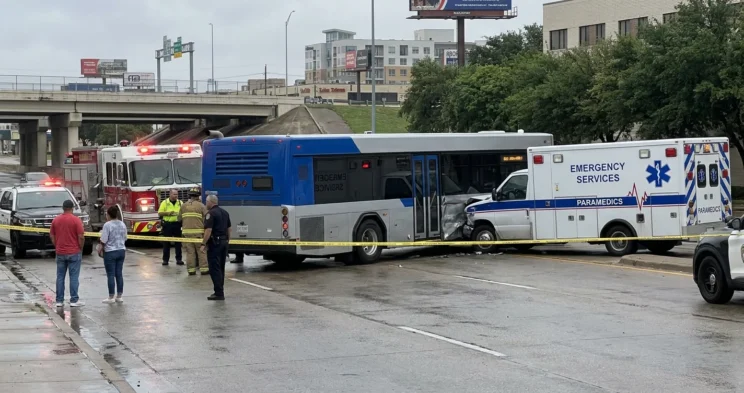
You were riding the bus home through Oak Cliff when a fire truck came screaming up to the intersection. The bus lurched, brakes locked, and the next thing you knew you were on the floor with a sharp pain in your neck. Now you are stuck with medical bills and a hard question: who actually pays for this when both vehicles belong to the government?
When Two Government Vehicles Collide
A crash between a transit bus and an emergency vehicle is one of the few accidents where two government entities may be on the hook at the same time. That means you could be dealing with two separate immunity claims, two sets of deadlines, and two damage caps from a single crash.
Most bus accidents put one government vehicle against a private car. This one is different. When a public bus collides with an ambulance or fire truck, both operators may work for a governmental unit.
Neither side gets to claim immunity automatically. Texas law shields government entities in some situations, but it carves out exceptions for crashes like this one.
If you were a passenger on the bus, a bystander on the sidewalk, or a driver caught in the wreck, you are not part of any immunity dispute between the two agencies. You are the injured person, and you have the right to ask both of them to answer for what happened.
For crashes involving only one government vehicle, the picture is simpler. We cover what happens when an ambulance hits your vehicle and what to do when a city bus strikes your car in separate guides.
Right-of-Way Rules for Buses & Emergency Vehicles
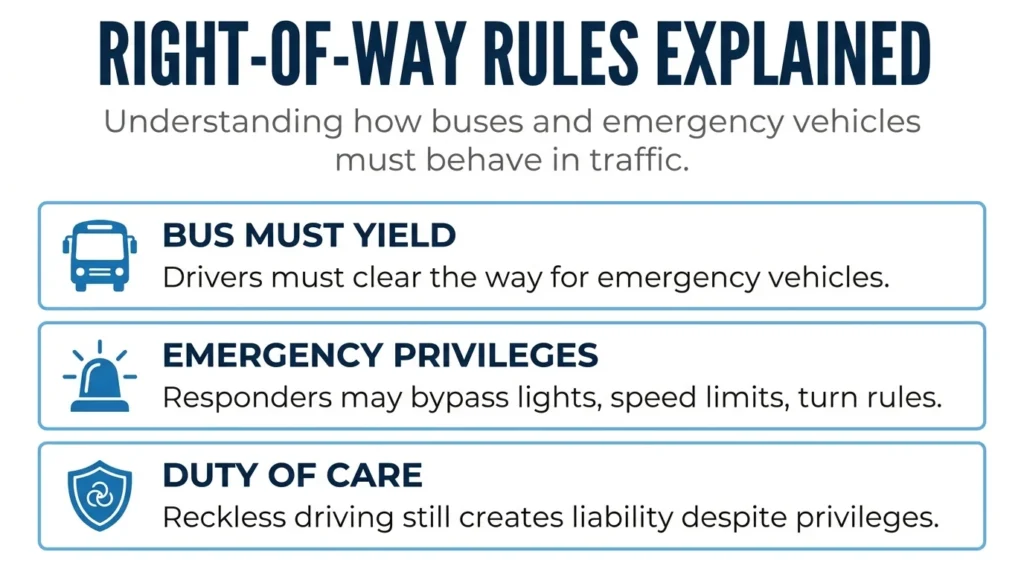
A bus driver must yield to an emergency vehicle that is using its lights and siren. Under Texas Transportation Code § 545.156, every operator, including a transit bus driver, has to pull over and clear the way for an authorized emergency vehicle showing audible and visual signals.
When a bus driver fails to yield and a crash follows, that failure can support a negligence finding against the transit authority. The duty is clear, and ignoring it has consequences.
Emergency vehicle operators get certain breaks from normal traffic rules. Under Texas Transportation Code § 546.001, emergency vehicle operators may proceed past a red light or stop sign after slowing as necessary for safe operation, exceed the posted speed limit without endangering life or property, and disregard turn restrictions while responding to a call.
Those breaks are not a free pass. Under Texas Transportation Code § 546.005, an emergency driver still owes a duty of care to everyone else on the road. Driving with reckless disregard for your safety can still make the responder liable.
So the fact that a fire truck or ambulance had the legal right to proceed does not end the question. If the operator barreled through a crowded intersection without slowing or checking, that conduct can still support a claim against the agency.
Governmental Immunity & Its Exceptions Under Texas Law
Governmental immunity usually protects Texas government entities from lawsuits, but it is not absolute. The Texas Tort Claims Act, found in Texas Civil Practice and Remedies Code (CPRC) Chapter 101, creates specific exceptions that let injured people sue.
Those exceptions are the doorway to recovery in a bus-emergency vehicle crash. Understanding which one applies to each agency is the heart of your case. During your initial conversation with our legal team, we will break down how these rules affect injury claims.
The Motor Vehicle Waiver
The most important exception is the motor vehicle waiver. Under CPRC § 101.021, immunity is waived when a government employee negligently operates a motor vehicle while doing their job.
Both the transit bus driver and the emergency vehicle operator can fall under this waiver. That means you may hold two separate governmental units accountable for the same crash, each through the same legal door.
The Emergency Exception
The emergency responder has a defense that the bus operator does not. Under CPRC § 101.055, immunity comes back for emergency responders when they act in compliance with the law and without conscious indifference or reckless disregard for your safety.
This is a defense, not a guarantee. If the emergency operator violated § 546.005 by responding with reckless disregard, the exception may not protect the agency at all.
The facts of the response decide everything here. An attorney can investigate how the emergency vehicle was being driven and determine whether immunity actually bars your claim.
Filing Claims Against Two Government Entities
You must give written notice to each governmental unit within six months of the crash. Under CPRC § 101.101, missing that deadline against either entity bars your claim against that entity for good.
Two government defendants means two sets of rules to follow in order. These are the procedural steps that decide whether your claim survives.
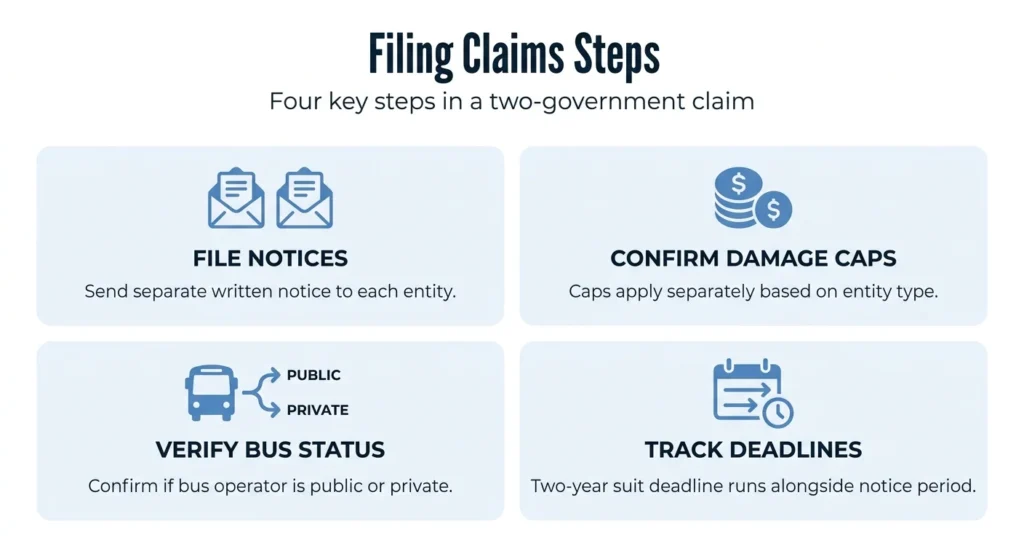
Step 1: File separate notices with each governmental unit. The transit authority and the emergency responder are distinct entities with distinct legal identities. If you want to sue a government entity, you should know that you cannot serve both with a single notice, so each one needs its own written notice within the six-month window.
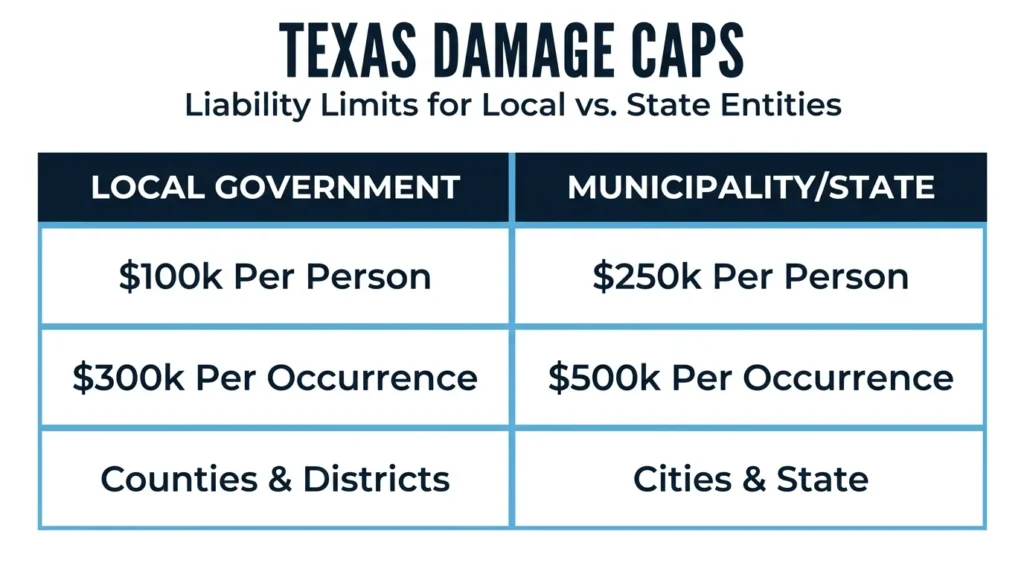
Step 2: Identify which damage cap applies to each entity. Under CPRC § 101.023, the caps apply separately to each governmental unit. For units of local government other than municipalities, the cap is $100,000 per person and $300,000 per occurrence for bodily injury or death. Municipalities carry a higher cap of $250,000 per person and $500,000 per occurrence. The state’s cap matches municipalities. Because each cap applies independently, two liable governmental units can raise the total recovery available to you. The exact cap for each defendant depends on how that entity is classified under Texas law.
Step 3: Confirm whether the bus operator is public or private. A private charter bus company is not a governmental unit. If a private company ran the bus, the rules for suing public transportation and the six-month notice deadline do not apply to that company at all.
Step 4: Track the two-year filing deadline alongside the notice deadline. The standard personal injury statute of limitations under CPRC § 16.003 gives you two years to file suit against non-government parties. The six-month notice rule is a separate, shorter prerequisite that comes first when a government defendant is involved. Talking to an attorney early helps you protect both deadlines before either one closes.
Injured on the Bus? Your Rights as a Passenger
If you were a passenger, the transit authority owed you a heightened duty of care as a common carrier. That duty stands on its own, separate from right-of-way rules, and it can support a claim even when the bus driver did yield to the emergency vehicle.
You are not stuck suing only the agency whose vehicle “caused” the crash. Both the bus operator and the emergency vehicle operator may share fault, and you can pursue both. Our bus accident injury page explains how passenger claims take shape.
Passenger injuries from this kind of crash often include soft-tissue damage, broken bones, and head injuries from a sudden stop or impact. The severity affects which cap applies and how fast you need to gather medical records. You can see what past clients have said about working through claims like these.
Work with a Texas Bus Accident Attorney
A crash involving both a transit bus and an emergency vehicle is among the most procedurally complex injury claims in Texas. It can demand two separate immunity analyses, two written notices, and fast action before the six-month clock runs out.
Angel Reyes & Associates has handled government vehicle claims across Texas for over 30 years, with offices across the state ready to help. We offer free initial consultations, we charge no fee unless we win, and we have more than $1 billion recovered for clients.
If a bus and an emergency vehicle collision left you injured, do not let two sets of deadlines decide your case for you. Reach out to us for a free consultation.
Past results do not guarantee future outcomes.
Frequently Asked Questions
What if the ambulance was operated by a private company, not a government agency?
A privately run ambulance company is not a governmental unit, so Texas Tort Claims Act caps and the six-month notice deadline do not apply to it. You would file a standard personal injury claim against the private company under the normal two-year statute of limitations.
Does Texas proportionate responsibility law apply when a government entity is at fault?
Yes. Texas proportionate responsibility rules still apply to TTCA claims, meaning a jury can assign a percentage of fault to each party, including the injured person. If your share of fault is 51 percent or more, you cannot recover under Texas law.
Can family members file a wrongful death claim if someone died in this type of crash?
Texas law allows eligible family members to bring a wrongful death claim against a governmental unit under the TTCA, subject to the same six-month notice requirement and damage caps. The claim must be filed by the spouse, children, or parents of the person who died.
What evidence is most useful to gather at the scene of a bus-emergency vehicle crash?
Photographs of vehicle positions, visible injuries, and traffic signals matter most in the early hours after a crash. Witness names and contact details are also valuable because government entities may dispute the sequence of events.
Does the same TTCA framework apply if the bus was a school district bus?
Yes. A school district is a governmental unit in Texas, so TTCA procedures apply, including the six-month notice deadline and the applicable damage caps. The emergency responder side of the claim follows the same immunity analysis described for other government entities.
About the Authors

Angel Reyes
Writer
Angel L. Reyes, III is the Founder and Managing Partner of Angel Reyes & Associates. A nationally recognized trial attorney and business leader, Angel has helped over 70,000 injury victims recover more than $1 billion since founding the firm in 1993. Named to the Texas Super Lawyers list annually since 2008, Angel brings Wall Street experience, Ivy League education, and a deep commitment to client advocacy. He is a frequent legal commentator and published author with extensive contributions to legal scholarship, trial strategy, and consumer protection.

Kyle Nicolas
Editor
Kyle Nicolas is the Web Content & SEO Manager at Angel Reyes & Associates. He has more than 10 years of experience as a marketing co...

Angel Reyes
Reviewer
Angel L. Reyes, III is the Founder and Managing Partner of Angel Reyes & Associates. A nationally recognized trial attorney and business...