Who Is Responsible If an Ambulance Hits Your Car in Texas?


Every article on this site is researched by our internal team, reviewed for legal accuracy against current Texas law, and held to State Bar of Texas advertising standards before publication. We do not publish content that overstates outcomes or makes promises about results.
Learn more about our
editorial standards .
Key Takeaways
- Public EMS providers have limits on how much they may have to pay, but private ambulance companies generally do not have the same government liability limits.
- Public EMS ambulance claims require written notice within six months of the crash.
- If an ambulance had its lights and sirens on, this still does not excuse a reckless disregard for your safety.
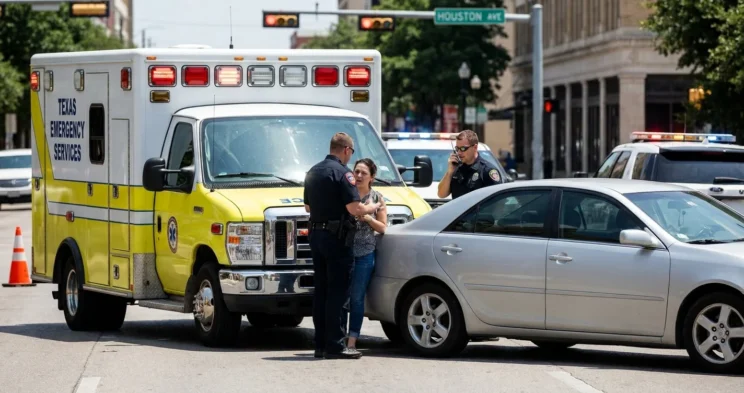
A car accident is stressful enough on its own, but after an ambulance hits your car in Houston, you suddenly find yourself dealing with injuries, medical bills, and an insurance claim with very different rules than an ordinary car crash.
Your ability to recover compensation depends on the owner and operator of the ambulance itself.
Ambulance Accidents and Injury Claims
Nearly 60% of ambulance accidents happen while the ambulance is responding to an emergency call. Crashes caused by an ambulance driver rushing to a scene can lead to serious injuries for everyone involved, regardless of whether the other vehicle was a civilian car or another emergency unit. Ambulances are involved in an estimated 6,500 accidents nationwide every year, injuring thousands of people.
If you or a loved one has been hit by an ambulance, you’ll need a car accident lawyer who understands insurance claims and the special legal rules that protect emergency responders. An experienced attorney can make sure your claim is handled fairly.
Texas Rules for Emergency Vehicles
Ambulances operate under a unique set of rules for several reasons:
- They often drive at high speeds to reach patients quickly.
- Drivers may use lights and sirens to move through traffic more easily.
- Even during an emergency, they still must drive safely and follow basic traffic laws.
These rules come from Texas Transportation Code Section 546.001, which also allows an authorized emergency vehicle operator to park anywhere, run a red light or stop sign after slowing down first, and exceeding the speed limit without endangering others.
Lights and Sirens
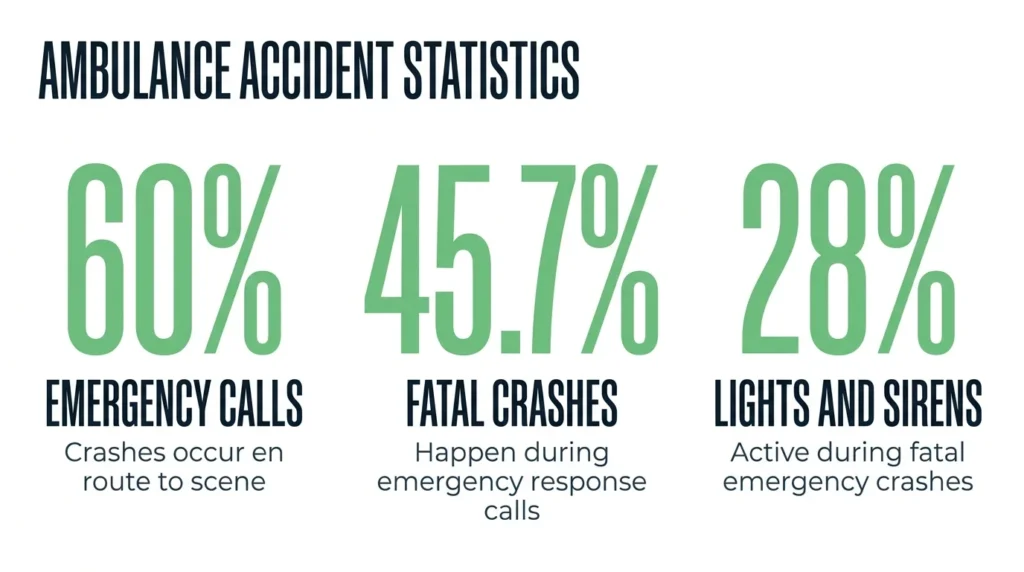
The above exemptions only apply while the ambulance is using its lights and sirens, as required by Section 546.003. Research shows that nearly 45.7% of fatal emergency vehicle crashes happen during an emergency response, and 28% happen while lights and sirens are active.
If the ambulance was not using its lights and sirens, then these special exemptions may not apply at all, and even when the lights and sirens are on, Section 546.005 still requires the driver to consider the safety of others. To win a claim against an ambulance that was responding to an emergency call, you must generally prove that the driver recklessly ignored the safety of others. The same standard applies whenever any authorized emergency vehicle responds to a call, not just an ambulance.
What Do I Do After an Ambulance Accident?
If you have been hit in an ambulance accident, take these steps right away to protect your health and your claim:
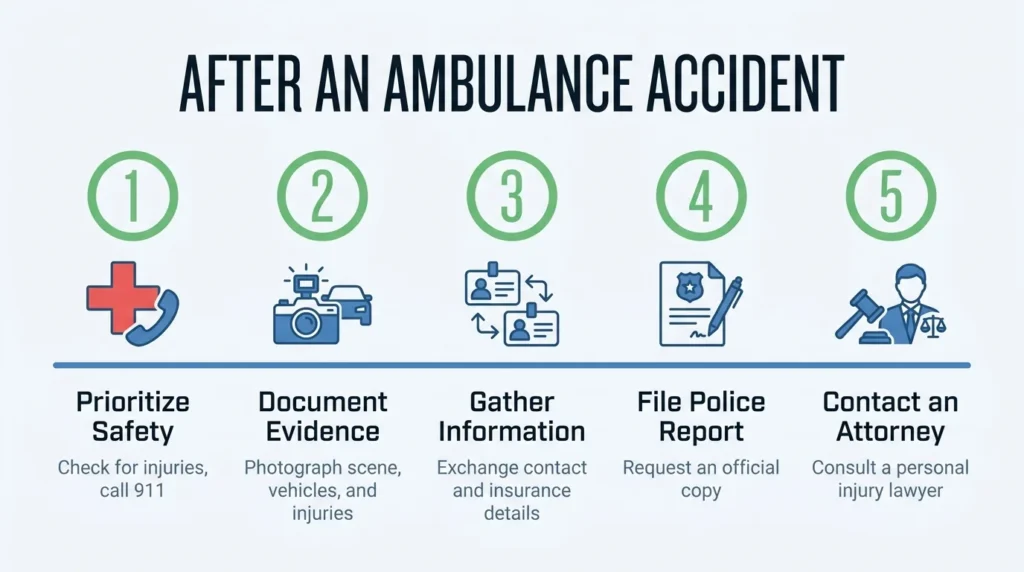
- Prioritize Your Safety: Check everyone involved for injuries. If anyone is hurt, call 911 immediately. Even if you feel fine, get checked by a medical professional as soon as possible after the crash.
- Document Your Evidence: If it is safe to do so, then take photos of the accident scene, including the ambulance, your vehicle, and any visible injuries.
- Gather Contact and Insurance Information: Exchange contact and insurance details with the ambulance crew and anyone else involved, including any witnesses.
- File a Police Report: Get an official police report on record and request a copy for your files.
- Contact a Trusted Personal Injury Attorney: Cases involving emergency vehicles are complex and require knowledge of Texas law, so consult an attorney as soon as possible to help with your claim.
What Can You Recover After an Ambulance Crash?
You can file an insurance claim after an ambulance accident, just as you would in any other type of car accident. However, ambulance accidents also come with unique restrictions that can be hard to navigate on your own.
With the help of a personal injury attorney, you may be able to recover:
- Full medical expenses for injuries resulting from the accident
- Vehicle repair or replacement costs
- Lost wages if your injuries keep you from working
- Compensation for pain and suffering
The biggest factor in how your claim is handled and how much you can realistically recover is whether the ambulance belonged to a government-linked EMS provider or a private company.
Government vehicle accident claims often come with rules that catch people off guard. Knowing how an insurance claim against a government agency usually unfolds can help you recognize whether a settlement offer is too low.
Public EMS Providers vs. Private Ambulance Companies
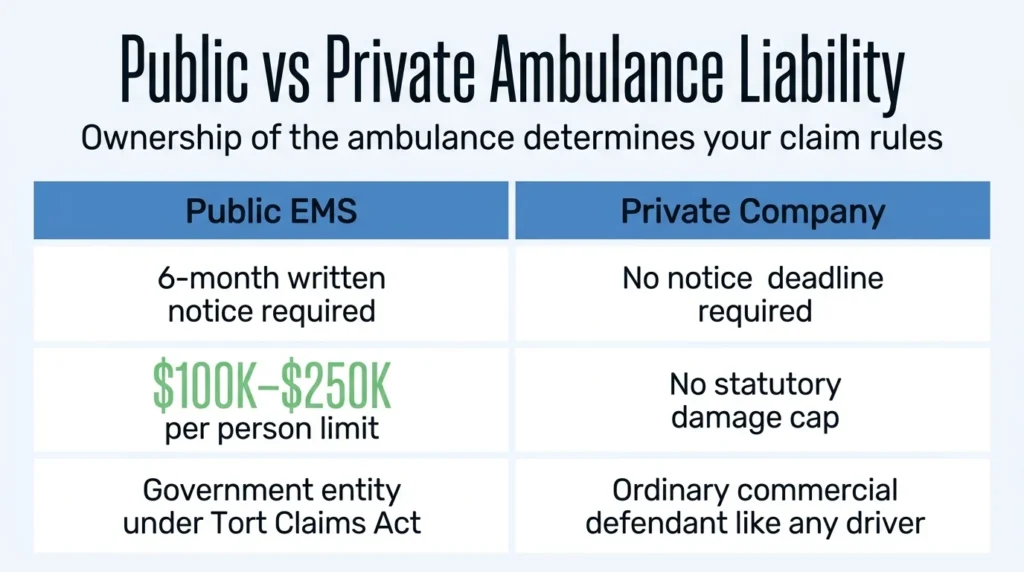
Who is responsible for your ambulance accident often depends on who owns the ambulance: a government entity or a private company. If it belongs to a government entity, then different rules may apply, which can affect how long you have to file a claim and how much compensation you may be able to recover.
Public EMS Providers
Most city, county, and hospital-district ambulances count as government units under the Texas Tort Claims Act.
A claim against one of these providers generally requires written notice within six months of the crash, under Texas Civil Practice and Remedies Code Section 101.101. However, some cities set their own deadlines under their city charters. Be sure to check your city’s specific deadline, so you do not miss out on filing your claim.
Recovery may also be limited when you are suing a government agency or an emergency service organization. Under Section 101.023, many local government units and emergency service organizations have a limit of $100,000 per person and $300,000 per occurrence for injury or death. For cities, the limit is higher at $250,000 per person and $500,000 per occurrence. These are strict limits, and they apply no matter how serious your injuries are.
If you are unsure how to handle a claim against a government entity, it’s useful to learn how to sue a government entity in Texas and to review how Tort Claims Act limits apply in similar cases.
Private Ambulance Companies
A private ambulance company is not protected by the Tort Claims Act. Instead, it is an ordinary commercial defendant, just like any other driver you might sue after a normal car crash. This means there is no six-month notice deadline or limit on statutory damages. Instead, your recovery is limited only by your actual damages and the company’s available insurance coverage.
This is why finding out who owns and operates the ambulance that hit you is one of the first things an attorney does, because it will determine your deadline and your realistic recovery amount.
How Attorneys Handle Ambulance Accident Claims
Filing a claim after an ambulance accident is a more complex process than a standard car crash claim. These cases often involve emergency services, ambulance providers, and sometimes government entities, along with specific traffic laws for emergency vehicles. Determining fault can be difficult when lights and sirens were active or another emergency vehicle was involved.
Personal injury attorneys can gather key evidence, such as accident reports and medical records, to determine how the crash happened and who is liable. When emergency responders are involved, your attorney will also review whether the other driver followed the proper rules.
Your attorney can also handle negotiations with insurance companies that try to minimize payouts. If the insurer will not offer a fair settlement, your attorney can take the case to court to pursue the compensation you deserve.
Work With an Attorney on Your Ambulance Accident Claim in Texas
If you have been in an ambulance accident in Texas, you do not have to face this challenge alone. Angel Reyes & Associates is committed to protecting your rights and helping you pursue the compensation you deserve, whether you are dealing with a private ambulance company or a government EMS provider.
We have over 30 years of experience handling claims like these, and we have recovered more than $1 billion for clients. We work on a contingency basis, which means we charge no fee unless we win your case.
Claims against a government entity often require written notice within six months, so waiting to act means risking your case. Contact us today for a free, confidential consultation.
Past results do not guarantee future outcomes.
Ambulance Crash FAQs
Can I still recover damages if I was partially at fault for the ambulance accident?
Yes, as long as your own share of fault was 50% or less. Texas law only prohibits recovery if a claimant’s share of fault was over 50%.
Will my own car insurance cover my injuries if an ambulance hits me?
If you have personal injury protection (PIP), it can pay your medical bills and lost wages, regardless of who caused the crash. Texas insurers must offer PIP unless you reject it in writing. You can also pursue a separate claim against the ambulance operator for costs that your coverage does not fully pay.
What if I was a passenger in the car that the ambulance struck, or a pedestrian who was hit by an ambulance?
The same liability rules apply whether you were driving, riding as a passenger, or walking nearby. In fact, passengers and pedestrians make up a large share of the people who are injured in ambulance crashes each year.
About the Authors

Angel Reyes
Writer
Angel L. Reyes, III is the Founder and Managing Partner of Angel Reyes & Associates. A nationally recognized trial attorney and business leader, Angel has helped over 70,000 injury victims recover more than $1 billion since founding the firm in 1993. Named to the Texas Super Lawyers list annually since 2008, Angel brings Wall Street experience, Ivy League education, and a deep commitment to client advocacy. He is a frequent legal commentator and published author with extensive contributions to legal scholarship, trial strategy, and consumer protection.

Kyle Nicolas
Editor
Kyle Nicolas is the Web Content & SEO Manager at Angel Reyes & Associates. He has more than 10 years of experience as a marketing co...

Spencer Browne
Reviewer
Spencer Browne is a partner at Angel Reyes & Associates and a Board Certified personal injury trial lawyer with nearly 100 jury trials a...