Bus Accident PTSD and Emotional Distress Claims in Texas


Every article on this site is researched by our internal team, reviewed for legal accuracy against current Texas law, and held to State Bar of Texas advertising standards before publication. We do not publish content that overstates outcomes or makes promises about results.
Learn more about our
editorial standards .
Key Takeaways
- Texas treats bus accident PTSD as non-economic damages within a broader personal injury claim.
- Government and school bus claims require written notice within six months of the crash.
- A DSM-5 diagnosis and steady treatment records form the backbone of an emotional distress claim.
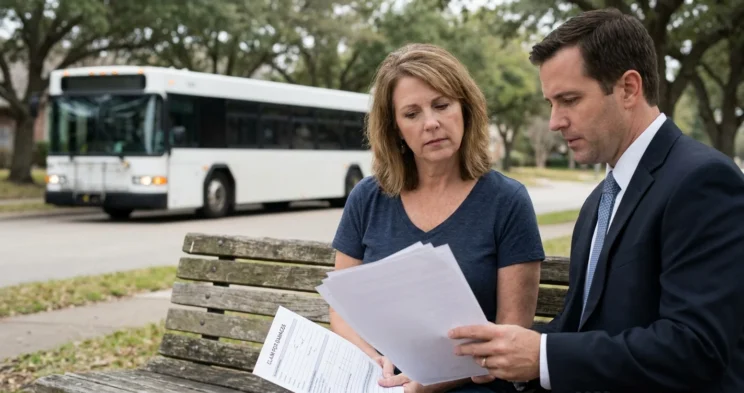
Your child was in a school bus crash near Westheimer Road. Though they didn’t get so much as a scratch, weeks later they still wake up screaming. Years before, you walked away from a transit bus collision. Now you can’t step onto a bus without your heart pounding. The bruises healed, yet your fear did not. You’re left wondering whether that kind of suffering counts for anything in a legal claim.
PTSD & Emotional Distress After a Bus Crash
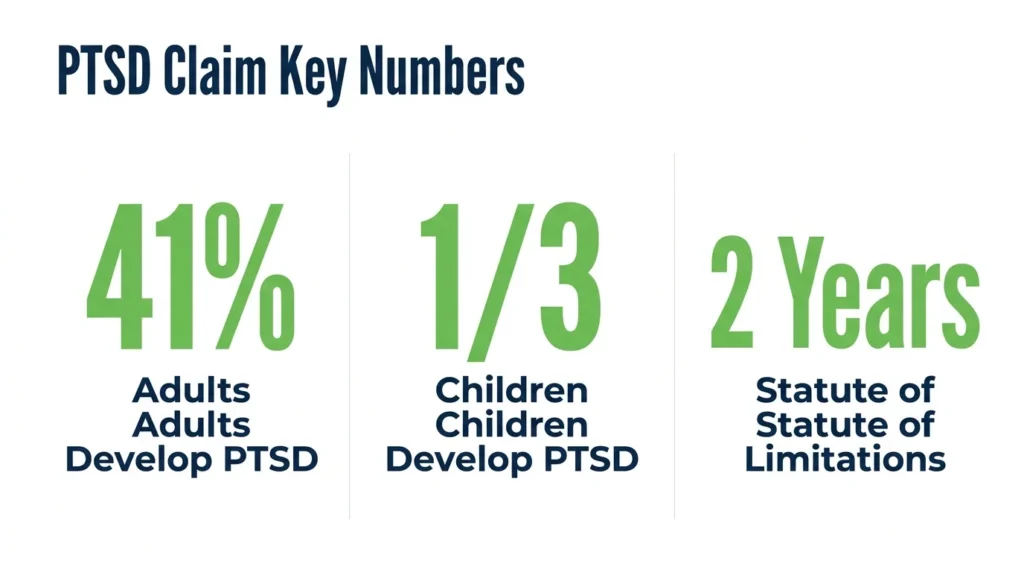
Post-traumatic stress disorder (PTSD) is a documented clinical outcome for bus accident survivors, not a rare or imagined reaction. One study found that roughly 41% of surviving bus crash passengers developed PTSD within 13 months after a bus accident.
PTSD symptoms are real and disruptive. Survivors often report flashbacks, nightmares, and severe anxiety. Many avoid buses or cars entirely and cannot return to the routines they once took for granted.
Children have an even higher risk. About one in three children involved in a road traffic crash develops PTSD. A school bus crash can derail a child’s sleep, schoolwork, and sense of safety for months.
Emotional distress after a crash also takes other forms. This distress can include depression, panic attacks, and a lasting loss of enjoyment in daily life. Under Texas law, these psychological injuries are non-economic damages you can recover, much like pain and suffering in a personal injury claim.
How Texas Law Treats Emotional Distress Claims
In Texas, you can recover emotional distress and mental anguish most effectively as non-economic damages inside a broader personal injury claim. That claim ties your psychological harm to the physical injury you suffered in the crash.
Texas doesn’t recognize a standalone claim for negligently inflicting emotional distress in most situations. Recovery generally requires that someone breached a duty and caused you physical harm. The same fault-sharing rules that govern any crash, set out in the Texas Civil Practice and Remedies Code (CPRC) Chapter 33, can also reduce what you collect when more than one party shares blame.
Direct Victim Claims
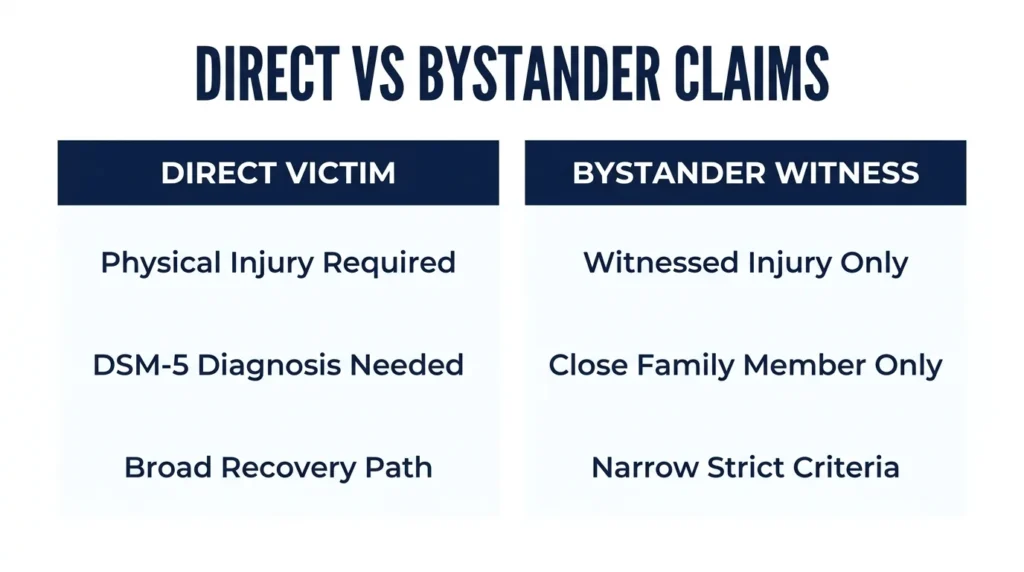
If you were physically hurt in the bus crash, you can recover emotional distress damages as part of your overall injury claim. The key is linking your PTSD or anxiety diagnosis directly to the crash.
A formal Diagnostic and Statistical Manual of Mental Disorders Fifth Edition (DSM-5) diagnosis of PTSD or a related disorder considerably strengthens that valuation. Your recoverable damages can include past and future mental anguish, lost enjoyment of life, and the cost of therapy and psychiatric treatment, all of which factor into the average bus accident settlement.
Bystander & Witness Claims
Texas allows a narrow category of bystander claims when you witness a close family member suffer serious injury or death in a crash. The requirements are strict, and most witnesses don’t meet them.
You must satisfy three conditions. You were present at or near the scene; your distress came from directly perceiving the event; and the victim was a close family member such as a parent, child, sibling, or spouse.
A stranger who witnesses a horrifying bus crash generally can’t recover as a bystander, no matter how lasting the trauma. If you’re unsure whether your situation qualifies as a bystander emotional distress claim, speak with an attorney to discuss the facts before the filing deadline passes.
Government Buses, School Buses, & the Tort Claims Act
When a city bus, school bus, or other government vehicle caused your crash, your claim falls under the Texas CPRC Chapter 101, known as the Tort Claims Act. This law limits both what you can recover and how you must file.
The notice deadline comes fast. You must give the government entity formal written notice within six months of the crash. Some city charters cut that window down to 45 to 90 days, and missing it can bar your recovery entirely.
The act also caps damages. Claims against the state or city are capped at $250,000 per person, while claims against school districts and counties face a lower $100,000 per person limit. Those caps cover everything, including your PTSD and emotional distress, as explained in our breakdown of Tort Claims Act damage limits.
Intentional misconduct is outside of the act’s immunity waiver. That is why negligence-based claims with a clear physical injury are the standard path against a government bus operator.
The same rules apply to school district crashes. A district is a government unit, so the six-month notice rule and the $100,000 cap apply when a parent brings a child’s PTSD claim. Our bus accident practice page explains how these claims take shape.
Documenting PTSD & Emotional Distress for Your Claim
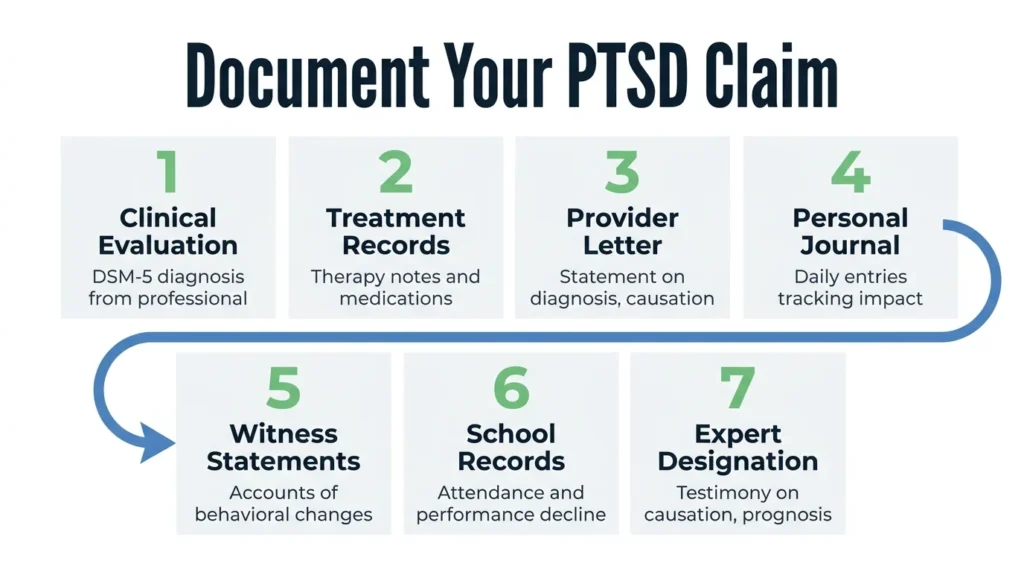
The foundation of any emotional distress claim is a formal evaluation from a licensed mental health professional, obtained as soon as symptoms appear. A DSM-5 diagnosis of PTSD or an anxiety disorder is the evidence everything builds on. Gather the following to support your claim:
- Clinical evaluation: a psychiatric or psychological assessment with a formal DSM-5 PTSD or anxiety diagnosis.
- Treatment records: therapy notes, medication prescriptions, and any hospital or urgent care visits for psychological symptoms.
- Provider letter: a written statement from your treating provider on your symptoms, causation, diagnosis, and expected duration.
- Personal journal: dated entries tracking the daily toll on your work, sleep, parenting, and relationships.
- Witness statements: accounts from family, co-workers, or teachers describing the behavioral changes they observed.
- School records: attendance or performance decline for a child claimant.
- Expert designation: a mental health professional ready to testify on causation and prognosis.
Insurers challenge psychological claims harder than physical ones because the injury never shows up on a scan. Consistent, uninterrupted treatment and contemporaneous records are your strongest response to this tactic.
For a child traumatized in a school bus crash, find a pediatric trauma specialist early. Document every school accommodation, therapy referral, and behavioral note from teachers and counselors. You can review the broader steps in our guide on how to file a bus accident claim.
Timing controls everything. The two-year deadline under the Texas CPRC § 16.003 governs emotional distress claims within a personal injury case. For government bus claims, the six-month notice requirement is even sooner and is just as fatal if missed.
Speak with a Texas Bus Accident Attorney
Psychological injuries after a bus crash are real, recognized, and worth pursuing, but the path is narrow and the deadlines unforgiving. Government bus claims can demand written notice within months, and insurers fight PTSD claims at every turn. Getting legal guidance early protects your right to recover before a deadline closes the door.
Angel Reyes & Associates has spent more than 30 years representing injured Texans, with more than $1 billion recovered for clients. We work on a contingency basis, so there’s no fee unless we win. You can read what our clients say about working with us to learn how we approach these cases.
If you or your child is struggling after a bus crash, schedule a free consultation so we can review your options and the deadlines that apply to you.
Past results do not guarantee future outcomes.
Frequently Asked Questions
Is there a cap on emotional distress damages if the bus was privately owned?
No. Damage caps only apply when the at-fault bus was operated by a government entity under the Texas Tort Claims Act. Claims against private bus companies have no statutory limit on non-economic damages, including PTSD and mental anguish.
What if my PTSD symptoms didn't appear until weeks or months after the crash?
Delayed-onset PTSD is clinically recognized under DSM-5, and a diagnosis that arrives later can still support your claim. The two-year statute of limitations runs from the date of the crash, not the date symptoms appear, so don’t wait to seek a mental health evaluation.
Can I still recover emotional distress damages if I was partly at fault for the crash?
Yes, as long as you were not more than 50% responsible. Under Texas proportionate responsibility law, your damages are reduced by your share of the fault, so a claimant found to be 20% at fault recovers 80% of the total award.
Are bus accident PTSD settlement proceeds taxable?
Compensation for emotional distress resulting from a physical injury in a personal injury claim is generally not taxable under federal tax rules. Texas has no state income tax, so federal rules govern in these cases. The key factor is whether the psychological harm is tied to a physical injury from the crash.
How do juries and insurers actually put a dollar value on mental anguish?
Two methods are commonly used: a multiplier (typically 1.5 to 5 times your economic damages) or a per diem rate applied to the number of days you experienced significant disruption. The strength of your clinical records, treatment history, and expert testimony directly affects which end of that range your claim reaches.
About the Authors

Angel Reyes
Writer
Angel L. Reyes, III is the Founder and Managing Partner of Angel Reyes & Associates. A nationally recognized trial attorney and business leader, Angel has helped over 70,000 injury victims recover more than $1 billion since founding the firm in 1993. Named to the Texas Super Lawyers list annually since 2008, Angel brings Wall Street experience, Ivy League education, and a deep commitment to client advocacy. He is a frequent legal commentator and published author with extensive contributions to legal scholarship, trial strategy, and consumer protection.

Graham Griffin
Editor
Graham Griffin is the Web & Content Manager at Angel Reyes & Associates, where he oversees content strategy, AI-powered workflows, a...

Angel Reyes
Reviewer
Angel L. Reyes, III is the Founder and Managing Partner of Angel Reyes & Associates. A nationally recognized trial attorney and business...