Bus Accident Statute of Limitations in Texas


Every article on this site is researched by our internal team, reviewed for legal accuracy against current Texas law, and held to State Bar of Texas advertising standards before publication. We do not publish content that overstates outcomes or makes promises about results.
Learn more about our
editorial standards .
Key Takeaways
- Texas gives you two years to file a bus injury lawsuit against private operators.
- Government bus claims require written notice within six months, or 90 days by city charter.
- Missing the notice window means you cannot file a claim, even if the two-year deadline has not passed.
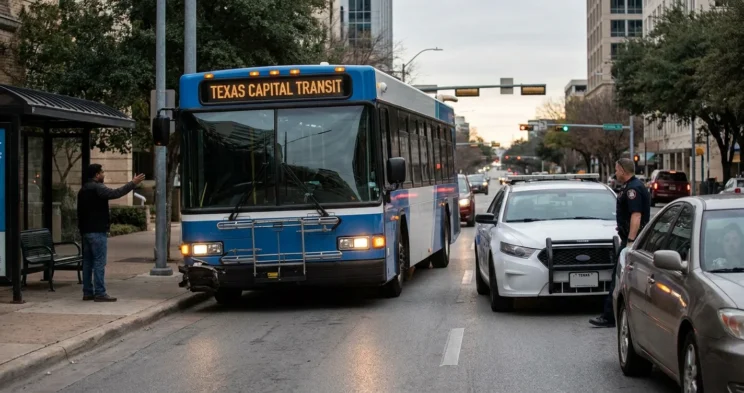
You step off a Houston METRO bus, and the next thing you remember is the pavement and the pain. Now you’re weeks into recovery, the medical bills are stacking up, and one question keeps you awake: How long do you actually have to act? The answer depends on facts you may not have sorted out yet.
Two Deadlines That Govern Texas Bus Claims
Texas bus accident claims run on two separate deadlines, and which one applies depends on who operated the bus. If you were recently hurt, the clock is already running on both.
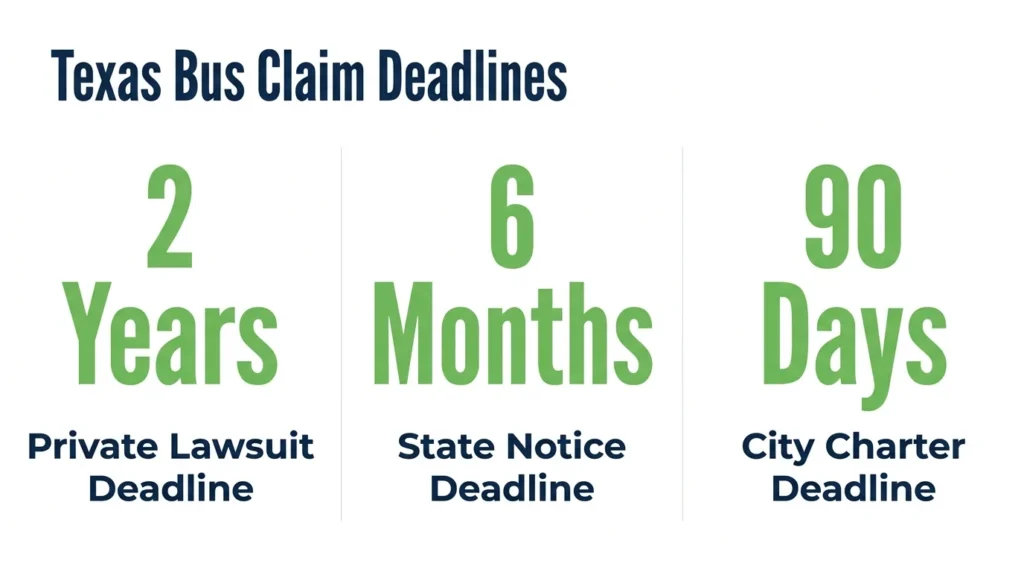
The first deadline is the standard two-year filing window for personal injury claims. The Texas Civil Practice and Remedies Code (CPRC) § 16.003 gives you two years from the injury date to file a personal injury lawsuit. This applies to claims against private bus operators.
A second deadline applies when a government entity ran the bus. The CPRC § 101.101 notice rule under the Texas Tort Claims Act requires written notice within a short window.
These deadlines run at the same time, not one after the other. Missing the notice window forfeits your right to sue completely. That holds true even when the two-year lawsuit window is still wide open.
Government vs. Private Bus: Which Rules Apply?
The type of bus you were in decides which legal framework governs your claim. A government transit bus and a private charter coach follow different rules with very different deadlines.
Government Transit Buses
Government transit buses fall under the Texas Tort Claims Act, which sets strict notice rules. This category includes METRO in Houston, DART in Dallas, VIA in San Antonio, and Capital Metro in Austin.
The state default notice window under Texas Civil Practice and Remedies Code Chapter 101 is six months. Houston, Dallas, San Antonio, and Austin all apply 90-day charter deadlines instead. Most claimants never learn about this shortened window until it’s too late.
Your written notice must describe the injury, the time and place of the incident, and the incident itself. An incident report alone does not satisfy this requirement.
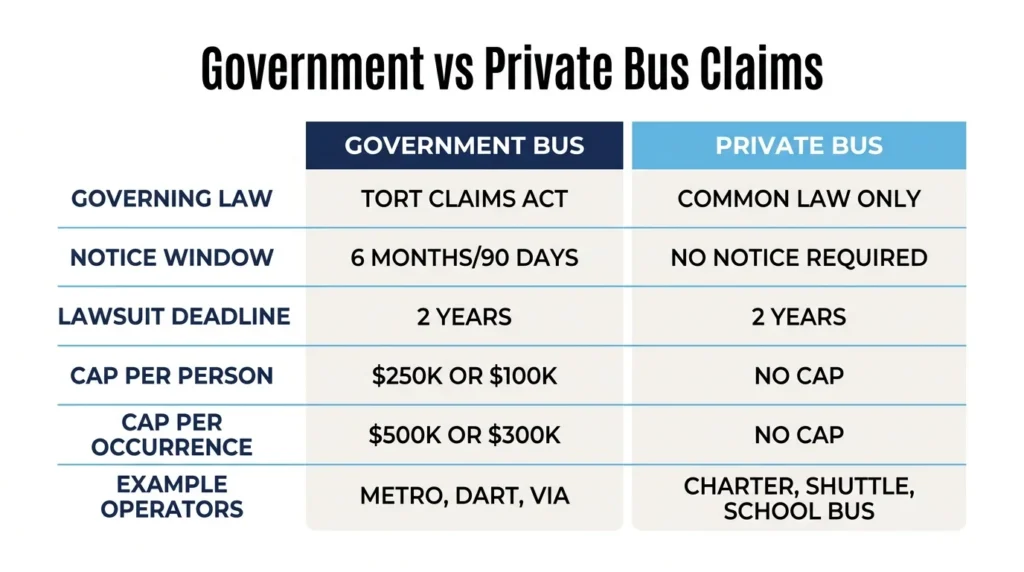
Damage caps also apply under the Texas Tort Claims Act. CPRC § 101.023 limits recovery to:
- $250,000 per person and $500,000 per occurrence for the state and municipalities
- $100,000 per person and $300,000 per occurrence for other units of local government, including regional transit authorities
Which cap applies depends on the operating entity’s legal classification.
Private & Charter Bus Operators
Private and charter operators are not covered by the Tort Claims Act, so only the two-year deadline applies. This group includes:
- Charter coaches
- Private shuttle companies
- School bus contractors
No written-notice rule applies to private operators. Early investigation is still important here because video footage, vehicle data, and witness memories degrade fast.
Confirming bus ownership quickly can be the difference between a viable claim and a forfeited one. An attorney can help determine who is liable in a Texas bus accident and start preserving evidence.
The Six-Month Notice Requirement
The government notice requirement demands a specific written notice sent to the right office within the deadline. Verbal reports, police calls, and insurance contacts do not count.
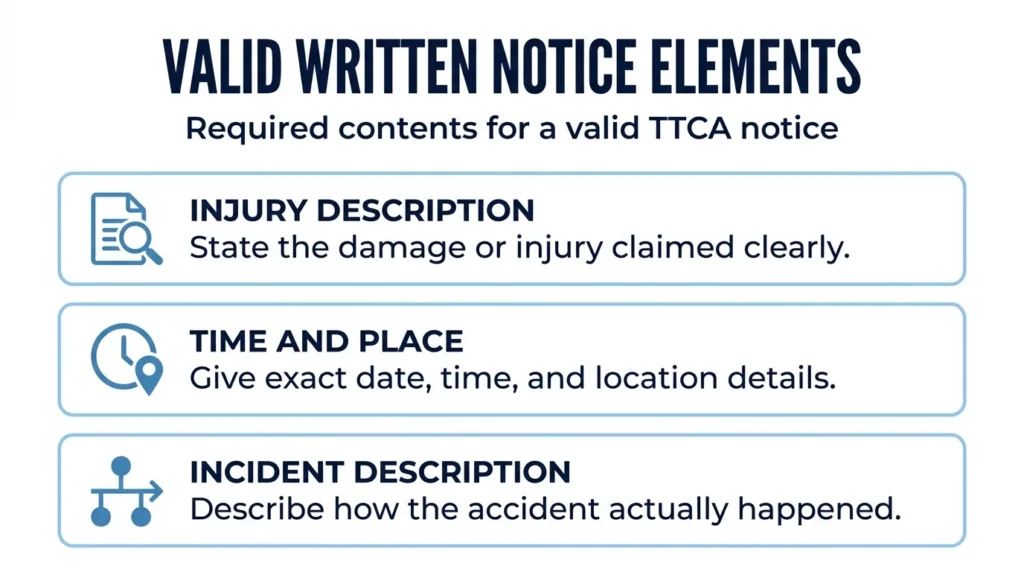
Notice must go to the governmental unit’s legal department or its designated contact. A valid written notice includes three elements:
- A description of the damage or injury claimed
- The time and place of the incident
- A description of the incident itself
A narrow exception exists under CPRC § 101.101(c). It may excuse the written notice when the governmental unit had actual knowledge of both the injury and its potential liability. This exception is heavily litigated and doesn’t apply simply because a transit authority showed up at the scene.
Miss the notice deadline without a valid exception, and your claim is barred entirely. That stays true no matter how much time remains on the two-year window.
What Happens When You Miss a Deadline?
Missing a deadline usually ends the case before a court ever weighs the facts. The specific result depends on which deadline you missed.
Missing the six-month or 90-day notice window for a government bus claim almost always means dismissal on immunity grounds.
Missing the two-year deadline for a private operator bars the lawsuit for good. Courts have no power to extend it without a recognized tolling reason. Tolling reasons that could extend the deadline include:
- An injured person who is under 18
- An injured person with a legal disability, such as mental incapacity
- The discovery rule, when the injury could not have been found at the time
A lawyer can explain exceptions to the statute of limitations in Texas and when each applies.
Once you confirm your deadline status, the next step is filing a bus accident claim.
If there is any question about whether a deadline has passed, or whether a tolling exception applies, talk to an attorney as early as possible to protect the options still open.
Speak with a Bus Accident Attorney About Your Claim
Angel Reyes & Associates has more than 30 years of experience handling Texas bus accident claims across Texas. We take on government transit claims under the Tort Claims Act and private operator lawsuits alike.
We work on a contingency basis, which means no fee unless we win. You pay nothing up front to start your case. Our team has recovered more than $1 billion for clients, and you can review our case results to see how.
Free consultations are available 24/7. Schedule a free consultation to learn whether your claim is still within the deadline.
Past results do not guarantee future outcomes.
Bus Accident FAQs
How can I tell whether the bus that hit me was government-operated or privately owned?
Check the bus livery, route numbers, and any agency markings at the scene, then request the crash report from the responding officer, which typically lists the vehicle owner. Major Texas transit buses display branding for METRO, DART, VIA, or Capital Metro; unmarked coaches, shuttles, and contracted vehicles are usually private.
Does the two-year deadline apply if someone died in a Texas bus accident?
Wrongful death claims in Texas have a two-year statute of limitations, but the clock starts on the date of death, not the date of the crash. If the bus was government-operated, the written-notice requirement still applies and runs from the date of the accident, not the date of death.
Does it matter whether a school bus was run by the district or a private contractor?
Yes. A school bus operated directly by a public school district falls under the Texas Tort Claims Act, which means a written-notice deadline and a damage cap of $100,000 per person. A bus run by a private contractor under a district contract is a private defendant, so no notice requirement and no cap apply.
Is there a damages cap when suing a private bus company in Texas?
No. The $250,000 per-person and $500,000 per-occurrence caps under the Texas Tort Claims Act apply only to government entities. Private and charter bus operators carry no statutory damage ceiling, and full compensatory damages may be available depending on the facts.
How should I send the written notice to a government transit agency?
Send it by certified mail to the agency’s legal department or its designated claims office, and keep the return receipt as proof of timely delivery. Ordinary mail or email may not satisfy the requirement, and the delivery date, not the postmark, typically determines whether the deadline was met.
About the Authors

Angel Reyes
Writer
Angel L. Reyes, III is the Founder and Managing Partner of Angel Reyes & Associates. A nationally recognized trial attorney and business leader, Angel has helped over 70,000 injury victims recover more than $1 billion since founding the firm in 1993. Named to the Texas Super Lawyers list annually since 2008, Angel brings Wall Street experience, Ivy League education, and a deep commitment to client advocacy. He is a frequent legal commentator and published author with extensive contributions to legal scholarship, trial strategy, and consumer protection.

Kyle Nicolas
Editor
Kyle Nicolas is the Web Content & SEO Manager at Angel Reyes & Associates. He has more than 10 years of experience as a marketing co...

Angel Reyes
Reviewer
Angel L. Reyes, III is the Founder and Managing Partner of Angel Reyes & Associates. A nationally recognized trial attorney and business...