Bus Accidents on Bridges & Overpasses in Texas


Every article on this site is researched by our internal team, reviewed for legal accuracy against current Texas law, and held to State Bar of Texas advertising standards before publication. We do not publish content that overstates outcomes or makes promises about results.
Learn more about our
editorial standards .
Key Takeaways
- A claim against a Texas government entity demands written notice within six months.
- Private-party bus crash claims must be filed within two years of the crash date.
- A guardrail or structural failure can qualify as a special defect under the Tort Claims Act.
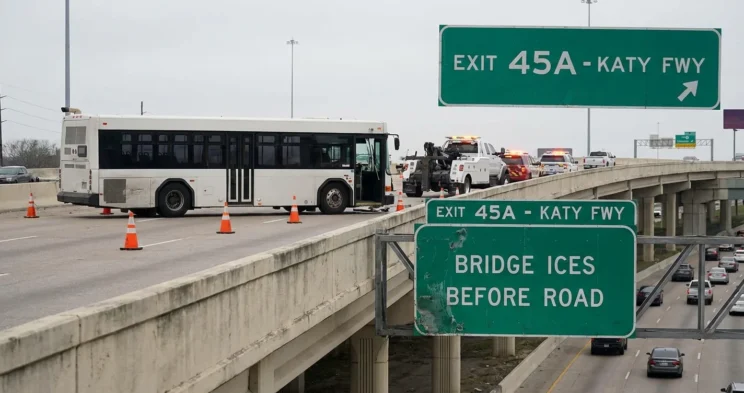
You were riding a charter bus across the Ship Channel Bridge on Houston’s east side when the driver fought the wind, then clipped the railing. Now you are in a hospital bed, wondering how a crash on a bridge is any different from one on a flat road.
It turns out the answer changes who you can hold responsible, and how much time you have to act.
Bridge & Overpass Hazards Unique to Buses
Buses face dangers on bridges and overpasses that passenger cars rarely do. Their height, weight, and high center of gravity turn ordinary structures into real risks.
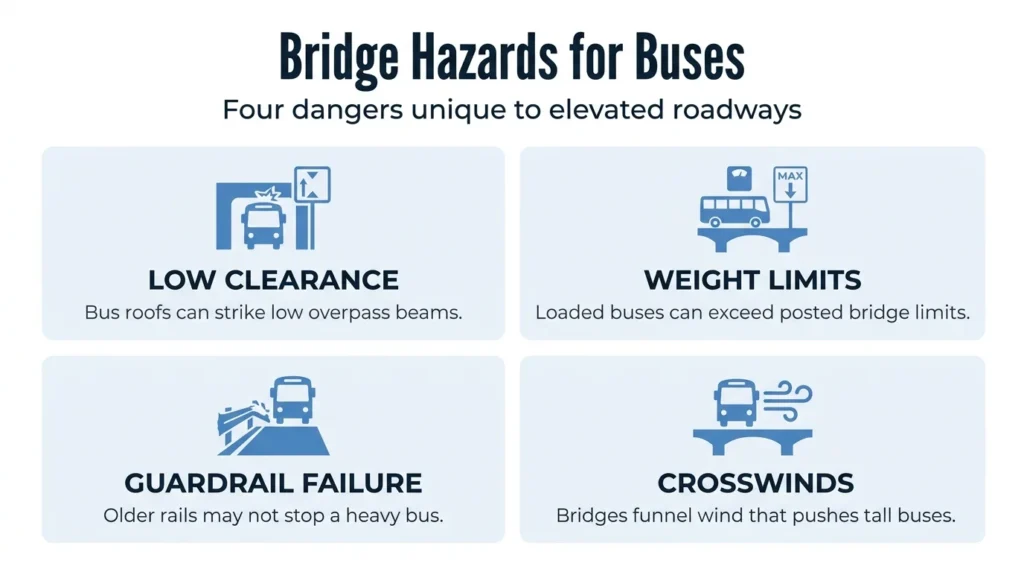
Low-clearance overpasses are one of the biggest threats. A bus roof can strike a beam that a car would clear easily, shearing off rooftop components or forcing the driver to overcorrect. Carriers carry the duty to plan routes that respect every posted overpass height restriction along the way.
Weight is the next hidden danger. A fully loaded bus can approach or pass a bridge’s posted weight limit, straining a structure that was never built to carry it. A carrier that ignores those limits, posted under the authority of Texas Transportation Code § 621.102, exposes itself to a negligence claim.
Guardrails matter too. Older bridge railings may not meet current TxDOT bridge railing standards, and a rail that fails can let a bus go over the edge during a sideswipe or rollover. When a guardrail cannot redirect a heavy vehicle, the consequences turn catastrophic fast.
Wind adds a final layer. Bridges funnel crosswinds that push against a bus’s tall body far harder than they push a sedan. A driver who fails to slow down or adjust lane position lets that wind do real damage.
These hazards rarely act alone. Ice, debris, and standing water collect on elevated structures more than on flat ground, and each one sharpens the danger already built into the bridge.
Government Liability for Bridge Defects in Texas
TxDOT or a local government can be held responsible when a bridge or overpass condition causes a bus crash. The rules come from the Texas Tort Claims Act, and they differ sharply from the rules for suing a private company.
Premises Defects vs Special Defects
The law splits dangerous conditions into two types, and the type controls what you have to prove. A collapsed guardrail or a sudden structural failure can qualify as a special defect, which raises the government’s duty and removes the need to show it knew about the exact hazard in advance.
An ordinary TxDOT bridge defect claim often involves a premises defect instead. These are ongoing problems, like deteriorated guardrails or crumbling pavement, where you must show the government had actual or constructive notice before liability attaches.
Inspection records can supply that notice. Federal rules require bridge inspections at intervals no longer than 24 months under Title 23, Part 650. A report that flagged a known defect, then went ignored, can prove the government should have acted.
Sovereign Immunity & When It Is Waived
Government entities usually cannot be sued, but the Texas Tort Claims Act opens a narrow door. Texas Civil Practice and Remedies Code (CPRC) § 101.021 waives immunity for bodily injury caused by a condition of real property, and bridges and overpasses count.
That door comes with limits. Damages caps, or limits, apply per person and per occurrence, and they change depending on which entity you are suing. A state agency, a city transit authority, and a county each face a different statutory cap.
Knowing who owns the structure shapes the whole claim. TxDOT controls state highway bridges, city public works departments handle municipal overpasses, and county commissioners courts oversee county roads. A defective bridge condition can make it hard to tell which one is at fault, so it helps to speak with an attorney before drawing conclusions about who is liable in a bus accident.
Bus Carrier Liability on Bridges & Overpasses
The bus company and driver can be liable on their own, separate from any claim against the government. Their failures often sit at the center of a bridge crash.
Federal law sets the baseline. Commercial bus operators must follow the federal motor carrier safety regulations covering driver qualification, hours of service, vehicle inspection, and route planning. Skipping any of these gives an injured passenger a clear line of fault.
Weight violations carry their own weight in court. A carrier that sends a loaded bus across a bridge it is too heavy to cross violates the posted weight limit set under Texas Transportation Code § 621.102, and that violation counts as evidence of negligence per se. The rule means the broken law itself helps prove the carrier was careless.
Drivers hold direct duties at elevation. Slowing in high wind, respecting posted clearance and weight signs, and holding a proper lane are all driver-level choices. A failure on any of them can stand as its own act of negligence.
Maintenance is the quiet factor. Brakes can fade under repeated braking, tires can run low, and worn suspension can fail on the jolt of a bridge expansion joint. A carrier’s inspection program is supposed to catch each of these before the bus ever rolls.
One bridge crash can pull in many responsible parties at once. The carrier, the driver, a third-party vehicle, a government entity, and even a parts manufacturer can all share blame, and Texas proportionate responsibility rules under Texas Civil Practice and Remedies Code (CPRC) § 33.001 divide fault among them.
When responsibility is split this way, an attorney can identify which parties to preserve claims against before key evidence disappears.
Filing Deadlines for Bridge Crash Claims in Texas
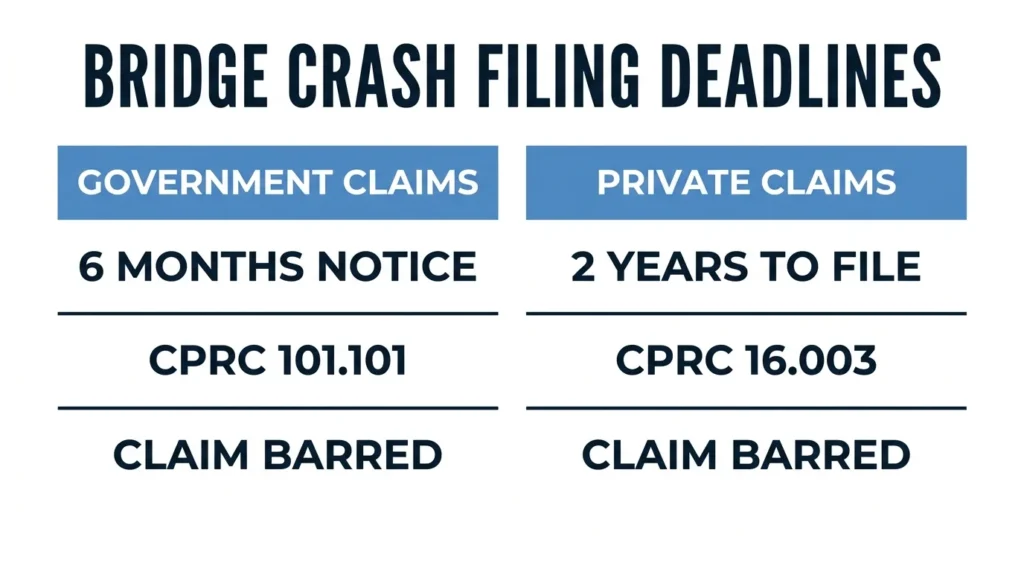
Two deadlines control a bridge crash claim, and missing the shorter one can end your case before it begins:
- Government notice within six months. Any claim against TxDOT, a city transit authority, or a county requires written notice of the claim within six months, as set by Texas Civil Practice and Remedies Code (CPRC) § 101.101. Miss it, and your right to recover from that entity is almost certainly gone.
- Keep the notice simple but complete. The notice must name you, describe the injury or damage, and give the time, place, and general circumstances of the crash. More detail helps, but the legal floor is low, so do not let perfectionism cost you the deadline.
- File private-party claims within two years. Claims against the bus carrier, the driver, or a third-party vehicle must be filed within two years of the crash under Texas Civil Practice and Remedies Code (CPRC) § 16.003. This longer window never extends the six-month government notice deadline.
- Wrongful death claims follow the same clock. When a bridge crash takes a life, surviving family can bring a wrongful death claim, with the two-year period running from the date of death. The government notice rule still applies on top of it.
- Preserve evidence early. Bridges are public infrastructure, and agencies can repair guardrail damage, pavement markings, or signage quickly. An early preservation letter slows that process, and reviewing the general bus accident claims process can help you understand what records to request.
One more rule shapes recovery. Texas follows a fault-sharing system, and a passenger or other party found more than 50% responsible recovers nothing. A claim that documents the facts and pins primary fault on the carrier or government protects what you are owed.
Injured on a Texas Bridge? Talk to Angel Reyes & Associates
Bridge and overpass crashes raise hard questions about infrastructure, government immunity, and who truly caused the harm. Angel Reyes & Associates has recovered more than $1 billion for clients across Texas, including victims of complex bus accidents involving government entities and infrastructure defects.
You can read about how we have served injured Texans through our client reviews and testimonials and meet our legal team before you ever call.
Our consultations are free, there is no fee unless we win, and we are available 24/7 across the state. Contact us for a free consultation.
Past results do not guarantee future outcomes.
Bus Accidents on Bridges & Overpasses FAQs
How much liability insurance must a commercial bus carry in Texas?
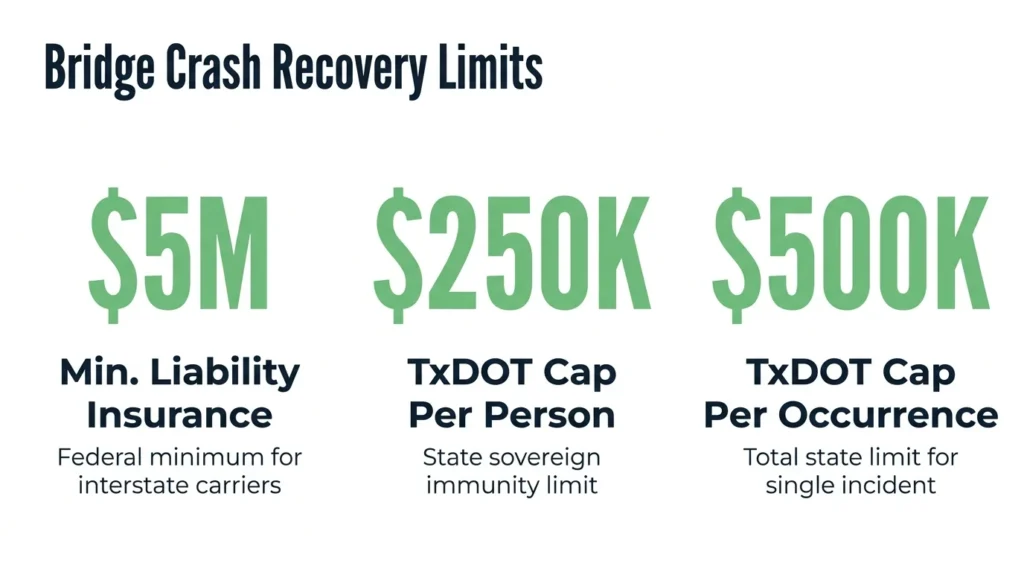
Federal law requires for-hire passenger buses designed to carry 16 or more people to carry at least $5 million in liability coverage for interstate routes. That floor sets the minimum pool of insurance available to injured passengers before other sources of recovery come into play.
What is the maximum amount a person can recover from TxDOT after a bridge crash?
Under Texas Civil Practice and Remedies Code Section 101.023, claims against a state agency like TxDOT are capped at $250,000 per person and $500,000 per occurrence for bodily injury or death. No matter how severe the injuries are, the statutory cap limits what that entity must pay.
If another driver caused the bus to crash on the bridge, can a passenger sue that driver directly?
Yes. An injured bus passenger can bring a claim directly against the at-fault third-party driver’s liability insurance, and can also pursue a separate claim against the bus carrier if its own negligence contributed to the crash. Texas proportionate responsibility rules allow fault to be split across both parties.
Can a family member who watched the crash from outside the bus recover for emotional harm?
Texas recognizes bystander claims for mental anguish when a person was near the scene, directly and contemporaneously witnessed the accident through their senses, and is closely related to the injured or killed victim. All three requirements must be met, and the relationship typically means an immediate family member.
Can a bus passenger's own actions reduce or eliminate their recovery?
Yes. If a passenger’s conduct, such as standing in the aisle, contributed to their injuries, Texas’s fault-sharing rules can reduce the amount they recover in proportion to their share of responsibility. A passenger found more than 50 percent at fault for their own injuries recovers nothing.
About the Authors

Angel Reyes
Writer
Angel L. Reyes, III is the Founder and Managing Partner of Angel Reyes & Associates. A nationally recognized trial attorney and business leader, Angel has helped over 70,000 injury victims recover more than $1 billion since founding the firm in 1993. Named to the Texas Super Lawyers list annually since 2008, Angel brings Wall Street experience, Ivy League education, and a deep commitment to client advocacy. He is a frequent legal commentator and published author with extensive contributions to legal scholarship, trial strategy, and consumer protection.

Kyle Nicolas
Editor
Kyle Nicolas is the Web Content & SEO Manager at Angel Reyes & Associates. He has more than 10 years of experience as a marketing co...

Spencer Browne
Reviewer
Spencer Browne is a partner at Angel Reyes & Associates and a Board Certified personal injury trial lawyer with nearly 100 jury trials a...