Bus Boarding and Exiting Accident Claims


Every article on this site is researched by our internal team, reviewed for legal accuracy against current Texas law, and held to State Bar of Texas advertising standards before publication. We do not publish content that overstates outcomes or makes promises about results.
Learn more about our
editorial standards .
Key Takeaways
- If you fell on a bus, even if there was no crash, you can still file a claim if a defect or lurch caused the fall.
- Claims against a Texas government bus system need written notice within six months.
- Charter bus injury claims fall under Texas's two-year deadline, not a notice rule.
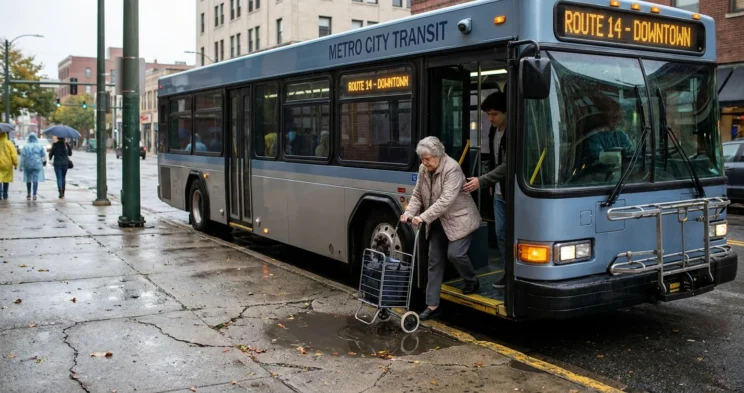
You were stepping down from a city bus near Houston’s Museum District when your foot caught a cracked edge on the bottom step. You grabbed for the handrail, but it was loose, and you hit the pavement hard. There was no crash and no other vehicle, just you and an injury that already has you worried about medical bills. So can anyone be held responsible for a fall like that?
Slip & Fall Bus Accident Claims
Plenty of serious bus injuries happen without a collision. You might slip on a wet or damaged step, lose your grip on a broken handrail, or fall when the bus lurches before you reach a seat.
Many people are surprised to learn that they can file a claim after being injured getting on or off a bus. Knowing when you can sue a public transportation provider is the first step.
A boarding accident raises a different question than a typical bus accident claim involving a collision. The law has to decide whether your injury falls under ordinary vehicle-accident rules or under premises-liability principles tied to the bus’s condition.
If a broken step or defective handrail caused your fall, that can support a claim the same way a collision can.
These falls are also more common than most riders realize. They rarely make the news the way a collision does, but they add up to a steady stream of injury claims every year.
Premises Liability or Vehicle Accident?
Your claim depends on one question: did the bus’s condition cause your fall, or did the way it was driven? Texas treats bus operators as common carriers, so they owe passengers one of the highest duties of care in state law.
That common carrier duty of care shapes both the vehicle-operation analysis and the premises-defect analysis. Which one applies depends on what actually caused you to fall.
If you’re not sure which framework fits your fall, it helps to see how fault is determined in bus accident cases before narrowing in on your own situation.
When the problem is the bus itself, your case looks a lot like an ordinary slip-and-fall claim. The key becomes whether the operator knew or should have known about the hazard and failed to fix it.
Falls Caused by a Static Defect
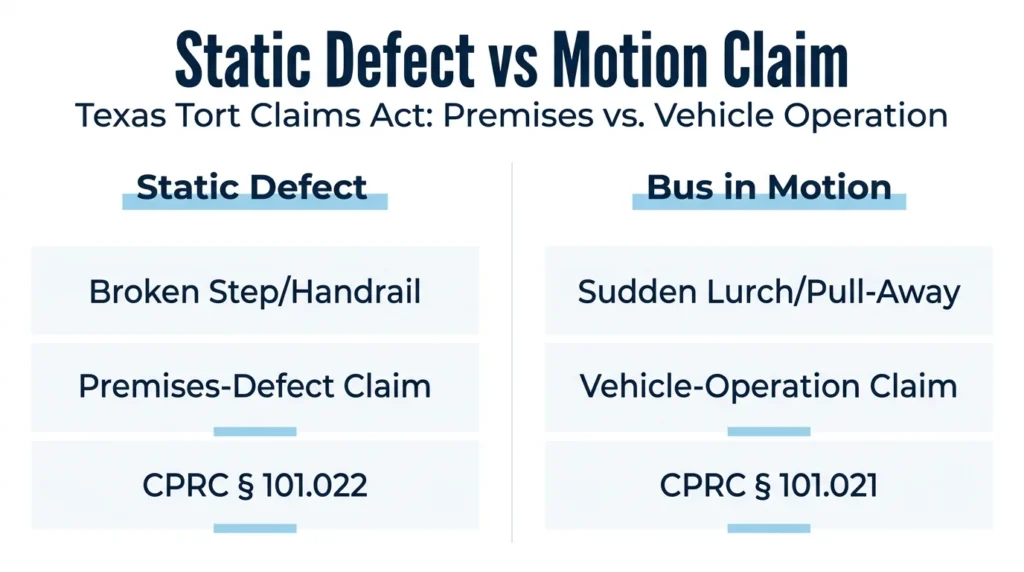
When the bus was standing still and a broken step or loose handrail caused your fall, your claim is analyzed as a premises-defect case. The focus is whether the operator knew or should have known about the hazard.
For a government-run bus, a fall from a static defect is measured under the Texas Civil Practice and Remedies Code (CPRC) § 101.022, which sets the standard for premises-defect claims against a government body.
Federal accessibility rules back up what a safe bus should look like. Code of Federal Regulations 49 § 49.38.29 requires handrails, stanchions, and adequate stepwell lighting, giving you a baseline to show a defect broke an applicable safety rule.
Falls Caused by the Bus in Motion
When the bus itself moved, an abrupt lurch or a pull-away before you were seated, your fall looks more like a vehicle-operation claim. That difference can push your claim toward the motor-vehicle rules instead of the premises rules.
Texas courts look closely at what actually caused the fall, not simply whether the bus was moving. In LeLeaux v. Hamshire-Fannett ISD, 835 S.W.2d 49 (Tex. 1992), the Texas Supreme Court found no waiver of immunity because the bus was parked and unattended when the injury happened, so the vehicle was only the backdrop for the accident, not its cause. In Dallas Area Rapid Transit v. Morris, a rider hurt when the bus lurched while boarding recovered under the common carrier’s high degree of care, showing how differently these claims can play out depending on the facts.
A fall caused by the bus’s own motion more plausibly fits the motor-vehicle-operation waiver under CPRC § 101.021, which lets you pursue a government body for negligent vehicle operation.
Public Transit Authority Claims in Texas
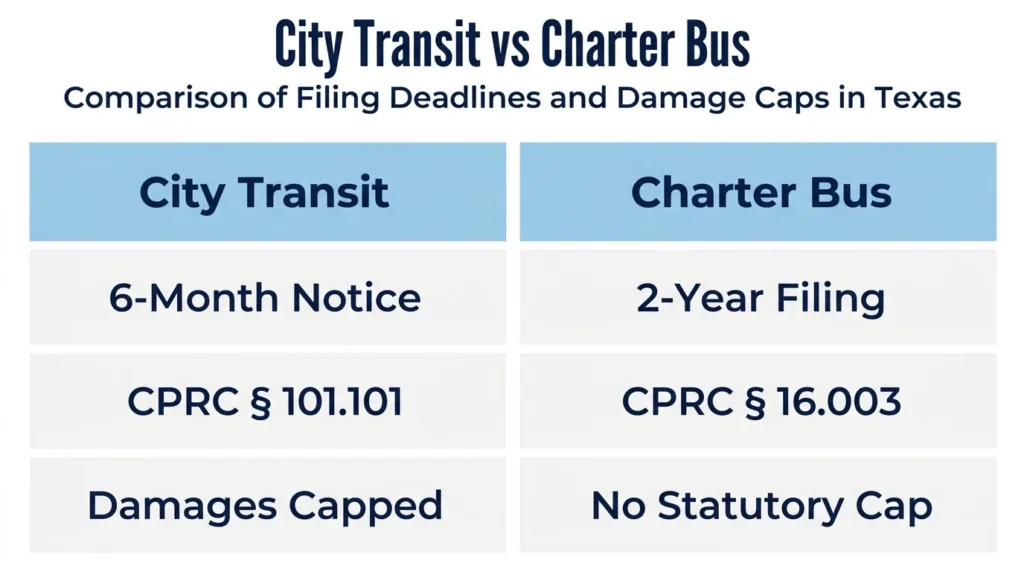
If a city bus system or transit authority is involved, the time you have to file a claim is short. You generally must give the government written notice of your claim within six months of the fall, and some city charters shorten that window even more.
That notice rule comes from CPRC § 101.101, and missing it can end an otherwise strong claim before it begins.
Because these deadlines trip up so many riders, it is worth understanding how the Tort Claims Act limits bus accident claims before you file.
Recovery against a government transit authority is also capped. CPRC § 101.023 limits what you can collect, which helps you set realistic expectations about what a claim against a city bus system is worth.
These rules work the same way whether your fall happened in Houston, El Paso, or a small town in between.
Common Carrier Duty on Charter Buses
Charter and tour bus companies follow different rules from a city transit system. As private common carriers, they fall outside the Tort Claims Act’s notice deadlines, but they still owe you a high degree of care.
That common carrier duty can support a claim for a defective step, a broken handrail, or a driver who pulls away before you are safely aboard, even without a collision.
Instead of the six-month notice rule, a claim against a private charter or tour operator falls under Texas’s general filing deadline. The Texas Civil Practice and Remedies Code § 16.003 gives you two years from the date of injury to file.
Federal safety guidance also shapes what reasonable care looks like on these buses. The motorcoach passenger safety guidance tells riders to use handrails and take care boarding and exiting, which helps frame the standard both sides are measured against.
Evidence for a Bus Boarding Claim
A boarding or exiting fall rarely comes with a police report or crumpled bumpers to prove what happened. That makes a handful of specific records the backbone of your claim.
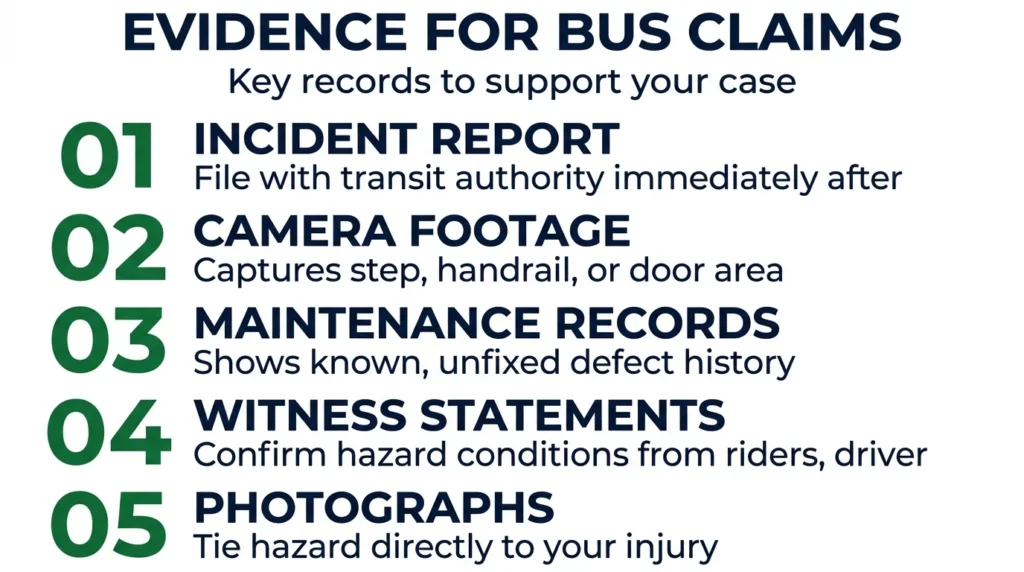
- Incident report: File one with the transit authority or bus company right away, while the details are fresh.
- Camera footage: Onboard or station cameras often capture the step, handrail, or door area at the moment you fell.
- Maintenance records: Inspection and repair logs for that specific bus or handrail can show a known, unfixed defect.
- Witness statements: Other passengers or the driver can confirm what the step or handrail looked like.
- Photographs: Pictures of the defect and your injury tie the hazard directly to the harm.
Once you have gathered what you can, the next move is to file a bus accident claim in Texas.
Work with an Experienced Bus Accident Attorney
A fall while boarding or getting off a bus is exactly the kind of claim that gets dismissed too early. It is also exactly the kind we take seriously. Angel Reyes & Associates has spent more than 30 years handling injury claims for Texans, and over that time our work has meant more than $1 billion recovered for clients. You can read more about our firm and how we help with injuries like these.
You owe no attorney fee unless we win, and your first consultation is always free. We serve the entire state of Texas and can handle most of your case remotely, so where you fell never limits whether we can help. You can find our office locations across Texas if you want to talk to someone nearby.
You can schedule a free consultation to go over what happened and what your options are.
Past results do not guarantee future outcomes.
Bus Boarding Accident FAQs
Are falls on a school bus treated the same as falls on a city transit bus?
Not exactly. School districts are government units too, so the same six-month notice rule can apply, but Texas law sets a lower cap on what you can recover from a school district than from other government transit systems.
What if I fell at the bus stop itself, not on the bus?
That is usually a separate premises liability issue against whoever owns or maintains the stop, often the city, rather than a claim against the bus operator. Some city charters set notice deadlines even shorter than the six-month state rule, so the timeline depends on where the stop is located.
Can I still recover damages if I was partly responsible for my own fall?
Yes, as long as a jury finds you 50% or less at fault, though your award gets reduced by your share of the blame. If you are found 51% or more responsible, Texas law bars you from recovering anything.
Can I still make a claim if no incident report was filed at the time?
Yes, Texas law does not require an incident report before you can file a claim, though skipping one can make proving what happened harder. Photos, medical records, and witness accounts can help fill that gap.
About the Authors

Angel Reyes
Writer
Angel L. Reyes, III is the Founder and Managing Partner of Angel Reyes & Associates. A nationally recognized trial attorney and business leader, Angel has helped over 70,000 injury victims recover more than $1 billion since founding the firm in 1993. Named to the Texas Super Lawyers list annually since 2008, Angel brings Wall Street experience, Ivy League education, and a deep commitment to client advocacy. He is a frequent legal commentator and published author with extensive contributions to legal scholarship, trial strategy, and consumer protection.

Kyle Nicolas
Editor
Kyle Nicolas is the Web Content & SEO Manager at Angel Reyes & Associates. He has more than 10 years of experience as a marketing co...

Angel Reyes
Reviewer
Angel L. Reyes, III is the Founder and Managing Partner of Angel Reyes & Associates. A nationally recognized trial attorney and business...