Bus Fire & Burn Injury Claims in Texas


Every article on this site is researched by our internal team, reviewed for legal accuracy against current Texas law, and held to State Bar of Texas advertising standards before publication. We do not publish content that overstates outcomes or makes promises about results.
Learn more about our
editorial standards .
Key Takeaways
- Bus fire liability often splits between the bus manufacturer and the operator who ran it.
- Manufacturer defect claims escape the government damage caps that limit operator recovery.
- Government bus fire claims demand written notice within six months, far short of two years.
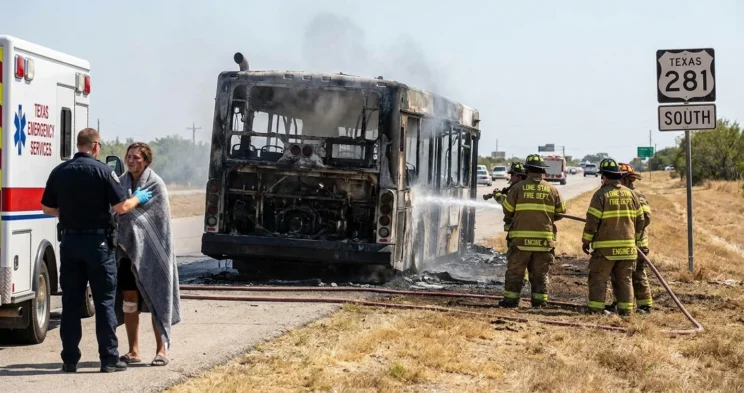
You were riding a commuter bus along the Katy Freeway one morning when smoke started pouring from the rear of the cabin. Within seconds, flames spread and the exit nearest you would not open. Now you are dealing with burns, hospital bills, and a question no one has answered: who is responsible for what happened to you?
What Causes Bus Fires in Texas?
Most bus fires trace back to one of three sources, and the cause usually decides who you can hold responsible. A fuel system failure, an electrical fault, or a battery problem in an electric bus each points toward a different party.
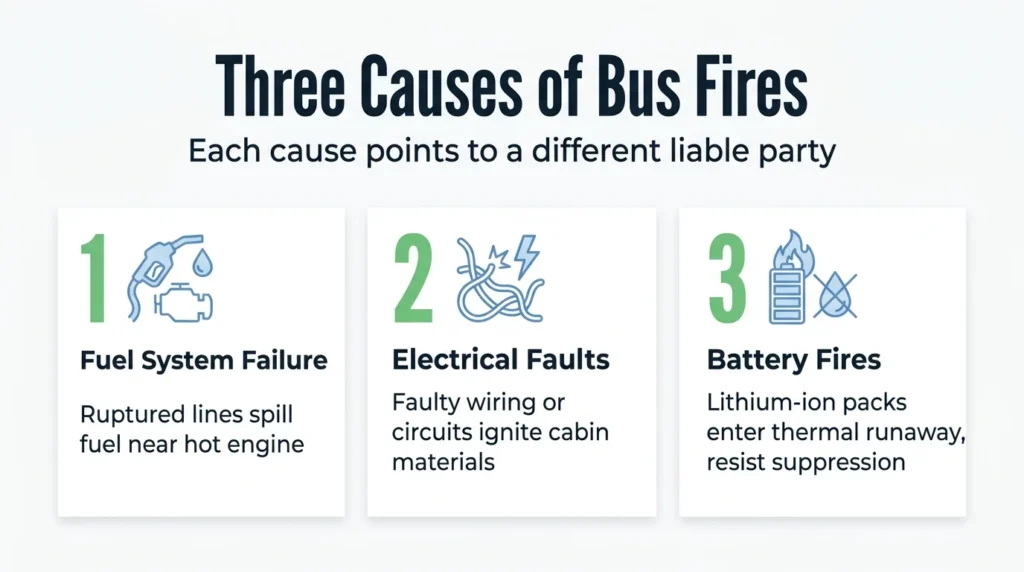
Fuel system failures happen when fuel lines rupture or a tank loses integrity. Spilled fuel reaches a hot engine or an electrical spark, and the fire starts fast.
Electrical faults are just as common. A failed wiring harness, an overloaded circuit, or a long-deferred repair can arc and ignite the materials inside the cabin.
Battery fires are the newest risk. Electric and hybrid buses use large lithium-ion packs that can enter thermal runaway, a self-sustaining fire that standard suppression systems struggle to stop.
The injuries get worse when passengers cannot get out. Blocked or non-compliant emergency exits trap people after ignition, and federal rules under 49 CFR § 571.217, FMVSS Standard No. 217 set the operating force and marking standards those exits must meet.
Each cause maps to a different responsible party. Fuel and battery defects point toward the manufacturer, while poor maintenance points toward the operator.
Who Is Liable for a Bus Fire Injury?
Two separate legal tracks can apply to your bus fire, and sometimes both run at once. One track targets the company that built a defective bus or component. The other targets the company or agency that operated and maintained it.
Manufacturer Defect Claims
A manufacturer can be held responsible when a defective part caused or worsened the fire. Texas law recognizes three kinds of product defects: a design defect, a manufacturing defect, and a marketing defect.
A design defect means the whole component type is dangerous as built. A manufacturing defect means one specific unit came out wrong. A marketing defect means the maker failed to warn you about a known fire risk.
These claims fall under the Texas Civil Practice and Remedies Code Chapter 82, which governs liability for defective products that cause injury. You do not have to prove the manufacturer was careless, only that the product was defective and hurt you.
Federal safety standards can strengthen your case. A bus that violates 49 CFR § 571.301, FMVSS Standard No. 301 for fuel system integrity may be liable under a negligence per se theory, which means the violation itself can establish fault.
Interior materials that fail the flammability limits in 49 CFR § 571.302, FMVSS Standard No. 302 can support the same argument when they speed the spread of a fire.
Electric buses raise a separate standard. 49 CFR § 571.305, FMVSS Standard No. 305 addresses electrolyte spillage and electrical shock protection for electric vehicles, but it currently applies only to electric buses below 4,536 kg. The newer FMVSS 305a will cover larger transit buses, yet it is not yet mandatory for those vehicles.
Past investigations can also reveal that a maker knew about a problem. NTSB accident investigation reports, including the 2024 report on a battery electric transit bus fire, can show prior notice of a known defect.
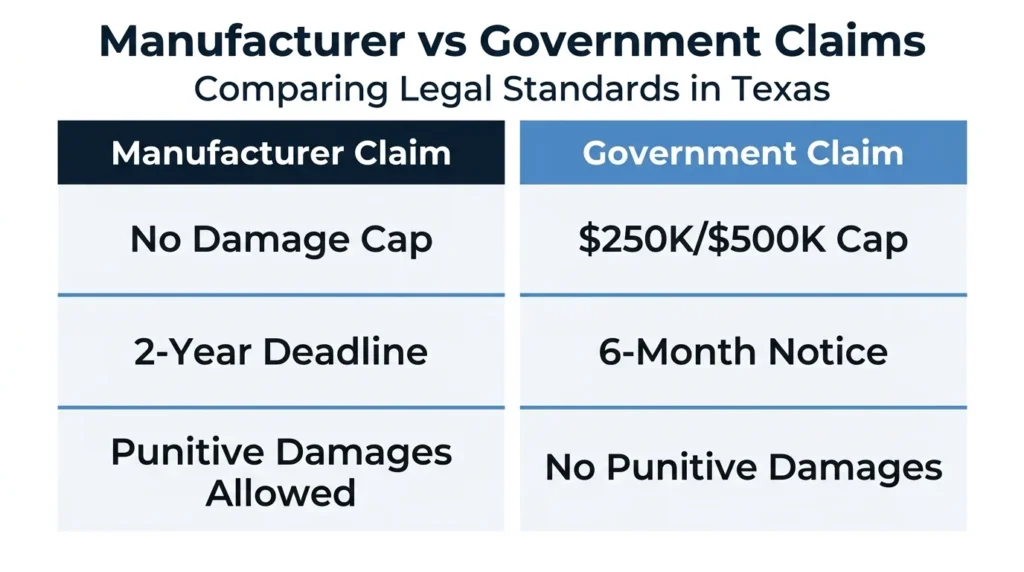
A manufacturer claim carries one more advantage. It is not subject to the damage caps that limit claims against government operators, so your recovery against a private maker is not artificially capped.
Operator Negligence Claims
The operator can be liable when it fails to maintain, inspect, or run the bus safely. That includes a transit company, a school district, or a private charter carrier.
Texas requires regular vehicle inspections under Texas Transportation Code Chapter 548. An operator that ignored fire suppression systems, fuel lines, or electrical wiring may have breached that duty.
Negligent hiring and training can also create liability. A driver or mechanic who skipped a required pre-trip inspection may have let a dangerous bus stay on the road.
Private carriers like charter and tour companies carry no immunity shield. A two-year filing deadline applies, and no statutory cap limits your compensation from bus accident burn injuries. Government operators are a different story, and immunity becomes the first question.
An attorney familiar with Texas bus law can identify which liability track fits your situation before the deadline passes.
Texas Tort Claims Act & Government Bus Operators
When a city bus, school bus, or county transit vehicle catches fire, sovereign immunity is your first hurdle. A government operator is usually protected from suit unless a specific law removes that protection.
Waiver of Immunity Under the TTCA
Texas Civil Practice and Remedies Code § 101.021 waives that immunity for injuries arising from a government employee’s operation or use of a motor vehicle. The fire must arise from the bus’s operation or use to fall within this Texas Tort Claims Act waiver.
The fire’s origin can change everything. When a manufacturing defect caused the fire, your claim may lie mostly against the private maker, outside this framework entirely, with no immunity shield and no cap.
Notice deadlines are short and strict. Claims against state entities require written notice within six months of the incident, and some city charters cut that to 90 days. Missing the deadline can end your claim before it starts.
Damages Caps for Government Bus Claims
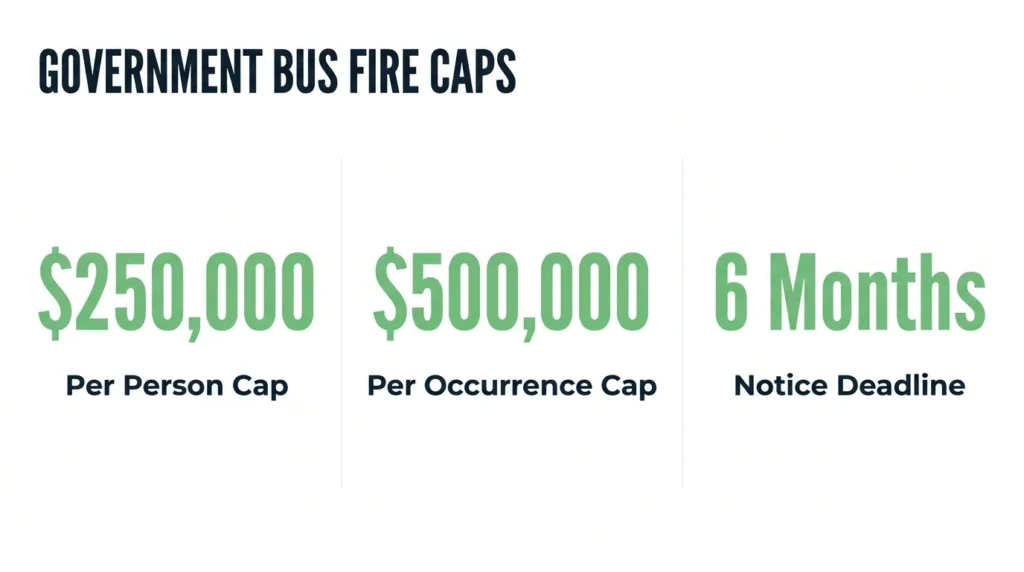
When the Tort Claims Act applies, your recovery is capped. Texas Civil Practice and Remedies Code § 101.023 limits recovery to $250,000 per person and $500,000 per occurrence for municipalities and state agencies.
School districts and counties may carry different caps. The cap that applies depends on which governmental unit operated the bus.
Punitive damages are off the table against a government unit, leaving only compensatory damages. That makes the manufacturer track more valuable when a defect plays a role.
A documented battery defect can shift part of your claim outside those caps. The NHTSA battery safety initiative tracks electric bus battery fire investigations, and a known electric bus battery fire injury history can move at least part of the claim to the private maker.
Burn Injuries & Smoke Inhalation Damages
Burn and smoke inhalation injuries often drive higher damages than typical bus crash injuries. You can recover both economic and non-economic damages, and severe burns push both categories up.
Economic damages cover your hard costs. That includes emergency burn treatment, hospitalization, surgical debridement, skin grafts, long-term wound care, physical therapy, and lost wages. Severe scarring or disability can also reduce your future earning capacity.
Non-economic damages cover the human toll. Pain and suffering, disfigurement, permanent scarring, emotional distress, and lost enjoyment of life all carry heightened weight in bus accident burn injuries cases.
Smoke inhalation deserves its own attention. Respiratory damage, carbon monoxide poisoning, and lung scarring can cause long-term disability that is not obvious right after the fire. Ongoing medical records are what document the full scope of these injuries.
A bus fire often involves more than one defendant. When a manufacturer and an operator are both at fault, the total recovery available can increase.
Steps to Take After a Bus Fire Injury
Your first move is medical care, and your second is preserving the evidence that bus fire claims uniquely depend on. Two different deadlines can apply, so acting early protects both your health and your claim:
- Step 1: Get emergency medical care right away. Burns and smoke inhalation can worsen for hours after the fire, so early treatment also creates the first record of your injuries.
- Step 2: Document the fire scene as soon as you safely can. Note where the fire started, the bus make and model, and the condition of the emergency exits. Photos and witness names help.
- Step 3: Preserve every medical record from the first visit forward. Smoke and burn injuries need continuous documentation to show the full extent of your damages over time.
- Step 4: Request recall and investigation records for that bus. Ask for NHTSA recall and defect investigation records for the specific make and model, and check whether an NTSB report covers the fleet or route.
- Step 5: Secure the fire investigation reports. A transit authority may run its own investigation, and fire marshal and police incident reports matter just as much.
- Step 6: Track both filing deadlines. The general personal injury deadline runs two years from the injury under Texas Civil Practice and Remedies Code § 16.003, but a school bus fire or other government claim adds a separate six-month notice deadline.
Work with an Experienced Attorney
A bus fire claim moves on layered tracks: manufacturer defect analysis, operator negligence, and tight notice deadlines for government buses. Early legal help protects the evidence and the timeline before either slips away. Angel Reyes & Associates has handled complex Texas bus accident and product liability claims for over 30 years, with more than $1 billion recovered for clients across Texas.
You can read what past clients say in our client reviews and testimonials, and you can meet the people who would handle your case.
We work on contingency, so there is no fee unless we win, and your initial consultation is free. Contact us for a free consultation to discuss your bus fire burn injury claim.
Past results do not guarantee future outcomes.
Bus & Fire Burn Injury Claim FAQs
Can I still file a claim if I was injured on a bus my employer provided?
Workers’ compensation may cover your claim against the employer, but it does not block a separate product liability claim against the bus manufacturer if a defect caused the fire. Texas law allows injured employees to sue third parties like manufacturers even when workers’ comp applies to the employer relationship.
Can family members file a wrongful death claim if someone died in a Texas bus fire?
Under Texas Civil Practice and Remedies Code Chapter 71, a surviving spouse, children, or parents can file a wrongful death claim. The deadline is two years from the date of death, and the same notice requirements apply if the bus was operated by a government entity.
Does my percentage of fault affect how much I can recover?
Texas follows a modified comparative fault rule: your damages are reduced by your share of fault, but you are barred from recovering anything if you are found 51% or more at fault. So a passenger found 20% at fault in a bus fire case would still recover 80% of their total damages.
Will my health insurer want to be paid back from my settlement?
Yes, health insurers can place a subrogation lien on your settlement, meaning they may claim reimbursement for medical bills they covered. The lien amount can often be negotiated down before the settlement funds are distributed.
If a school district operated the bus, are the damage caps lower than for a city bus?
Yes. Under the Texas Tort Claims Act, school districts face a lower cap of $100,000 per person and $300,000 per occurrence, compared to $250,000 per person and $500,000 per occurrence for municipalities. This makes the manufacturer liability track more important when a school bus fire involves a product defect.
About the Authors

Angel Reyes
Writer
Angel L. Reyes, III is the Founder and Managing Partner of Angel Reyes & Associates. A nationally recognized trial attorney and business leader, Angel has helped over 70,000 injury victims recover more than $1 billion since founding the firm in 1993. Named to the Texas Super Lawyers list annually since 2008, Angel brings Wall Street experience, Ivy League education, and a deep commitment to client advocacy. He is a frequent legal commentator and published author with extensive contributions to legal scholarship, trial strategy, and consumer protection.

Graham Griffin
Editor
Graham Griffin is the Web & Content Manager at Angel Reyes & Associates, where he oversees content strategy, AI-powered workflows, a...

Angel Reyes
Reviewer
Angel L. Reyes, III is the Founder and Managing Partner of Angel Reyes & Associates. A nationally recognized trial attorney and business...