Can You Claim PTSD After a Motorcycle Accident?


Every article on this site is researched by our internal team, reviewed for legal accuracy against current Texas law, and held to State Bar of Texas advertising standards before publication. We do not publish content that overstates outcomes or makes promises about results.
Learn more about our
editorial standards .
Key Takeaways
- Texas law explicitly covers mental or emotional pain as a recoverable non-economic damage after a crash.
- A formal DSM-5 diagnosis and consistent treatment records are required to support a PTSD claim.
- Texas gives you two years from the crash date to file, but a discovery rule may extend the window.

The crash happened on a stretch of US-290 outside Austin, and it was over in seconds. The bones healed. The bruises faded. But months later, you still can’t make yourself get back on the bike, and certain sounds send you straight back to that moment.
What you’re experiencing has a name. It also has legal weight.
PTSD Is a Recognized & Recoverable Injury in Texas
Most people assume personal injury claims cover broken bones and hospital bills. They don’t know that Texas law specifically allows recovery for psychological injuries including PTSD, anxiety, and depression caused by a crash.
Texas Civil Practice and Remedies Code Chapter 41 defines “noneconomic damages” to include “mental or emotional pain or anguish” as a compensable category.
That definition covers the psychological toll of a motorcycle accident: the flashbacks, the sleep disruption, the inability to ride, the hypervigilance on the road. These are real injuries under Texas law, and you can seek compensation for them.
Texas does not cap non-economic damages in standard personal injury cases. The medical malpractice cap does not apply to motorcycle accident claims. If your PTSD is severe and well-documented, there is no legal ceiling on what a jury may award.
What PTSD From a Crash Actually Looks Like
Not every bad feeling after a crash qualifies as PTSD. Texas courts require damages that reflect a “high degree of mental pain and distress” amounting to a substantial disruption in daily life.
PTSD vs. Normal Post-Crash Anxiety
Normal stress after a serious crash is expected. Most people feel shaken, nervous, or on edge for days or even weeks after a collision. That is not PTSD.
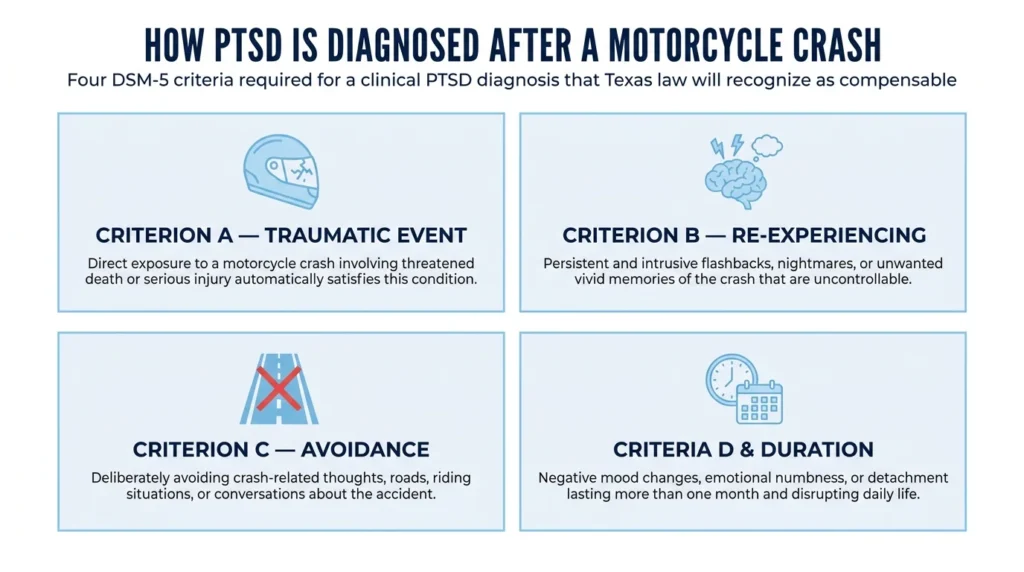
PTSD is a clinical diagnosis under the DSM-5 criteria published by the VA National Center for PTSD. It requires specific symptoms that you experience for more than a month and seriously affect your daily life.
A motorcycle crash meets DSM-5 Criterion A by definition: direct exposure to threatened death or serious injury. The diagnosis also requires evidence across three additional symptom areas.
- Criterion B: Intrusive re-experiencing. Flashbacks, nightmares, or vivid unwanted memories of the crash that you feel you cannot control.
- Criterion C: Avoidance. Deliberately avoiding crash-related thoughts, roads, riding situations, or conversations about the accident.
- Criterion D: Persistent negative thoughts or mood changes since the trauma, including guilt, blame, emotional numbness, or detachment from people and activities you previously enjoyed.
Symptoms must last more than one month and must interfere with your ability to work, maintain relationships, or handle normal tasks.
Other Compensable Psychological Conditions
PTSD is the most recognized diagnosis in crash cases, but Texas law allows recovery for other crash-caused mental health conditions as well. A formal diagnosis connecting the condition to the accident is required in each case.
Anxiety disorder can develop when crash-related fear extends beyond a reasonable recovery period and begins controlling your behavior. Refusing to use freeways, avoiding traffic entirely, or experiencing panic attacks while driving are all documented presentations.
Depression following a serious motorcycle accident often shows up as sustained low mood, withdrawal from activities you once enjoyed, and difficulty functioning at work. Adjustment disorder is a time-limited but clinically significant stress response; it may be diagnosed when symptoms do not fully meet PTSD criteria but still cause measurable disruption.
Any of these diagnoses, documented by a licensed mental health professional and linked to the crash, can support a non-economic damages claim.
How to Document Your PTSD Claim
Getting compensated for psychological injuries requires more paperwork than a broken arm, but the documentation path is clear. Building this record early strengthens your position before an insurer ever makes an offer.
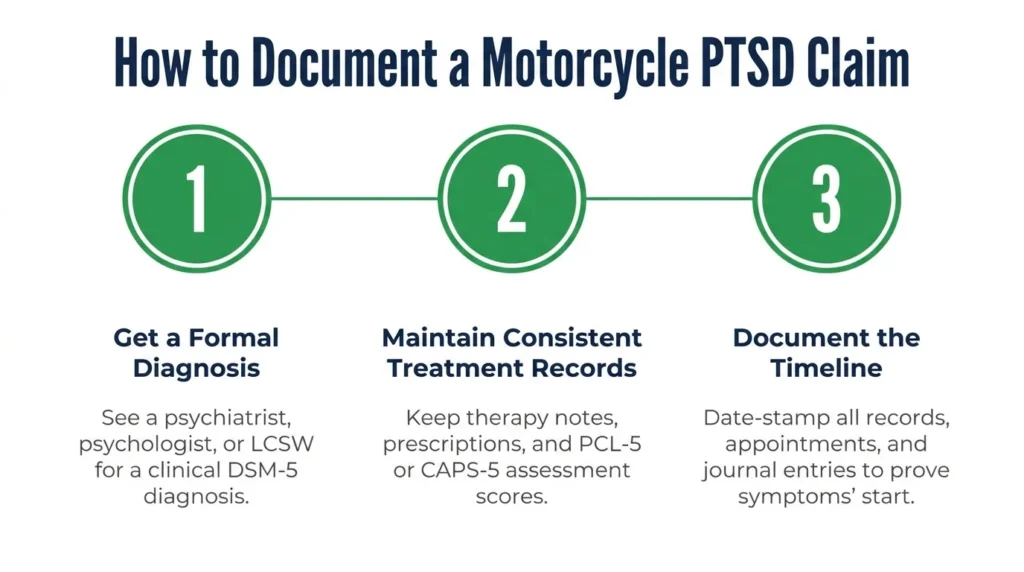
- Step 1: Get a formal diagnosis. See a psychiatrist, psychologist, or licensed clinical social worker. A self-described “anxiety after the crash” does not meet the legal standard for non-economic damages. A clinician will evaluate your symptoms against DSM-5 criteria and produce a formal diagnosis that your attorney can use.
- Step 2: Maintain consistent treatment records. Session notes from therapy, medication prescriptions, and standardized assessment scores are your evidence. Clinicians commonly use the PCL-5 or CAPS-5 instruments to measure PTSD severity over time. Consistent treatment records also weakens the insurer’s standard argument that symptoms were mild.
- Step 3: Document the crash-to-diagnosis timeline. Records that show when your symptoms started and how they connect to the accident date are critical. A gap between the accident and your first mental health appointment is not automatically fatal, but it will be questioned. Date-stamp everything.
- Step 4: Keep personal records. A dated journal documenting your symptoms, work absence records showing days missed because of psychological symptoms, and written statements from family members or coworkers who observed behavioral changes all support the clinical picture.
Understanding what evidence is needed early makes a difference in how a psychological injury claim develops.
How Insurers Challenge Mental Health Claims
Insurers treat PTSD and emotional distress as the easiest part of a motorcycle claim to fight. They know that psychological injuries are harder to show on an X-ray, and they use that to their advantage during negotiations.
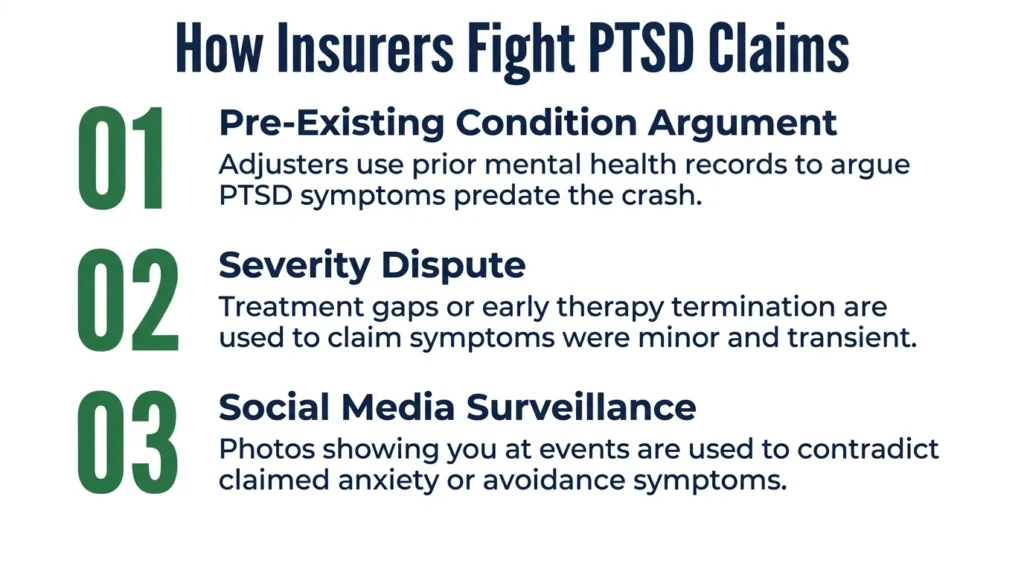
The most common tactic is the pre-existing condition argument. The adjuster will search for any prior mental health history, counseling records, or prescription history to argue the PTSD existed before the crash. Even a single therapy appointment years earlier can become a leverage point.
A clean crash-to-diagnosis timeline is your best protection against that argument. Knowing how insurers verify and contest pre-existing injury claims before your first contact with the adjuster gives you a meaningful advantage.
A second tactic is severity dispute. If your treatment record shows gaps or you stopped seeing a therapist early, the adjuster will argue your symptoms were transient and minor, not the substantial disruption Texas courts require. Consistent ongoing treatment is your defense against this argument.
Social media surveillance is routine. Photos, check-ins, or posts showing you at events, smiling, or appearing to function normally are used to contradict claimed anxiety or avoidance symptoms. Adjusters and defense investigators actively monitor claimants’ social media during the claims process.
Some insurers also request an independent medical examination (IME) conducted by a psychiatrist of their choosing. These exams are not neutral.
The doctor is paid by the insurance company, and findings typically minimize severity. Your own treating clinician’s records and documented assessment scores are the counterweight.
Texas Filing Deadline for Psychological Injury Claims
The same deadline for physical injury claims governs PTSD claims. Under Texas Civil Practice and Remedies Code (CPRC) § 16.003, you have two years from the date of the crash to file a personal injury lawsuit in Texas. Miss that deadline and the right to sue is almost certainly gone, regardless of how strong the psychological injury claim is.
PTSD has a wrinkle: symptoms do not always appear immediately. Texas courts recognize a discovery rule that may stall the two-year clock when a psychological injury was not immediately apparent. The deadline may start from when the injury reasonably should have been discovered, which matters if your PTSD surfaced weeks or months after the crash.
Waiting for symptoms to worsen before seeking legal help is risky. The two-year window runs regardless of whether treatment has started.
If you are unsure whether your psychological symptoms meet the threshold for a claim, that is a question for an attorney, not a reason to wait.
Talk to an Attorney About Your Motorcycle PTSD Claim
Psychological injuries are real, they are recoverable, and they deserve the same attention as the physical injuries from your crash.
Angel Reyes & Associates has spent over 30 years representing injured Texans in personal injury claims, including cases where non-economic damages for psychological injury were a central part of the recovery. Our attorneys handle these claims on contingency, which means no fee unless we win. Plus, we have more than 20 offices across the state to help serve you better.
There is no upfront cost to find out where you stand. If you are dealing with PTSD, anxiety, or emotional trauma after a motorcycle accident, reach out for a free consultation. We can review what you experienced, what you have documented, and what your options are under Texas law.
Past results do not guarantee future outcomes.
Motorcycle Accident PTSD Claim FAQs
Can I still claim PTSD if I was not physically injured in the motorcycle crash?
Texas courts generally require some physical impact for a personal injury claim, but being directly involved in a serious crash typically satisfies that requirement even when visible physical injuries are minor. The key is a formal diagnosis linking your psychological symptoms to the accident.
Does health insurance cover PTSD treatment after a motorcycle accident?
Your health insurance can pay for PTSD therapy, medication, and psychiatric visits, and those out-of-pocket costs may be recoverable as part of your injury claim against the at-fault party. Keep all receipts and explanation-of-benefits statements as documentation.
What if the other driver had no insurance? Can I still recover for PTSD?
Texas uninsured motorist (UM) coverage pays for non-economic damages, including PTSD and emotional distress, when the at-fault driver carries no insurance. If you carry UM coverage on your own policy, that coverage may apply to your psychological injury claim.
Can the insurer require me to undergo a psychiatric evaluation?
An insurer may request an independent medical examination (IME) with a psychiatrist of their choosing as part of the claims process. You can counter those findings with records from your own treating clinician and standardized assessment scores from ongoing therapy.
How does PTSD affect the value of a motorcycle accident settlement?
PTSD and documented emotional distress add to the non-economic damages portion of a claim, which has no statutory cap in standard Texas personal injury cases. The severity of the diagnosis, the consistency of treatment, and the degree of functional impairment all influence how much a court or insurer assigns to the psychological injury.
About the Authors

Angel Reyes
Writer
Angel L. Reyes, III is the Founder and Managing Partner of Angel Reyes & Associates. A nationally recognized trial attorney and business leader, Angel has helped over 70,000 injury victims recover more than $1 billion since founding the firm in 1993. Named to the Texas Super Lawyers list annually since 2008, Angel brings Wall Street experience, Ivy League education, and a deep commitment to client advocacy. He is a frequent legal commentator and published author with extensive contributions to legal scholarship, trial strategy, and consumer protection.

Kyle Nicolas
Editor
Kyle Nicolas is the Web Content & SEO Manager at Angel Reyes & Associates. He has more than 10 years of experience as a marketing co...

Angel Reyes
Reviewer
Angel L. Reyes, III is the Founder and Managing Partner of Angel Reyes & Associates. A nationally recognized trial attorney and business...