Can You Get a Blood Clot After a Car Accident?


Every article on this site is researched by our internal team, reviewed for legal accuracy against current Texas law, and held to State Bar of Texas advertising standards before publication. We do not publish content that overstates outcomes or makes promises about results.
Learn more about our
editorial standards .
Key Takeaways
- Crash trauma, fractures, and immobility all raise your risk of a dangerous blood clot.
- Most clots after trauma appear after discharge, at a median of 18 days post-injury.
- A hospital that skipped indicated clot prevention may share responsibility under Texas law.
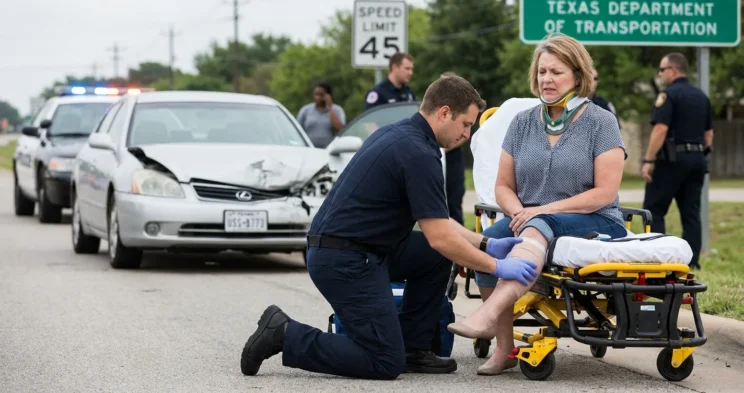
You left the hospital after the wreck with a fractured leg, a walking boot, and instructions to rest. Three weeks later your calf is swollen and warm, and the stairs leave you short of breath.
Yes, you can get a blood clot after a car accident. Crash trauma is a documented cause of dangerous clots, and the risk does not end when you are discharged.
That matters legally as well as medically. The driver who caused the crash created the risk, and if the hospital skipped the clot prevention its own trauma standards call for, Texas law lets both failures be examined in the same case.
How Does a Car Accident Cause a Blood Clot?
Serious car accident trauma is a well-documented cause of venous thromboembolism, the medical term covering deep vein thrombosis and pulmonary embolism.
A deep vein thrombosis, or DVT, is a clot that forms in a deep vein, most often in the leg, thigh, or pelvis. A pulmonary embolism, or PE, happens when part of that clot breaks loose and travels to the lungs.
Crash injuries trigger all three of the conditions that produce clots at once. The impact and any resulting surgery damage vessel walls, immobility slows blood flow in the legs, and the body’s own injury response makes the blood more likely to clot.
About half of DVT cases produce no symptoms at all, which is why a clot can build quietly while you focus on the broken bone you can feel.
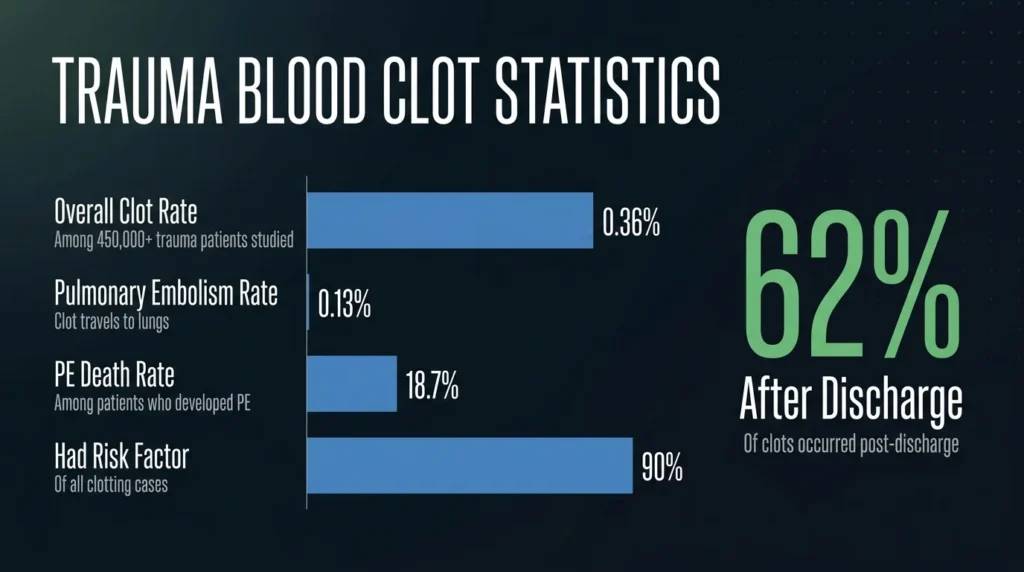
A review of more than 450,000 trauma patients in the American College of Surgeons National Trauma Data Bank recorded 1,602 clotting episodes, an overall rate of 0.36%, with pulmonary embolism in roughly 0.13% of patients. Among the patients who developed a PE, 18.7% died.
90% of all clotting cases occurred in patients who had at least one identifiable risk factor.
The rate is low across all trauma patients. It is not low if you are in the risk group described next.
Immobilization, Fractures, & Other Risk Factors for DVT After Injury
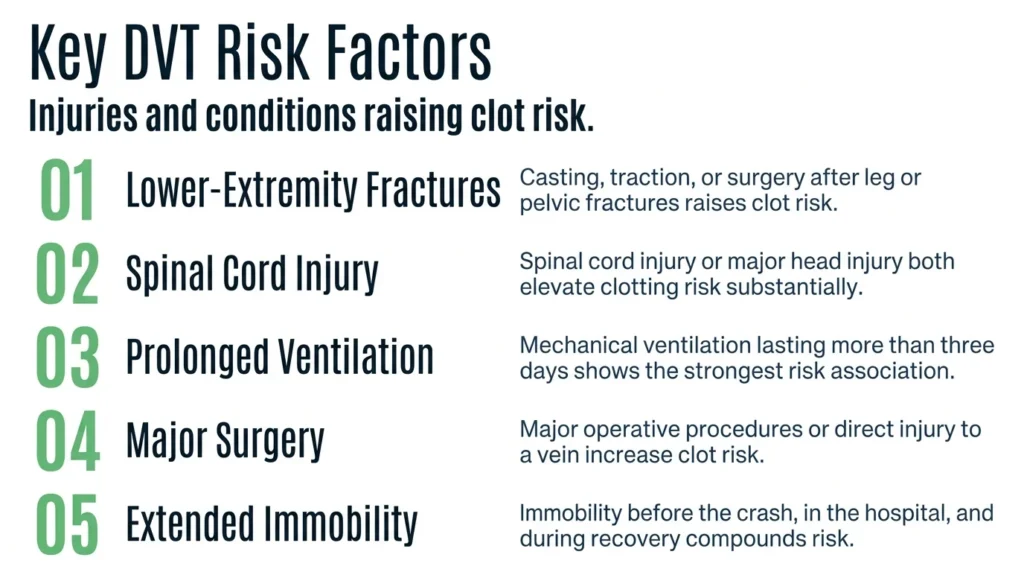
Being laid up is the common thread. DVT after injury concentrates in patients who cannot move normally, and the recognized risk factors line up with exactly the injuries a serious collision produces:
- Lower-extremity and pelvic fractures, which bring casting, traction, or surgery
- Spinal cord injury and major head injury
- Mechanical ventilation lasting more than three days, the single strongest association in the trauma registry data
- Major operative procedures and direct injury to a vein
- Immobility before the crash, in the hospital bed, and during recovery at home
- Older age, male sex, greater overall injury severity, a prior superficial vein clot, and soft-tissue injury to the leg
A broken femur or tibia and a spinal cord injury both carry risk several times higher than an uninjured baseline. Severity drives the risk, so the crash that puts you in a cast for six weeks deserves more attention than a sore neck does.
Timing is the part most people get wrong. In a population-based study of acute trauma patients, 62% of clotting events happened after hospital discharge, and the median time from the trauma to the clot was 18 days.
By the time the clot shows up, the emergency room visit can feel like old news. It is still part of the same injury.
Warning Signs and How Doctors Diagnose a Blood Clot
Call your doctor for leg symptoms and call 911 for lung symptoms. Sudden death is the first sign of a pulmonary embolism in roughly one in four cases, so this is not a wait-and-see situation.
Signs of a DVT in the leg include:
- Swelling in one leg, ankle, or foot
- Pain, cramping, or tenderness, often in the calf
- Skin that feels warm or looks red or discolored
Signs of a pulmonary embolism include:
- Shortness of breath that comes on suddenly
- Sharp pain when you breathe deeply
- Rapid breathing or a racing heart
- Coughing, sometimes with blood, along with anxiety, lightheadedness, or sweating
Doctors confirm a clot with imaging rather than symptoms alone. CT pulmonary angiography is the primary test for a suspected PE, with ventilation-perfusion scans and D-dimer blood tests also in use, and ultrasound is standard for a suspected leg clot.
Those images become the backbone of any later claim, because they date the clot and tie it to the injury.
What Hospitals Are Supposed to Do for At-Risk Trauma Patients
Trauma centers are expected to prevent clots in high-risk patients, not simply react to them. That expectation is written down.
The American Association for the Surgery of Trauma’s clinical consensus document treats pharmacologic prophylaxis, meaning a blood thinner, as the primary prevention tool. Mechanical prophylaxis such as intermittent pneumatic compression sleeves serves as the adjunct when bleeding risk rules out medication.
The document also sets timing. For solid-organ injury, prophylaxis should generally begin within 48 hours of injury absent ongoing bleeding or another contraindication. For traumatic brain injury, the window is 24 to 72 hours after admission, pending stable imaging and neurosurgical clearance.
Low-molecular-weight heparin is generally favored over unfractionated heparin. Without any prophylaxis at all, clotting rates in high-risk trauma populations run remarkably high, reaching up to 54% in the brain-injury patients described in that consensus.
This standard is the benchmark. When an attorney pulls your hospital chart, the question is whether a prophylaxis order exists, when it was written, and whether anyone actually carried it out.
When the Driver & the Hospital May Share Responsibility
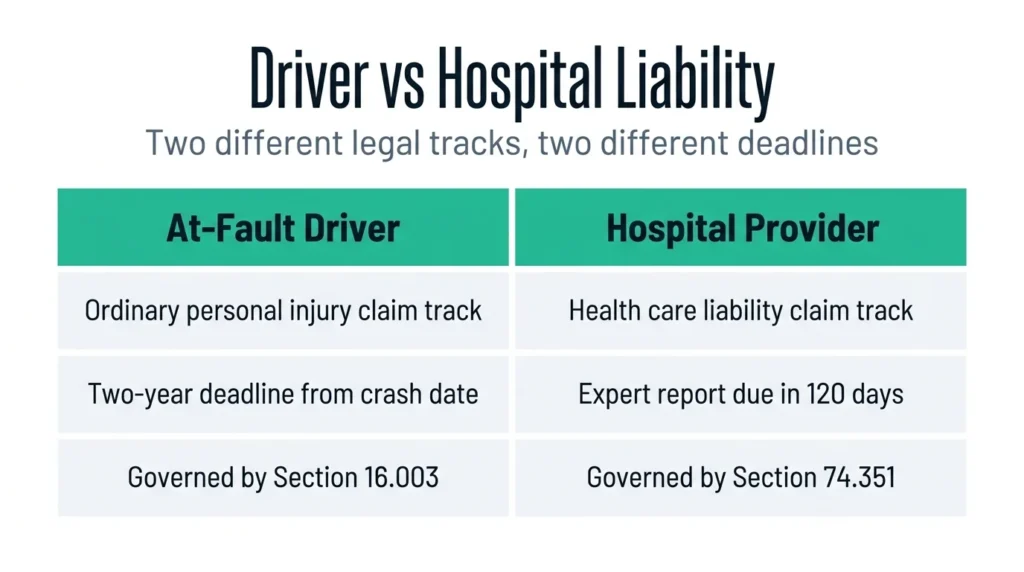
Two different failures can contribute to one pulmonary embolism, and they are evaluated on two different legal tracks.
The at-fault driver can be held responsible for the crash and the injuries connected to it, which may include a complication linked to the crash injury and the immobility that followed. That claim runs on the ordinary Texas personal injury track under Texas Civil Practice & Remedies Code § 16.003.
A hospital or provider that failed to give indicated clot prevention faces a separate question. In a review of 277 malpractice lawsuits involving PE and DVT, failure to administer prophylactic anticoagulation was the most frequently cited negligent act, and death was the claimed injury in 80% of those cases. Where a clot proves fatal, the family’s wrongful death claim can reach both parties.
Texas law supplies the mechanism for sorting that out. Under Texas Civil Practice & Remedies Code § 33.013, each defendant pays the percentage of damages matching its assigned share of responsibility, and a defendant found more than 50% responsible becomes liable for the entire award. Section 33.001 governs how a claimant’s own share of fault is weighed in that same allocation.
The claim against a facility is harder to bring. It qualifies as a health care liability claim, so Texas Civil Practice & Remedies Code § 74.351 requires a supporting expert report within 120 days of that defendant’s answer. Miss it, and the claim is dismissed with prejudice and the claimant can owe that provider’s attorney’s fees.
The clocks differ too. Section 74.251 and § 16.003 both set two-year periods, but they can start running from different events, such as the crash date for one defendant and the date of the alleged medical failure for another. Do not assume one deadline covers both, and do not wait to ask.
None of this is automatic. It is a possibility worth investigating, and the investigation rests on three records: the prophylaxis order or its absence, the imaging confirming the clot, and the anticoagulation treatment documentation.
Talk to Angel Reyes & Associates About Your Blood Clot Case
A clot diagnosed after a crash is worth a legal review, especially if your recovery involves a cast, surgery, a hospital stay, or weeks of sitting still. You do not need to know who is at fault before you call.
Bring what you have: your crash records, your discharge paperwork, the imaging that confirmed the clot, and any prescriptions for blood thinners. If pieces are missing, the firm can request the hospital chart and look for the prophylaxis order itself.
Angel Reyes & Associates has guided injured Texans through situations like this for over 30 years, working on contingency so there is no upfront cost to you. Request a free consultation to have your situation reviewed.
Past results do not guarantee future outcomes.
Accident-Related Blood Clot FAQs
What should you do if you develop blood clot symptoms weeks after a car accident?
Prompt medical evaluation is important because DVT and PE can develop after discharge, and sudden shortness of breath, chest pain, coughing blood, or fainting requires emergency medical attention.
Can a blood clot after a car accident be considered a separate injury?
Potentially, depending on the medical evidence connecting the clot to the crash, the resulting injuries, and subsequent complications; the timing and medical records can be important in establishing that connection.
What medical records are important in a car accident blood clot case?
Useful records can include emergency and hospital records, imaging confirming the DVT or PE, medication and anticoagulation records, mobility restrictions, surgical records, and documentation of any clot-prevention measures.
About the Authors

Angel Reyes
Writer
Angel L. Reyes, III is the Founder and Managing Partner of Angel Reyes & Associates. A nationally recognized trial attorney and business leader, Angel founded the firm in 1993, which has gone on to help over 70,000 injury victims recover more than $1 billion. Named to the Texas Super Lawyers list annually since 2008, Angel brings Wall Street experience, Ivy League education, and a deep commitment to client advocacy. He is a frequent legal commentator and published author with extensive contributions to legal scholarship, trial strategy, and consumer protection.

Kyle Nicolas
Editor
Kyle Nicolas is the Web Content & SEO Manager at Angel Reyes & Associates. He has more than 10 years of experience as a marketing co...

Angel Reyes
Reviewer
Angel L. Reyes, III is the Founder and Managing Partner of Angel Reyes & Associates. A nationally recognized trial attorney and business...