What Are Warning Signs of Pain Medication Dependence?


Every article on this site is researched by our internal team, reviewed for legal accuracy against current Texas law, and held to State Bar of Texas advertising standards before publication. We do not publish content that overstates outcomes or makes promises about results.
Learn more about our
editorial standards .
Key Takeaways
- Dependence from prescribed post-crash pain medication is not a pre-existing condition
- Texas foreseeability rules can keep injury-related opioid dependence in the causal chain
- Prescription history, no prior substance use, and an addiction evaluation carry the proof

You took the pills exactly the way the doctor wrote them after the crash. Months later your body needs them, and you are quietly afraid that saying so out loud will sink your injury claim.
Under Texas negligence law, dependence that grows out of medication prescribed to treat an injury someone else caused is generally treated as part of the harm from that injury, not as a separate problem that cancels your right to recover. The prescription was a normal and foreseeable response to being hurt. What decides the fight is the record showing exactly that.
What Counts as Dependence on Pain Medication After an Injury
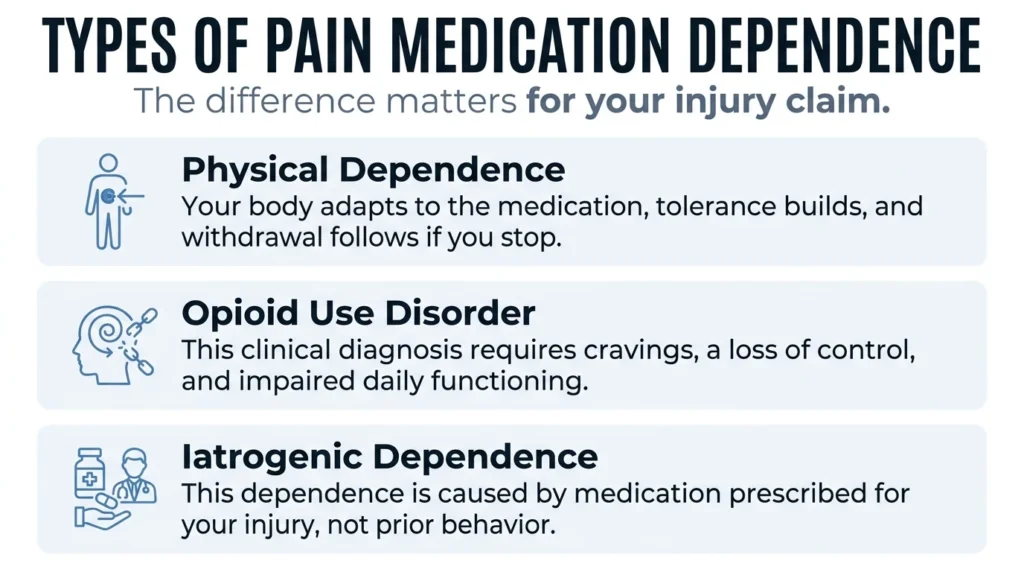
The word “dependence” gets used for two different conditions, and the difference means a lot for your claim.
Physical dependence means your body has adapted to the medication. Tolerance builds, and stopping brings withdrawal symptoms. This can happen to anyone who takes opioids as directed under a doctor’s supervision.
Opioid use disorder is a clinical diagnosis, and the bar is higher. Under the DSM-5 criteria, it requires findings such as cravings, loss of control over use, and impairment in daily functioning.
That same diagnostic standard draws a line that protects patients like you. Tolerance and withdrawal that occur solely under appropriate medical supervision do not, by themselves, count toward an opioid use disorder diagnosis.
Clinicians call the situation you are describing iatrogenic dependence. In plain terms, the dependence developed because of medication prescribed to treat your injury, not because of anything you were doing beforehand.
How Common Opioid Dependence Is After an Accident Injury
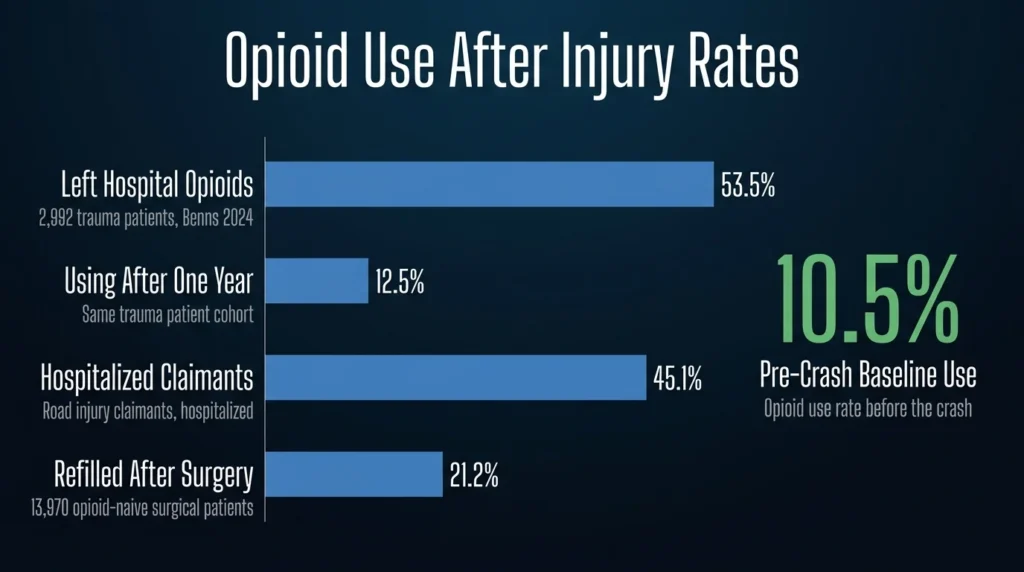
Persistent opioid use after a serious injury is a documented and measurable outcome, not a rare personal failure. The rates differ by study, by population, and by how researchers define persistent use, so each figure below stays attached to the research behind it:
- Among 2,992 trauma patients studied by Benns and colleagues in 2024, 53.5% left the hospital with opioids and 12.5% were still using opioids one year after the injury.
- Among 734 road traffic injury compensation claimants studied by Berecki-Gisolf and colleagues in 2016, opioid use ran 10.5% before the crash, then reached 45.1% among those hospitalized and 21.1% among those not hospitalized.
- Among 13,970 opioid-naive surgical patients treated between 2013 and 2019, 21.2% refilled an opioid prescription between three months and one year after surgery.
- Across national surgical data, new persistent opioid use fell from 2.7% in 2013 to 1.1% in 2021 as prescribing practices tightened.
No single number describes every injured patient. The honest read is that this outcome is common enough to be studied, planned for, and documented, which is precisely what an insurer would rather you not do.
One more finding from the trauma research deserves attention. Opioid use before the injury, not the injury itself, was the strongest predictor of persistent use. That is the crack an adjuster will try to pry open, and it is the same pressure people face in claims for chronic pain that never goes away after a crash.
Why Texas Law Still Treats This as Part of the Original Accident
Texas causation doctrine is built to follow harm downstream. When opioid prescribing was a normal and medically necessary response to an injury caused by someone else’s negligence, the dependence that follows generally sits inside the foreseeable chain of consequences from that negligence.
Proximate cause in Texas has two parts. There must be cause in fact, meaning both but-for causation and substantial-factor causation, and there must be foreseeability, meaning a person of ordinary intelligence should have anticipated the general character of the danger the negligent act created. The Texas Supreme Court restated that framework in Pediatrics Cool Care v. Thompson, 649 S.W.3d 152 (Tex. 2022).
Foreseeability is the hinge. A later act by someone else does not sever the original wrongdoer’s causation when that act was itself foreseeable, as the court held in Travis v. City of Mesquite, 830 S.W.2d 94 (Tex. 1992). Medical treatment made necessary by a crash is about as foreseeable as consequences get.
Texas courts have also framed the question as whether a result was a natural and probable consequence of the conduct, the phrasing used in Schneider v. Esperanza Transmission Co., 744 S.W.2d 595 (Tex. 1987). Prescription analgesia for a severe injury fits that description.
General common-law doctrine points the same direction. The Restatement of Torts holds an original wrongdoer responsible for additional harm that flows from normal efforts to provide medically necessary aid, on the theory that the risk of treatment harm rides along with causing the injury in the first place.
Texas case law is consistent with that principle, though no located Texas appellate decision applies it to opioid dependence by name.
So this is a reasoned legal explanation, not a promised result. Facts specific to your treatment still carry weight, including whether the dosing was appropriate, how long the course ran, what alternatives were tried, and how you handled the medication.
When Insurers Call It a Pre-Existing Problem, This Is the Record That Answers Them
Expect the argument. An adjuster’s job is to shrink what the claim is worth, and the cheapest way to shrink this one is to recast your dependence as an old addiction or a character flaw rather than a new injury-related harm. Using a claimant’s substance-use history, real or alleged, to attack credibility is a standard defense move.
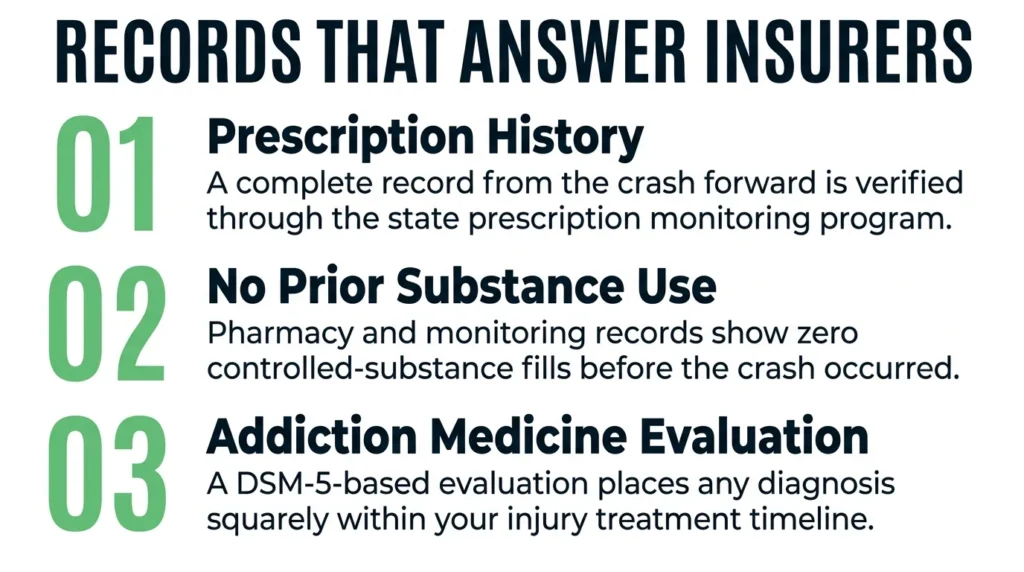
Documentation answers it, and three records do most of the work:
- The complete prescription history from the date of the crash forward. Texas prescribers must check the Texas Prescription Monitoring Program and document that check before prescribing opioids, a requirement that became mandatory on March 1, 2020. The same state database that regulators built to screen patients can later prove when your prescriptions actually started.
- Records establishing no prior substance-use history. Pharmacy and monitoring-program records showing no controlled-substance fills before the crash meet the pre-existing addiction theory head on, especially given research identifying pre-injury use as the dominant predictor of persistent use.
- An addiction medicine evaluation. A qualified evaluation applying the DSM-5 criteria can place any diagnosable disorder inside the treatment timeline that began with your injury.
Your medical chart should already help. Texas Medical Board prescribing rules in 22 Texas Administration Code Chapter 170 require the prescriber to discuss the risks of dependence, addiction, tolerance, and withdrawal, and to document a problem-focused history and examination.
That paperwork is a contemporaneous statement of why opioids were indicated for your specific injury.
Two facts can be true at once. The CDC’s 2022 clinical practice guideline confirms opioid therapy has an important role for acute pain from severe traumatic injuries when it is appropriately dosed and time limited. An appropriate prescription and a later dependence are not contradictions, and the law does not require you to choose between them.
The character attack fails on the medicine, too. The National Institute on Drug Abuse describes substance use disorders as chronic, treatable medical conditions that arise from changes in the brain, not as moral failures.
Talk to Angel Reyes & Associates About the Full Cost of Your Injury
You do not have to keep this part of your recovery to yourself. Dependence that started with a prescription written for a crash injury belongs in the accounting of what that crash actually cost you.
Angel Reyes & Associates has guided injured Texans through the legal process for more than 30 years, and the firm’s Texas car accident attorneys look at the whole arc of an injury, including complications that surface months later.
The initial consultation is free. You pay no attorney’s fee unless the firm wins your case, and the firm will explain in writing how fees and case expenses work before you decide anything.
Contact Angel Reyes & Associates to talk through where your claim stands and what records you should start collecting now.
Past results do not guarantee future outcomes.
Pain Medication Dependence FAQs
Can you recover treatment costs for opioid dependence caused by an accident injury in Texas?
Potentially, if the evidence connects the treatment to the injuries caused by the accident. Depending on the circumstances, damages may include reasonable medical expenses associated with treating the resulting condition.
What should you do if you need addiction treatment while a Texas personal injury claim is pending?
Seek medically appropriate treatment rather than delaying care because of the claim, and keep records showing the diagnosis, treatment plan, medications, and relationship between the treatment and the original injury.
Does stopping pain medication affect a Texas personal injury claim?
Stopping or reducing an opioid prescription does not automatically determine whether dependence-related damages are recoverable, but the medical reason for any change and the resulting symptoms should be documented in the treatment record.
About the Authors

Angel Reyes
Writer
Angel L. Reyes, III is the Founder and Managing Partner of Angel Reyes & Associates. A nationally recognized trial attorney and business leader, Angel founded the firm in 1993, which has gone on to help over 70,000 injury victims recover more than $1 billion. Named to the Texas Super Lawyers list annually since 2008, Angel brings Wall Street experience, Ivy League education, and a deep commitment to client advocacy. He is a frequent legal commentator and published author with extensive contributions to legal scholarship, trial strategy, and consumer protection.

Graham Griffin
Editor
Graham Griffin is the Web & Content Manager at Angel Reyes & Associates, where he oversees content strategy, AI-powered workflows, a...

Angel Reyes
Reviewer
Angel L. Reyes, III is the Founder and Managing Partner of Angel Reyes & Associates. A nationally recognized trial attorney and business...