Why Won’t You Recover the Full Amount of Your Medical Bills?


Every article on this site is researched by our internal team, reviewed for legal accuracy against current Texas law, and held to State Bar of Texas advertising standards before publication. We do not publish content that overstates outcomes or makes promises about results.
Learn more about our
editorial standards .
Key Takeaways
- Texas caps medical damages at what was actually paid or is still legally owed.
- Insurer write-offs are not recoverable, so a billed charge is not your award.
- Itemized bills, adjustments, payments, and lien records prove your recovery.

The itemized statement from the hospital shows up weeks after the wreck on I-35, and the total at the bottom is staggering. Then you learn the at-fault driver’s insurer will never be asked to pay that number.
Texas law limits what you can recover for medical care to the amount actually paid or still legally owed on your behalf, not the amount the provider originally billed. That limit comes from Texas Civil Practice & Remedies Code § 41.0105, and it is the main reason a frightening bill does not turn into a large medical damages award.
The gap between the two numbers is rarely a billing error. It is the distance between a provider’s sticker price and what that provider had a legal right to collect.
What “Paid or Incurred” Means Under Texas Law
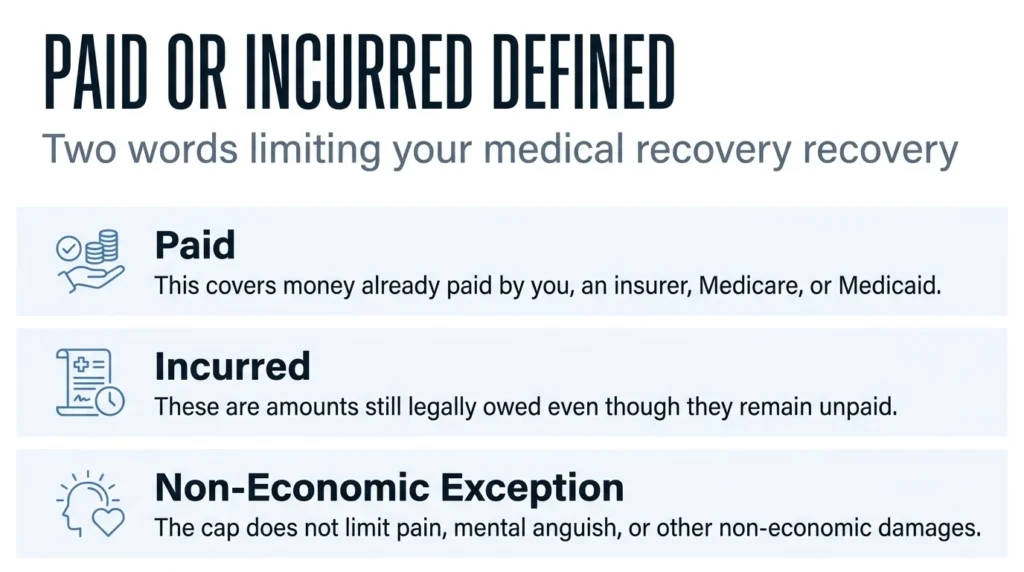
The statute runs a single sentence. In addition to any other limitation under law, recovery of medical or health care expenses incurred is limited to the amount actually paid or incurred by or on behalf of the claimant.
Two words carry all the weight. “Paid” covers money that has already changed hands, whether it came from you, your health insurer, Medicare, or Medicaid. “Incurred” covers amounts that are still legally owed even though no one has written the check yet.
Texas added this provision in 2003 as part of the tort reform package passed as House Bill 4, and it has remained in force in that form since.
The cap reaches your medical and health care expenses only. It does not touch what you can seek for pain, mental anguish, or other non-economic harm, which are measured on their own terms.
Why a Large Bill Doesn’t Mean a Large Award
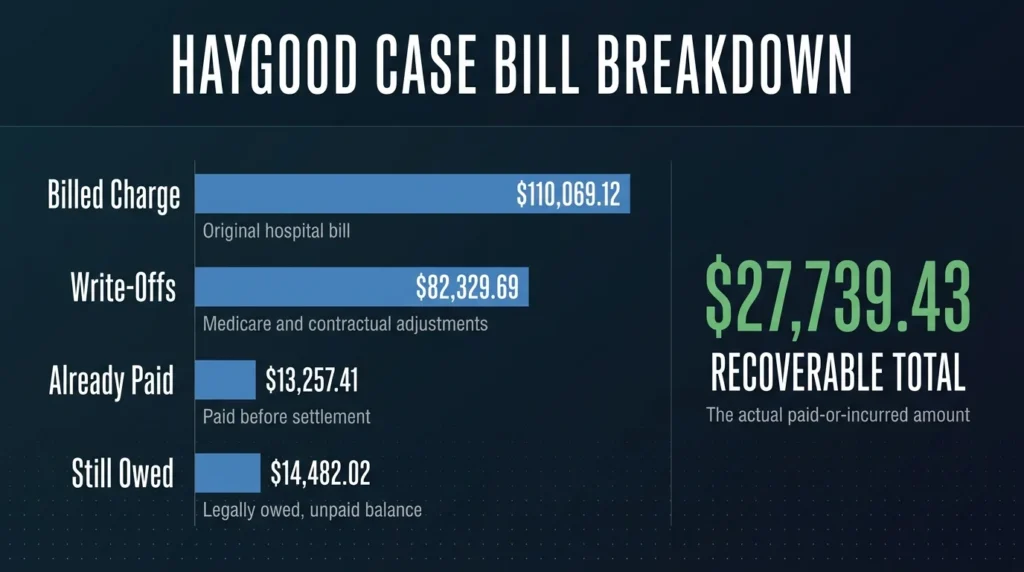
Work the arithmetic and the drop-off becomes obvious. Start with the billed charge, subtract the write-off or contractual adjustment the provider accepted, and what remains is the paid-or-incurred figure that caps your medical damages.
The numbers below come from an actual Texas Supreme Court case, not a typical result. In Haygood v. De Escabedo, a hospital billed $110,069.12 for the claimant’s treatment. Medicare-driven write-offs and contractual adjustments cut that by $82,329.69, leaving $27,739.43 actually paid or incurred, made up of $13,257.41 already paid and $14,482.02 still owed.
Recoverable medical expenses start from that $27,739.43 figure, not the $110,069.12 on the original bill.
The reasoning is straightforward. Nobody will ever pay the written-off portion, because the provider surrendered the right to collect it. A loss no one actually absorbs is not a loss the at-fault driver caused, and awarding it would hand you a windfall rather than compensation.
That is what the Texas Supreme Court decided in Haygood v. De Escabedo. The court held that “actually paid or incurred” excludes amounts a provider billed but had no legal right to collect, and that the jury is not permitted to hear the original billed figure at all.
Adjustments vary widely from provider to provider and payer to payer. This case shows how the mechanism works, not how far a typical Texas bill gets written down.
What Counts as “Incurred” When the Bill Isn’t Paid Yet
An unpaid balance is not automatically off the table. Haygood reads “actually paid or incurred” to cover expenses that have been or will be paid, so a balance you still legally owe can be part of your recoverable figure as long as the provider has a legal right to be paid it.
This comes up most often when treatment happens under a letter of protection. The provider agrees to hold off on billing until your case resolves, and your attorney promises to protect the provider’s interest out of the settlement proceeds.
A letter of protection does not convert the provider’s billed number into your recoverable number. In In re K & L Auto Crushers, LLC, the Texas Supreme Court confirmed that § 41.0105 operates in addition to the older common law rule, which has always required medical expenses to be reasonable and necessary before a jury can award them.
Balances billed under a letter of protection draw the same scrutiny as insurance-adjusted bills. Defense counsel may take proportional discovery into the provider’s negotiated and reimbursement rates and the methodology behind its chargemaster prices, all to test whether the billed amount is reasonable.
An unpaid balance can count as incurred, then, but only at its reasonable value. It does not count simply at whatever figure the provider printed on the statement.
How You Prove the Paid-or-Incurred Amount
The recoverable figure is a documentary question, and medical billing in a Texas settlement splits into two halves. One half is what has already been resolved. The other half is what is still owed.
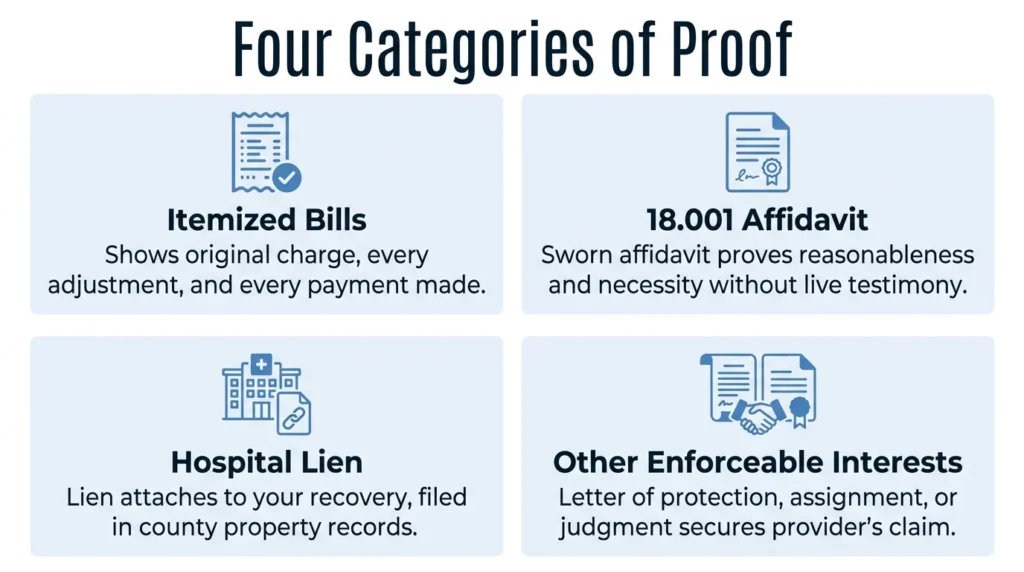
Four categories of proof carry that burden:
- Itemized billing records. These show the original charge, every adjustment or write-off applied to it, and every payment made against it. They are the baseline documentary proof of the post-adjustment number you can actually recover.
- An affidavit under § 18.001. Texas Civil Practice & Remedies Code § 18.001 lets you establish that the charges were reasonable and the services necessary through a sworn affidavit instead of live expert testimony. Serve it by the earlier of 90 days after the defendant files an answer, the court’s expert designation deadline, or the date the court otherwise orders. An unrebutted affidavit is sufficient evidence of reasonableness and necessity, though it does not prove that the crash caused the injury.
- Hospital lien documentation. Tex. Property Code Chapter 55 lets a hospital attach a lien to your injury recovery when you were admitted within 72 hours of the accident. The lien reaches charges from the first 100 days of treatment, is capped at the lesser of the hospital’s charges or half of your recovery, and must be filed in the county property records to attach.
- Other enforceable interests. A provider without a statutory hospital lien generally needs a signed letter of protection, an assignment, a judgment, or a similar enforceable interest before it can reach your settlement proceeds.
Assemble those four and the paid-or-incurred number stops being a guess. Leave gaps in them and the defense will argue the number down.
Get Help Sorting Out What You Can Actually Recover
None of this is intuitive, and the figure that lands in your settlement depends on paperwork most people never see. Someone has to gather the itemized statements, match every charge to its adjustment and payment, confirm which liens were properly filed, and be ready to defend any unpaid balance as reasonable and necessary.
That work has to happen before your case resolves and the money is disbursed. Handled loosely, it leaves recoverable expenses off the claim or carries an unexamined lien straight through to disbursement.
Angel Reyes & Associates has guided injured Texans through decisions like this for over 30 years, with board-certified personal injury attorneys and investigators on the team. Bring your bills, your explanation of benefits statements, and any lien notices you have received.
Contact Angel Reyes & Associates for a free consultation.
Past results do not guarantee future outcomes.
Medical Bill Recovery FAQs
Can health insurance payments affect how much medical expenses can be recovered in a Texas personal injury claim?
Yes. Under Texas law, the recoverable medical-expense amount is generally tied to expenses actually paid or legally owed, so insurance payments and contractual adjustments can affect the amount claimed rather than allowing recovery of the provider’s full original charge.
Can Medicare or Medicaid affect a Texas personal injury settlement?
Yes. Government benefit programs can have reimbursement or recovery interests when they paid accident-related medical expenses, so those interests should be identified and addressed before settlement proceeds are distributed.
What should I do with my explanation of benefits after a Texas car accident?
Keep every explanation of benefits statement with your medical records and bills because it can help document payments, contractual adjustments, and amounts that remain outstanding.
About the Authors

Angel Reyes
Writer
Angel L. Reyes, III is the Founder and Managing Partner of Angel Reyes & Associates. A nationally recognized trial attorney and business leader, Angel founded the firm in 1993, which has gone on to help over 70,000 injury victims recover more than $1 billion. Named to the Texas Super Lawyers list annually since 2008, Angel brings Wall Street experience, Ivy League education, and a deep commitment to client advocacy. He is a frequent legal commentator and published author with extensive contributions to legal scholarship, trial strategy, and consumer protection.

Graham Griffin
Editor
Graham Griffin is the Web & Content Manager at Angel Reyes & Associates, where he oversees content strategy, AI-powered workflows, a...

Angel Reyes
Reviewer
Angel L. Reyes, III is the Founder and Managing Partner of Angel Reyes & Associates. A nationally recognized trial attorney and business...