How Do You Get an Autopsy Report?


Every article on this site is researched by our internal team, reviewed for legal accuracy against current Texas law, and held to State Bar of Texas advertising standards before publication. We do not publish content that overstates outcomes or makes promises about results.
Learn more about our
editorial standards .
Key Takeaways
- Request autopsy records from the medical examiner or JP responsible for the case.
- Request toxicology and investigator reports by name, and ask which records remain pending.
- Order a certified death certificate through Texas vital records in a separate request.
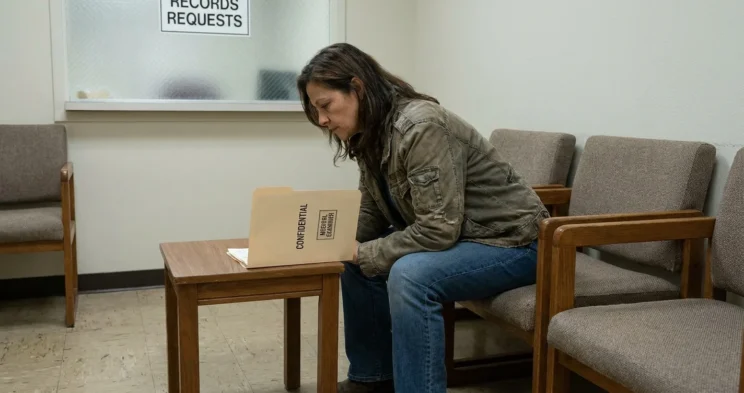
Waiting for answers while grieving can be difficult. Knowing which office holds each record helps you make a specific request and follow up on unfinished reports. A certified death certificate requires a separate request through Texas vital records.
To get an autopsy report in Texas after a fatal crash, contact the office that handled the death investigation. Submit its written records request for the autopsy or examination report, toxicology results, and investigator’s narrative. Include the deceased’s name, date of death, case number if known, your contact details, and any required fee.
The Office That Handled the Death Investigation
Under Texas Code of Criminal Procedure Chapter 49, counties served by a medical examiner handle death investigations through that office. Elsewhere, a justice of the peace (JP) conducts the inquest.
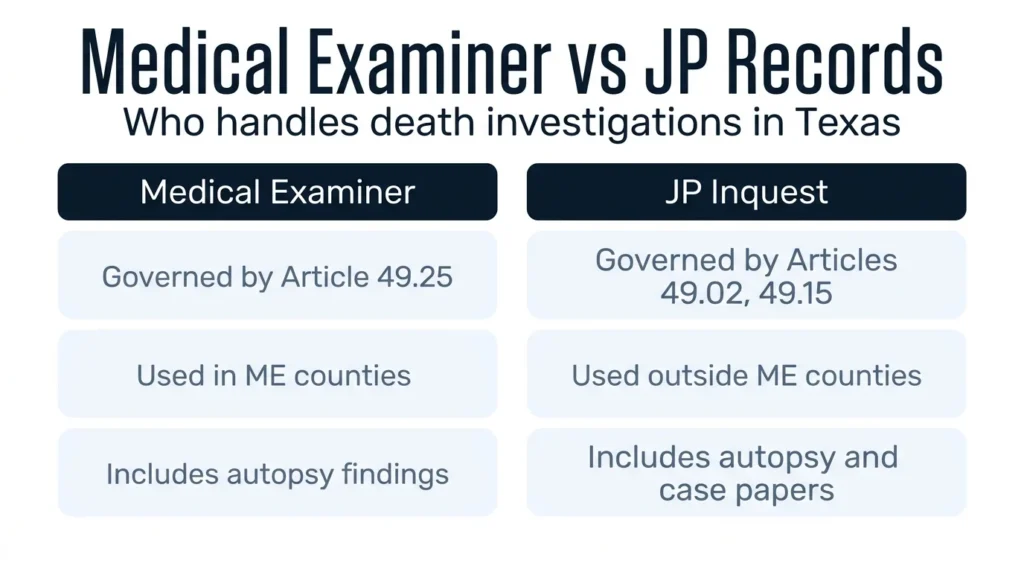
Chapter 49 covers unnatural deaths, so a fatal crash on I-35 or a rural farm road can lead to an official investigation. Confirm the county handling the case, the case number if known, and the office responsible for the records:
- Medical examiner records. Article 49.25 governs medical examiner offices, whose records include autopsy findings. Section 11 prohibits withholding those records under discretionary exceptions in the Texas Public Information Act. An ongoing criminal investigation alone does not create that discretionary basis to withhold the report.
- Justice of the peace inquest records. Articles 49.02 and 49.15 govern JP inquests in counties outside a medical examiner office or district. The inquest record includes the autopsy and case papers.
A medical examiner’s laboratory may perform an examination for another county’s JP without becoming the office that releases the records. Dallas County treats these out-of-county inquest records as judicial records and requires approval from the appropriate justice of the peace.
Autopsy photographs, X-rays, and next-of-kin information have specific disclosure rules. Other confidentiality laws can also apply, so access to the report does not mean access to every item in the file.
Request the Autopsy, Toxicology & Investigator’s Reports
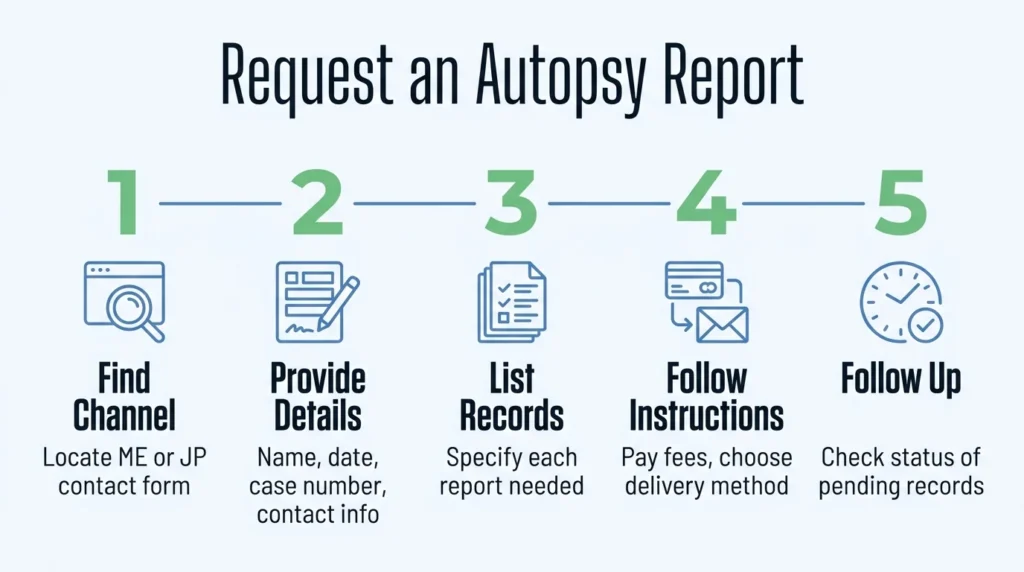
Name each record in your request and ask which items remain pending. Reports are not necessarily sent automatically: the Tarrant County Medical Examiner says next of kin must request them. Not every death receives an autopsy or toxicology testing:
- Find the responsible medical examiner or JP’s current request form or contact channel.
- Provide the deceased’s full name, date of death, case number if known, and your mailing address, phone, and email.
- List each record you want, including available supplements.
- Follow the office’s payment and delivery instructions.
- Follow up separately on unfinished records.
You can adapt this suggested wording; it is not a required state form:
“Please provide the finalized autopsy or external-examination report, toxicology report, death-investigation report or investigator’s narrative, and available supplements for [name], date of death [date], case number [if known]. Please advise what remains pending, any fee, and the procedure for obtaining outstanding records.”
Dallas County. Its autopsy report request form lists $15 for a certified copy and $5 for a noncertified copy, paid by check or money order and mailed with the request to ME Records. These are Dallas fees, not statewide charges.
Tarrant County. Its records forms page directs family requests to [email protected] and provides a request form and fee schedule. Different record types require separate payments. Requests for referred cases go to the responsible JP or medical examiner; requests in homicide cases go to the district attorney’s office.
The death investigator’s narrative is distinct from the police crash report. Request each document from the office that holds it.
How Long Do the Reports Take?
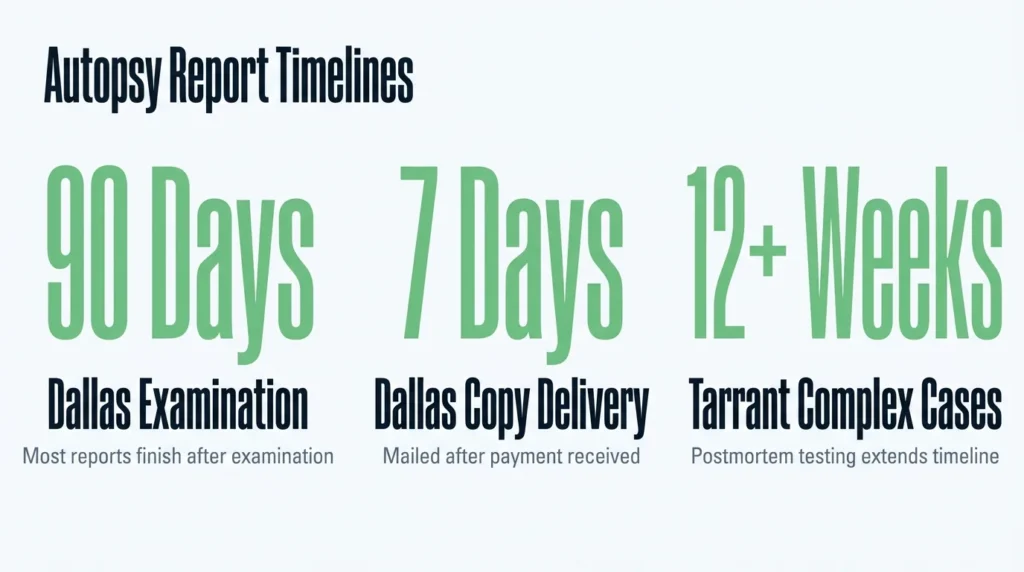
Timing varies by county and by the testing needed. Completing the examination, finishing laboratory tests, finalizing reports, and delivering requested copies are separate steps. Ask the responsible office about each record’s status.
Local estimates offer a starting point:
- Dallas examination reports: The county request form says most finish within 90 days after the examination.
- Dallas copy delivery: Once the report is complete, Dallas mails it within seven business days after receiving the request and payment.
- Tarrant complex cases: The medical examiner’s FAQ says complex cases and postmortem testing can take 12 weeks or longer. Release follows associated testing and final transcription.
These local estimates are not guaranteed dates. Ask for separate timing estimates for toxicology and the investigator’s narrative; either may remain pending after other records are available. Ask what remains outstanding and when to check again.
Order a Certified Texas Death Certificate Separately
Order a certified death certificate through Texas vital records, separately from the autopsy file. Texas Health and Safety Code Chapter 193 governs filing and medical certification; Texas Department of State Health Services (DSHS) guidance explains who qualifies for a certified copy.
Chapter 193 requires filing by the 10th day after death. That does not guarantee a family will receive a final certified copy within 10 days. If medical certification cannot be completed on time, the law requires notice to the funeral director explaining why.
Under DSHS qualified-applicant guidance, applicants include:
- Immediate relatives by blood, marriage, or adoption, including a child, parent or guardian, sibling, grandparent, or spouse
- Guardians and legal agents or representatives
- Other applicants with documentation showing a direct, tangible interest
The DSHS death record FAQ explains that Texas restricts access to death certificates for 25 years. Applicants must qualify, provide acceptable identification, and pay the fee.
You can order online, by mail, or in person. A verification letter does not replace a certified death certificate. Eligibility for this certificate is separate from authority to release remains and access to medical examiner or JP records.
Why These Records Count After a Fatal Crash
The medical examiner or inquest report, toxicology results, certified death certificate, and investigator’s narrative help explain the death and surrounding circumstances. Together, they may support a Texas wrongful death claim. No single record automatically proves civil fault, conscious suffering, or another driver’s intoxication:
- Cause of death. Examination findings and medical certification document the medical cause; inquest materials supply circumstances. A cause or manner of death does not, by itself, decide civil responsibility.
- Conscious pain before death. An autopsy can contribute evidence about timing, but surviving after a crash does not establish consciousness. In Beamers Private Club v. Jackson, a Texas appeals court considered the autopsy’s time of death alongside police and eyewitness evidence when assessing conscious suffering. Witness accounts and treatment records can help address what happened before death.
- Intoxication. Toxicology addresses the person tested, and testing is not performed in every case. The decedent’s results cannot establish the other driver’s condition. Evidence about a surviving driver may require a separate request to the investigating agency or steps through litigation; a positive result alone does not establish crash causation.
- The investigator’s narrative. Compare the account and available attachments with medical findings to identify gaps or inconsistencies. Its scope varies, and it is separate from the police crash report.
Talk With Angel Reyes & Associates About a Fatal Crash Claim
Gathering records while grieving can feel overwhelming. The team at Angel Reyes & Associates can help you request and review available records and understand your options for a potential claim.
Contact Angel Reyes & Associates for a free consultation.
Past results do not guarantee future outcomes.
Autopsy Report FAQs
What is the difference between an autopsy report and a police crash report in Texas?
An autopsy report documents medical findings related to the death, while a police crash report addresses the collision and the investigating officer’s findings. These records serve different purposes, so you may need to request both from separate agencies.
How can an autopsy report help investigate a fatal truck accident involving a commercial driver?
An autopsy report may help document the deceased person’s injuries and medical cause of death, while toxicology findings may provide information about substances in the tested person’s system. Investigating potential liability may also require trucking company records, driver qualification files, vehicle data, crash reconstruction, and evidence about the truck driver’s conduct.
What if the driver responsible for a fatal crash was never charged with a crime?
A criminal charge is not required to pursue a civil wrongful death claim in Texas. Civil liability is evaluated under a different legal standard, and evidence such as crash reports, witness statements, expert analysis, and medical findings may help establish responsibility.
About the Authors

Angel Reyes
Writer
Angel L. Reyes, III is the Founder and Managing Partner of Angel Reyes & Associates. A nationally recognized trial attorney and business leader, Angel founded the firm in 1993, which has gone on to help over 70,000 injury victims recover more than $1 billion. Named to the Texas Super Lawyers list annually since 2008, Angel brings Wall Street experience, Ivy League education, and a deep commitment to client advocacy. He is a frequent legal commentator and published author with extensive contributions to legal scholarship, trial strategy, and consumer protection.

Kyle Nicolas
Editor
Kyle Nicolas is the Web Content & SEO Manager at Angel Reyes & Associates. He has more than 10 years of experience as a marketing co...

Angel Reyes
Reviewer
Angel L. Reyes, III is the Founder and Managing Partner of Angel Reyes & Associates. A nationally recognized trial attorney and business...