Can You Sue an Insurer Under the DTPA?


Every article on this site is researched by our internal team, reviewed for legal accuracy against current Texas law, and held to State Bar of Texas advertising standards before publication. We do not publish content that overstates outcomes or makes promises about results.
Learn more about our
editorial standards .
Key Takeaways
- A DTPA insurance claim needs a Chapter 541 violation that caused loss, not just a denial.
- Claimants against the other driver's insurer usually are not DTPA consumers of that policy.
- Send notice meeting both the DTPA 60-day and Chapter 541 61st-day rules before you sue.

Yes. A qualifying Texas consumer can bring a DTPA insurance claim when an insurer violates Texas Insurance Code Chapter 541 and that violation causes recoverable harm. A denial alone is not enough.
If your own insurer disputes benefits after a crash, start with the policy, your relationship to it, and the claim handling. Proper written notice also counts before filing suit.
When Does the DTPA Apply to an Insurance Claim?
The Texas Deceptive Trade Practices Act applies when a consumer shows that an insurer violated Chapter 541 and that the violation caused a loss. Texas Business and Commerce Code §17.50(a)(4) expressly lets a consumer sue under the DTPA for conduct that violates Insurance Code Chapter 541.
That connection matters because a denial on its own is not a violation. You have to point to actionable insurer conduct and the loss it caused. Disagreeing with the claim decision is not enough.
Texas Insurance Code §541.060 gives two examples of conduct that can qualify, misrepresenting a material policy provision, and refusing to pay a claim without a reasonable investigation. The law draws a line when the adjuster’s methods cross into misrepresentation or unreasonable claim handling.
What the Texas Deceptive Trade Practices Act adds to an insurance dispute is a set of remedies. A consumer who prevails can recover economic damages, court costs, and reasonable and necessary attorney fees.
Additional damages and mental anguish damages depend on specific findings the statute requires. Enhanced damages are discretionary. The statute does not promise a threefold payout for every denial.
Can You Sue Your Own Insurer Over UM, PIP, or MedPay Handling?
You may have a claim if two things are true. Your relationship to the policy must make you a consumer, and the insurer’s claim handling must have caused you a loss. Under §17.45(4), consumer status depends on seeking or acquiring goods or services by purchase or lease.
The policy transaction and your connection to it decide that question. Being injured or named as a beneficiary does not automatically make someone a consumer. At the same time, the person who wrote the premium check is not necessarily the only one who can qualify.
How UM, PIP, & MedPay Coverage Differ
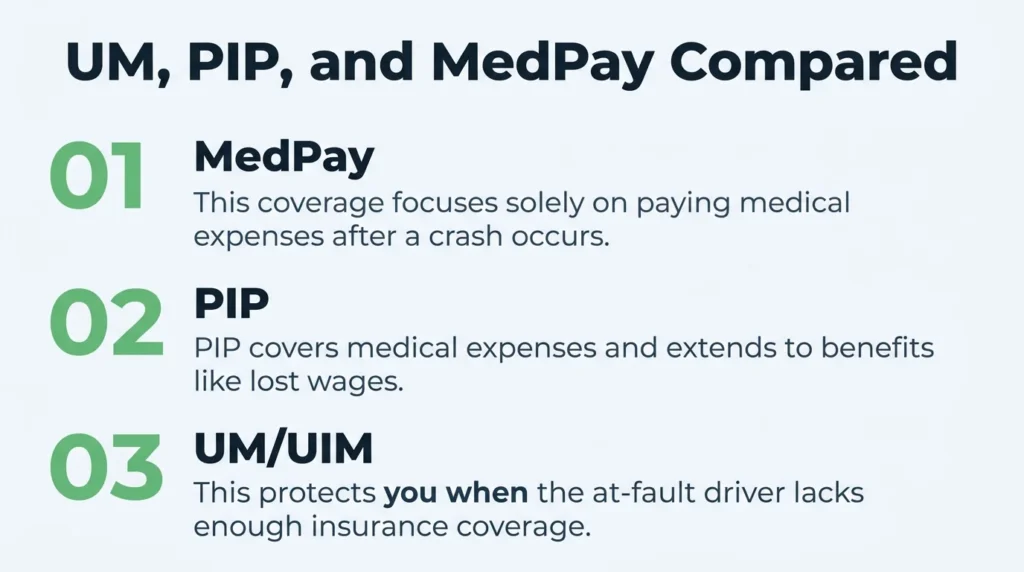
The Texas Department of Insurance treats these as distinct first-party coverages. Medical payments (MedPay) coverage pays medical expenses after a crash. Personal injury protection (PIP) pays medical expenses plus other benefits, such as lost wages.
Uninsured and underinsured motorist (UM/UIM) coverage protects you when the at-fault driver has no insurance or not enough of it. Every claim starts with the language in your actual policy. Having the coverage does not prove the insurer broke the law.
Policy Benefits vs Harm From Insurer Misconduct
The Texas Supreme Court separated these two ideas in USAA Texas Lloyds Co. v. Menchaca. As a general rule, you cannot recover policy benefits as statutory damages unless the policy entitled you to those benefits. The DTPA does not create coverage the policy never provided.
Menchaca also calls for separate analysis in two other situations. One is misconduct that costs you a contractual right. The other is an injury independent of the policy benefits.
A denial alone does not count as an independent injury. The decision does not mean you must always win a separate breach-of-contract lawsuit before raising statutory claims.
Why Underinsured Motorist Claims Need Extra Care
UIM disputes often add a step. With In re State Farm Mutual Automobile Insurance Co., the Texas Supreme Court reviewed a UIM claimant who sought benefits through statutory claims. The Court held that entitlement depended on establishing the other motorist’s liability and the covered damages, and it required a first trial phase on those issues before the statutory phase.
That holding addresses UIM claims. It does not automatically impose the same trial sequence on PIP or MedPay disputes.
Why is a Claim Against the Other Driver’s Insurer Different?
If you are seeking payment from the at-fault driver’s liability insurer, you usually are not a DTPA consumer of that policy. The other driver bought that coverage. You did not acquire that insurer’s services.
Texas law also addresses settlement conduct directly. The law does not create an unfair settlement cause of action for a third party asserting claims against the insurer’s policyholder.
Unusual direct-action situations can follow different rules, but an ordinary third-party claimant does not have this route.
The DTPA Does Not Replace Your Injury Claim
Keep three kinds of loss separate: damages from the crash, benefits owed under a policy, and loss caused by insurer misconduct. Only the last category is the core of a DTPA insurance claim.
Section 17.49(e) generally excludes DTPA causes of action for bodily injury, death, or infliction of mental anguish. That exclusion is expressly subject to §17.50(b) and (h), so mental anguish or related losses can still arise under the DTPA in some cases.
Your claim against the driver who hit you stays a separate injury claim. It does not become a DTPA case because an insurance company is involved.
What Notice Must You Send Before Filing Suit?
You generally must send the insurer written notice before you sue. The DTPA requires notice at least 60 days before filing a damages suit. Insurance Code Chapter 541 requires notice no later than the 61st day before filing. A claim that relies on both statutes has to satisfy both timing rules and both lists of required contents.
For that reason, the familiar “DTPA 60 day notice” shorthand can mislead. Filing exactly 60 days after you mail a letter is not necessarily enough.
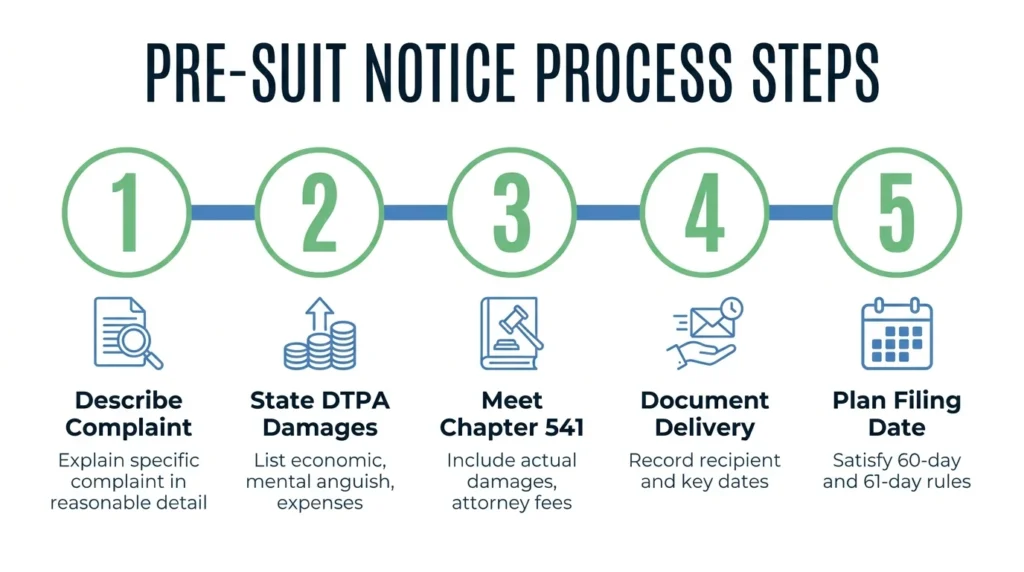
The notice process generally follows these steps:
- Describe the complaint. Under DTPA §17.505, the notice must explain the specific complaint in reasonable detail.
- State the DTPA damages. The DTPA notice must give the amount of economic damages, mental anguish damages, and expenses reasonably incurred, including attorney fees.
- Meet the Chapter 541 requirements. Insurance Code §541.154 requires the specific complaint and the amount of actual damages and expenses, including reasonably incurred attorney fees.
- Document delivery. Record the recipient, the date you sent the notice, and the date it arrived. Neither statute makes certified mail a universal requirement for individual notice. Documented delivery still protects your timeline.
- Plan the filing date. Choose a date that satisfies both the 60-day DTPA rule and the 61st-day Chapter 541 rule.
Both statutes include narrow exceptions. They cover notices made impracticable by an approaching limitations deadline and claims raised as counterclaims. Under the DTPA, inadequate notice can lead to abatement, which pauses the case. It does not automatically mean you lose on the merits.
What to Do With a Settlement Offer
A notice letter sometimes prompts a response or a settlement offer. Under §17.5052, a qualifying DTPA settlement offer can affect later damages and attorney fee recovery if the statute’s conditions and the court’s findings are met.
An offer does not admit wrongdoing, and it does not prove bad faith. Keep every offer and response in full so a lawyer can evaluate it.
What Records Help Evaluate a DTPA Insurance Claim?
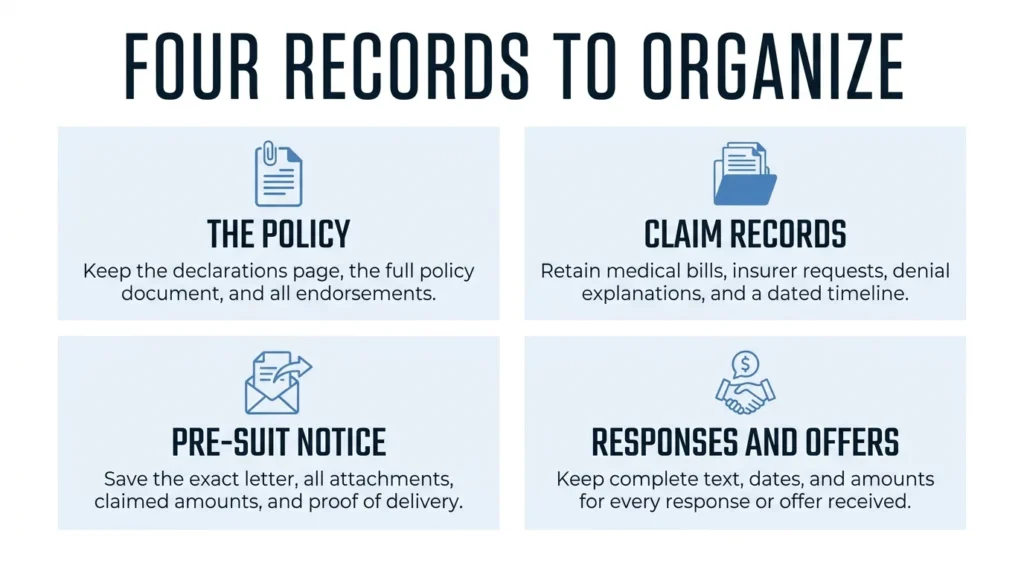
Organize your records into four groups so a lawyer can assess consumer status, benefit entitlement, insurer misconduct, the loss it caused, and pre-suit notice:
- The policy. Keep the declarations page, the full policy, and all endorsements. They show coverage, limits, the disputed provision, and your connection to the policy.
- Your claim records. Keep medical bills and forms you submitted, the insurer’s requests, denial explanations, emails, and letters. Build a dated timeline of what the insurer knew, what it did, and what loss followed.
- The pre-suit notice. Keep the exact letter, its attachments, the amounts claimed, the recipient, and proof of delivery with dates.
- Responses and offers. Keep the complete text and dates of each response, any payment or fee components, and your reply.
You probably won’t have the insurer’s entire internal file at the start. Begin with the records you have.
The Texas Department of Insurance auto complaint process is a separate administrative route. TDI invites supporting records and can review complaints about regulated insurers, but it cannot decide fault. Filing a TDI complaint is not the same as sending the statutory notice to the insurer.
Talk With Angel Reyes & Associates About an Insurance Dispute
When your own insurer mishandles a UM, PIP, or MedPay claim, you have options. You do not have to work out consumer status, notice timing, and damages on your own.
Angel Reyes & Associates has guided injured Texans for over 30 years and can review your policy, your claim history, and any notice or offer you have received.
Bring your policy and claim records to a free consultation with Angel Reyes & Associates.
Past results do not guarantee future outcomes.
Suing an Insurer Under the DTPA FAQs
Does an insurance company have to pay triple damages for a DTPA violation in Texas?
No. Enhanced damages are not automatic in a Texas DTPA insurance lawsuit. Additional damages depend on the required statutory findings, and any enhanced award is discretionary. The amount you may recover depends on the evidence and the specific legal requirements that apply.
Can someone who did not purchase the insurance policy file a DTPA claim?
Possibly. Texas consumer status depends on the person’s relationship to the policy transaction and whether they sought or acquired goods or services through a purchase or lease. Paying the premiums is not necessarily the only way to qualify, but being injured or named as a beneficiary does not automatically establish consumer status.
What happens if you send an insufficient DTPA notice letter before filing suit?
An inadequate notice letter may lead to abatement, which temporarily pauses the lawsuit to address the notice deficiency. It does not automatically mean the claim fails on its merits. Because the DTPA and Texas Insurance Code Chapter 541 have distinct notice requirements, a letter involving both claims should address the applicable complaints, damages, expenses, and timing rules.
About the Authors

Angel Reyes
Writer
Angel L. Reyes, III is the Founder and Managing Partner of Angel Reyes & Associates. A nationally recognized trial attorney and business leader, Angel founded the firm in 1993, which has gone on to help over 70,000 injury victims recover more than $1 billion. Named to the Texas Super Lawyers list annually since 2008, Angel brings Wall Street experience, Ivy League education, and a deep commitment to client advocacy. He is a frequent legal commentator and published author with extensive contributions to legal scholarship, trial strategy, and consumer protection.

Kyle Nicolas
Editor
Kyle Nicolas is the Web Content & SEO Manager at Angel Reyes & Associates. He has more than 10 years of experience as a marketing co...

Angel Reyes
Reviewer
Angel L. Reyes, III is the Founder and Managing Partner of Angel Reyes & Associates. A nationally recognized trial attorney and business...