What If You’re Hurt in a Ride Medicaid Pays a Friend or Relative to Provide?


Every article on this site is researched by our internal team, reviewed for legal accuracy against current Texas law, and held to State Bar of Texas advertising standards before publication. We do not publish content that overstates outcomes or makes promises about results.
Learn more about our
editorial standards .
Key Takeaways
- Medicaid mileage reimbursement alone does not establish commercial carrier status.
- Preserve the driver's program records, reimbursement documents, and full auto policy.
- A coverage dispute does not decide fault; review all applicable insurance and claims.

When you’re injured in a ride that Medicaid paid a relative or friend to provide, it can be challenging to know what to do next. In addition to recovering from your injuries, you probably have numerous legal questions.
You can pursue a claim against whoever caused the crash, even when Medicaid pays your friend or relative mileage to drive you to care. Reimbursement alone does not establish that the ride was a commercial carrier service. It also does not settle whether the driver’s auto insurance covers your injuries.
An insurer may argue that the payment triggers a fare, livery, or business-use exclusion. The answer depends on the full policy and the trip records. After a Medicaid mileage reimbursement accident in Texas, fault and insurance coverage are separate questions.
What Kind of Medicaid-Paid Ride Was This?
Texas Medicaid recognizes individuals who use personal vehicles to take themselves, friends, or family to covered care. The Medical Transportation Program Handbook calls them Individual Transportation Participants, or ITPs.
The handbook describes ITPs separately from demand-response common carriers and transportation network companies. ITPs register with TMHP; they do not enroll as Medicaid providers. This program distinction explains why mileage reimbursement does not automatically make a friend’s ride a commercial transportation service, but it does not decide auto coverage.
The handbook covers fee-for-service Medicaid. Managed care members must check their health plan’s process. For example, Texas Children’s Health Plan requires driver registration and approval, a valid license, auto insurance, vehicle registration, and medical-provider confirmation for reimbursement.
Those are one plan’s instructions. Start by identifying your program or health plan, the transportation administrator, the driver’s registration or approval, and the trip authorization.
Could the Driver’s Insurer Treat Mileage Reimbursement as a Fare?
Yes. An insurer could argue that a third-party mileage payment falls within an exclusion for carrying passengers for a fee or certain business use. That is a possible coverage argument, not an automatic denial rule.
A publicly available Texas personal auto policy specimen illustrates the issue. It excludes liability arising from carrying people for a fee, with an exception for expense-sharing carpools. Its base business exclusion has a private-passenger-auto exception, but an included endorsement replaces that wording with a broader exclusion.
This specimen is an example, not necessarily your driver’s policy. It shows why you need both the base form and every endorsement effective on the crash date.
The insurer may say the driver received compensation for carrying a passenger. The passenger’s response may point to reimbursement of driving expenses under a Medicaid program, the relationship with the driver, and the trip’s medical purpose. Neither the payment label nor the family relationship decides coverage by itself.
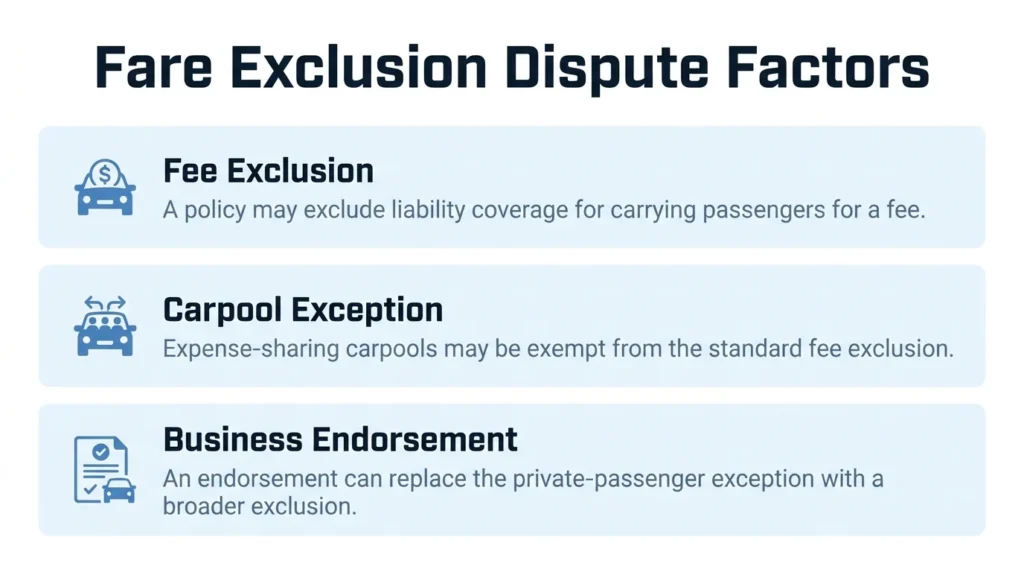
Do not assume a carpool exception applies. An operating expense exception for lending a vehicle also is not a general exception for paid passenger transportation. The Texas Department of Insurance’s temporary vehicle guidance discusses exclusion wording in that specific setting; it is not a Medicaid ride coverage rule.
Which Records Will Show What Happened & What Coverage May Apply?
The essential records are the driver’s program registration, the trip reimbursement documents, and the full auto policy. An insurance card alone does not establish coverage. Gather the records in these steps:
- Request program records. Keep the driver’s application or registration, approval letter or portal record, participation terms, and the health plan or administrator’s name.
- Preserve trip and payment records. Save the authorization, appointment confirmation, trip log, mileage calculation, signed reimbursement form when applicable, payment record, and related messages. Keep proof of the trip’s purpose even if the crash prevented arrival or reimbursement.
- Obtain the complete policy. Request the declarations, base form, every endorsement, listed or excluded drivers, covered vehicle information, and claim correspondence.
- Document the crash and injuries. Keep the crash report, photographs, witness contacts, medical records and bills, and proof of lost income.

The fee-for-service handbook’s H3017 record includes the trip date, authorized mileage, authorization number, client, and ITP, with provider and driver signatures. Managed care plans may use other forms.
How Does an Injured Passenger Pursue a Claim if Coverage is Disputed?
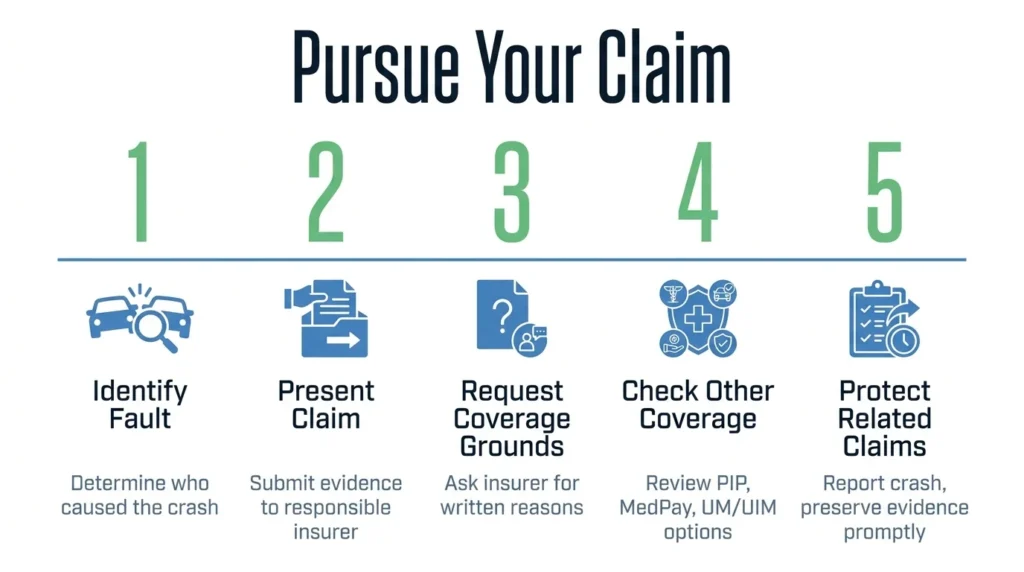
A coverage dispute does not decide who caused your injuries. You can investigate and pursue responsibility while the insurance question is reviewed:
- Identify who caused the crash. Another motorist, your friend or relative, or multiple drivers may be responsible. Texas Civil Practice and Remedies Code Chapter 33 provides for allocating responsibility in covered cases. You do not share a driver’s fault simply because you were their passenger.
- Present the injury claim. If liability coverage applies, submit evidence of the responsible driver’s fault and your injuries to that insurer.
- Obtain the coverage grounds. If the insurer disputes coverage, ask for its reasons and the specific provisions it relies on in writing. Have those provisions reviewed against the full policy and trip facts.
- Check other applicable coverage. Personal injury protection, medical payments, or uninsured or underinsured motorist coverage may be available under vehicle, personal, or household policies. The TDI auto insurance guide explains their different purposes. Insured status, exclusions, and policy conditions still apply.
- Protect related claims. Report the crash promptly, preserve evidence, and check how settling one claim could affect others.
Proving fault and collecting from a driver personally are different issues. Likewise, reimbursement alone does not make HHSC, a health plan, or a broker responsible for the driver’s negligence; an institutional claim needs a separate factual and legal basis.
What Happens to Medical Bills, Medicaid Recovery & Filing Time?
Transportation reimbursement is separate from payment for crash-related medical care. According to TMHP’s third-party liability guidance, other available medical payment resources generally come before Medicaid. When liability payment is substantially delayed, Medicaid may consider a claim.
Medicaid payments for care may create a financial recovery interest in a later settlement. Coordinate with the relevant program or health plan before distributing settlement funds; you may not keep the entire amount.
Under Texas Civil Practice and Remedies Code §16.003, personal injury lawsuits generally have a two-year deadline from accrual. Section 16.001 addresses qualifying legal disabilities existing when the claim accrues. Insurance notice requirements and special circumstances also need prompt review.
Talk With Angel Reyes & Associates About the Crash
Recovering from a crash is difficult enough without sorting through policy endorsements and Medicaid paperwork. For your consultation, gather the driver’s program records, trip and reimbursement documents, complete auto policy, and crash and medical records.
Angel Reyes & Associates has guided injured Texans for over 30 years. Our team can review your documents and explain your possible claim paths. Contact Angel Reyes & Associates for a free consultation.
Past results do not guarantee future outcomes.
Medicaid Ride Injury Claim FAQs
Can I file a claim if the friend or relative who drove me was not approved for Medicaid mileage reimbursement?
Yes. A driver’s failure to meet Medicaid program requirements does not automatically eliminate an injured passenger’s right to pursue a claim against a negligent driver. However, the lack of approval may affect how the trip and any insurance coverage dispute are evaluated.
Does Medicaid have to be repaid if I receive a car accident settlement in Texas?
Potentially. Texas Medicaid may have a recovery interest in settlement funds attributable to medical care it paid for, and applicable reimbursement obligations should be resolved before distributing the settlement.
Can I recover compensation if both the driver and another motorist caused the accident?
Yes. Texas follows proportionate responsibility rules under Chapter 33 of the Texas Civil Practice and Remedies Code, which allow fault to be allocated among multiple responsible parties. Your ability to recover may depend on the percentage of responsibility assigned to each party.
Does it matter if the Medicaid-paid ride was for a medical appointment that I never reached because of the crash?
No. The fact that the crash prevented you from reaching your appointment does not automatically eliminate your ability to pursue an injury claim. Trip authorization, mileage records, and other documentation may help establish the ride’s purpose.
About the Authors

Angel Reyes
Writer
Angel L. Reyes, III is the Founder and Managing Partner of Angel Reyes & Associates. A nationally recognized trial attorney and business leader, Angel founded the firm in 1993, which has gone on to help over 70,000 injury victims recover more than $1 billion. Named to the Texas Super Lawyers list annually since 2008, Angel brings Wall Street experience, Ivy League education, and a deep commitment to client advocacy. He is a frequent legal commentator and published author with extensive contributions to legal scholarship, trial strategy, and consumer protection.

Kyle Nicolas
Editor
Kyle Nicolas is the Web Content & SEO Manager at Angel Reyes & Associates. He has more than 10 years of experience as a marketing co...

Angel Reyes
Reviewer
Angel L. Reyes, III is the Founder and Managing Partner of Angel Reyes & Associates. A nationally recognized trial attorney and business...