Charter Bus Accident Liability in Texas


Every article on this site is researched by our internal team, reviewed for legal accuracy against current Texas law, and held to State Bar of Texas advertising standards before publication. We do not publish content that overstates outcomes or makes promises about results.
Learn more about our
editorial standards .
Key Takeaways
- Charter bus operators face full civil liability, unlike immune public transit agencies.
- Buses built for 16 or more passengers must carry at least $5 million in coverage.
- Being over 50% at fault bars recovery under Texas proportionate responsibility law.
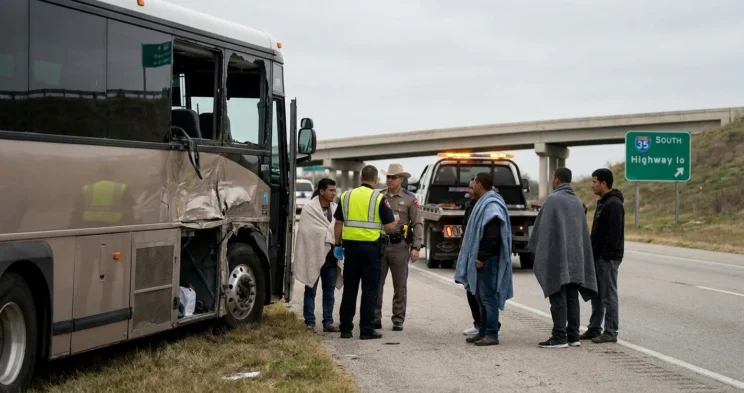
You boarded a charter bus in San Antonio for a weekend group trip, glad to let someone else handle the driving. Somewhere along I-10, the bus lurched hard, and now you are facing injuries you never saw coming. The company that booked the trip blames the driver, the driver blames the bus, and no one will tell you who pays your medical bills.
Who Is Liable in a Charter Bus Accident?
More than one party usually shares the blame after a charter bus crash. Depending on what went wrong, responsibility can fall on the driver, the charter company, a subcontractor, or the bus manufacturer.
Large bus crashes cause heavy harm because of their size and passenger load. That pattern shows up clearly in federal crash data on large buses.
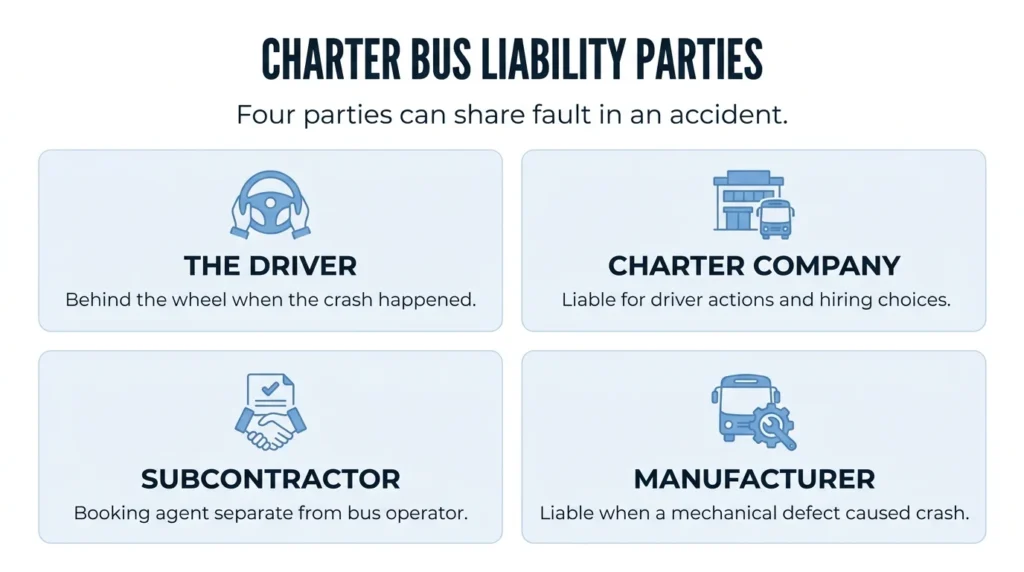
A single charter bus crash can put four different parties in the frame:
- The driver who was behind the wheel when the crash happened.
- The charter bus company, both for its driver’s actions and for its own hiring, training, and supervision choices. This is where charter bus company liability most often begins.
- A subcontracted carrier or booking agent, when the business that sold your trip is not the one that ran the bus.
- The vehicle or parts manufacturer, when a mechanical defect helped cause the crash.
The company’s share often rests on a common law rule rather than a statute: an employer answers for what its employees do on the job.
When more than one party is at fault, Texas divides responsibility under Texas Civil Practice and Remedies Code Chapter 33. Each one pays in line with its own percentage of the blame.
If investigators find you partly at fault, your recovery drops by your share. Cross more than 50% and Texas law bars you from recovering anything.
Sorting out those percentages drives every claim, which is why knowing how fault is determined in Texas protects your recovery. The same rules that shape Texas car accident claims apply when a charter bus is involved.
Charter Bus Regulation Under Federal & State Law
Two agencies regulate charter operators, and which one applies depends on where the bus travels. Federal rules cover trips that cross state lines, while Texas rules cover trips that stay inside the state.
The Federal Motor Carrier Safety Administration (FMCSA) registers and oversees for-hire passenger carriers that operate between states, including charter and tour companies. Its licensing and insurance rules for passenger carriers set the baseline every interstate operator must meet.
When a charter stays entirely within Texas, the Texas Department of Motor Vehicles handles that oversight instead. This is a separate authority from FMCSA’s interstate jurisdiction.
Knowing which agency governed your trip tells you which safety records exist and who had to keep them. The same commercial rules behind truck accident cases also reach large passenger carriers.
Charter Bus Insurance Requirements in Texas
Charter operators must carry far more insurance than an ordinary driver. Federal law sets a floor of at least $5 million in liability coverage for buses built to carry 16 or more passengers.
Federal regulations spell out these minimum levels of financial responsibility in 49 CFR Part 387. The higher floors exist because a single crash can injure everyone on board at once.
The specific requirement for larger buses sits in 49 CFR § 387.33. Smaller vehicles carry lower minimums, but most charter and tour coaches fall into the higher bracket.
That coverage can shape your recovery in a serious crash. A private car might carry only a $30,000 state-minimum policy. A charter bus stands behind millions, and that gap can decide whether your bills get paid in full.
Why Charter Buses Are Not Immune from Lawsuits
Whether you can sue at all comes down to who owned and ran the bus. Public transit systems carry legal protections that private charter companies do not.
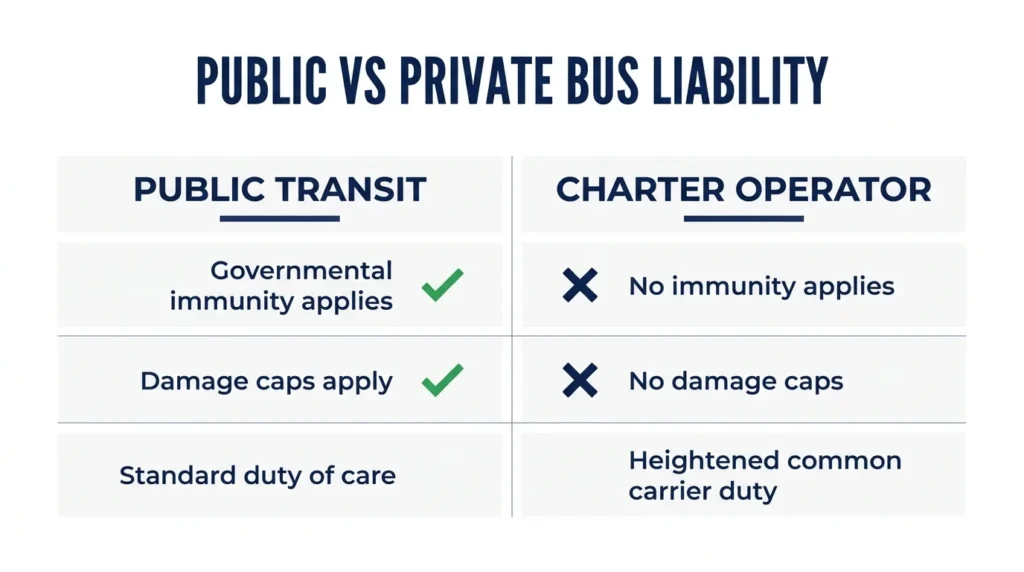
Public Transit Retains Governmental Immunity
Government-run transit systems enjoy governmental immunity, which limits when you can sue and caps what you can recover. The Texas Tort Claims Act allows claims against these agencies only in narrow situations.
Even a successful claim runs into a damage cap set by that law. Those caps on bus accident recovery can sharply reduce what a victim collects from a public agency.
Charter Operators Face Full Civil Liability
Private charter and tour bus operators get none of these protections. The law treats them as ordinary commercial businesses, so no immunity and no damage caps apply.
This is the core of charter bus accident liability in Texas: a private operator answers for its negligence like any other company. There is no cap on what a jury can award against it.
They also owe you more than an average driver does. Texas law holds charter operators to the common carrier duty of care, a heightened standard owed to every paying passenger.
If you are not sure which category your trip falls under, our broader guide to bus accident liability compares public, school, and charter buses side by side.
Confirming whether your bus was privately chartered or government-run is the first step, since that one fact decides which rules and recovery options apply to you.
When a charter bus crash takes a life, this full liability extends to a Texas wrongful death claim against the operator.
Charter Bus Negligence Claims
Most claims against charter operators come down to negligence, built on the federal safety rules they must follow. Three failures appear again and again.
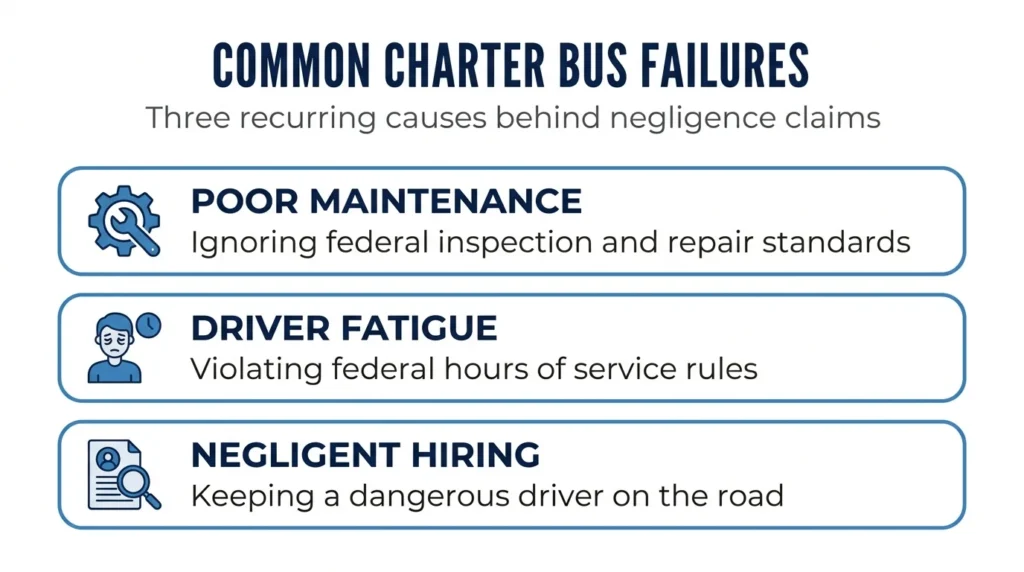
Poor maintenance is the first. Operators must meet federal inspection and repair standards under 49 CFR Part 396, and ignoring them can turn a worn brake into a crash.
Driver fatigue is the second. Passenger carrier drivers must obey federal hours of service rules, and a violation points straight to the operator that set the schedule.
Negligent hiring or retention is the third. When a company keeps a dangerous driver on the road, it becomes responsible for the harm that follows. Our results in past injury cases reflect what careful investigation can uncover.
Maintenance records, driver logs, and inspection reports often vanish within weeks of a crash, so start tracking down and preserving them early.
Work with a Texas Charter Bus Accident Attorney
Angel Reyes & Associates has spent more than 30 years standing with injured Texans against insurers and large operators. We know how charter companies try to limit what they pay, and we push for the full liability the law allows.
You pay no fee unless we win, and your first consultation is free. With offices across the entire state, we can help no matter where your trip began. Our results include more than $1 billion recovered for clients.
If a charter bus crash upended your life, schedule a free consultation so we can review your options and next steps.
Past results do not guarantee future outcomes.
Frequently Asked Questions
How long do you have to file a claim after a charter bus accident in Texas?
You generally have two years from the crash date to file a personal injury lawsuit in Texas. Missing that deadline usually bars you from recovering anything, regardless of how strong your case is.
How much time do you have to act if the bus was booked through a school or government program?
If a government entity owned or ran the bus, the Texas Tort Claims Act generally requires written notice within six months of the crash, much sooner than the two-year deadline for private lawsuits. Some cities set even shorter notice windows in their own charters.
Can someone outside the bus, like another driver or a pedestrian, file a claim against a charter bus company?
Yes. A person hurt by a negligent charter bus driver can bring a claim against the driver and the company, even if they were never a passenger.
Are charter buses required to have seatbelts for passengers?
Motorcoaches built after November 2016 must come equipped with lap and shoulder belts, but federal law does not require passengers to wear them. Older buses on the road may not have seatbelts at all.
About the Authors

Angel Reyes
Writer
Angel L. Reyes, III is the Founder and Managing Partner of Angel Reyes & Associates. A nationally recognized trial attorney and business leader, Angel has helped over 70,000 injury victims recover more than $1 billion since founding the firm in 1993. Named to the Texas Super Lawyers list annually since 2008, Angel brings Wall Street experience, Ivy League education, and a deep commitment to client advocacy. He is a frequent legal commentator and published author with extensive contributions to legal scholarship, trial strategy, and consumer protection.

Kyle Nicolas
Editor
Kyle Nicolas is the Web Content & SEO Manager at Angel Reyes & Associates. He has more than 10 years of experience as a marketing co...

Angel Reyes
Reviewer
Angel L. Reyes, III is the Founder and Managing Partner of Angel Reyes & Associates. A nationally recognized trial attorney and business...